May 2026 · 18 min read
A welcome drink is the first impression a guest receives. Before a word is exchanged, before a menu is read, the drink in their hand tells them something about the host — whether it is a family gathering, a wedding, a hotel lobby, or a restaurant table. Get it right and it sets the tone for everything that follows. Get it wrong and it lingers in memory for all the wrong reasons.
I have worked on welcome drink formulations across every scale — from small café chains asking for a consistent signature house drink to event caterers serving 2,000 guests and needing a drink that looks the same in glass one and glass two thousand. The principles are the same whether you are making a welcome drink recipe at home or developing one for commercial production.
This guide covers both.
What Makes a Good Welcome Drink
Before getting into specific welcome drink recipes, it helps to understand what separates a memorable welcome drink from a forgettable one. There are five things that matter:
Balance — A welcome drink should not be aggressively sweet, sharply sour, or heavily spiced. It should feel refreshing and effortless. The flavour should arrive cleanly and finish without heaviness.
Colour — Visual appeal matters enormously for a welcome drink. A vibrant, clear, stable colour signals freshness and care. A dull, oxidised, or separated drink signals the opposite — before anyone has tasted it.
Temperature — A welcome drink served at the right temperature (properly chilled for cold drinks, properly hot for warm ones) communicates attention to detail. Temperature also affects flavour perception significantly — a drink that tastes balanced at 8°C may taste too sweet at 15°C.
Aroma — The moment the glass approaches the face, the nose receives the drink before the mouth does. A good welcome drink has a clean, inviting aroma — whether that is mint, rose, citrus, or spice.
Consistency — For home use, consistency is about replicating a good recipe. For commercial and event use, it is about producing the same drink 500 times in a row with identical taste, colour, and presentation.
Classic Indian Welcome Drink Recipes
Indian hospitality has some of the finest welcome drink traditions in the world. These are not imitations of Western cocktails — they are original, deeply flavoured, and naturally functional. Here are the most important ones, with proper recipes and the formulation insight behind each.
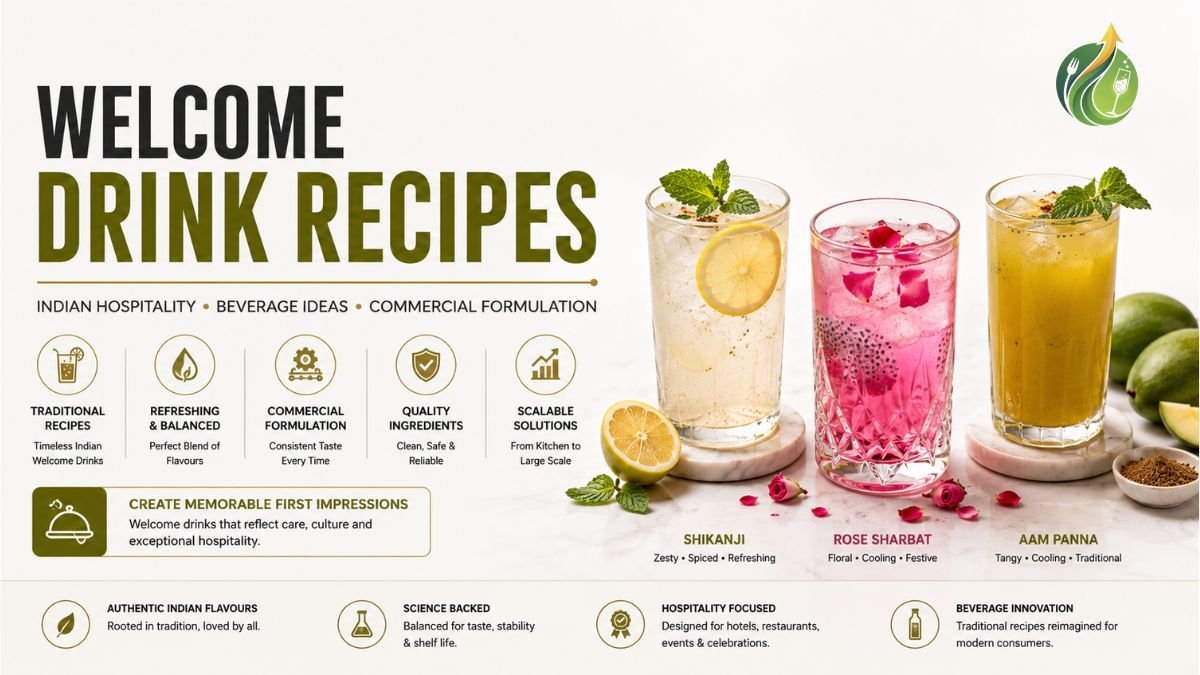
1. Shikanji — The North Indian Welcome Drink
Shikanji is arguably India’s most iconic welcome drink. It is a spiced lemon drink that delivers sourness, saltiness, sweetness, and a cooling spice note simultaneously — a complexity that most commercial beverages spend years trying to replicate.
Recipe (serves 4):
- Fresh lemon juice — 80ml (from 3–4 lemons)
- Sugar — 4 tablespoons (adjust to preference)
- Black salt (kala namak) — ½ teaspoon
- Regular salt — ¼ teaspoon
- Roasted cumin powder — ½ teaspoon
- Fresh ginger, grated — ½ inch piece
- Cold water — 800ml
- Ice — as needed
- Fresh mint — for garnish
Method: Combine lemon juice, sugar, and both salts in a jug and stir until sugar dissolves. Add grated ginger and cumin powder. Pour cold water and stir well. Taste and adjust — more lemon for sourness, more sugar for sweetness, more black salt for depth. Serve over ice with a mint sprig.
What makes it work: The black salt is what separates shikanji from a generic lemon drink. The sulphur compounds in kala namak add a savoury depth that makes the drink feel cooling and complex. Roasted cumin adds an earthy warmth. Together, they create a layered flavour experience that a simple lemonade cannot achieve.
Formulation insight for commercial use: For events or café service where you are making shikanji in large batches, replace fresh lemon juice with standardised lemon juice concentrate (standardised to 40% citric acid equivalent) to eliminate batch-to-batch variation from different lemons. Use roasted cumin oleoresin instead of cumin powder to avoid settling in the serving jug. Pre-mix the base (juice concentrate, sweetener, salts, cumin extract) as a concentrated syrup and dilute to order — this gives consistent flavour across every glass.
For a full guide on commercially scaling shikanji and other traditional Indian drinks, read our piece on traditional drinks formulation.
2. Rose Sharbat — The Ceremonial Welcome Drink Recipe
Rose sharbat is the welcome drink of celebrations — weddings, Eid, festivals, family gatherings. Its deep pink colour, floral aroma, and sweet delicacy make it immediately festive.
Recipe (serves 4):
- Rose syrup (good quality) — 60ml
- Cold water — 700ml
- Lemon juice — 1 tablespoon
- Sabja seeds (basil seeds), soaked for 20 minutes — 1 teaspoon
- Ice — as needed
- Rose petals — for garnish (optional)
Method: Combine rose syrup and lemon juice in a jug. Add cold water and stir. Add soaked sabja seeds — they should be plump and gel-like at this point. Serve over ice with a rose petal garnish if available.
What makes it work: The small addition of lemon juice is the key step that most home recipes skip. It cuts the sweetness of the rose syrup and adds a brightness that makes the drink feel refreshing rather than cloying. The sabja seeds add texture, visual interest, and a subtle cooling effect that Indian tradition has associated with summer drinks for centuries.
Formulation insight for commercial use: The biggest challenge with rose sharbat at commercial scale is colour stability. Rose colour (anthocyanin-based) is pH-sensitive — it shifts from pink toward purple in alkaline conditions and toward red in highly acidic conditions. Maintaining consistent pH (target 3.5–4.2) is essential for consistent colour. Use commercially produced, food-grade rose flavour and colour rather than relying on rose syrup quality alone — rose syrup quality varies enormously between suppliers.
3. Aam Panna — The Summer Welcome Drink
Aam panna is a raw mango drink that is one of the most naturally functional welcome drinks in the Indian repertoire. It is cooling, electrolyte-rich (from the black salt and cumin), and genuinely thirst-quenching in a way that sweet drinks are not.
Recipe (serves 4):
- Raw mango (kacchi keri) — 2 medium
- Jaggery — 3–4 tablespoons (or sugar if preferred)
- Black salt — ½ teaspoon
- Roasted cumin powder — ½ teaspoon
- Fresh mint leaves — 10–12
- Cold water — 700ml
- Ice — as needed
Method: Pressure cook or boil the raw mangoes whole until soft. Allow to cool, then squeeze out the pulp and discard the skin and seed. Blend the pulp with jaggery, black salt, and cumin until smooth. Add fresh mint and blend briefly. Strain through a fine mesh, dilute with cold water, adjust seasoning, and serve over ice.
What makes it work: The tartness of raw mango is fundamentally different from lemon sourness. It has body and depth from the natural malic acid and tannins in the fruit. Jaggery adds a caramel warmth that refined sugar cannot replicate. The combination creates a drink that is simultaneously tart, savoury-sweet, spiced, and cooling — one of the most complex flavour profiles in Indian cuisine.
Formulation insight for commercial use: Raw mango’s seasonal availability and batch-to-batch flavour variation make it challenging to commercialise without a standardised pulp source. Aseptic-packed raw mango pulp, standardised for Brix and acidity, is available from food processors in Maharashtra and Andhra Pradesh and gives year-round supply with consistent flavour. We cover the full commercial formulation of aam panna as a beverage brand in our dedicated guide on commercial aam panna brand development.
4. Thandai — The Festival Welcome Drink
Thandai is the welcome drink of Holi and Mahashivratri, but its rich, spiced, milk-based profile makes it equally at home as a premium welcome drink for formal events and fine dining.
Recipe (serves 4):
- Full-fat milk — 800ml
- Almonds — 20 (soaked overnight, peeled)
- Cashews — 10
- Poppy seeds (khus khus) — 1 tablespoon (soaked 2 hours)
- Fennel seeds — 1 teaspoon
- Cardamom — 4 pods
- Black pepper — 4–5 corns
- Rose petals — 1 tablespoon (dried or fresh)
- Sugar — 4 tablespoons
- Saffron — a pinch (soaked in 2 tablespoons warm milk)
Method: Drain and blend soaked almonds, cashews, poppy seeds, fennel, cardamom, black pepper, and rose petals with a small amount of milk until a smooth paste forms. Heat remaining milk to a simmer, add sugar and the blended paste. Stir well, add saffron milk, and cook for 2 minutes. Strain through a fine muslin cloth. Chill thoroughly. Serve cold with a saffron strand and crushed pistachio garnish.
What makes it work: Thandai is a complete sensory experience — the aroma of cardamom and saffron, the creaminess of nut milk, the warmth of black pepper, the sweetness of fennel. The cooling effect associated with thandai comes from fennel and poppy seeds, both traditionally considered cooling in Ayurvedic practice.
Formulation insight for commercial use: Thandai is one of the most commercially interesting traditional Indian drinks to develop as an RTD product because the organised market for it is virtually empty. The key formulation challenge is emulsion stability — the nut paste and milk mixture must remain homogenous without separation over the product’s shelf life. A proper emulsifier system (lecithin, mono and diglycerides within FSSAI-permitted levels) and homogenisation are required. We cover this fully in our guide on thandai commercial RTD formulation.
5. Jaljeera — The Digestive Welcome Drink
Jaljeera is the welcome drink of the chaat counter — a tamarind, cumin, and spice-based drink that works as both a palate awakener and a digestive. For Indian restaurant welcome drinks, it is an ideal choice.
Recipe (serves 4):
- Tamarind concentrate — 2 tablespoons
- Roasted cumin powder — 1 teaspoon
- Coriander powder — ½ teaspoon
- Black salt — ½ teaspoon
- Mint leaves — 15–20
- Ginger — ½ inch piece
- Sugar — 2 tablespoons
- Lemon juice — 2 tablespoons
- Cold water — 750ml
- Ice — as needed
Method: Blend mint, ginger, tamarind, and a small amount of water until smooth. Strain. Add cumin, coriander, black salt, sugar, and lemon juice. Mix with cold water, taste and adjust, serve over ice.
What makes it work: Tamarind gives jaljeera its characteristic body and rounded sourness that pure citric acid cannot replicate. The combination of cumin, coriander, and black salt creates the complex spice profile that makes this drink instantly recognisable. It is genuinely cooling and genuinely functional as a digestive — not a marketed claim but a traditional result.
6. Coconut Water Welcome Drink
Simple, clean, and naturally hydrating. A well-presented coconut water welcome drink — served in a chilled glass with a lime wheel — is one of the most effective welcome drinks for health-conscious guests and modern hospitality settings.
Recipe (serves 4):
- Fresh tender coconut water — 600ml
- Fresh lime juice — 2 tablespoons
- Fresh ginger juice — 1 teaspoon
- Himalayan pink salt — a pinch
- Honey — 1 teaspoon (optional)
- Ice — as needed
- Mint — for garnish
Method: Combine all ingredients and stir gently. Serve immediately over ice — coconut water oxidises and loses its fresh character quickly after extraction, so this drink must be served fresh.
What makes it work: Fresh coconut water has a natural sweetness and a faint nuttiness that no commercial coconut water fully replicates. The lime juice brightens it, the ginger adds warmth, and the pinch of salt enhances the natural mineral character. It is a drink that tastes expensive and requires almost no effort.
Welcome Drink Recipes for Weddings
Wedding welcome drinks need to satisfy a room full of guests with wildly different preferences — children, elderly relatives, those who want something simple, and those who want something impressive. Here are the formats that work best:
For large-scale wedding service (100+ guests): Shikanji and rose sharbat are the most reliable choices. Both can be pre-mixed in concentrate form and diluted to order, allowing consistent flavour across hundreds of servings. Both are visually appealing when served in proper glassware. Both are universally acceptable across age groups and dietary preferences.
For premium or intimate weddings: Thandai (for winter or spring weddings) and aam panna (for summer weddings) offer a more distinctive, memorable experience. These require more preparation and more skilled service — they are better suited to smaller guest lists or as the premium tier of a multi-drink welcome station.
For destination weddings and outdoor events: Coconut water welcome drinks with regional garnishes (curry leaf, kokum, local fruits) create a sense of place that guests find memorable. The challenge is managing fresh coconut water at scale — pre-chilled, portioned coconut water served immediately avoids the oxidation problem.
Presentation for weddings: The glass matters as much as the drink. A beautifully presented welcome drink in a proper glass — not a plastic disposable — communicates the quality of the event before a single word of welcome is spoken. Invest in appropriate glassware for your welcome drink service.
Welcome Drink Recipes for Hotels and Hospitality
Hotel welcome drinks have a specific set of requirements that home recipes do not face:
Consistency across multiple servings — A hotel check-in desk may serve the same welcome drink 80 times in a day. The 80th glass must taste identical to the first. This is a formulation and preparation protocol challenge, not a recipe challenge.
Shelf stability during service — A welcome drink sitting in a dispenser or pre-poured in glasses for 30–60 minutes must maintain its colour, clarity, and flavour. Drinks that oxidise, separate, or fade quickly are not suitable for hotel service without modification.
Scalability — Hotel kitchens need recipes that can be prepared in batches of 10 litres or more, not 1 litre. This requires standardised ingredients, precise ratios, and reliable preparation protocols.
Allergen management — Nut-based drinks (thandai, almond sharbat) require allergen declaration and often alternative options for nut-allergic guests. Milk-based drinks require lactose-free or dairy-free alternatives for guests with dairy restrictions.
For hotel F&B teams developing a signature welcome drink for their property, the approach we recommend is: identify 2–3 flavour options that reflect the hotel’s location or character, develop standardised base concentrates for each, and train staff on consistent preparation and presentation protocols. This ensures that the welcome drink genuinely reflects the property’s identity rather than being a generic sugar-water with colour.
Welcome Drink Formulation: Scaling From Recipe to Commercial Product
For beverage brands, restaurant chains, hotel groups, or event companies who want to commercialise a welcome drink concept — turning a kitchen recipe into a consistent, shelf-stable, commercially produced product — the process goes well beyond getting the recipe right.
What changes at commercial scale:
A welcome drink recipe that works beautifully when freshly prepared in a kitchen has a number of fragile characteristics: fresh fruit juice that oxidises, volatile mint oil that fades, natural colours that shift with pH, spice notes that change during heat processing. All of these must be engineered for stability before the product can be commercially produced.
The typical welcome drink formulation process involves:
Ingredient standardisation — Replacing variable fresh ingredients (fresh lemon juice, seasonal fruit pulp, fresh mint) with standardised commercial ingredients (lemon juice concentrate, standardised fruit pulp, mint extract) that deliver consistent flavour from batch to batch.
pH calibration — Setting the product pH at the target level for both taste and shelf life. For most ambient-shelf welcome drinks, a pH of 3.5–4.0 is the target range for microbial safety without refrigeration.
Stability system — Adding a hydrocolloid stabiliser (xanthan gum, pectin, or carrageenan within FSSAI-permitted levels) to prevent settling or phase separation over the product’s shelf life.
Preservation — Selecting the appropriate preservation system (thermal processing, preservative addition, or pH-based natural preservation) for the intended packaging format and shelf life target.
Sensory validation — Confirming that the commercial formula delivers the same sensory experience as the original recipe through structured sensory testing with trained panellists.
Shelf life testing — Running accelerated and real-time stability studies to confirm that the product maintains its taste, colour, and safety profile throughout its intended shelf life.
This is the difference between a welcome drink recipe and a welcome drink formulation. The recipe tells you how it should taste. The formulation tells you how to make it taste that way consistently, safely, and at any scale.
If you are exploring the commercial development of a welcome drink or any traditional Indian beverage, our beverage formulation services page outlines how we approach this process, and our guide on non-alcoholic beverage development covers the broader development landscape.
Quick Welcome Drink Ideas for Home
Not every welcome drink needs to be a complex recipe. Here are five quick ideas for home use that require minimal preparation:
Nimbu Pani with a twist — Fresh lemon juice, water, sugar, a pinch of black salt, and a muddled basil leaf. Ready in 2 minutes.
Cold hibiscus tea — Brew hibiscus (dried roselle flowers) in hot water, add honey and lemon, chill thoroughly. The deep red colour is naturally striking.
Chilled buttermilk (chaas) — Fresh yogurt whisked with cold water, cumin, salt, and a few torn curry leaves. One of India’s finest traditional welcome drinks and one of the simplest to prepare.
Watermelon cooler — Fresh watermelon blended, strained, chilled, with a squeeze of lime and a mint leaf. Seasonal, stunning in colour, and requiring almost no skill.
Rooh Afza with lemon soda — A rose syrup and lemon soda combination that takes 30 seconds to assemble and is universally loved across generations in Indian households.
Getting the Welcome Drink Right
Whether you are making a welcome drink recipe at home for guests, developing a signature welcome drink for your hotel or restaurant, or building a commercial welcome drink product for retail or events — the principles are the same: balance, visual appeal, aroma, appropriate temperature, and consistency.
The recipes in this guide are a starting point. The formulation thinking behind each one is what helps you scale, refine, and consistently deliver a welcome drink that genuinely welcomes.
If you are working on a commercial welcome drink product or a branded beverage inspired by Indian hospitality traditions, our team at FlavorCatalyst works with brands exactly like yours — from the initial recipe concept through formulation, stability testing, and commercial launch.
You can also explore our broader library on types of beverages and drinks and beverages for further context on the beverage development landscape.
Frequently Asked Questions
1. What is the best welcome drink recipe for guests at home?
Shikanji is one of the best welcome drink recipes for home guests — it is quick to prepare, universally liked, and works across seasons. For a simpler option, nimbu pani with black salt and roasted cumin takes under 2 minutes and leaves a lasting impression. If you want something more festive, rose sharbat with sabja seeds is visually striking and requires no cooking.
2. Which welcome drink recipe is best for weddings in India?
Shikanji and rose sharbat are the most reliable wedding welcome drinks because both can be pre-mixed in large batches as concentrates and diluted to order — giving consistent flavour across hundreds of servings. For premium or intimate weddings, thandai in winter and aam panna in summer offer a more distinctive experience that guests genuinely remember.
3. What is a good non-alcoholic welcome drink recipe for events?
Any of the Indian welcome drinks covered in this guide — shikanji, aam panna, jaljeera, thandai, rose sharbat, coconut water — are naturally non-alcoholic and work well for events. For large-scale events, shikanji and rose sharbat are the easiest to manage operationally. For smaller, premium events, thandai or aam panna create a stronger impression.
4. How do hotels and restaurants make welcome drinks consistently every time?
Professional hospitality operations use pre-mixed base concentrates rather than making each drink from scratch. The base concentrate contains all flavouring, sweetening, and seasoning ingredients in a standardised ratio. Staff dilute this concentrate to order with water or soda, add ice, and garnish. This approach eliminates batch-to-batch variation and allows consistent flavour whether the drink is served to the first guest or the five hundredth.
5. What is the difference between a welcome drink recipe and a welcome drink formulation?
A welcome drink recipe tells you what ingredients to use and in what approximate quantities to make a good-tasting drink. A welcome drink formulation goes further — it specifies standardised ingredients, precise ratios, pH targets, stability requirements, and processing parameters that allow the drink to be produced consistently at commercial scale, with a defined shelf life, and in compliance with food safety regulations. Recipes are for kitchens. Formulations are for commercial production.
6. How do I make a welcome drink that stays fresh for hours during an event?
Choose ingredients that are naturally stable — avoid fresh mint leaves (they wilt and brown), avoid fresh fruit juice (it oxidises), and avoid dairy (it separates at room temperature). Use mint extract instead of fresh mint, lemon juice concentrate instead of freshly squeezed juice, and keep the serving vessel chilled throughout the event. Pre-chilling the serving jugs and using a covered dispenser significantly extends how long a welcome drink stays fresh and presentable.
7. Can welcome drink recipes be commercialised and sold as packaged beverages?
Yes — several traditional Indian welcome drink formats have strong commercial potential as packaged RTD (ready-to-drink) beverages. Aam panna, shikanji, thandai, and jaljeera are all categories where the organised beverage market has very few established brands, making them genuine commercial opportunities. Commercialising a welcome drink recipe requires formulation for shelf stability, FSSAI compliance, packaging selection, and manufacturing scale-up — a process distinct from developing the home recipe itself.
8. What welcome drink ideas work best for South Indian events and weddings?
Coconut water-based welcome drinks, nannari sharbat (Indian sarsaparilla), panakam (jaggery and ginger drink), and buttermilk (majjiga) are the most regionally authentic choices for South Indian events. Nannari sharbat in particular — made from the roots of the Indian sarsaparilla plant — has a distinctive cooling flavour that is deeply associated with Tamil Nadu summer hospitality and is virtually unknown outside the region, making it a distinctive choice for events wanting a sense of place.