May 2026 · 17 min read
For three decades, the bottled drink ruled the shelf. One bottle, one liquid, one consumer experience. Then the cap got smart. A tiny chamber, a sealed dose of powder, a twist, a shake — and suddenly the entire economics of functional beverages started shifting.
The twist cap powder vs bottled drinks debate is no longer a packaging conversation. It is a margin conversation, a stability conversation, a regulatory conversation, and — for any founder building in India’s exploding ₹3.3 lakh crore RTD market — a survival conversation. Because the format you choose today decides your COGS, your shelf life, your funding pitch, your FSSAI pathway, and whether your product can actually scale through quick commerce without bleeding cash.
Most blogs on this topic read like a sales pitch for one side. This one will not. We have formulated both formats for Indian brands across hydration, protein, energy, immunity, and gut-health. Both have a place. Both have hidden costs. The right answer depends on your product, your consumer, and your distribution plan — and by the end of this guide, you will know exactly where your concept fits.
Trying to decide between a twist-cap powder format and a traditional bottled drink for your next launch?
Get a free format-fit assessment from our beverage scientists. We will map your concept against margin, stability, FSSAI, and scale-up reality. → Book a free consultation with Flavor Catalystz
First, Let’s Define What We’re Actually Comparing
The format war confuses a lot of founders because the terms get used loosely. Let’s draw clean lines.
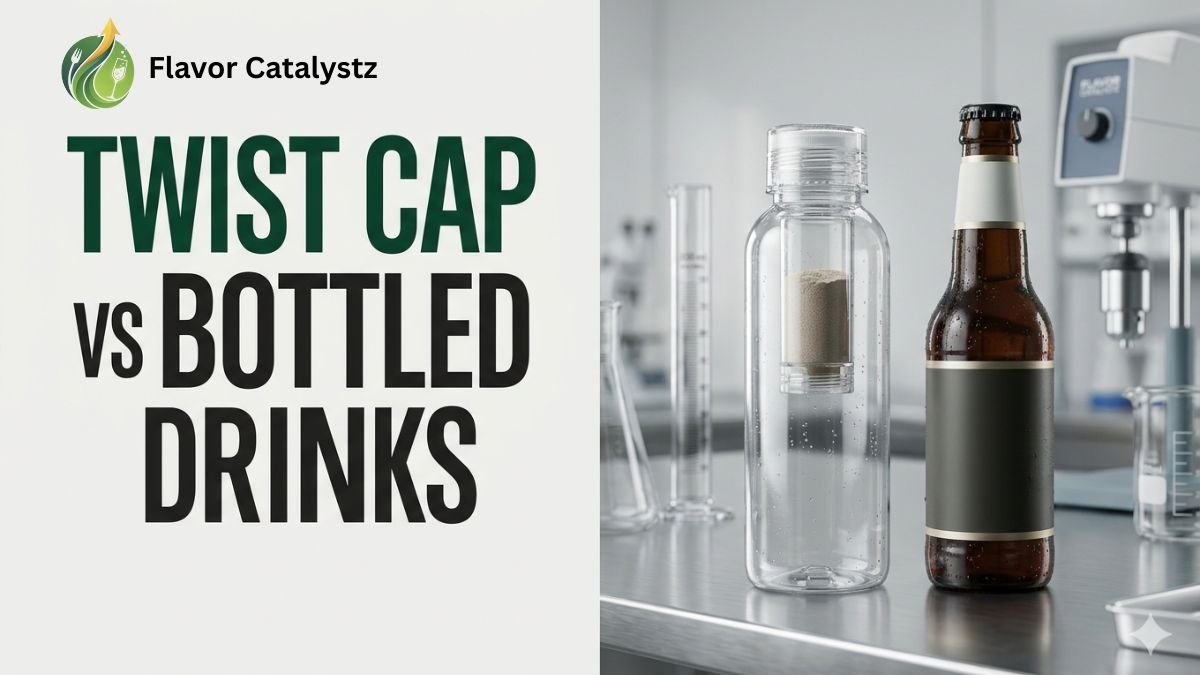
Twist Cap Powders (also called powder-in-cap, activation caps, or twist-to-activate beverages) are a hybrid format. A pre-filled bottle of water (or a sealed empty bottle, in some variants) sits below a specially engineered cap that holds a measured powder dose — typically 3 to 5 grams. Twist the cap, an internal seal breaks, the powder drops into the liquid, you shake, you drink. The powder stays dry, sealed, and stable until the moment of consumption.
Bottled Drinks (Ready-to-Drink / RTD) are the classic pre-mixed format. Active ingredients are dissolved into liquid at the factory, the bottle is filled, capped, and shipped. The consumer opens and drinks. No mixing step. No interaction. Just convenience.
The difference is not just mechanical. It is chemical, economic, and behavioural. And every one of those dimensions matters when you decide which format your brand should ship.
The 2026 Market Reality: Why This Debate Got Urgent
The format conversation got real in the last 18 months for three reasons.
India’s RTD market is on track to double from USD 20 billion in 2025 to USD 40 billion by 2030, driven almost entirely by quick commerce. The RTD non-alcoholic category is growing 100%+ through Blinkit, Zepto, and Swiggy Instamart — and consumers are buying for immediate, need-based consumption, not planned stock-up. That changes everything about packaging weight, unit economics, and shelf efficiency.
The functional beverage shift has exposed the technical limits of bottled drinks. Probiotics lose viability in liquid. Vitamin C oxidises. Collagen hazes. Adaptogens contribute off-notes over time. Brands chasing health-conscious consumers are running into shelf-life walls that powdered formats simply do not have.
The global twist-cap and powder-in-cap segment is now a billion-dollar packaging category, with the twist caps market projected to expand from USD 350 million in 2024 to USD 650 million by 2034 at a 6.3% CAGR — and the bigger twist-cap closure market is already valued above USD 8 billion globally. This is no longer a novelty. It is industrialised packaging with global suppliers, FSSAI-compliant materials, and proven scale-up paths.
These three forces collide on every Indian beverage founder’s pitch deck. You cannot ignore them.
Flavor Catalystz
Confused between twist-cap powder and RTD format?
We help beverage founders evaluate margin, stability, FSSAI pathway, quick-commerce fit, and ingredient compatibility before committing to a format.
Twist Cap Powder vs Bottled Drinks: The Honest Head-to-Head
Here is the comparison nobody else publishes — because it is not a clean win for either side.
| Factor | Twist Cap Powder | Bottled Drink (RTD) |
|---|---|---|
| Gross Margin Range | 45–60% | 28–40% |
| Shipping Weight per Unit | Light (water bottle + 5g powder) | Heavy (full liquid weight) |
| Shelf Life (ambient) | 18–24 months | 6–12 months |
| Functional Ingredient Stability | Excellent (dry storage) | Variable (depends on actives) |
| Production CapEx | Higher (specialised cap-filling) | Lower (standard bottling lines) |
| Per-Unit Packaging Cost | Higher (engineered cap = ₹6–18 extra) | Lower (standard PET + closure) |
| Cold-Chain Required | No | Often yes (for sensitive RTDs) |
| Consumer Effort | Twist + shake (2 seconds) | Zero (open and drink) |
| Perceived Premium | High (interactive, fresh-mix feel) | Standard (commoditised) |
| FSSAI Pathway | Dual-component approval needed | Standard beverage license |
| Best Fit Categories | Probiotics, vitamins, electrolytes, collagen, BCAA | Juices, teas, sodas, energy drinks, dairy |
Read that table twice. The twist cap wins on margin and shelf life. The bottle wins on production simplicity and consumer effort. Neither is universally better — the answer depends entirely on what you are selling and to whom.
Where Twist Cap Powders Genuinely Win
1. Functional Ingredient Stability — The Big One
This is the killer argument for powder-in-cap, and it is grounded in real food science. Probiotic counts in liquid drop by 40–70% over 90 days at ambient storage. Vitamin C in RTD form degrades 20–35% in six months. Collagen peptides hydrolyse and haze. B-vitamins are light-sensitive. The moment you put these actives into water, the clock starts.
A twist cap keeps them dry. The active ingredient stays in its original potency until the second of consumption. For brands making label claims — “10 billion CFU at consumption” instead of “10 billion CFU at manufacture” — that is the entire difference between a product that delivers and one that lies. This is exactly why functional beverage development projects increasingly start with format selection before recipe work.
2. Margin Math That Actually Holds Up at Scale
The margin advantage is real, but the maths is more nuanced than most blogs admit. A twist-cap unit costs more to produce per unit at small scale because the cap itself is engineered packaging — typically ₹6–18 more than a standard closure. But you save on cold chain, you save on shipping weight (water can be sourced locally or even consumer-supplied in some formats), and you cut spoilage to near zero.
Net result at 50,000+ unit volumes: gross margins of 45–60%, versus 28–40% for an equivalent RTD. For a founder doing 10,000 units a month, that margin gap is the difference between burning runway and being unit-economic profitable.
3. The Quick Commerce Reality
Quick commerce delivery economics reward light, dense, durable SKUs. A twist-cap product weighs roughly 60% less than its RTD equivalent (because the water-heavy version ships full). Lower weight means lower last-mile cost, smaller dark-store footprint, more units per delivery slot. As beverage industry trends in 2026 increasingly point to quick commerce as the dominant growth channel, this matters more every quarter.
4. Premium Positioning Without Premium Ingredients
The interactive twist-and-shake ritual creates a perceived premium that adds 25–40% to acceptable price points. Consumers experience the product as “made fresh, for me, now” — even if the active dose is identical to a cheaper RTD. That is positioning gold for any brand fighting for shelf differentiation.
5. Cleaner Label, Fewer Preservatives
RTDs need preservatives — sodium benzoate, potassium sorbate, EDTA — to survive shelf life. Powders in dry cap chambers do not. That means a cleaner ingredient declaration, which directly supports clean-label positioning and FSSAI front-of-pack readiness.
Where Bottled Drinks Still Win (And Why You Can’t Ignore Them)
This is the part most twist-cap evangelists skip. The bottle is not dying. It is evolving.
1. Mass-Market Convenience Still Rules Volume
For impulse purchase, social drinking, and habitual hydration, the cognitive load of “twist, then shake, then drink” is real. A teenager grabbing an energy drink from a kirana store does not want a ritual. They want it open and gone in 20 seconds. RTDs win on absolute purchase frequency and volume velocity in the mass market.
2. Lower Barrier to Manufacture and Launch
Standard PET bottling lines exist in every Indian beverage manufacturing hub. Twist-cap filling requires specialised equipment, validated cap suppliers (mostly imported from China, Croatia, or the Netherlands), and tighter quality control. For a first-time founder, the bottled drink path is faster to market, lower-CapEx, and easier to find a contract manufacturer for. Our work in non-alcoholic beverage development consistently shows that RTD is the right call when speed-to-shelf trumps margin optimisation.
3. Established Branding Surface Area
A 500ml RTD bottle gives you a full sleeve of brand real estate. Visual identity, label design, claims, ingredient stories — all on display. A twist-cap product splits visual attention between the bottle body and the engineered cap, and many caps come in restricted colour and printing options. For brand-first plays, the bottle is still the bigger canvas.
4. Categories Where Powder Just Doesn’t Fit
Carbonated drinks. Juices with pulp. Dairy-based beverages. Cold-brew coffees. Anything where the liquid texture or natural composition is the product itself. You cannot powder a fresh juice into a cap and call it the same product. Some energy drink formulations, particularly carbonated ones, are inherently RTD-format products — no twist cap will replicate them.
5. Consumer Trust at the Mass Tier
In Tier 2 and Tier 3 Indian markets, the twist-cap format still reads as “different” — sometimes as “complicated.” The bottled drink is unimpeachably familiar. For brands targeting deep market penetration before premium positioning, the RTD format reduces friction.
Already have a recipe but stuck on format decision?
Our beverage scientists run a Format-Fit Audit — scoring your concept across margin, stability, FSSAI, scale-up, and consumer behaviour. → Talk to a Beverage Consultant at Flavor Catalystz
The Format-Fit Decision Framework
Here is the framework we use with Indian beverage founders. Run your product through these five questions before you commit.
Question 1: How fragile are your active ingredients in liquid?
If your hero claim depends on probiotics, oxygen-sensitive vitamins, live enzymes, heat-labile actives, or anything that loses potency in water over 90 days — twist cap is structurally superior. If your actives are stable in liquid (caffeine, taurine, most B-vitamins in low pH, electrolytes in acid systems), RTD works fine.
Question 2: What is your target unit price?
Below ₹40: RTD almost always wins. The twist-cap packaging premium does not justify itself.
₹40–₹80: Either format works. Margin maths decides.
₹80+: Twist cap unlocks premium positioning and margin headroom that RTD struggles to match.
Question 3: What is your distribution strategy?
Quick commerce + D2C + premium modern trade: twist cap wins on logistics economics.
General trade + Tier 2/3 penetration + impulse retail: RTD wins on familiarity and speed.
Hybrid: Many serious brands now ship both formats — RTD for mass, twist cap for premium SKUs.
Question 4: How much CapEx can you commit?
Twist-cap filling lines, cap supply contracts, and validation runs typically require 2–3x the upfront investment of a standard RTD launch. If you are bootstrapping under ₹50 lakh, RTD is the realistic path. If you have ₹2 crore+ in committed launch capital, twist cap becomes viable.
Question 5: What FSSAI category are you registering under?
RTDs follow the standard non-alcoholic beverages category. Twist-cap products often need dual-component approval (the liquid base and the powder dose as separate ingredient declarations), plus migration testing for the cap material itself. The pathway is well-established but longer.
The Categories Where Each Format Is Already Winning in India
Twist Cap Powder is dominating in:
Hydration and electrolytes — where freshness messaging and clean labels matter more than convenience. Several natural electrolyte drink brands are building entire portfolios on the twist-cap format.
Protein and amino acids — where dose precision and stability matter, and where protein water has emerged as the breakout sub-category.
Pre-workout and BCAA — the segment where the twist-and-shake ritual feels native to the consumer.
Daily vitamin shots — where freshness claims drive premium pricing.
Adaptogen and ayurvedic blends — where heat-sensitive actives like ashwagandha and brahmi degrade in liquid.
Bottled Drinks (RTD) is dominating in:
Mass-market sodas, juices, and iced teas — where consumption is impulse-driven and brand familiarity is the moat.
Carbonated energy drinks — structurally impossible in powder format.
Flavoured dairy and milk-based beverages — emulsion-dependent, no powder equivalent.
Traditional Indian beverages — packaged lassi, aam panna, jaljeera, shikanji, where the liquid-cultural format is the product itself.
Premium kombucha and fermented drinks — where the live liquid is the product.
The Hybrid Future: Why Smart Brands Are Doing Both
Walk into a serious functional beverage company in 2026 and you will not find a “powder team” and a “bottle team” fighting for budget. You will find one R&D function thinking format-first about every concept. Twist cap for the premium SKU. RTD for the mass-tier SKU. Same brand, two formats, two consumer segments.
Major global brands — Activate Drinks in the US, Cedevita in Europe, several Indian D2C hydration startups — already run this dual-format playbook. It hedges margin against volume, premium against mass, and stability against speed-to-shelf.
If you are planning a beverage brand launch in India, the most strategic question is not “which format?” — it is “which format first, and what is the path to the second?”
Common Mistakes Founders Make in Format Selection
Mistake 1: Choosing twist cap because it is trendy, not because the actives demand it. If your formula is stable in liquid, the twist-cap premium just adds cost without consumer benefit.
Mistake 2: Choosing RTD because it is cheap, then losing claims to stability failure. A 10 billion CFU probiotic at manufacture that delivers 2 billion CFU at consumption is a label problem and a trust problem. Pick the format the science demands.
Mistake 3: Underestimating twist-cap CapEx and supply chain complexity. Cap suppliers are concentrated, lead times can run 90–120 days, and minimum order quantities are real. Plan inventory accordingly.
Mistake 4: Ignoring FSSAI dual-component pathway for twist cap products. Some founders treat the powder as an “add-on” and discover at launch that the regulatory file requires separate ingredient declarations and migration data.
Mistake 5: Designing the formula before choosing the format. Format dictates ingredient choices, stabiliser systems, pH ranges, and processing steps. Picking format last forces expensive reformulation. Our beverage research and development process always sequences format selection before final recipe lock.
The Verdict: There Is No Universal Winner
The headline most blogs would write here is “twist cap wins.” That headline is wrong. The honest answer is that twist cap powders win for functional, premium, stability-critical, quick-commerce-aligned products — and bottled drinks still win for mass-market, impulse-purchase, carbonated, dairy-based, and high-velocity categories.
The smartest beverage brands in India in 2026 are not picking a side. They are picking format on a per-SKU basis, building dual-format portfolios, and using each format where it structurally delivers the most consumer and commercial value.
Your job as a founder or R&D head is not to fall in love with a format. It is to match format to product, to consumer, and to the unit economics of your distribution model. Get that right, and the format becomes a weapon. Get it wrong, and it becomes the line item that quietly kills your margin.
Ready to Pick the Right Format for Your Beverage?
At Flavor Catalystz, we have run format-fit assessments, dual-format reformulations, and ground-up R&D for some of India’s most ambitious beverage brands — across hydration, protein, energy, immunity, gut-health, and adaptogenic categories. We work as your embedded R&D, regulatory, and scale-up partner, not as an external consultancy that drops a deck and disappears.
Whether you are launching your first SKU, evaluating a twist cap pilot, or rebuilding your portfolio for the quick commerce era, we will help you make the format call with data, not opinion — and then execute it from bench to commercial shelf.
Frequently Asked Questions
What is the main difference between twist cap powder and bottled drinks?
Twist cap powders store the active ingredient as a dry powder in a sealed cap chamber, releasing it into liquid only at the moment of consumption. Bottled drinks (RTDs) come pre-mixed in liquid form. The core difference is ingredient stability, shelf life, margin profile, and consumer interaction — twist cap keeps actives potent longer, while bottled drinks offer zero-effort convenience.
Are twist cap powders really more profitable than bottled drinks?
Generally yes, at moderate-to-high volumes. Twist cap formats deliver 45–60% gross margins versus 28–40% for equivalent RTDs, primarily due to lower shipping weight, no cold chain, longer shelf life, and premium price acceptance. However, twist cap packaging costs ₹6–18 more per unit, and production CapEx is higher — so the margin advantage only materialises above 50,000+ unit volumes.
Can carbonated drinks be made in twist cap format?
No. Carbonation requires the CO₂ to be dissolved into liquid under pressure during bottling. Twist cap powders activate at the moment of consumption in still water, so they cannot deliver true carbonation. For sparkling and carbonated products, RTD format is the only structural option.
Do twist cap powder products need FSSAI approval differently than bottled drinks?
Twist cap products typically require dual-component declaration under FSSAI — the liquid base and the powder dose are evaluated as separate ingredient systems, with combined nutritional labelling. The cap material itself must also pass migration testing. The pathway is established but takes longer than a standard RTD beverage license. Working with a regulatory-experienced beverage consultant accelerates this significantly.
Which format is better for probiotic beverages?
Twist cap, almost always. Probiotic viability in liquid RTDs drops 40–70% over 90 days at ambient storage, making “live culture” claims difficult to defend. Dry powder storage in a sealed cap maintains potency until the moment of consumption — which is why most serious probiotic beverage brands have either migrated to powder-in-cap or are running pilot trials on it.
How long is the shelf life of twist cap powder beverages?
Most well-formulated twist cap products achieve 18–24 months ambient shelf life, compared to 6–12 months for equivalent RTDs. The dry chamber prevents the hydration-driven degradation that limits RTD shelf life. Some vitamin and electrolyte formats stretch to 30 months with optimised cap liners and desiccant inclusion.
What is the minimum order quantity for twist cap production in India?
Twist cap MOQs are higher than RTD because of imported cap supply and specialised filling. Realistic starting MOQs for an Indian launch sit between 25,000 and 50,000 units per SKU, depending on cap supplier and contract manufacturer. RTD MOQs typically start at 5,000–10,000 units.
Can I use the same formulation for both twist cap and bottled drink versions?
Rarely. The formats demand different ingredient systems. Twist cap powders need precise particle size, anti-caking agents, instant solubility design, and dose accuracy. RTDs need pH stabilisation, preservative systems, emulsion design, and processing tolerance. Most brands shipping both formats run parallel recipes optimised for each.
Which format should a first-time beverage founder choose?
If your hero ingredient is stable in liquid and you are targeting mass-market price points (under ₹50), start with RTD — lower CapEx, faster launch, easier contract manufacturing. If your product is functional, premium-priced (₹80+), and depends on sensitive actives, twist cap delivers stronger unit economics and a defensible product story. Many successful founders launch RTD first, then add a premium twist-cap SKU once distribution is established.
Is the twist cap format sustainable compared to bottled drinks?
Generally yes. Twist cap formats reduce shipping weight by 50–60%, eliminate cold-chain energy use, and extend shelf life — all of which lower lifecycle carbon footprint. However, the cap itself is a multi-component plastic assembly, which complicates end-of-life recycling. The net sustainability advantage holds, but it is not absolute, and brands making green claims need to substantiate them with proper lifecycle data.