May 2026 · 9 min read
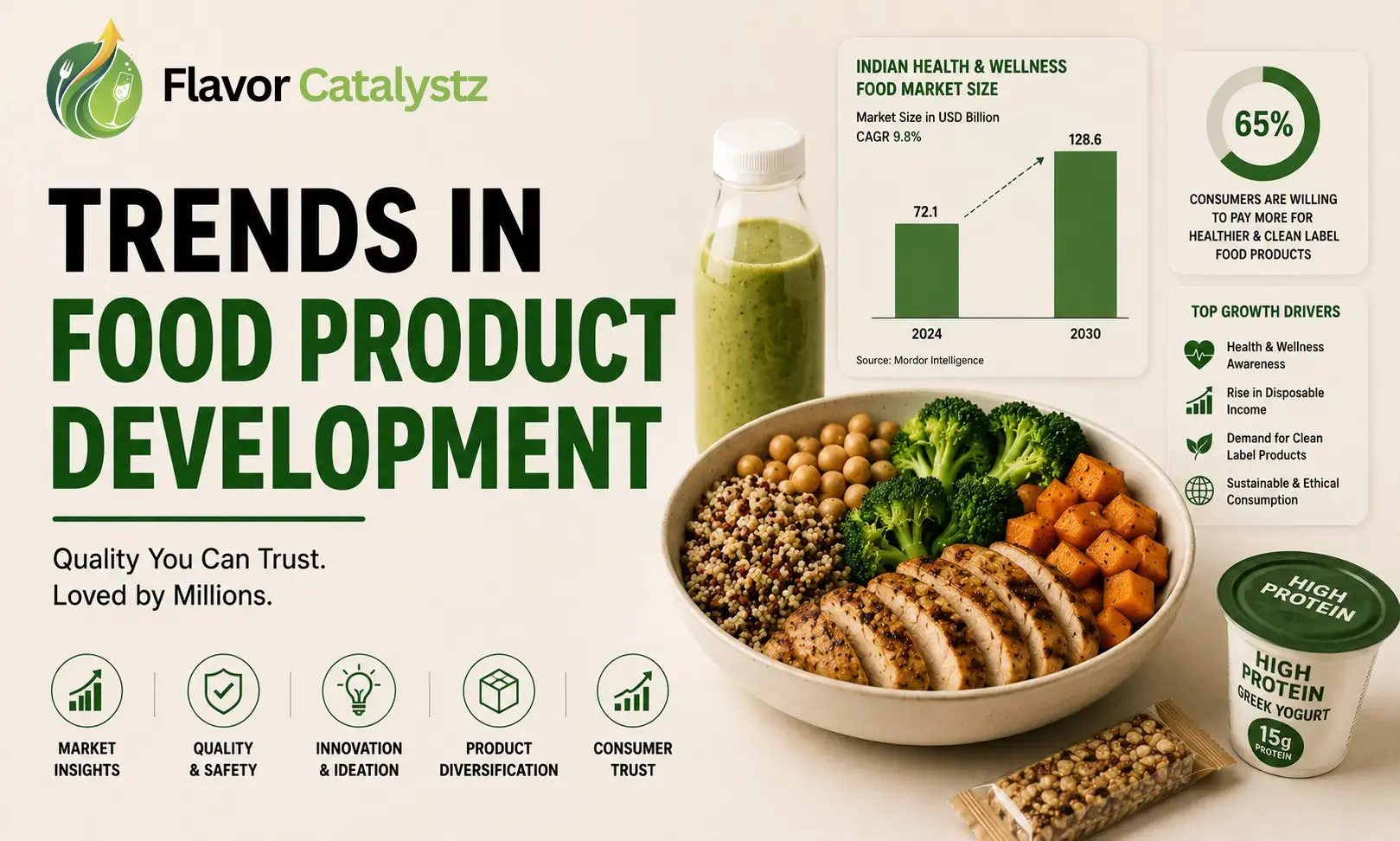
The food industry in India is moving faster than ever. Consumers are no longer just buying food. They are buying trust, health, and convenience, often all three at once. For brands and startups entering the market today, keeping up with the latest food product development trends is not optional — it is the difference between a product that lasts and one that sits on a shelf.
This guide covers ten major trends shaping food product development in 2026, with real context on why each one matters and how Indian brands are responding. Whether you are building a new product from scratch or reformulating an existing one, this is where the market is heading.
1. High-Protein Foods Are Moving Into Everyday Categories
Protein is no longer just for gym-goers. It has entered biscuits, breakfast cereals, makhana brands, dahi, ready-to-eat meals, and beverages. Indian consumers are increasingly aware of protein deficiency, and brands are responding with reformulated staples.
In food product development, this means formulators are working with plant proteins like pea, soy, chickpea, and rice protein to meet the 5-15 gram per serving targets that consumers now look for on labels. The challenge is achieving this without changing the texture or taste of familiar products.
What this means for new product development: If you are entering the snack, dairy, or ready-to-eat segment, a protein-forward positioning now has a clear consumer pull behind it, especially in Tier 1 and Tier 2 cities.
2. Clean Label Is Becoming Non-Negotiable
Clean label means fewer ingredients, no artificial preservatives, no synthetic colours, and a list that a regular consumer can read and understand. This shift is happening across categories in India and is particularly strong in the premium and health food segments.
From a formulation standpoint, clean label development is harder than conventional product development. Formulators need to find natural alternatives that still deliver shelf life, stability, and the right texture. This takes more iteration but results in a product that consumers increasingly trust.
Brands that have moved to clean label are reporting better repeat purchases. The label itself has become part of the product experience.
3. Millet-Based Products Are in Full Expansion
India declared 2023 the International Year of Millets, and the impact on food product development has been significant. Bajra, jowar, ragi, and foxtail millet are showing up in cookies, energy bars, breakfast mixes, pasta, and beverages. The Ministry of Food Processing Industries has also allocated Rs. 800 crore under the Production Linked Incentive Scheme specifically for millet-based products.
For brands, this is one of the strongest formulation opportunities right now. Millets are gluten-free, high in fibre, and carry strong cultural familiarity in many parts of India. The main development challenge is texture and binding, since millets behave differently from wheat in baking and extrusion applications.
4. Functional Foods Are Expanding Beyond Supplements
Functional ingredients like ashwagandha, moringa, turmeric, probiotics, and prebiotics are moving out of supplement bottles and into food formats. Consumers want their food to do more — support immunity, improve gut health, reduce stress, and enhance sleep.
This is one of the more complex areas of food product development because FSSAI regulates health claims carefully. Formulators must check that each functional ingredient is listed under the correct FSSAI schedule and that any claim made on the label is supported by the regulatory framework.
Product categories seeing the most functional ingredient activity: beverages, dairy alternatives, protein snacks, and breakfast formats.
5. Gut Health Is a Category in Itself
Gut health has grown from a niche wellness interest into a mainstream consumer priority. Products containing probiotics, prebiotics, postbiotics, and fermented ingredients are seeing strong demand. Kombucha, probiotic dahi, kefir, lacto-fermented drinks, and fibre-enriched snacks are all growing.
For product developers, gut health creates formulation complexity. Live cultures need to survive processing, packaging, and shelf life. Stability testing is a critical part of gut health product development, and choosing the right strain at the right CFU count while meeting FSSAI norms requires precise technical work.
6. Plant-Based Products Are Maturing
The first generation of plant-based products in India focused on meat alternatives. The second generation is focused on better taste, lower price points, and wider category coverage including dairy alternatives, egg replacers, and plant-based seafood analogues.
Indian consumers are not primarily vegan. They are flexitarian — meaning they reduce animal protein for health or cost reasons while still wanting familiar flavour and texture. Product development in this space now focuses on meeting that middle-ground consumer rather than a strict vegan market.
The India plant-based food market generated USD 1,124 million in 2026 and is on a strong growth curve, driven by both health consciousness and rising awareness around sustainable eating.
7. Convenience Formats Are Driving New Product Categories
Ready-to-eat, ready-to-cook, and ready-to-drink formats are seeing strong growth. Busy urban consumers want products that are quick to prepare without compromising nutrition. This has opened up product development opportunities in meal kits, single-serve formats, heat-and-eat meals, and functional beverages.
From a development standpoint, convenience formats require careful attention to packaging-product interaction, shelf life under different storage conditions, and portion standardisation. These are not just recipe challenges — they are food science and engineering challenges.
8. Sustainable Ingredients and Packaging Are No Longer Optional
Sustainability has entered food product development from two directions. The first is ingredient sourcing — brands are choosing ingredients that are locally grown, require less water, and come with lower carbon footprints. The second is packaging — biodegradable, recyclable, and reduced-plastic solutions are being built into new product briefs from day one.
This shift is partly consumer-driven and partly regulatory. FSSAI and the Ministry of Environment have been moving toward stricter plastic and packaging norms, which means brands building products today need to factor in packaging decisions early in the development process.
9. Personalised Nutrition Is Moving From Concept to Product
Personalised nutrition — where food products are designed around individual health data, dietary needs, or life stage — is becoming commercially viable. In India, this is showing up in products designed for diabetics, women’s health, senior nutrition, and children’s cognitive development.
For startups and mid-size brands, this does not require genetic testing or advanced diagnostics. It can begin with clearly targeted formulations — a product designed specifically for post-workout recovery, or one built around iron and folic acid for women aged 20-40. Specificity in positioning is itself a form of personalisation that the market is responding to.
10. Fortification Is Expanding Into Traditional Indian Formats
Government-driven fortification continues to expand, and so does commercial interest in fortified foods. Micronutrient deficiencies — especially iron, Vitamin D, Vitamin B12, and zinc — remain widespread in India, and brands are finding both a market and a purpose in addressing them.
The innovation here is that fortification is now entering traditional Indian formats like atta, rice, namkeen, and chai blends. This is a more technically demanding space than fortifying processed foods, because traditional formats have different pH levels, moisture content, and cooking temperatures that affect nutrient stability.
Key Takeaway for Brands Developing Products in 2026
The strongest products entering the market this year share a common structure: they are built around a real consumer need (protein, gut health, convenience), formulated cleanly without unnecessary ingredients, and positioned with enough specificity to cut through a crowded market.
Trends do not build brands. Solid formulation, FSSAI-compliant development, and a clear market fit do. The trends above are the direction — the work is in the execution.
Launch A Market-Ready Food Product With Us
Flavor Catalystz helps founders, startups, and FMCG brands develop winning food products — from recipe formulation and ingredient sourcing to FSSAI compliance, packaging, shelf-life testing, and pilot manufacturing. Turn your food idea into a retail-ready product faster with expert-led food product development services.
Frequently Asked Questions
What are the biggest food product development trends in 2026?
The most significant trends are high-protein product development, clean label formulation, millet-based innovation, functional foods with gut health benefits, and sustainable ingredient and packaging choices. In India specifically, plant-based products and fortified traditional foods are also seeing strong growth.
Why is clean label food development so important right now?
Consumers in India are reading labels more carefully. They want fewer artificial additives and more transparency. Brands that invest in clean label formulation tend to see stronger repeat purchases, especially in health and premium food segments. It also helps build long-term consumer trust.
Are millet-based products a good opportunity for new food brands?
Yes. Millets are backed by government support, carry strong nutritional credentials, are gluten-free, and have good consumer awareness after the International Year of Millets. The formulation challenges around texture and shelf life are real but solvable with the right food technology expertise.
What is the difference between functional food and regular food?
Regular food provides nutrition and energy. Functional food provides additional health benefits beyond basic nutrition — such as improved digestion from probiotics, better immunity from botanical extracts, or improved joint health from added collagen. In India, functional food claims on labels must comply with FSSAI health claims regulations.
How does FSSAI regulation affect food product development trends?
FSSAI sets the rules for what ingredients can be used, at what levels, and what claims can be made on packaging. This means that developing a product around a trend like functional ingredients or health claims requires regulatory expertise from the start, not as an afterthought. Products that skip this step often face delays or label revisions after development is complete.
How long does it take to develop a new food product in India?
A straightforward formulation with FSSAI-standard ingredients and standard packaging can be developed in 4 to 8 weeks from concept to pilot batch. More complex products involving novel ingredients, health claims approval, or new packaging formats can take 3 to 6 months. Functional food products requiring stability data may take longer.
Is the gut health trend a passing fad or a lasting category?
Gut health is a lasting category backed by strong science. The connection between gut microbiome and immunity, mood, metabolism, and overall health is well-documented. Consumer awareness is rising steadily in India, and the category is expected to grow significantly over the next five years. Brands building in this space now are not chasing a trend — they are entering a maturing market early.