Jun 2026 · 8 min read
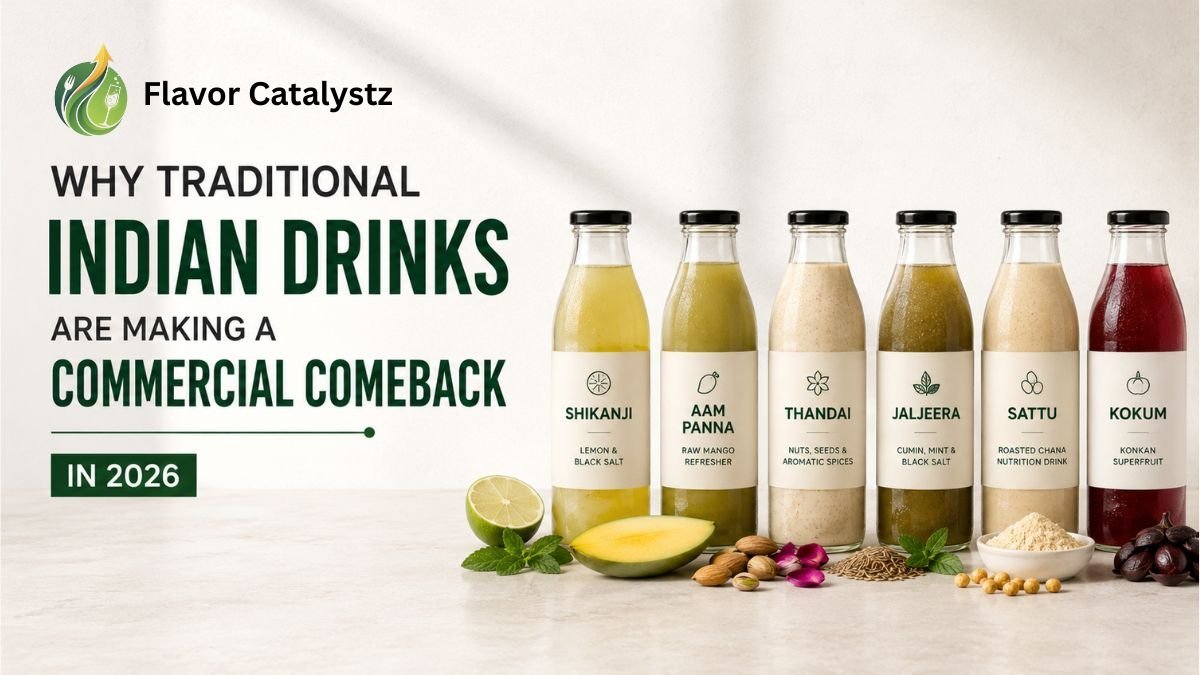
Shikanji. Aam panna. Thandai. Jaljeera. Sattu. Kokum. Bael sharbat. Rose sharbat.
These are not new beverages — they are some of the oldest drinks in the subcontinent, consumed for centuries across India’s diverse regions. They are the drinks that cool workers through summer heat, that welcome guests at weddings, that mark seasons and festivals and family memories.
And in 2026, they are also a commercial opportunity that is growing faster than almost any other segment in the Indian beverage market.
This is the story of why traditional Indian drinks are making a commercial comeback — and what it means for founders, formulation teams, and the broader beverage industry in India.
Planning to Launch a Traditional Indian Beverage Brand?
Whether you’re developing authentic shikanji, aam panna, jaljeera, thandai, sattu, kokum, or rose sharbat, commercial success depends on the right formulation, shelf life, taste consistency, and FSSAI compliance. We help founders transform traditional recipes into market-ready beverage brands.
The Cultural Moment: Why Now?
The revival of traditional Indian drinks is not happening by accident. It is the result of several converging forces that have created the right commercial conditions for the first time.
The Post-Colonial Reclamation of Indian Food Identity
India’s food culture is undergoing a broad reclamation — a conscious movement to celebrate, elevate, and commercialise indigenous food knowledge that was devalued during colonial rule and the subsequent dominance of Western and multinational FMCG brands.
This is visible across categories: craft Indian spirits (Indian gin, Indian whisky with Indian botanicals), regional Indian cuisine gaining Michelin recognition, traditional grains (millets, jowar, ragi) experiencing a commercial renaissance. Traditional Indian beverages are part of this same cultural shift.
Paper Boat Validated the Market
Paper Boat, launched in 2013 by Hector Beverages, demonstrated something that had never been proven at scale before: Indian consumers in modern retail and e-commerce would pay premium prices for traditional Indian flavours packaged in a contemporary format.
Aam panna, jaljeera, thandai, kokum — Paper Boat built a significant business on these flavours. The market is proven. The question now is: who builds the next generation of traditional Indian drink brands that go further, do it better, and reach categories and segments Paper Boat has not?
The Health Credentials of Traditional Indian Drinks
Traditional Indian beverages were not designed by food scientists — but many of them are remarkably aligned with modern functional beverage trends.
Aam panna: Raw mango, rich in Vitamin C and iron, cooling in Ayurvedic terms, genuinely effective at preventing heat stroke — documented in traditional medicine.
Jaljeera: Cumin, mint, lemon, black salt — a digestive tonic that increases bile production and supports gut motility. Also a natural electrolyte with sodium from black salt.
Thandai: A blend of almonds, seeds, spices, and rose — a natural adaptogen stack long before adaptogens became a marketing category.
Sattu: Roasted chickpea flour — a whole-food protein source with 20–25g protein per 100g, high fibre, and a low glycaemic index. An ancient functional food.
Kokum: Rich in hydroxycitric acid, anti-inflammatory, digestive support, naturally cooling. The Konkan coast’s answer to a summer tonic.
The functional beverage consumer is exactly the right market for traditional Indian drinks — and the health story is authentic, not manufactured.
The Premiumisation of Indian Food Culture
Urban Indian consumers are paying more for quality across food categories. The same consumer who pays ₹400 for a specialty coffee is willing to pay ₹150–200 for a premium, authentically formulated aam panna or rose sharbat. The price ceiling for quality Indian traditional beverages is higher than it has ever been.
The Commercial Opportunity: Category by Category
Aam Panna — The Summer Drink with Functional Credentials
Raw mango drink with a genuine cooling and nutritional story. Natural Vitamin C, iron, and heat stroke prevention associations make this one of the most functionally credible traditional Indian beverages.
Commercial potential: Year-round RTD (not just summer) with functional positioning. Explore our detailed commercial aam panna brand guide for the full commercial development pathway.
Shikanji — India’s Original Electrolyte Drink
Lemon, black salt, cumin, and water — this is natural electrolyte replenishment in its most traditional form. In an era of commercial electrolyte sports drinks, shikanji has an authenticity story that no manufactured product can replicate.
Commercial potential: Premium RTD electrolyte positioning. Artisanal glass bottle format. HoReCa placement. Naturally pairs with the functional beverage trend. See our shikanji recipe formulation guide for formulation parameters.
Thandai — Ancient Adaptogen Blend
A festival drink (Holi, Mahashivratri) that has clear commercial potential as a year-round premium functional beverage. The ingredient stack — almonds, seeds, rose, cardamom, saffron, fennel — reads like an adaptogen blend from a modern functional food brand.
Commercial potential: Premium RTD in elegant glass bottle. Gifting format for festivals. HoReCa specialty menu item. See our thandai commercial RTD guide for the full formulation and commercialisation path.
Jaljeera — The Digestive Tonic
Cumin-spiced, tangy, black salt-seasoned — jaljeera is consumed across North India as a digestive appetiser. As a functional beverage brand, jaljeera’s digestive health credentials are genuine and documentable.
Commercial potential: Pre-meal functional drink. Digestive health positioning. Pairs naturally with restaurant and foodservice distribution. Our jaljeera drink guide covers the commercial opportunity in detail.
Sattu — India’s Original Protein Drink
Roasted chickpea flour consumed as a drink — sattu is Bihar and Eastern India’s ancient functional food. 20–25g protein per 100g, high fibre, natural cooling properties. In an era of expensive imported protein powders, sattu offers an authentic, affordable, culturally rooted alternative.
Commercial potential: Protein premix sachet brand. Namkeen (savoury) and meetha (sweet) variants. Strong potential for fitness and health consumer segments. See our sattu drink formulation guide.
Rose Sharbat — The Floral Beverage Category
Rose sharbat (gulab sharbat) has an enormous cultural footprint in India — and as a commercial product, is dominated by a single brand (Rooh Afza) that has not had meaningful premium competition in decades. The opportunity for a natural, clean-label, premium rose sharbat brand is significant.
Commercial potential: Premium syrup for dilution. RTD rose-flavoured sparkling water. Mocktail mixer. HoReCa and modern trade. See our rose sharbat formulation guide for the full commercial pathway.
Regional Specialties: Kokum, Bael, Kanji, Solkadi
Beyond the pan-Indian classics, regional traditional beverages represent niche but growing commercial opportunities:
Kokum (Karnataka/Goa/Maharashtra): Anti-inflammatory, digestive, cooling. A regional speciality moving to national premium positioning.
Bael sharbat (North India): Digestive, cooling, Vitamin C-rich. The wood apple drink that is widely consumed fresh but rarely available commercially.
Kanji (North India): Fermented black carrot or mustard drink — natural probiotic, purple colour, deeply traditional. Emerging as a premium fermented beverage for gut health consumers.
Solkadi (Konkan coast): Coconut milk + kokum — a functional digestive drink that also works as a savoury beverage or dip.
What Makes a Traditional Indian Drink Brand Commercially Successful
The revival trend is real — but not every traditional drink brand will succeed. The ones that do share common characteristics:
Formulation integrity: The product must taste authentically like the traditional drink — not a diluted, over-sweetened approximation. Consumers who grew up with real aam panna will reject a pale imitation immediately.
Shelf life solved properly: Traditional drinks made at home are consumed fresh. Commercial products must achieve shelf life without compromising the authentic flavour. Cold press + HPP for short shelf life premiums. Proper acidification and preservation for ambient mainstream.
Modern packaging: The flavour is traditional. The packaging should be contemporary — clean design, modern format, photogenic. The combination of authentic flavour and modern presentation is the winning formula.
Reduced sugar versions: Traditional sharbats and drinks are often heavily sweetened. A reduced-sugar or naturally sweetened version positions the product for the health-conscious consumer who loves the flavour but is sugar-aware.
FSSAI compliance: Traditional does not mean unregulated. Every commercial traditional beverage needs FSSAI licensing, compliant labelling, and if making functional claims, appropriate product approval. See our FSSAI beverage compliance guide for the full framework.
Ready to Build the Next Great Indian Beverage Brand?
From authentic recipe development and commercial beverage formulation to shelf-life validation, FSSAI compliance, packaging, and manufacturing support, Flavor Catalystz helps founders launch premium traditional Indian drinks that are ready for modern retail, D2C, and export markets.
Ready to Build a Traditional Indian Drink Brand?
India’s traditional beverage knowledge is one of the most underexploited commercial assets in the Indian food industry. The consumer appetite is proven, the health credentials are genuine, and the cultural timing could not be better.
At Flavor Catalystz, we specialise in taking traditional Indian recipes to commercial scale — with formulations that preserve authenticity, achieve shelf life, and meet FSSAI compliance.
FAQs
Why are traditional Indian drinks trending commercially in 2026?
A combination of cultural reclamation of Indian food identity, proven consumer demand (Paper Boat effect), genuine functional health credentials aligning with modern wellness trends, and premiumisation of Indian food culture creating willingness to pay for quality.
Which traditional Indian drink has the most commercial potential?
Aam panna, shikanji, thandai, jaljeera, and sattu all have strong commercial fundamentals. Rose sharbat has a large existing market dominated by one brand — significant opportunity for a premium competitor. Sattu has the strongest functional health story with the least commercial competition.
How do you give traditional Indian drinks a commercial shelf life?
Hot fill + acidification (pH below 4.0) for ambient products 9–12 months. HPP + cold chain for premium fresh positioning 30–60 days. Concentrate/syrup format (high Brix) for 12–18 months ambient.
Is the traditional Indian drink category profitable?
Yes — premium traditional Indian drinks command ₹100–250 per unit in modern trade and D2C, with COGS that support strong gross margins at quality-conscious production levels. The category’s cultural premium allows pricing above commodity beverages.
What is the difference between Paper Boat and a new traditional Indian drink brand?
Paper Boat occupies the nostalgic, mass-market, mid-price segment. The opportunity for new brands is premium, authentically formulated, health-positioned traditional drinks — targeting consumers who want the genuine article, not a sweetened approximation.