Jul 2026 · 15 min read
Walk down the confectionery aisle of any Indian kirana store, modern-trade outlet, or quick-commerce app in 2026, and the shelf tells a story that goes beyond nostalgia. India’s candy market was valued at roughly USD 2.35 billion in 2025 and is projected to reach close to USD 7.7 billion by 2034, growing at a compound annual growth rate of nearly 13.6 percent. That pace is being driven by rising disposable incomes, deeper e-commerce and quick-commerce penetration, and a generation of consumers who treat candy as an everyday pick-me-up rather than an occasional treat.
This guide focuses specifically on candy brands — hard-boiled sweets, toffees, mints, chewing gum, and the fast-growing functional gummy segment — rather than protein bars and tablets, which follow their own, somewhat different growth story. Some names below are Indian legacies that shaped how an entire generation understands “candy.” Others are multinational brands that localised their portfolios for Indian palates. One is a new-age player that shows exactly where the category is headed next.
Every brand, figure, and regulatory detail in this article reflects publicly reported data current through mid-2026, cross-checked across company disclosures, trade press, and market research reports — because a “top brands” list is only useful when the numbers behind it hold up.
Start candy business 2026
Launch a New Candy Product Startup
Build a candy brand consumers love with end-to-end product development support. We help startups and food businesses create unique candy formulations, improve taste and texture, ensure regulatory compliance, and streamline manufacturing for faster market entry and long-term growth.
Top 10 Candy Brands in India 2026 — Quick Overview
For readers who want the shortlist before the detail, here is where India’s candy market stands today.
| Rank | Brand | Parent Company | Known For | Segment |
| 1 | Pulse | DS Group (Dharampal Satyapal) | Tangy raw-mango hard candy | Hard-boiled candy |
| 2 | Alpenliebe / Center Fresh / Mentos | Perfetti Van Melle India | Deposited candy, mints, gum | Candy, mints & gum |
| 3 | Melody / Mango Bite / Poppins / Kismi | Parle Products | Toffee-eclair hybrids, rainbow candy | Toffee & hard candy |
| 4 | Candyman | ITC Limited | Fruit toffees, sour jelly, coffee-toffee | Toffee & jelly candy |
| 5 | Pan Pasand / Mango Mood | Ravalgaon Sugar Farm | India’s first paan-flavoured candy | Ethnic/heritage candy |
| 6 | Coffy Bite | Lotte India | Coffee-toffee hybrid since 1987 | Toffee & gum |
| 7 | Polo / Eclairs | Nestlé India | Mint with a hole; toffee-eclair | Mints & toffee |
| 8 | Orbit / Boomer / Skittles | Mars Wrigley India | Chewing gum, bubble gum, fruit candy | Gum & fruit candy |
| 9 | Hajmola Candy | Dabur India | Ayurvedic digestive candy | Functional candy |
| 10 | Power Gummies | Power Gummies (D2C) | Sugar-free, vegan functional gummies | Nutraceutical gummies |
How Big Is India’s Candy Market in 2026?
India’s overall candy market — spanning chocolate-based candy, hard-boiled sweets, gum, and functional formats — was estimated at around USD 2.35 billion in 2025, with projections putting it near USD 7.7 billion by 2034. Chocolate-based candy remains the single largest type by value, holding just over half the market, driven by gifting culture and premium variants. But the growth story for 2026 is really in three other pockets: hard-boiled candy (still dominated by legacy Indian brands), chewing gum (led by multinational localisation), and functional or better-for-you formats, which are growing far faster than the category average even from a smaller base.
| Segment | Approx. Size / Share (2025-26) | 2026 Trend |
| Chocolate-based candy | ~54% of candy market by type | Premiumisation & gifting-led growth |
| Hard-boiled / tangy candy | ~₹4,000 crore category | Steady growth; Pulse holds ~19% share |
| Chewing gum & bubble gum | Sizeable, MNC-led sub-segment | Boomer growing at high double digits |
| Functional / sugar-free gummies | Small base, fastest-growing | Estimated 12–15%+ annual growth |
| Overall India candy market | USD 2.35 billion (2025) | ~13.6% CAGR through 2034 |
Top 10 Candy Brands in India 2026 — Detailed Profiles
Ranked by market presence, distribution reach, and brand recognition rather than a single financial metric, since hard-boiled candy, gum, and functional gummies aren’t directly comparable on revenue alone.
1. Pulse — DS Group
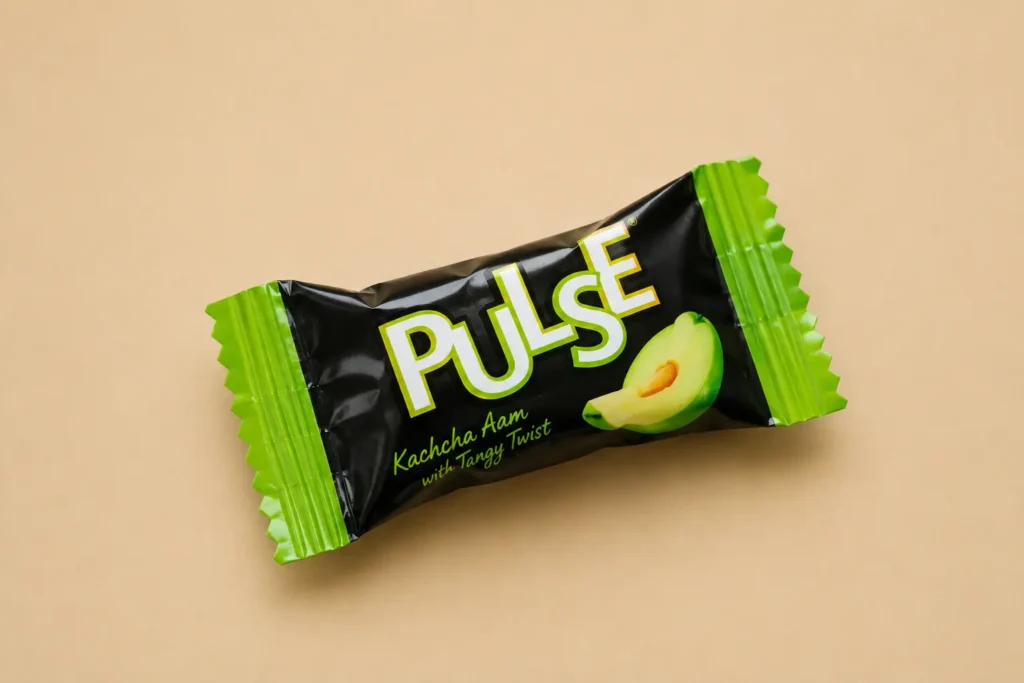
Segment: Hard-boiled tangy candy · Market share: 19% of India’s ~₹4,000 crore hard-boiled candy segment · FY 2024-25 revenue: over ₹750 crore
Launched in 2015 with a raw-mango-and-tangy-core formula, Pulse broke from the assumption that candy was a children’s product and successfully targeted adults as well. It has held the top spot in India’s hard-boiled candy segment for nine consecutive years, growing at a 15 percent CAGR against an industry average of about 9 percent. DS Group sells Pulse through more than 3.5 million retail outlets and is targeting ₹1,000 crore in revenue within two years, alongside plans to expand into children’s formats and sugar-free variants.
2. Alpenliebe, Center Fresh & Mentos — Perfetti Van Melle India
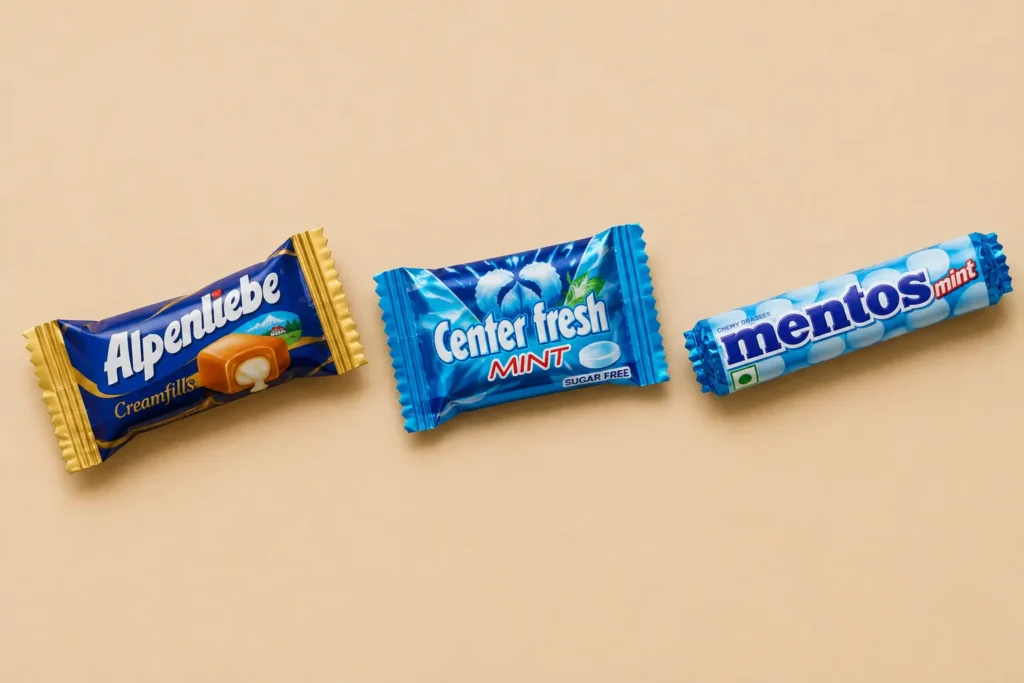
Segment: Candy, mints & gum · Market share: close to 20% of India’s confectionery market · India entry: 1994, with Center Fresh
The Italian-Dutch confectionery major built its Indian business around a compact set of core brands rather than spreading thin across dozens of product lines: Alpenliebe (a deposited candy known for creamfills and fruit-filled variants), Center Fresh, Center Fruit, Mentos, Chupa Chups, Happydent, Big Babol, and Chlormint. That focused-brand strategy has helped Perfetti Van Melle India stay one of the two or three largest players in the category by value for over a decade.
3. Melody, Mango Bite, Poppins & Kismi — Parle Products
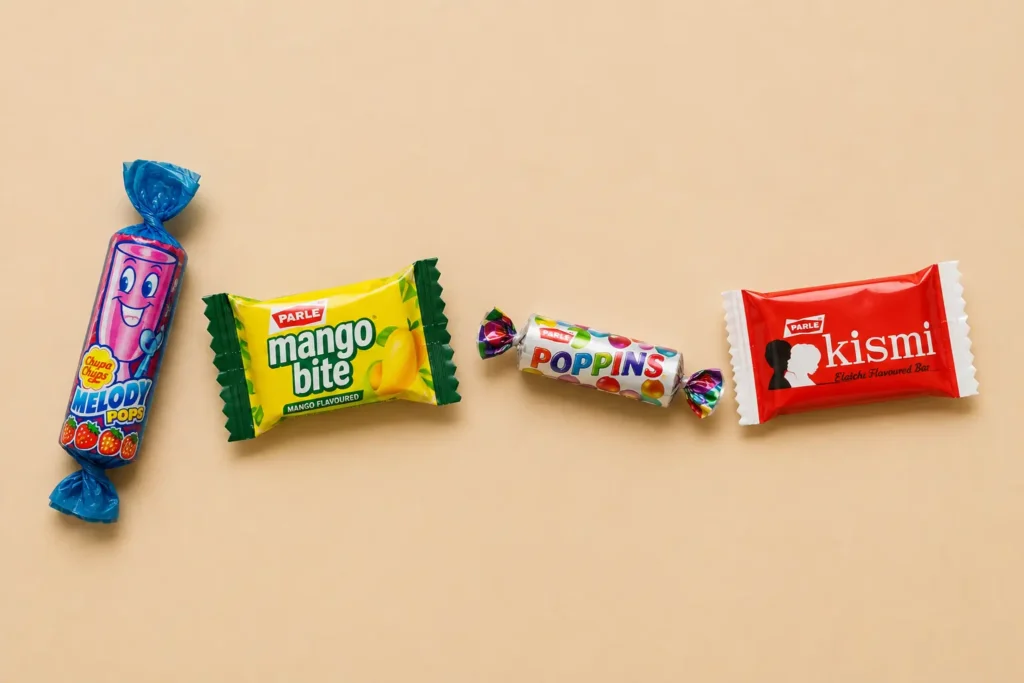
Segment: Toffee & hard candy · Founded: 1929, Mumbai (Chauhan family) · Notable products: Melody, Mango Bite, Poppins, Kismi Toffee Bar
Parle Products built on the success of Parle-G biscuits to enter confectionery, and its candy portfolio remains one of the most recognisable in India. Melody, often described as a toffee-chocolate-eclair hybrid, resurfaced in mainstream conversation in 2026 after being referenced during a diplomatic exchange in Rome. Poppins, with its distinctive rainbow-coloured discs, has been in the market since the 1950s, while Kismi Toffee Bar now comes in elaichi, kulfi, rajbhog, and rosemilk flavours. Parle’s strength lies particularly in Tier II and Tier III markets, where its distribution network runs deep.
4. Candyman — ITC Limited
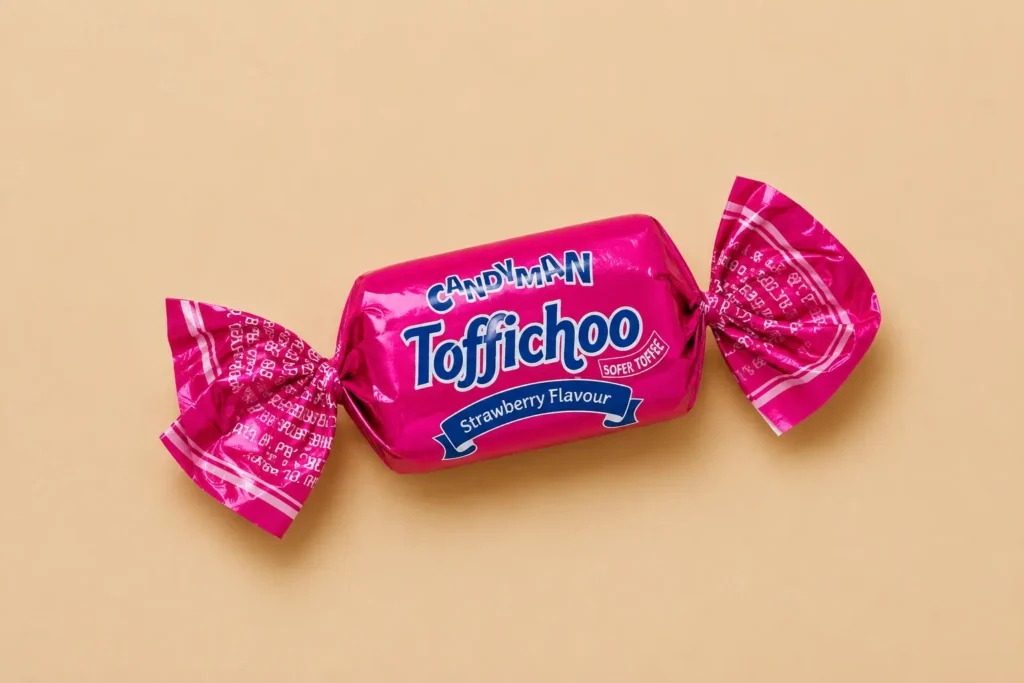
Segment: Toffee & jelly candy · Parent: ITC Limited · Recent launch: Candyman Sourzzz (2024)
ITC’s confectionery arm is known for fruit-forward toffees like Mango Delite, Orange Josh, and Pineapple Punch, and it was among the first Indian brands to introduce layered candy formats. It later expanded into the coffee-toffee segment with Candyman Cofitino. In 2024, ITC launched Candyman Sourzzz, a sour jelly candy aimed squarely at the bold-flavour trend gaining traction among younger consumers — a good example of how legacy brands are refreshing their portfolios rather than relying purely on heritage recall. ITC also owns the Mint-o brand.
5. Pan Pasand & Mango Mood — Ravalgaon Sugar Farm
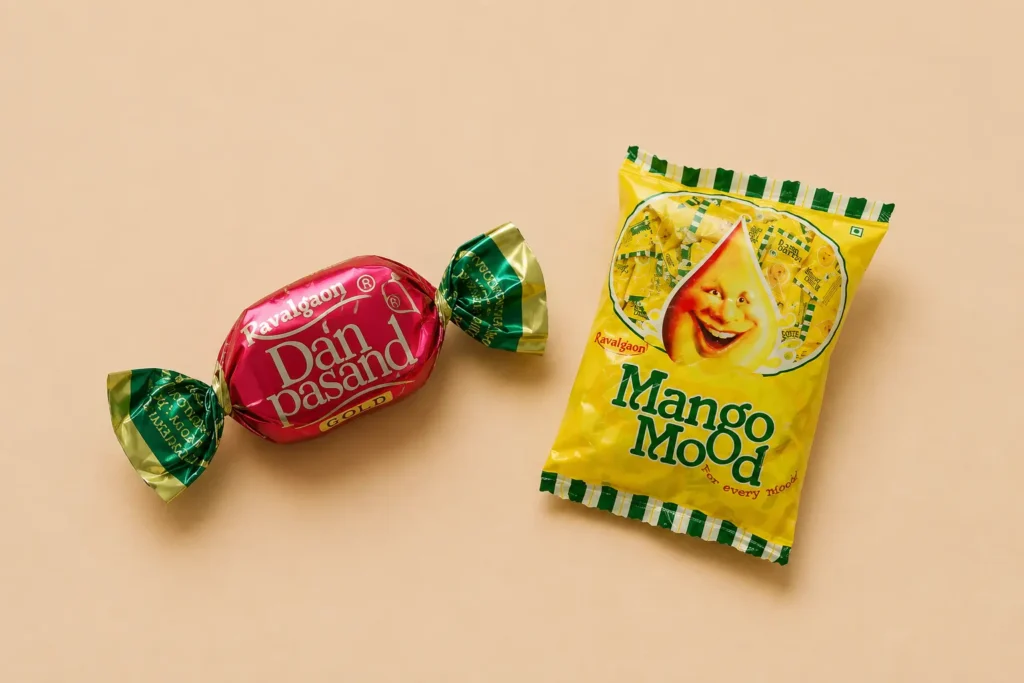
Segment: Ethnic/heritage flavoured candy · Signature product: Pan Pasand, widely credited as India’s first paan-flavoured candy · Base: Ravalgaon, Nashik district, Maharashtra
Ravalgaon built an enduring niche by turning a distinctly Indian flavour — paan — into a mainstream candy format, something no multinational brand had attempted at the time. Pan Pasand and its Mango Mood sibling have stayed relevant across generations largely on legacy trust and repeat purchase rather than heavy advertising spends, which makes Ravalgaon something of an outlier in a category increasingly shaped by multinational marketing budgets.
6. Coffy Bite — Lotte India
Segment: Coffee-toffee hybrid & gum · In market since: 1987 · Distribution: 2,000+ distributors reaching over 1 million retail outlets
Originally built as Parry Confectionery and now part of South Korea’s Lotte Group, Lotte India owns one of the most recognisable tag lines in Indian confectionery advertising: “Is it a coffee or a toffee?” Beyond Coffy Bite, the company’s portfolio includes Lacto King, Lotte Eclairs, Caramilk, and the liquid-filled BooProo and Spout gums. Lotte India runs its distribution through 26 clearing-and-forwarding agents and four regional offices, and it launched a premium Coffy Bite Rich variant to capture rising demand within the hard-boiled candy category.
7. Polo & Eclairs — Nestlé India
Segment: Mints & toffee-eclair · Signature product: Polo, “the mint with the hole” · Notable 2026 move: global commitment to remove artificial colours from Nestlé’s full portfolio by year-end
Nestlé India’s candy line sits alongside a much larger chocolate portfolio that includes Milkybar, Munch, Kit Kat, and Bar-One, and it leans on Nestlé’s extensive retail distribution to keep Polo and Eclairs in steady rotation. Nestlé’s parent company’s 2026 pledge to eliminate artificial colourings globally is a useful signal for the wider Indian confectionery industry, given how closely it lines up with FSSAI’s own tightening expectations around clean-label formulation.
8. Orbit, Boomer & Skittles — Mars Wrigley India
Segment: Chewing gum, mints & fruit candy · India presence since: early 2000s · India-specific launches: Orbit Raw Mango, Doublemint Paan Mint, Boomer Burst
Mars Wrigley operates three manufacturing facilities in India — Pune, Bengaluru, and Baddi in Himachal Pradesh — supporting a portfolio that includes Orbit, Boomer, Skittles, Doublemint, and M&M’s alongside its Galaxy and Snickers chocolate lines. Boomer bubble gum has driven high double-digit growth in recent quarters as part of a mid-teens CAGR for the company’s India business. The brand’s India-only launches — a raw-mango Orbit gum, a paan-flavoured Doublemint, and Boomer Burst, an orange powder-filled gum described as a global first — show how deliberately global confectionery majors now formulate for Indian taste preferences rather than simply importing their standard portfolio.
9. Hajmola Candy — Dabur India
Segment: Ayurvedic/digestive functional candy · Flavours: aam (mango) and imli (tamarind) · Positioning: extension of Dabur’s long-established Hajmola digestive tablet
Hajmola Candy represents “candy as functional food” rather than pure indulgence, and it leans directly on the digestive-health credibility Dabur had already built with the original Hajmola tablet. It sits within a broader Ayurveda-led functional confectionery trend that also includes herbal lozenges infused with tulsi and ashwagandha from brands such as Himalaya — a category that is small in absolute size today but growing meaningfully faster than traditional candy.
10. Power Gummies — India’s Functional Candy Movement
Segment: D2C functional/nutraceutical gummies · Founded: 2018 · Funding raised: USD 6 million (~₹44 crore) Series A
Power Gummies isn’t a traditional candy brand, but its rise captures where a meaningful slice of the category is heading. Its chewable, candy-format products double as hair, skin, nail, weight-management, and collagen supplements, formulated to be sugar-free, vegan, and gelatin-free. It represents the convergence between the confectionery aisle and the wellness aisle — a shift that rewards brands willing to invest early in formulation science and consumer-safety testing rather than treating those steps as an afterthought once a flavour idea already exists.
What’s Shaping India’s Candy Market in 2026
A handful of shifts explain most of the movement inside this category right now:
- Bold, sour flavour innovation — Candyman Sourzzz is a clear example of brands chasing the intense-flavour preferences of younger, Gen Z-influenced consumers.
- Functional and Ayurvedic confectionery — digestive candies like Hajmola and herbal lozenges built around tulsi or ashwagandha are blurring the line between indulgence and wellness.
- Sugar-free and reduced-sugar formats — growing at double-digit rates globally and gaining ground in India as diabetes and obesity awareness rises among urban consumers.
- Clean-label pressure — Nestlé’s 2026 commitment to remove artificial colours worldwide is a preview of where Indian regulation and consumer expectations are both heading.
- Quick commerce and D2C distribution — ten-minute delivery apps are reshaping impulse-purchase behaviour, while D2C brands such as Power Gummies bypass traditional retail almost entirely.
- Premiumisation and gifting — foil-wrapped, gift-box candy formats are gaining share around festivals, mirroring a trend already well established in chocolate.
For an entrepreneur or an existing FMCG brand eyeing this shift, the hardest part usually isn’t the flavour idea — it’s translating that idea into a formula that survives Indian summers, meets FSSAI’s ingredient rules, and can be reproduced identically at scale. That is essentially what a structured food formulation process is meant to solve: locking down ingredient ratios, moisture control, and shelf-life targets before a product goes anywhere near a commercial mixer. Consultancies such as Flavor Catalystz work through exactly this stage with founders, so a recipe that tastes right in a test kitchen doesn’t fall apart on the factory floor.
FSSAI Rules and Regulatory Changes Every Candy Brand Should Track in 2026
Candy manufacturing in India runs on a tiered FSSAI licensing system based on annual turnover, and enforcement around ingredient safety has grown noticeably stricter in recent years. Two banned colourants — Metanil Yellow and Rhodamine B — remain a live enforcement risk in coloured candy and sweets, and smaller manufacturers are disproportionately represented in seizure reports involving them. Since 2024, FSSAI has also mandated that total sugar, salt, and saturated fat be displayed in bold letters and a larger font size on packaged food labels, including candy and confectionery. A broader front-of-pack warning label system for foods high in fat, sugar, or salt has been under discussion since a 2022 draft notification; as of mid-2026, the Supreme Court has been pushing FSSAI to finalise the format, with a phased compliance requirement expected once the rules are notified.
| Licence Type | Annual Turnover | Typical Use Case |
| Basic Registration | Up to ₹12 lakh | Home-based or very small candy makers |
| State Licence | ₹12 lakh – ₹20 crore | Regional manufacturers, single-state distribution |
| Central Licence | Above ₹20 crore, or multi-state / import-export | Large-scale or national candy manufacturers |
Launching or Scaling a Candy Brand in India: What It Actually Takes
Beyond choosing the right FSSAI licence, most first-time candy brands underestimate three things: ingredient sourcing (sugar, glucose syrup, and every flavour or colour has to be declared correctly by INS number and common name), formulation stability in Indian heat and humidity (a candy that performs perfectly in an air-conditioned test kitchen can soften, sweat, or discolour on a warm retail shelf), and distribution economics (traditional trade still carries rural reach that quick commerce hasn’t replicated, even as urban impulse purchases shift toward ten-minute delivery apps). Contract manufacturing and co-packing arrangements have made it possible to enter the category with a lower minimum order quantity than a full in-house plant would require, which is often the more realistic starting point for a new brand.
| Stage | What It Involves |
| Concept & market research | Flavour positioning, target segment, competitive gap analysis |
| Formulation & stability testing | Recipe development, shelf-life and climate-stability testing |
| Regulatory compliance | FSSAI licensing, ingredient and colour compliance, label review |
| Manufacturing setup | In-house plant versus contract manufacturing or co-packing |
| Distribution & launch | Traditional trade, modern trade, quick commerce, or D2C |
This is where structured food product development support becomes genuinely useful. Before a single batch goes into production, working through recipe stabilisation, packaging compatibility, and FSSAI-ready labelling with a food consultancy such as Flavor Catalystz can save a founder months of trial-and-error and at least a few avoidable recalls.
The Bottom Line
India’s candy market in 2026 sits at an interesting midpoint. Legacy names like Pulse, Melody, and Pan Pasand still command the shelf space that decades of distribution and consumer trust have earned them, multinational players keep localising flavours to stay relevant, and a new generation of functional and D2C candy brands is quietly redrawing what “candy” even means. For anyone building in this space, the brands worth watching closely aren’t necessarily the ones with the biggest advertising budgets — they’re the ones getting the formulation, compliance, and consumer trust right, in that order.
Frequently Asked Questions
Which is India’s best-selling candy brand?
By volume, DS Group’s Pulse leads the hard-boiled candy segment with about a fifth of that ₹4,000 crore category and more than 750 crore units sold in FY 2024-25. Across the wider confectionery market, Perfetti Van Melle India (Alpenliebe, Center Fresh) is estimated to hold a similar share by value, so “No. 1” depends on whether hard-boiled candy, gum, or total confectionery is being measured.
How big is India’s candy market in 2026?
India’s candy market was valued at around USD 2.35 billion in 2025 and is projected to reach roughly USD 7.7 billion by 2034, growing at close to a 13.6 percent CAGR, according to industry market research estimates. Chocolate-based candy accounts for the single largest share, at just over half the market by type.
Which Indian candy brand has been around the longest?
Parle Products, founded in 1929 in Mumbai, is among the oldest continuously operating candy makers in India, with Melody and Poppins tracing back to the mid-20th century. Ravalgaon’s Pan Pasand and Lotte India’s Coffy Bite, in the market since 1987, are also long-standing heritage names.
What licence do I need to sell or manufacture candy in India?
Every candy business needs FSSAI registration or licensing based on annual turnover: Basic Registration for turnover under ₹12 lakh, a State Licence for ₹12 lakh to ₹20 crore, and a Central Licence above ₹20 crore or for multi-state operations. Manufacturers also have to meet ingredient, colour, and labelling standards under the FSS (Labelling and Display) Regulations, 2020.
Is sugar-free candy actually healthier than regular candy?
Sugar-free candies replace sugar with polyols or high-intensity sweeteners, which can help manage blood-sugar spikes and calorie intake in moderation, but they aren’t automatically “healthy.” Some can cause digestive discomfort in large quantities, so it’s worth checking the full ingredient label rather than relying on the sugar-free claim alone.
How is chocolate different from candy in India’s market data?
Industry reports typically classify chocolate-coated or chocolate-based products, such as Dairy Milk or 5 Star, under “chocolate candy,” while sugar-based hard-boiled sweets, toffees, and gums, such as Pulse, Melody, or Boomer, fall under separate candy or sugar-confectionery categories — even though chocolate candy is technically the largest single sub-segment of the broader candy market by value.
Which candy category is growing fastest in India right now?
Functional and better-for-you formats — sugar-free gummies, vitamin-infused chews, and Ayurvedic digestive candies — are growing faster than traditional hard-boiled candy, driven by rising health consciousness and the entry of D2C wellness brands into a category that was once built almost entirely around indulgence.
Can a new or regional brand realistically compete with DS Group, Perfetti, or Parle?
Yes, particularly in niche or functional sub-categories where large FMCG players tend to move more slowly. Regional flavours, Ayurvedic positioning, and D2C-first wellness gummies are all routes smaller brands have used to build a foothold, provided the formulation, compliance, and distribution basics are solid before scaling.