May 2026 · 7 min read
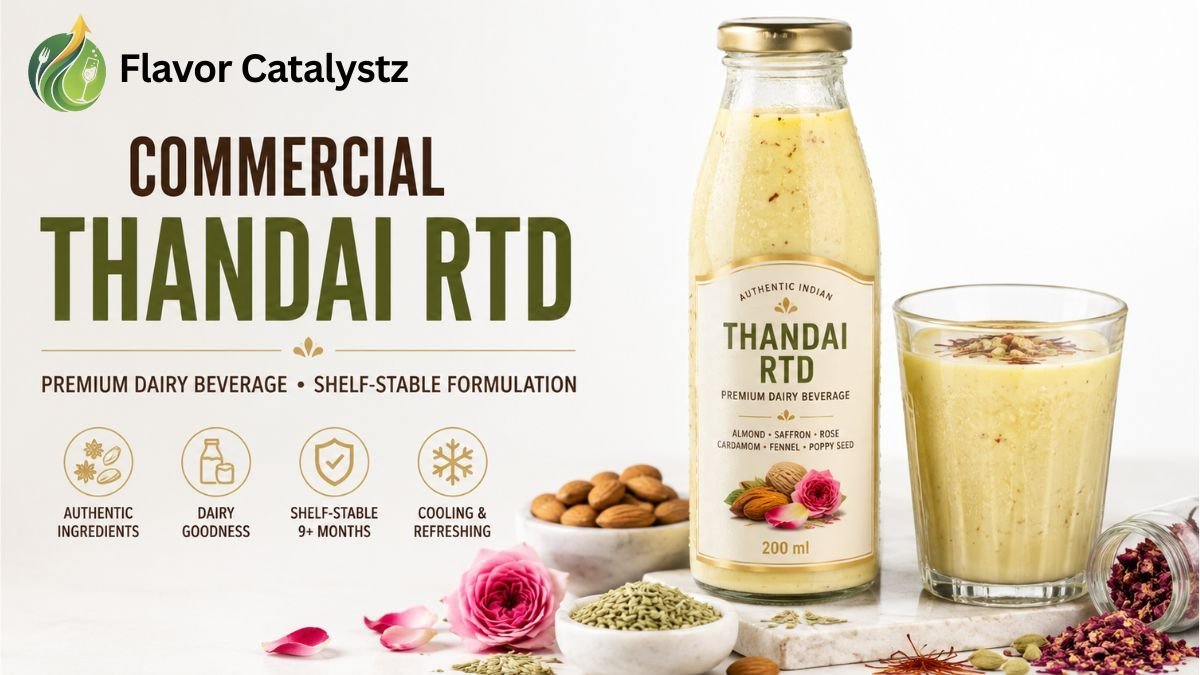
There is something frustrating about thandai from a commercial perspective. Every year during Holi and Mahashivratri, it is the single most searched, most made, and most consumed festive drink in India. And every year after the festival, it disappears from store shelves almost completely.
That seasonality is not a product problem — it is a brand strategy problem. Thandai has all the ingredients of a year-round premium RTD: a deeply layered spice-nut-floral flavor profile that no synthetic flavor can replicate, cultural authority that no new brand can invent from scratch, and a consumer base that is increasingly interested in premium dairy and functional beverages.
The opportunity to build a thandai brand that competes year-round — not just for two festive weeks — is real. This is our guide to making the formulation work.
Understanding Thandai: What Makes It a Formulation Challenge
Thandai is a spiced milk drink made with almonds, fennel seeds (saunf), poppy seeds (khas khas), rose petals, cardamom, black pepper, saffron, and sugar — traditionally blended to a smooth paste, strained, and mixed with chilled milk. The flavor profile is extraordinarily complex: simultaneously cooling (fennel, rose), warming (pepper, cardamom), nutty (almond), and floral (rose, saffron).
That complexity is what makes thandai exceptional — and what makes commercial formulation genuinely difficult:
- Nut-oil emulsification: Almond and poppy seed oils separate in a liquid medium unless precisely emulsified. Home thandai is consumed immediately; a commercial RTD must maintain stable emulsion for 9+ months.
- Heat-sensitive aromatics: Rose flavor compounds, saffron carotenoids, and cardamom volatiles degrade significantly at high processing temperatures. Standard UHT at 142°C destroys much of thandai’s authentic aroma.
- Color stability: Saffron gives thandai its characteristic golden hue, but saffron’s crocin pigments are pH-sensitive and degrade on exposure to light. Commercial packaging must account for this.
- Dairy protein stability: Thandai is milk-based, meaning the formulation must manage protein denaturation during heat processing and prevent age-gelation during extended storage.
- Natural vs. authentic flavour: Using synthetic rose or almond flavor is technically simpler but commercially damaging for a premium thandai brand. Consumers know what real thandai smells like. Any inauthenticity in the aroma shows immediately.
Thandai Brands in India: Where the Market Stands
The current commercial thandai landscape:
| Brand / Product | Format | Positioning | Gap This Creates |
| Haldiram Thandai | Powder / concentrate | Mass market, festival seasonal | No premium RTD; no year-round brand |
| Guruji Kesaria Thandai | Powder concentrate | Traditional, HoReCa focused | No glass-bottle RTD; no modern brand |
| Paper Boat Thandai | RTD Tetra Pak | Premium festival drink | No dairy-based; almond milk only; seasonal |
| Patanjali Thandai | Powder / syrup | Ayurvedic positioning | No RTD format; limited premium credentials |
| Amul / Mother Dairy | Flavoured milk (not thandai) | Mass dairy | No authentic thandai positioning |
What the market is missing: a year-round premium thandai RTD in glass bottle, made with real nuts and spices, positioned as a festive-everyday luxury dairy drink at ₹80–150 per unit. That product does not exist at scale today.
Thandai RTD Formulation: Solving the Technical Problems
Processing Technology: The Dual-Stage Approach
Standard UHT processing (142°C, 4 seconds) is essential for ambient shelf life but devastating to thandai’s delicate aromatics. The solution we use at Flavor Catalyst is a dual-stage processing approach:
- Stage 1 — Spice and Nut Processing: Almond paste, poppy seed paste, and stabilizer system are processed at 121°C (retort-equivalent) in a concentrated form. This step achieves microbiological safety for the heat-stable components.
- Stage 2 — Aroma Addition (Post-Heat): Rose water, saffron extract, and cardamom oleoresin are added aseptically after the heat treatment step — protecting the volatile aromatics from thermal degradation.
- Inline Homogenization: Two-stage homogenization at 200/50 bar after mixing ensures the nut-oil emulsion is stable at particle size ≤1 micron — essential for preventing cream-line formation during storage.
Emulsification System for Nut-Based Thandai
For a dairy-based thandai RTD, the emulsification system must handle both dairy fat and almond/poppy seed oils simultaneously. The system we recommend:
- Sunflower Lecithin: 0.3–0.5% — primary emulsifier; clean label, preferred over soy lecithin
- Carrageenan (Iota): 0.015–0.025% — dairy protein stabilizer; prevents age-gelation in UHT milk systems
- Microcrystalline Cellulose (MCC): 0.1–0.2% — suspension stabilizer for nut particles; prevents sedimentation without adding viscosity
Saffron Colour Stability
Saffron’s primary colour compound (crocin) is water-soluble but photo-sensitive — it bleaches rapidly under fluorescent light in clear glass bottles. For a glass-bottle premium thandai: use amber glass (filters 90%+ of UV-visible light that causes degradation) or add a small amount of Vitamin C (0.03–0.05%) as antioxidant. Alternatively, use microencapsulated saffron extract which provides better photo-stability than raw saffron infusion.
Commercial Thandai RTD Base Formula (Per 200ml bottle)
| Ingredient | Quantity | Purpose |
| Full-cream milk (standardized 3.5% fat) | 150–160 ml | Primary dairy base — calcium, protein, richness |
| Almond Paste (fine-ground) | 8–12 g | Nutty richness — must be homogenized |
| Poppy Seed Extract (standardized) | 1–2 g | Traditional thandai note |
| Fennel (Saunf) Oleoresin | 0.04–0.06 g | Cooling, aniseed character |
| Green Cardamom Oleoresin | 0.02–0.04 g | Warm spice note |
| Rose Water / Rose Extract | 3–5 ml | Floral identity — added post-heat |
| Saffron Extract (microencapsulated) | 0.002–0.005 g | Colour + authentic flavour identity |
| Sugar | 18–22 g | Sweetness; can partially substitute stevia |
| Sunflower Lecithin | 0.4–0.6 g | Emulsification |
| Carrageenan (Iota) | 0.02–0.03 g | Dairy protein stability |
| Black Pepper Extract (trace) | trace | Warm pungent finish — authentic thandai note |
Year-Round Thandai Brand Strategy: Beyond Festival Season
The biggest strategic mistake a thandai brand can make is positioning itself as a Holi drink. Festival positioning creates a two-week demand spike and eleven months of low velocity. Here’s how to build a year-round thandai brand:
- Occasion expansion: Thandai is naturally a hot-weather drink (its name means ‘cooling’ in Hindi). Position it as the premium Indian summer drink — same occasion as aam panna, shikanji, or kokum sharbat, but with a dairy-luxury dimension.
- Dessert drink positioning: Premium glass-bottle thandai at ₹100–150 works as an after-dinner dessert drink substitute — a positioning that has no season.
- Corporate gifting SKU: A 4-bottle premium thandai gift set at ₹500–800 is a natural fit for Diwali, Holi, and general corporate gifting — an entirely different commercial channel from FMCG retail.
- HoReCa concentrate: A 5x thandai concentrate for restaurant/bar use (as a mocktail base or dessert drink ingredient) generates B2B revenue year-round with high margins.
Also Read From Flavor Catalyst
- Traditional Drink Formulation India
- Non-Alcoholic Beverage Development India
- Beverage Formulation Cost India
- Functional Beverage Development India
- Beverage Contract Manufacturing India
- How to Start a Beverage Brand in India
↗ Haldiram Thandai — Reference Product
Conclusion: Thandai RTD Is a Category Waiting to Be Built Properly
The thandai commercial RTD opportunity is clear: there is a beloved Indian drink with a loyal consumer base, a premium-willing price sensitivity, and a market that currently has no credible year-round brand. The formulation is complex — but solvable. The regulatory path is straightforward. The channel opportunity is real.
If you want to build India’s first genuinely premium, year-round thandai RTD brand — Flavor Catalyst has formulated dairy-based functional beverages with nut and spice complexity at commercial scale. We can help you get this right.
Ready to Build Your Brand?
Beverage Formulation | Beverage Consultant | Free Consultation →
FAQs
1. What is commercial thandai RTD?
Commercial thandai RTD is a ready-to-drink shelf-stable version of traditional thandai sold in bottles or cartons.
2. Can thandai be sold year-round?
Yes, modern premium positioning allows thandai brands to sell beyond Holi and festive seasons.
3. What is the shelf life of thandai RTD?
A properly processed dairy-based thandai RTD can achieve 9–12 months shelf life.
4. Why is thandai formulation technically difficult?
Nut oils, dairy proteins, saffron stability, and spice aromatics require advanced stabilization and processing.
5. Which packaging works best for thandai RTD?
Amber glass bottles and premium Tetra Pak formats work best for premium positioning.
6. Does commercial thandai require FSSAI approval?
Yes, FSSAI compliance is mandatory for all commercial dairy beverages in India.
7. Can thandai be positioned as a functional beverage?
Yes, thandai is often marketed around cooling, indulgence, premium dairy nutrition, and traditional wellness.
8. What is the estimated cost to launch a thandai RTD brand?
A small commercial launch can typically require ₹8 lakh to ₹25 lakh depending on scale and processing.