Jun 2026 · 8 min read
India has a sugar problem — and consumers are beginning to know it. With diabetes affecting an estimated 100 million Indians (the highest number of any country in the world), and obesity rates rising steadily in urban populations, the awareness of sugar’s health impact has reached mainstream consumer consciousness in a way that is reshaping purchasing behaviour.
The result is a structural shift in what Indian consumers want from their beverages. Not just “healthier” — specifically, lower sugar or zero sugar. And this shift is creating one of the most commercially significant opportunities in the Indian beverage market right now.
This guide covers why the sugar-free beverage category is growing in India, what the actual consumer demand looks like, and the formulation challenges that determine which brands succeed in this space.
Planning a Sugar-Free Beverage Brand?
Creating a great sugar-free beverage is much more than replacing sugar. The right sweetener system, clean taste, mouthfeel, shelf stability, and FSSAI-compliant claims determine whether your product succeeds in the market. We help brands develop commercially viable zero and low-sugar beverages from concept to launch.
Why Sugar-Free Beverages Are Growing in India
The Diabetes and Metabolic Health Driver
India’s diabetes epidemic is not abstract — it affects families directly. A significant portion of urban Indian consumers has a diabetic parent, spouse, or sibling. This creates acute personal motivation to reduce sugar intake — and beverage sugar is the easiest and most visible target.
Beverages are the single largest source of added sugar in the Indian diet for many urban consumers. A 300ml can of cola contains 30–35g of sugar. A glass of commercial fruit juice: 25–30g. A sweetened chai: 10–15g. When a health-conscious consumer starts tracking sugar, beverages are the first thing they change.
The Fitness and Body Composition Driver
India’s gym and fitness culture has expanded dramatically. Consumers tracking calories, macros, and body composition are acutely aware of “liquid calories” from sweetened beverages. The fitness consumer wants zero or minimal sugar — not diet messaging, just genuinely low-calorie options that do not compromise flavour.
The Young Urban Consumer Shift
India’s urban millennials and Gen Z are the most health-aware consumer generation in Indian history. They grew up with Google, nutritional awareness content on YouTube and Instagram, and an expectation that products should be transparent about what is in them. High sugar is a red flag, not an acceptable tradeoff.
The Diabetic Consumer Market
Beyond health-conscious consumers, India’s 100 million diabetics represent a specific, underserved consumer segment actively seeking sugar-free beverage options. Most current sugar-free products in India use artificial sweeteners (aspartame, acesulfame K) that this consumer is increasingly sceptical of. A genuinely clean-label, naturally sweetened zero-sugar beverage for diabetics is a significant commercial gap.
The Sugar-Free Beverage Category in India: What Is Selling
Zero-sugar sparkling water: The fastest-growing sub-category. Plain or lightly flavoured carbonated water with no sweetener — nothing but carbonation and natural flavour. Growing in HoReCa, premium retail, and quick commerce. See our sparkling water brand formulation guide.
Diet and zero-calorie versions of existing brands: Coca-Cola Zero, Sprite Zero, Diet Pepsi — these demonstrate that the zero-sugar demand exists even in the mass market. But they use artificial sweeteners that a growing segment of Indian consumers is moving away from.
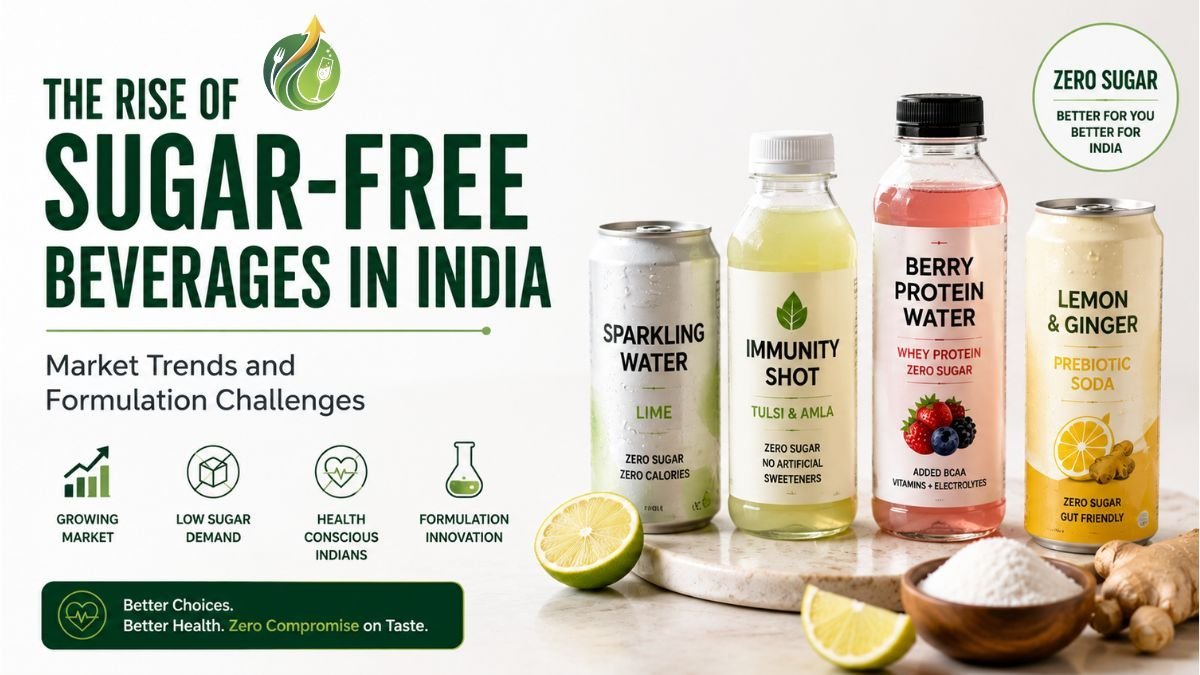
Naturally sweetened functional beverages: Stevia-sweetened immunity shots, monk fruit-sweetened protein waters, erythritol-based electrolyte drinks. Growing in D2C and health retail. See our immunity shot formulation and electrolyte powder sachet brand guides.
Low-sugar traditional Indian beverages: Reformulated shikanji, jaljeera, and aam panna with reduced sugar — leveraging India’s existing love for these flavours but repositioning for health-conscious consumers. See our low calorie beverages guide.
Sweetener Options for Sugar-Free Beverage Formulation
This is the technical heart of sugar-free beverage development. Choosing the right sweetener system determines both the flavour quality and the label claim you can make.
Stevia (Steviol Glycosides)
What it is: Natural high-intensity sweetener extracted from the Stevia rebaudiana plant. 200–300x sweeter than sucrose. Zero calories, zero glycaemic impact.
FSSAI status: Stevia is approved as a food additive in India (INS 960). Permitted in beverages within specified limits. Can be declared as “Stevia” on label — allowing “sweetened with stevia” marketing claims.
Flavour profile: The primary commercial challenge of stevia is its bitter, liquorice-like aftertaste — particularly at higher concentrations. Different steviol glycoside fractions have very different taste profiles:
- Stevioside: Most common, most bitter aftertaste
- Rebaudioside A (Reb A): Cleaner, less bitter — the industry standard for beverage use
- Rebaudioside M/D (Reb M, Reb D): Closest to sugar in taste profile, minimal aftertaste, significantly higher cost
Formulation approach: Use Reb A or Reb M at minimum effective concentration. Blend with a small amgnount of erythritol or sucrose (even 2–3g/serving) to round the flavour and reduce stevia intensity. Citrus and tropical flavour profiles mask stevia’s aftertaste better than subtle or floral flavours.
Erythritol
What it is: A sugar alcohol occurring naturally in certain fruits and fermented foods. 60–70% as sweet as sucrose. Near-zero calories (0.2 kcal/g), minimal glycaemic impact, and excellent digestive tolerance (unlike most other sugar alcohols which cause GI distress at high doses).
FSSAI status: Permitted food additive. Declare as “Erythritol” on label.
Flavour profile: Very clean, very similar to sugar with a slight cooling sensation. No bitter aftertaste. Excellent for beverages. The cooling sensation can be perceived at higher concentrations — typically not an issue in beverages at typical inclusion levels (3–6g per serving).
Best use: As a bulk sweetener in combination with stevia or monk fruit. Provides body and mouthfeel that high-intensity sweeteners alone cannot replicate.
Monk Fruit Extract (Luo Han Guo)
What it is: Natural high-intensity sweetener from monk fruit (Siraitia grosvenorii). The active compounds are mogrosides — 150–250x sweeter than sucrose. Zero calories, zero glycaemic impact.
FSSAI status: Requires verification of current FSSAI approved food additive status before commercial use — monk fruit’s regulatory status in Indian food products is still evolving.
Flavour profile: Slightly fruity, very clean, minimal aftertaste compared to stevia. Considered the premium natural high-intensity sweetener for beverage applications.
Allulose
What it is: A rare sugar occurring naturally in small amounts in some foods. 70% as sweet as sucrose but with only 0.2 kcal/g. Does not raise blood glucose. Functions like sugar in solution — providing body, mouthfeel, and Maillard browning.
FSSAI status: Regulatory status in India requires verification. Check current FSSAI novel food or additive status before commercial use.
Blended Sweetener Systems
The most commercially successful sugar-free beverages use blended sweetener systems — combining 2–3 sweeteners to achieve a flavour profile closer to sugar than any single sweetener can achieve.
Example system:
- Reb A (stevia): 0.015g/100ml — primary high-intensity sweetener
- Erythritol: 3–4g/100ml — body, mouthfeel, flavour rounding
- Citric acid: to pH 3.5 — the sour balance that makes sweeteners taste more natural
This combination is the workhorse of the natural sugar-free beverage industry globally.
The Formulation Challenges of Sugar-Free Beverages
Beyond sweetener selection, sugar-free beverages face additional formulation challenges that founders must address:
Mouthfeel and Body
Sugar does more than sweeten — it adds viscosity, body, and mouthfeel. A sugar-free beverage made by simply removing sugar and adding high-intensity sweetener typically feels “thin” and watery. Compensate with:
- Gum arabic or gum acacia at 0.1–0.3%
- Pectin at low levels
- Erythritol as a bulk sweetener
Flavour Carrier
Sugar is also an excellent flavour carrier — it enhances and prolongs flavour perception on the palate. Without it, flavours can seem flatter and less persistent. Compensate with:
- Slightly higher natural flavour inclusion (0.1–0.2% above standard level)
- Flavour modifiers (masking agents and taste modifiers available from flavour houses)
FSSAI Claim Compliance
Sugar-free and low-sugar claims have specific regulatory definitions under FSSAI:
- “Sugar-free”: Maximum 0.5g sugars per 100ml
- “Low sugar”: Maximum 2.5g sugars per 100ml for beverages
- “No added sugar”: No sugar or sugar-containing ingredient has been added — naturally occurring sugars may still be present
Ensure your formulation genuinely meets the declared claim threshold — verified by third-party lab analysis. See our FSSAI health claims guide for complete claim compliance requirements.
Ready to Launch a Commercial Sugar-Free Beverage?
From sweetener selection and flavour optimisation to beverage formulation, shelf-life validation, FSSAI compliance, packaging, and commercial manufacturing, Flavor Catalystz helps founders develop sugar-free and low-sugar beverages that consumers love and businesses can scale.
FAQs
Why are sugar-free beverages growing in India?
India’s 100 million diabetics, rising obesity rates, growing fitness culture, and health-aware millennial consumers are all driving a structural shift toward lower sugar beverage consumption. Beverages are the most visible and easiest source of sugar to reduce.
What natural sweeteners are approved for beverages in India?
Stevia (steviol glycosides, INS 960) is clearly approved by FSSAI. Erythritol is a permitted food additive. Monk fruit and allulose require verification of current FSSAI status before commercial use.
What is the biggest formulation challenge in sugar-free beverages?
Taste — specifically, replicating the flavour profile, mouthfeel, and body that sugar provides. Blended sweetener systems (Reb A + erythritol + acid) combined with natural flavour optimisation are the most effective commercial approach.
Can I claim “sugar-free” on my beverage label in India?
Yes — if your product contains less than 0.5g of total sugars per 100ml, verified by lab analysis. The claim must be supported by your nutritional information panel declaration.
Is stevia safe and FSSAI approved?
Yes — stevia (steviol glycosides) is FSSAI-approved as a food additive (INS 960) with specified maximum usage levels for different food and beverage categories.