May 2026 · 13 min read
India’s functional beverage market is exploding. Health-conscious millennials, gym-goers, and urban professionals are no longer satisfied with plain water or sugar-loaded sports drinks. They want something smarter — and sparkling protein water is emerging as the perfect answer. Low-calorie, refreshing, protein-packed, and visually appealing, sparkling protein water formulation is now one of the hottest product development opportunities for beverage startups and FMCG brands across India.
This guide is your complete, research-backed blueprint to understand, formulate, and commercialize a sparkling protein water — from ingredient selection to manufacturing, regulatory compliance, and market positioning in India.
What Is Sparkling Protein Water and Why Is It Trending in India?
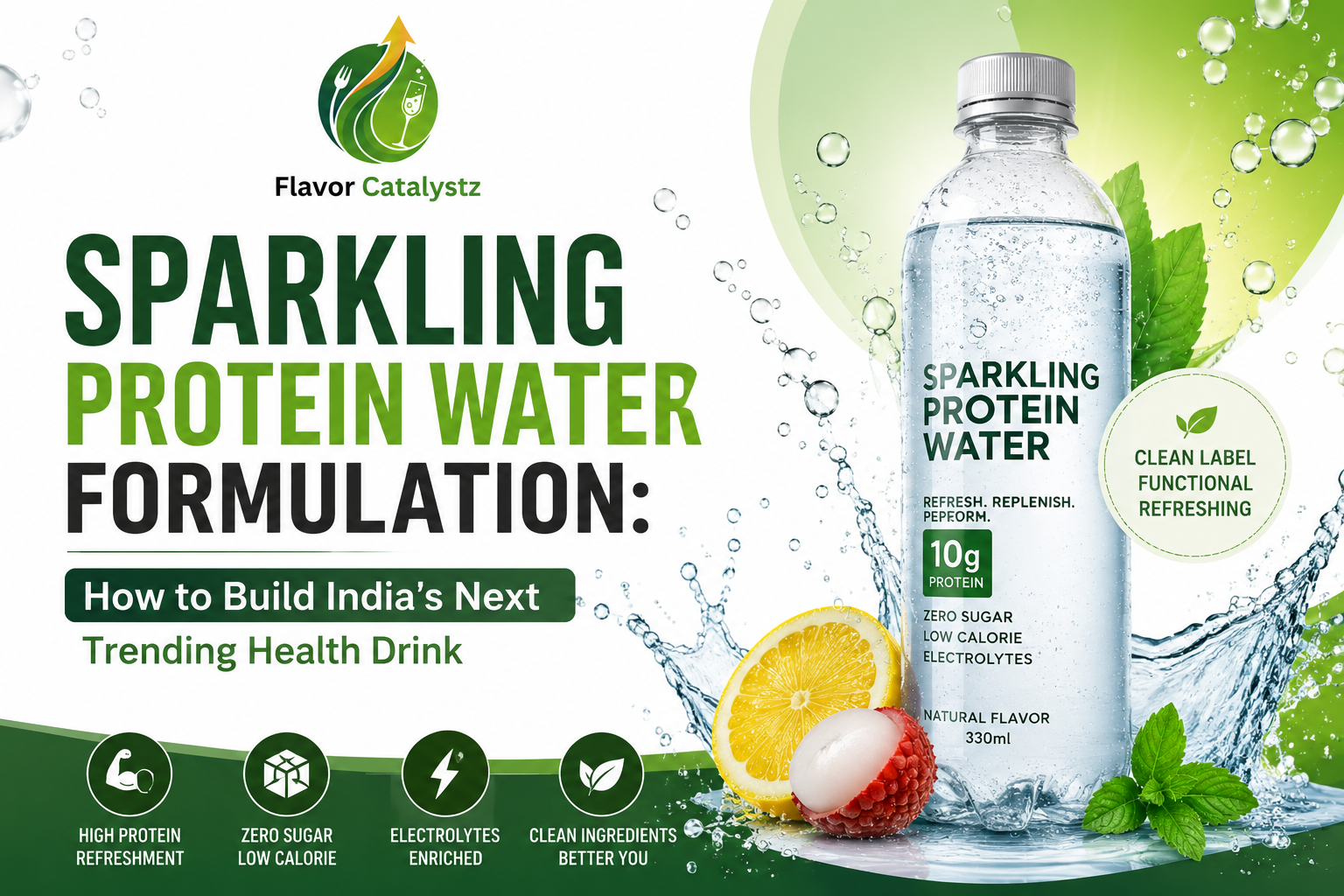
Sparkling protein water is a carbonated functional beverage that combines the refreshing mouthfeel of sparkling water with a meaningful dose of protein — typically 10g to 20g per serving — without the sugar, fat, or calories associated with traditional protein shakes.
Unlike RTD protein shakes that are thick and heavy, sparkling protein water is light, clear (in most formulations), and designed for on-the-go consumption. It bridges the gap between hydration and nutrition — making it ideal for India’s fast-paced, health-first consumer.
Why the Market Is Ready Now
- India’s protein supplement market is projected to cross ₹3,500 crore by 2027.
- Post-pandemic health awareness has driven a 40%+ surge in functional beverage consumption.
- Urban India’s 25-40 age group actively seeks ‘clean label’ and low-calorie nutrition options.
- Carbonated drinks are already a cultural norm in India — adding protein is a natural evolution.
- International brands like BodyArmor, Protein2o, and Sparkling Ice+Protein have already validated global demand.
Market Insight: India has no dominant domestic brand in sparkling protein water yet — this is a first-mover opportunity for smart formulators and beverage startups.
Understanding Sparkling Protein Water Formulation: The Core Science
The biggest challenge in sparkling protein water formulation is not the protein — it’s the stability. Proteins are notoriously difficult to keep soluble and clear in a carbonated, low-pH environment. This is why formulation expertise is not optional; it is everything.
The Core Formulation Challenge
When you add protein to acidic carbonated water, several problems arise simultaneously:
- Protein denaturation at low pH (carbonation naturally drives pH to 3.5–4.5).
- Cloudiness or haze formation — which kills the ‘clear water’ aesthetic.
- Sedimentation and phase separation during shelf storage.
- Unpleasant aftertaste, especially with plant-based proteins.
- Foaming problems during filling and capping at the manufacturing level.
Solving all five of these simultaneously is what makes sparkling protein water formulation both an art and a science. Let’s break down each component of the formula.
Helpful Guide:- Energy Drink Formulation: The Complete Guide to Crafting a Market-Ready Beverage
What Protein Works Best in Sparkling Drinks? A Deep-Dive Comparison
Not all proteins are created equal when it comes to carbonated beverages. Your protein choice is the single most impactful decision in the entire formulation process.
| Protein Type | Clarity | Acid Stability | Taste Profile | Best Use Case |
| Whey Protein Isolate (WPI) | High | Moderate | Mild, clean | Premium clear sparkling protein water |
| Hydrolyzed Whey (WPH) | Very High | High | Slightly bitter | Ultra-clear, fast-absorb formulas |
| Collagen Peptides | Very High | Very High | Neutral | Beauty & wellness sparkling water |
| Pea Protein Isolate | Moderate | Low | Earthy, grainy | Vegan variants (needs masking agents) |
| Soy Protein Isolate | Moderate | Low–Moderate | Beany | Budget vegan options |
| Rice Protein | Low | Low | Bland, chalky | Blend partner, not standalone |
Expert Recommendation: For India’s premium sparkling protein water market, Whey Protein Isolate (WPI) at 90%+ purity or Hydrolyzed Whey Protein (WPH) are the gold standards. For vegan positioning, a collagen-free pea + rice protein blend (70:30 ratio) with a flavour masking system is the best viable option.
Step-by-Step: How to Formulate Sparkling Protein Water
Here is a professional-grade sparkling protein water formula structure used in commercial beverage product development. Each stage must be precisely controlled.
Stage 1: Protein Solubilisation
Start by dissolving your protein in a small volume of purified water (RO/DI grade) at a temperature between 20–25°C. Avoid heat — protein denatures above 45°C, which ruins clarity. Use a high-shear mixer or homogeniser to fully hydrate the protein before adding any other ingredient. Use protein in the range of 10g–20g per 500ml serving (2–4% w/v concentration).
Stage 2: Acidification and pH Control
This is the most critical step. Carbonic acid from CO₂ already drops your water pH to ~3.8–4.2. You need to pre-acidify your base with a food-grade acid blend to match the final carbonated pH. Recommended acids: citric acid (primary), malic acid (roundness), lactic acid (smooth mouthfeel). Target final product pH: 3.5–4.2. Never exceed pH 4.5, as microbial risk increases. Never go below 3.0, as protein precipitation accelerates.
Stage 3: Stabiliser and Emulsifier System
To prevent sedimentation and haze, you need a carefully selected stabiliser system. Recommended functional ingredients:
- Modified Food Starch (OSA-starch): 0.1–0.3% — improves protein suspension.
- Pectin (LM-Pectin): 0.05–0.1% — excellent protein protection in acidic environments.
- Gum Arabic: 0.05–0.15% — natural, label-friendly emulsifier.
- Sodium Hexametaphosphate (SHMP): 0.02–0.05% — chelates minerals, prevents cloud formation.
Stage 4: Sweetener and Taste Optimisation
Sparkling protein water must be low-calorie. Avoid sugar entirely or keep below 2g per 100ml. Recommended sweetener system for India market:
- Stevia (Rebaudioside-A, RA-97): 0.02–0.05% — natural, FSSAI approved, no after-taste at correct dose.
- Erythritol: 1–3% — provides mouthfeel and masks protein bitterness.
- Sucralose: 0.003–0.008% — for extended sweetness tail.
Flavour system: Use natural fruit flavours in the 0.1–0.3% range. Best-performing flavour profiles for India: Lemon-Mint, Watermelon, Mango-Ginger, Litchi, Green Apple. Always use heat-stable, acid-stable flavour compounds rated for pH below 4.0.
Stage 5: Micronutrient Stack (Optional but High Value)
Adding a functional micronutrient stack dramatically increases your product’s perceived value and retail positioning:
- Vitamin C (Ascorbic Acid): 40–80mg per serving — antioxidant + natural preservative.
- Electrolytes (Sodium, Potassium, Magnesium): Full hydration claim support.
- B-Vitamins (B3, B6, B12): Energy metabolism support — popular with gym consumers.
- Zinc: Immune support angle, premium positioning.
Stage 6: Carbonation
Carbonation is added post-formulation during the filling process. Target CO₂ volume: 2.5–3.5 volumes for a refreshing but not aggressive sparkle. Over-carbonation worsens protein foaming. Use in-line carbonation with a Carboblend or Carbojet system. Fill at cold temperatures (2–4°C) to maintain CO₂ retention.
Stage 7: Preservation and Shelf Life
Sparkling protein water’s low pH is a natural preservative. For added safety and 12–18 month shelf life:
- Potassium Sorbate: 0.02–0.05% — yeast and mould inhibitor.
- Sodium Benzoate: 0.01–0.03% (use with caution — avoid combining with Vitamin C above pH 4.0 to prevent benzene formation).
- Alternative clean-label approach: Use rosemary extract or green tea extract as natural preservatives for premium positioning.
Pro Tip: Always run Accelerated Shelf Life Testing (ASLT) at 37°C and 45°C for 90 days to predict 12-month stability before market launch.
Helpful Guide:- Beverage Consultant India — End-to-End Drink Development by Flavor Catalystz
Is Sparkling Protein Water Healthy? Nutritional Profile Breakdown
This is one of the most searched questions by Indian consumers before purchase. Here’s what a well-formulated sparkling protein water should deliver per 500ml serving:
| Nutrient | Per 500ml Serving | % Daily Value (Approx.) |
| Calories | 60–90 kcal | 3–5% |
| Protein | 15–20g | 30–40% |
| Total Sugar | 0–3g | <1% |
| Total Fat | 0g | 0% |
| Sodium | 80–120mg | 4–6% |
| Potassium | 150–200mg | 4–5% |
| Vitamin C | 60mg | 100% |
Compared to a traditional whey protein shake (typically 150–300 calories, 5–15g fat), sparkling protein water offers a dramatically cleaner nutritional profile — making it genuinely suitable for weight management, post-workout recovery, and between-meal protein supplementation.
Clinical note: Whey and hydrolyzed protein sources are among the most bioavailable proteins available, with a PDCAAS (Protein Digestibility-Corrected Amino Acid Score) of 1.0 — the maximum score. This means the protein in your sparkling water is as effective as food protein for muscle synthesis.
FSSAI Regulatory Compliance for Sparkling Protein Water in India
Before you launch any functional beverage in India, you must meet FSSAI (Food Safety and Standards Authority of India) compliance requirements. Here is what applies specifically to sparkling protein water:
Product Category Classification
Sparkling protein water falls under: FSS (Food Products Standards and Food Additives) Regulations — Category 14.1.4 (Flavoured Water) combined with protein supplement regulations. Always consult a regulatory expert to determine the correct subcategory based on your protein dosage and health claims.
Key Regulatory Requirements
- FSSAI Central License mandatory if manufacturing and distributing across states.
- All ingredients must appear on the FSSAI approved additives list (Schedule I, II, III of FSS Regulations).
- Protein content must be declared per 100ml AND per serving on the label.
- Health claims (e.g., ‘builds muscle’, ‘supports recovery’) require scientific substantiation under FSSAI Health Claim Regulations 2018.
- Carbonated beverages require BIS (Bureau of Indian Standards) IS 2346 compliance for CO₂ purity.
- Label must include: Nutritional Information Table, Ingredient List, Allergen Declaration (especially whey = milk derivative), Best Before Date, Batch Number, and Manufacturer Details.
Important: Never use ‘high protein’ on your label unless you can substantiate a minimum of 12g of protein per 100g (or per standard serving as per FSSAI guidelines). Violations attract heavy penalties under FSS Act 2006.
Sparkling Protein Water Manufacturing in India: What You Need to Know
Whether you’re a startup looking for a contract manufacturer or an established brand setting up your own plant, understanding the manufacturing requirements for sparkling protein water is essential.
Manufacturing Infrastructure Requirements
- Carbonated Beverage Filling Line: Counter-pressure fillers rated for 3.0+ CO₂ volumes.
- CIP (Clean-in-Place) System: Mandatory for protein-based beverages to prevent biofilm buildup.
- Cold Room Storage: Finished goods and raw protein storage at 2–8°C recommended.
- High-Shear Mixing/Homogenisation: Required for protein hydration stage.
- Water Treatment Plant: Minimum RO + UV + Ozonation for base water quality.
- Quality Control Lab: In-house pH testing, Brix measurement, microbial testing, and protein content verification via Kjeldahl or DUMAS method.
Contract Manufacturing Route for Startups
If you’re a startup without capital for a full plant, India has a growing network of FSSAI-licensed beverage contract manufacturers in Pune, Haridwar, Surat, Bengaluru, and the Delhi NCR region who can handle sparkling protein water on a toll-manufacturing basis. Minimum order quantities typically range from 5,000 to 20,000 units per SKU. Work with a beverage formulation consultant to prepare your Master Formula Document (MFD) and SOP set before approaching any contract manufacturer.
Market Positioning and Launch Strategy for India
A great formula means nothing without a winning go-to-market strategy. Here’s how to position a sparkling protein water brand in India’s competitive beverage landscape:
Target Consumer Segments
- Urban gym-goers and fitness enthusiasts (Primary) — looking for clean post-workout recovery.
- Corporate professionals — want a smart alternative to regular water or soda at the desk.
- Weight-watchers and keto/intermittent-fasting followers — love the zero-sugar, high-protein profile.
- Health-conscious women 25–38 years — especially for collagen-based sparkling water variants.
Packaging Recommendations
- Format: 350ml slim aluminum can (premium, recyclable) or 500ml PET bottle.
- Design: Minimalist, clean, transparent label to show ‘water clarity’ — builds trust.
- Flavour Range at Launch: Start with 3 SKUs — Lemon, Watermelon, and Mango-Ginger.
Pricing Strategy
- Mass market: ₹60–₹90 per 500ml (compete with Gatorade, Sting).
- Premium: ₹120–₹180 per 500ml (compete with international imports, sell through gyms, D2C).
- Ultra-premium: ₹200+ (collagen + protein + micronutrients, boutique gyms and online channels).
Distribution Channels
- D2C Website + Amazon/Flipkart (fastest to market, highest margin).
- Modern Trade: Big Bazaar, Reliance Smart, DMart (requires 6–12 month runway for listing).
- Gym Retail & Supplement Stores: High-trust environment for protein products.
- Quick Commerce: Blinkit, Swiggy Instamart, Zepto (ideal for impulse purchase, urban markets).
Cost of Formulation and Product Development: What to Budget
For startups and brands asking about sparkling protein water product development services in India, here is a realistic cost framework:
| Development Stage | Estimated Cost (INR) | Timeline |
| Formulation Development (R&D) | ₹1.5L – ₹4L | 4–8 weeks |
| Stability Testing (ASLT) | ₹80K – ₹1.5L | 8–12 weeks |
| FSSAI Lab Testing & Compliance | ₹50K – ₹1.2L | 4–6 weeks |
| Packaging Design & Prototyping | ₹1L – ₹3L | 2–4 weeks |
| First Production Run (5K units) | ₹3L – ₹6L | 3–5 weeks |
| Total MVP Launch Budget | ₹8L – ₹16L | 5–6 months |
Working with an experienced beverage formulation consultant from day one can save you 30–50% of these costs by avoiding reformulation cycles, regulatory rejections, and manufacturing errors.
>Helpful Guide:- Beverage Formulation Cost India: Complete 2026 Guide
Conclusion: Your Next Step Toward Building India’s Best Sparkling Protein Water Brand
Sparkling protein water is not a fad — it is a structural shift in how India’s health-conscious consumer thinks about hydration and nutrition. The global market has validated the concept, the Indian consumer is primed and ready, and the domestic competitive landscape is still wide open for a bold, well-formulated brand to own.
But the path from idea to shelf is technical, regulatory, and strategically demanding. The formulation science must be precise. The ingredients must be carefully selected for stability in carbonated, acidic environments. The FSSAI compliance must be airtight. And the brand positioning must resonate with India’s rapidly evolving health-first consumer.
Whether you are a startup founder, a beverage investor, or an established FMCG brand looking to add a functional beverage line — the time to act on sparkling protein water formulation in India is now.
Frequently Asked Questions (FAQs)
Q: How do I formulate sparkling protein water without cloudiness or precipitation?
A: Use hydrolyzed whey protein (WPH) instead of standard WPI for better acid stability, pre-acidify your base to match the carbonated pH (3.5–4.2), and incorporate a stabiliser system of LM-Pectin + Gum Arabic at 0.05–0.15% each. Always homogenise protein completely before adding acids or carbonation.
Q: Is sparkling protein water healthy for daily consumption?
A: Yes, when properly formulated. A 500ml serving with 15–20g of high-quality whey or hydrolyzed protein, zero sugar, and added electrolytes is an excellent source of daily protein with no excess calories. It’s suitable for post-workout recovery, between-meal nutrition, and hydration support. Individuals with dairy allergies should choose plant-based protein variants.
Q: What protein works best in sparkling drinks?
A: Hydrolyzed Whey Protein (WPH) is the best option for maximum clarity and acid stability. Standard Whey Protein Isolate (WPI) at 90%+ purity is a close second. Collagen peptides are ideal for beauty-wellness positioning. For vegan products, a 70:30 Pea-Rice protein blend with a flavour masking system is currently the most commercially viable plant-based option.
Q: What is the shelf life of sparkling protein water and how to extend it?
A: Well-formulated sparkling protein water in hermetically sealed cans or bottles achieves a shelf life of 12–18 months at ambient temperature. To maximise shelf life: maintain pH below 4.2, use approved preservatives (potassium sorbate + sodium benzoate), avoid headspace oxygen by using nitrogen flushing, and ensure hot-fill or cold-fill aseptic packaging as per your product’s heat sensitivity.
Q: Do I need FSSAI approval before selling sparkling protein water in India?
A: Yes, absolutely. You need an FSSAI Central License to manufacture and distribute across India. Your product label must comply with FSS (Labelling and Display) Regulations 2020, including full nutritional information, allergen declaration, and proper category classification. All health claims must be scientifically substantiated and FSSAI-compliant.
Q: What is the minimum order quantity for sparkling protein water contract manufacturing in India?
A: Most FSSAI-licensed contract beverage manufacturers in India have a minimum order quantity (MOQ) of 5,000 to 20,000 units per SKU per run. Some boutique manufacturers specialising in functional beverages may accept 3,000-unit pilot runs for startups. Always ensure the contract manufacturer has prior experience with protein-based carbonated beverages, as standard soda manufacturers may not have the necessary CIP and protein handling protocols.
Q: How much does it cost to develop a sparkling protein water brand from scratch in India?
A: An end-to-end MVP launch — covering formulation development, stability testing, FSSAI compliance, packaging design, and a first production run of ~5,000 units — typically requires ₹8 lakh to ₹16 lakh. This can be optimised by working with a specialist beverage formulation consultant who prevents costly reformulation cycles and regulatory errors. Full brand launch with marketing and distribution support would require a total investment of ₹25 lakh to ₹75 lakh depending on market ambition.
Q: Which flavours work best for sparkling protein water in the Indian market?
A: Based on Indian consumer preference research and global beverage trends adapted for India, the top-performing flavour profiles are: Lemon-Mint (fresh, universal appeal), Watermelon (summer favourite, high impulse purchase), Mango-Ginger (uniquely Indian, premium positioning), Litchi (north India favourite), and Green Apple (modern, health-associated). Always use acid-stable, heat-stable natural flavour compounds rated for pH below 4.0 to maintain flavour integrity throughout shelf life.