May 2026 · 15 min read
Every week I speak with beverage founders who use “soda water” and “sparkling water” as if they mean the same thing. They do not. And that distinction — which sounds trivial on the surface — has real consequences for how a product tastes, how it behaves in a formula, what claims you can make on the label, and which consumer it ultimately appeals to.
This guide covers everything: what soda water and sparkling water actually are, how they differ chemically and sensorially, what the health evidence says, and what beverage brands building with carbonated water bases need to understand before they start formulating.
What Is Soda Water?
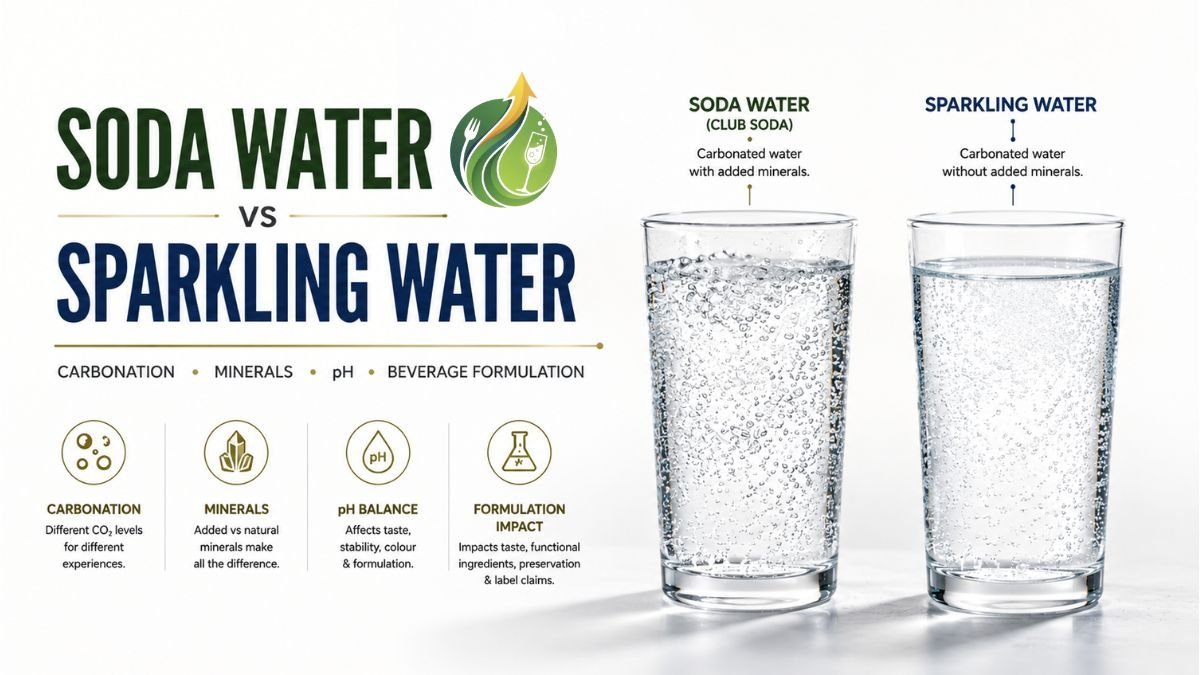
Soda water — also called club soda — is artificially carbonated water to which mineral salts have been added during the production process. The defining characteristic is not just the carbonation: it is the deliberate addition of dissolved minerals that gives soda water its distinctive taste and functional properties.
The minerals typically added to soda water include:
Sodium bicarbonate (baking soda) — The primary additive that gives soda water its slightly alkaline character and its name. It also acts as a buffer, softening the perceived acidity of the CO2 dissolution.
Sodium chloride (table salt) — Added at low levels to enhance perceived taste and round out the mineral profile.
Potassium sulphate or potassium bicarbonate — Added in some formulations to add a mild mineral complexity and to balance the sodium content.
Disodium phosphate — Less common but used in some commercial club sodas to prevent acidity.
The result is a water with a slightly salty, mineral character and a crisp, sharp effervescence. The carbonation in soda water is typically at the higher end of the CO2 volume range — usually 4.0 to 5.5 volumes of CO2 — which contributes to the aggressive, lively fizz that makes it the mixer of choice in the bar and cocktail industry.
Soda water formula: Soda water does not have one fixed chemical formula — it is a blend of carbonated water with dissolved salts. The formula varies by manufacturer and region. When people refer to the “soda water formula,” they typically mean the carbonation level combined with the specific mineral salt additions that define the product’s taste profile.
What Is Sparkling Water?
Sparkling water is water that contains dissolved carbon dioxide — either naturally occurring (from a mineral spring) or artificially added — without the deliberate addition of mineral salts. It is the purer, simpler product.
Naturally sparkling water (like Perrier or San Pellegrino) emerges from underground springs already containing dissolved CO2 and natural minerals from the geological environment through which the water has passed. The mineral content varies significantly from source to source and is determined by the rock composition the water has filtered through — not by a manufacturing decision. This natural mineral content is what gives different naturally sparkling waters their distinctive taste identities.
Artificially carbonated sparkling water is purified water to which CO2 has been added under pressure. When no mineral salts are added, this produces a clean, neutral-tasting sparkling water. When natural mineral content is added back (to replicate a specific spring water profile) or when flavours are added, this produces flavoured sparkling water or mineral water products.
The carbonation level in sparkling water varies more widely than in soda water — from light (2.5 volumes CO2) to highly sparkling (4.5+ volumes) — and the softer, cleaner taste is its primary consumer appeal.
Soda Water vs Sparkling Water: The Key Differences
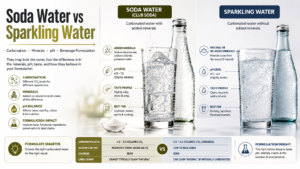
| Property | Soda Water (Club Soda) | Sparkling Water |
| Carbonation source | Artificial (CO2 injection) | Natural (spring) or artificial |
| Added minerals | Yes — sodium bicarbonate, NaCl, potassium salts | No added minerals (natural minerals vary by source) |
| Taste profile | Slightly salty, sharp, crisp | Clean, neutral to subtly mineral |
| pH | Slightly alkaline (due to bicarbonate) — typically 6.5–7.5 | Slightly acidic (CO2 dissolved = carbonic acid) — typically 4.5–6.0 |
| Carbonation level | Higher — 4.0 to 5.5 volumes CO2 | Variable — 2.5 to 4.5 volumes CO2 |
| Best application | Cocktail mixer, spirit base, cooking | Drinking water, flavoured water base, health positioning |
| Calorie content | Zero | Zero |
| Sodium content | Moderate — from added salts | Low to negligible (except high-mineral natural sources) |
| Label claims | Cannot typically claim “natural” | Can claim “natural” if naturally carbonated |
How pH Differs — And Why It Matters
This is the most technically important difference between the two, and the one most commonly misunderstood.
When CO2 dissolves in water, it forms carbonic acid (H₂CO₃) — a weak acid that drops the pH of the water below 7.0. Pure sparkling water typically sits between pH 4.5 and 6.0 depending on carbonation level. This mild acidity is what gives sparkling water its characteristic “bite” — the slightly sharp sensation on the palate.
Soda water, by contrast, contains sodium bicarbonate — an alkaline salt that buffers the pH upward. Despite being carbonated, soda water often sits closer to pH 6.5–7.5, which is near neutral or mildly alkaline. This buffering effect softens the perceived acidity and gives soda water a rounder, less sharp taste than pure sparkling water at equivalent carbonation levels.
For beverage formulation, this pH difference is significant:
- A formula diluted with sparkling water will be more acidic than the same formula diluted with soda water
- pH-sensitive natural colours (anthocyanins, red cabbage extract) will appear differently in soda water vs sparkling water
- A product’s preservation system calibrated for one base water may need adjustment for the other
- The final label’s nutritional panel will show different sodium content depending on which base is used
Taste: What Actually Tastes Different and Why
In a blind tasting, soda water and sparkling water are distinctly different — even to an untrained palate. Here is what drives each sensory experience:
Soda water has a sharper initial effervescence, a subtle salty-mineral finish, and a slightly rounder mouthfeel from the bicarbonate. The sodium content (typically 25–75mg per 250ml) is enough to be perceptible as a mild saltiness, especially after the carbonation subsides. Bartenders prefer soda water precisely because this mineral character integrates with spirits in a way that neutral sparkling water does not.
Sparkling water has a cleaner attack — the carbonation is often lighter, the mouthfeel is thinner, and the finish is neutral or very subtly mineral depending on the source. Its neutrality is its appeal: it enhances thirst quenching without adding any competitive flavour note.
For a beverage brand, choosing which base to use is not a trivial decision. A sparkling lemon drink made with soda water will taste rounder and slightly less tart than one made with sparkling water at the same formulation. A sparkling health drink making “natural” claims cannot use soda water as a base without complicating that claim.
Which Is Healthier: Sparkling Water or Soda Water?
This is the most commonly searched question on this topic, and the honest answer is: neither is unhealthy, and the difference between them from a health standpoint is minimal for most people.
For general hydration: Both hydrate as effectively as still water. The long-standing concern that carbonated water dehydrates you or leaches calcium from bones is not supported by current evidence. Studies on carbonated water and bone density have found no significant effect from sparkling or soda water consumption — the concern was primarily about cola drinks, where phosphoric acid is the relevant variable, not carbonation itself.
For dental health: Both soda water and sparkling water are mildly erosive to tooth enamel — more so than still water, less so than fruit juices or cola drinks. Sparkling water is slightly more acidic (lower pH) than soda water, so in strict theoretical terms, it has marginally greater erosion potential. However, the practical difference is negligible at typical consumption levels. The dental risk of carbonated water is significantly lower than that of sweetened carbonated beverages.
For digestive comfort: Some people find that carbonated water helps with mild indigestion or fullness — this is the basis for the traditional recommendation of soda water for upset stomach. The bicarbonate in soda water specifically may help neutralise mild acidity in the stomach, which is why this recommendation has some clinical basis. Plain sparkling water does not contain bicarbonate and therefore does not have this effect.
For sodium intake: People on sodium-restricted diets (hypertension, kidney conditions) should be aware that soda water contains added sodium from the mineral salts. At typical consumption levels (250–500ml per day) the sodium contribution is not large, but it is not zero. Sparkling water is effectively sodium-free (unless it is a high-mineral natural sparkling water from a sodium-rich source).
Can sparkling water reduce bloating? Carbonated water can temporarily worsen bloating in people who are sensitive to gas — the dissolved CO2 releases in the stomach and intestines, adding gas load. For some people with IBS or functional digestive issues, carbonated water makes bloating worse. For others, the mild bicarbonate in soda water can ease discomfort. Individual response varies significantly.
Does sparkling water lower blood glucose? There is no credible clinical evidence that drinking sparkling water — plain, unflavoured — has any meaningful effect on blood glucose levels. This claim circulates online but is not supported by the scientific literature.
Soda Water vs Sparkling Water for Beverage Formulation
For beverage brands, the choice between soda water and sparkling water as a base ingredient is a formulation decision with commercial, sensory, and regulatory implications.
When to use sparkling water as your base:
- You are building a natural, clean-label beverage
- You want to make “natural mineral water” or “naturally sparkling” claims
- Your flavour system is delicate and you do not want the mineral character of soda water competing
- You are targeting health-conscious consumers who read ingredient lists carefully — “sparkling water” on an ingredient list reads cleaner than “carbonated water with added minerals”
- You are building a flavoured sparkling water, prebiotic soda, or functional water where the water character should be neutral
When soda water character is appropriate:
- You are building a mixer or cocktail-adjacent product where the mineral character adds to the experience
- You are building a product where the bicarbonate buffering helps manage pH without using added citric acid
- You are targeting the bar and HoReCa channel where soda water is the established format
Carbonation level decisions: Whether you use a sparkling water or soda water base, the CO2 volume you target in your final product is a separate formulation decision. Most functional RTD sparkling beverages target 2.5–3.5 volumes CO2 — lighter than traditional soda water, refreshing but not aggressive. Energy drinks and carbonated sodas typically target 3.5–4.5 volumes. The carbonation level affects mouthfeel, the delivery of flavour on the palate, and — practically — the packaging pressure requirements.
For a deeper dive into how carbonated beverage formulation works from an ingredient and processing standpoint, our guide on carbonated drinks formulation covers the technical process in detail.
If you are developing a sparkling beverage brand — whether a prebiotic soda, functional sparkling water, or a carbonated traditional Indian drink — our sparkling beverage development guide covers the formulation and commercial launch process specifically for this format.
Soda Water vs Club Soda vs Tonic Water vs Sparkling Water: The Full Comparison
Since this question comes up regularly, here is the complete picture:
Soda water = club soda. These are the same product — carbonated water with added mineral salts. The two names are used interchangeably in most markets.
Tonic water is a completely different product. It contains quinine (from cinchona bark), which gives it a distinctive bitter taste, and is typically sweetened with sugar or high-fructose corn syrup. It has significant calorie content. It is not a health drink or a neutral mixer — it is a flavoured, sweetened, bitter carbonated beverage. Tonic water also contains significantly more sodium and other compounds than soda or sparkling water.
Sparkling mineral water is naturally carbonated water from a specific spring source, with its mineral content determined by the geological source rather than by manufacturing addition. It is the premium end of the sparkling water category.
Flavoured sparkling water is sparkling water (artificially carbonated, purified water) with natural or artificial flavours added. It is calorie-free or near calorie-free depending on whether sweeteners are added.
Seltzer (common in the US market) is plain carbonated water with no added minerals — essentially the same as artificially carbonated sparkling water with no mineral additions.
How Soda Water and Sparkling Water Are Made: The Production Process
Soda water production:
- Source water is purified through reverse osmosis or multi-stage filtration
- Mineral salts (sodium bicarbonate, sodium chloride, potassium sulphate) are dissolved in the purified water at precise concentrations
- The water is chilled (cold water absorbs more CO2)
- CO2 is injected under pressure in a carbonation tank — typically to 4.0–5.5 volumes
- The carbonated water is transferred under pressure to the filling line and filled into cans, bottles, or kegs under counter-pressure conditions to prevent CO2 loss
- Sealed and labelled
Natural sparkling water production:
- Spring water is collected at source — the water already contains dissolved CO2 and natural minerals from the geological environment
- The water is minimally processed — filtered to remove particulates but without removing the dissolved minerals that give it character
- Some CO2 may be removed during processing (to ensure consistency) and then added back at the same CO2 level before bottling
- Bottled under counter-pressure conditions
Artificial sparkling water production:
- Purified water (RO or deionised)
- Optionally, minerals may be added back to meet a specific mineral profile
- CO2 injection at target volume
- Counter-pressure filling
Understanding how each type is made is relevant for beverage brands because the production method affects what equipment your co-packer needs, the capital cost of production, and the label claims available to you. Our guide on beverage contract manufacturing covers what to look for in a co-packer for carbonated beverage production specifically.
Choosing Between Soda Water and Sparkling Water for Your Brand
If you are a beverage brand deciding which base to build on, here is the practical decision framework:
Start with your label claim and positioning. If “natural” is central to your brand, sparkling water is your base. If “premium mixer” or “cocktail culture” is your angle, soda water character works in your favour.
Consider your consumer. Health-focused consumers often perceive sparkling water as cleaner and more premium than soda water. Bar and hospitality consumers perceive soda water as the professional, classic mixer. Neither perception is wrong — they are just different markets.
Think about your flavour system. A delicate fruit or botanical flavour will come through more cleanly on a sparkling water base. A robust, spiced, or bitter flavour profile may benefit from the mineral roundness of a soda water character.
Check your co-packer’s capabilities. Not all beverage co-packers in India have the equipment for high-volume carbonated production. Ensure your manufacturing partner has counter-pressure filling capability, appropriate CO2 supply, and experience with carbonated beverages at your target CO2 volume. Our beverage formulation cost guide includes a breakdown of how carbonation choices affect production cost.
If you are at the stage of deciding which carbonated water base to use for your beverage brand and need formulation guidance, our team at FlavorCatalystz works with beverage founders on exactly these decisions — from the initial brief through formula development, stability testing, and commercial launch. Explore our beverage formulation services for more on how we work.
Frequently Asked Questions
Is soda water and sparkling water the same thing?
No. Soda water (club soda) has mineral salts — primarily sodium bicarbonate — deliberately added during production. Sparkling water is carbonated water without these added salts. The result is a different taste profile, a different pH, and different sodium content. The carbonation mechanism is the same; the composition is not.
Which is healthier, sparkling water or soda water?
Neither is unhealthy at typical consumption levels. Sparkling water has lower sodium content and is the better choice for anyone on a sodium-restricted diet. Soda water’s bicarbonate content may offer mild digestive comfort for some people. Both are significantly healthier than sugary carbonated drinks. For dental health, both are mildly erosive but far less so than fruit juices or cola beverages.
Can I use soda water instead of sparkling water in a recipe?
In most cooking and beverage applications, yes — but expect a subtle taste difference. Soda water has a slightly salty, mineral character from the added salts, which is barely noticeable in cocktails or cooking but may be detectable in very delicately flavoured drinks. In a lightly flavoured beverage or sparkling water drink, the difference is more perceptible.
Is soda water acidic or alkaline?
Soda water is typically close to neutral or mildly alkaline (pH 6.5–7.5) because the sodium bicarbonate it contains buffers the acidity from the dissolved CO2. Sparkling water, without this bicarbonate buffer, is typically mildly acidic (pH 4.5–6.0) due to the formation of carbonic acid when CO2 dissolves in water.
What is the soda water formula?
Soda water does not have a single fixed chemical formula. It is a blend of carbonated water (H₂O + dissolved CO₂ forming H₂CO₃) with dissolved mineral salts — primarily sodium bicarbonate (NaHCO₃), sodium chloride (NaCl), and often potassium sulphate (K₂SO₄). The exact concentrations vary by manufacturer. The sodium bicarbonate is the defining additive that distinguishes soda water from plain sparkling water.
How is sparkling water made?
Sparkling water is made either by collecting naturally carbonated spring water at source (naturally sparkling) or by purifying still water and injecting CO2 under pressure (artificially carbonated). In both cases, the water is filled into bottles or cans under counter-pressure conditions to prevent the CO2 from escaping during filling. No mineral salts are added in plain sparkling water — distinguishing it from soda water.
Can sparkling water reduce bloating?
It depends on the individual. For some people, the carbonation in sparkling water temporarily worsens bloating because the dissolved CO2 releases gas in the stomach. For others — particularly those with indigestion or acid reflux — the bicarbonate in soda water specifically may offer mild relief. If you are prone to bloating, still water is generally the safer choice until you know your individual response to carbonation.
Is sparkling water good for health?
Plain sparkling water is a healthy choice for most people. It hydrates as effectively as still water, contains no calories or sugar, and does not cause the metabolic harm associated with sugary carbonated drinks. Mild dental erosion risk exists at very high consumption levels but is not a concern at normal intake. People with GERD or severe IBS may find carbonation aggravates symptoms and should prefer still water.