Jul 2026 · 9 min read
Rice protein has moved from a niche, allergen-friendly ingredient to one of the fastest-growing plant proteins in food and beverage development. Market estimates place the global rice protein category above USD 195–210 million in 2026, growing at roughly 7–8% a year, while the organic segment is expanding even faster on the back of clean-label demand. For product teams, that growth is an opportunity, but rice protein in food formulation is not a simple ingredient swap. It behaves differently from whey, soy, and even pea protein, and getting the science wrong shows up immediately in solubility, mouthfeel, and shelf stability. Flavor Catalystz works alongside founders and R&D teams who want to get this right the first time, and this guide walks through what actually matters when you formulate with rice protein — from ingredient selection to category-specific application.
What Makes Rice Protein In Food Formulation Different From Whey, Pea And Soy
Rice protein is extracted from brown rice rather than from legumes or dairy, which gives it a mild flavor, a light color, and a naturally low allergenicity that regulatory bodies including the FDA and EFSA recognize as hypoallergenic. It supplies all nine essential amino acids, though it runs lower in lysine than pea protein, which is exactly why formulators often blend the two to build a complete amino acid profile for sports nutrition and meal-replacement products. Where rice protein truly separates itself from the pack is in raw functionality. In its native form, it has very low water solubility — often below 10% at acidic pH — which puts it at a disadvantage against pea and soy in any application that depends on dispersion, emulsification, or foaming.
RICE PROTEIN FOOD FORMULATION 2026
Develop High-Protein Foods with Optimized Rice Protein Formulations
Flavor Catalystz develops rice protein formulations with optimized protein levels, taste, texture, solubility, stability, shelf life, and commercial manufacturing support for food brands.
| Protein Source | Native Solubility | Allergen Profile | Amino Acid Gap | Best-Fit Applications |
| Rice protein | Low, needs modification | Hypoallergenic | Lysine | Infant nutrition, bakery, hypoallergenic blends |
| Pea protein | Moderate | Legume allergen | Methionine | Beverages, meat analogues |
| Soy protein | High | Major allergen | Minimal | Meat analogues, dairy alternatives |
| Whey protein | High | Dairy allergen | Minimal | Sports nutrition, RTD beverages |
Core Rice Protein In Food Formulation Challenges You Need To Solve First
Solubility is the gating property in almost every rice protein project, because it directly determines emulsification, gelling, foaming, and water-holding capacity downstream. Most native rice protein sits below 10% solubility at neutral-to-acidic pH, which is exactly the pH window most beverages, dairy alternatives, and RTD formats operate in. On top of that, like most plant-based proteins, rice protein can carry earthy, bitter, or slightly chalky notes that show up in the final product if flavor masking is treated as an afterthought rather than a parallel workstream. Particle size is the third variable that gets underestimated — a coarser particle distribution reads as grittiness in a beverage long before it shows up as a measurable defect on paper. Brands that treat these three factors as core R&D questions, rather than problems to patch after a failed pilot batch, consistently move faster from bench to shelf.
Extraction And Processing Methods That Shape Formulation Outcomes
The extraction and modification method used on the raw rice protein has a direct, measurable effect on how it will behave in your formulation. This is often decided by your ingredient supplier long before you receive the powder, which is why specification sheets matter as much as marketing claims when you are sourcing.
| Method | Mechanism | Effect On Functionality | Typical Trade-off |
| Alkaline extraction | High-pH solubilization, isoelectric precipitation | Higher yield | Can affect flavor and amino acid integrity |
| Enzymatic extraction | Enzyme-assisted breakdown of the starch–protein matrix | Milder process, cleaner label | Higher processing cost |
| Physical modification (ultrasound, high-pressure, microfluidization) | Disrupts protein aggregation and disulfide bonding | Improves solubility and emulsification | Needs specialized processing equipment |
| Fermentation / enzymatic hydrolysis | Microbial or enzymatic breakdown of protein structure | Improves solubility, digestibility, and reduces off-notes | Longer processing time, needs tighter process control |
Formulating Rice Protein Across Product Categories
The right grade of rice protein changes completely depending on what you are building. A form that performs beautifully in a protein bar can fail entirely in a beverage, and this is the single most common misstep brands make when they source based on protein percentage alone.
| Category | Recommended Form | Key Formulation Note |
| Protein beverages / RTD drinks | Hydrolyzed or modified isolate | Needs high solubility to prevent sedimentation and layering on the shelf |
| Protein bars | Concentrate or isolate blend | Manage water activity carefully; binder interaction drives final texture |
| Gluten-free bakery | Native or lightly modified isolate | Boosts protein content without a gluten network to fall back on |
| Dairy alternatives | Modified isolate with an emulsifier system | Emulsifier pairing is essential for creaminess and physical stability |
| Infant and clinical nutrition | Enzymatically hydrolyzed | Hypoallergenic positioning is the core value proposition here |
| Meat analogues | Concentrate blended with pea or soy | Improves texture and reduces overall protein-system cost |
A Step-By-Step Rice Protein In Food Formulation Process For Product Teams
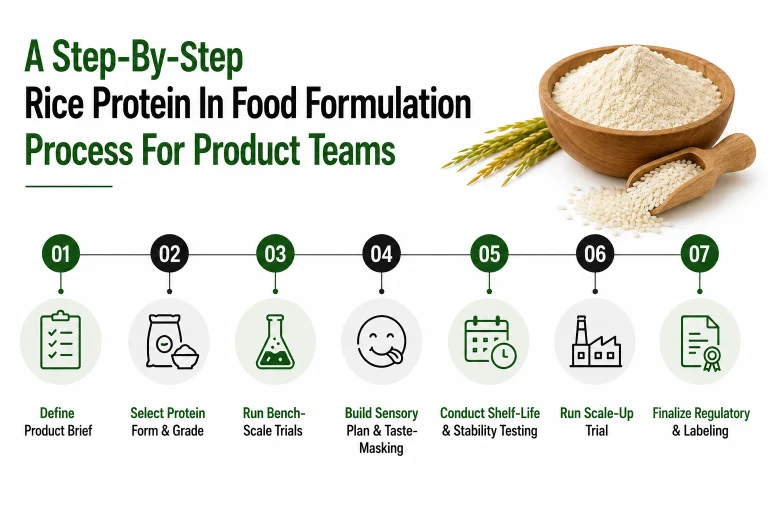
A structured process protects your budget and your timeline. In practice, most successful rice protein projects follow the same sequence:
- Define the product brief — target claim, category, price band, and competitive benchmark.
- Select the protein form and grade suited to your processing method and end format.
- Run bench-scale trials focused on solubility, taste, and texture before anything else.
- Build a sensory evaluation plan and a taste-masking strategy in parallel, not afterward.
- Carry out shelf-life and stability testing under real storage and transport conditions.
- Run a scale-up trial aligned to your actual plant equipment, not lab-scale assumptions.
- Finalize regulatory documentation, nutrition panel, and label claims before commercial production.
This sequence is, at its core, food formulation applied to one particularly demanding ingredient rather than to a full recipe. If you want the end-to-end process that sits behind every one of these steps, our detailed guide on food formulation walks through the discipline in more depth. Once the formulation itself is locked, the next question most teams ask is how this fits into the broader food product development timeline and budget — something we cover separately, along with the roadmap specific to this ingredient, in our companion piece on rice protein product development.
Common Mistakes That Derail Rice Protein Formulations
- Treating rice protein as a drop-in replacement for pea or soy protein without re-testing solubility from scratch.
- Ignoring particle size distribution in beverage applications, which later surfaces as sedimentation complaints from consumers.
- Under-budgeting for taste masking, then discovering off-notes only after a full pilot batch has already been produced.
- Skipping accelerated shelf-life testing on protein-fortified bakery items, where moisture migration quietly changes texture over weeks.
- Assuming an organic or clean-label position removes the need for separate sourcing and traceability verification.
Regulatory And Labeling Considerations In India And Beyond
In India, FSSAI protein content claims need to be substantiated through approved testing methods, and increasingly, brands are expected to reference protein quality — not just crude protein percentage — using scores such as PDCAAS or DIAAS. Hypoallergenic positioning also needs care: the word carries specific regulatory weight in several export markets, and using it without proper substantiation can create compliance risk down the line. If your production line also processes other allergenic proteins, allergen-adjacency labeling becomes a practical requirement rather than a nice-to-have, particularly for products aimed at infant nutrition or clinical categories where trust is the entire proposition.
Cost And Sourcing Realities For Rice Protein Ingredients
Rice protein pricing varies significantly by form and functionality, and this is often where budgets get set unrealistically early in a project.
| Form | Indicative Price Positioning | Sourcing Consideration |
| Rice protein concentrate | Lower cost | Lower minimum order quantities; suited to cost-sensitive bars and blends |
| Rice protein isolate | Mid-to-high cost | Moderate MOQs; the default choice for beverages and nutrition bars |
| Organic rice protein isolate / hydrolysate | Premium cost | Higher MOQs and longer lead times; needed for clean-label and infant lines |
| Fermented / enzymatically modified rice protein | Premium, functionality-driven pricing | Supplier scale varies widely; best for high-solubility RTD and dairy-alternative work |
Where This Fits Into Your Broader Food Product Development Plan
Formulation is one workstream inside a much larger journey that also includes market validation, pilot production, compliance, and go-to-market planning. Teams that plan for that bigger picture from day one tend to avoid the costly rework that happens when a formulation is locked before the packaging, claims, or manufacturing partner have been finalized. If you are mapping that full journey, our guide on food product development lays out the stages that typically follow once your rice protein formulation is stable.
Bringing It Together
Rice protein rewards teams that treat solubility, sensory work, and compliance as three parallel tracks rather than a checklist to work through in order. The ingredient itself is well suited to the direction the category is heading — allergen-conscious, plant-based, and increasingly clean-label — but only when the formulation work behind it is done properly. Flavor Catalystz has seen the same pattern play out across categories: brands that invest in bench-scale rigor before scale-up spend far less time firefighting after launch. Whether you are formulating your first rice-protein product or troubleshooting one that has already stalled at pilot stage, the fundamentals in this guide are the right place to start.
Frequently Asked Questions
What is rice protein used for in food formulation?
Rice protein is used to add protein content to beverages, bars, bakery items, dairy alternatives, infant nutrition, and meat analogues, particularly where a hypoallergenic, gluten-free, or clean-label position is important.
Is rice protein better than pea protein for food products?
Neither is universally better — pea protein offers higher native solubility and is stronger in methionine, while rice protein is hypoallergenic and higher in lysine gaps that pea protein helps fill. Many formulations blend both to balance amino acid profile and functionality.
Why is rice protein hard to dissolve in liquid formulations?
Native rice protein has strong intermolecular hydrogen bonding and disulfide bonds that limit water solubility, often below 10% at acidic pH. This is why beverage formulations typically require a modified or enzymatically hydrolyzed form.
Is rice protein hypoallergenic?
Rice protein is widely recognized as hypoallergenic and is commonly used in infant formula and clinical nutrition for this reason, though formulators still need to verify claims against the specific regulatory requirements of their target market.
Can rice protein replace whey protein in a formulation?
It can, but not as a direct substitute. Whey has high native solubility and a complete amino acid profile, so replacing it with rice protein usually requires a modified rice protein form plus reformulated flavor and texture systems.
What is the difference between rice protein concentrate and isolate?
Concentrate has a lower protein percentage and is generally more cost-effective, while isolate is more purified, higher in protein content, and typically better suited to beverages and premium nutrition products.
How much does it cost to formulate a rice protein product?
Cost depends on protein form, target category, and the number of trial iterations needed, with premium or organic hydrolyzed forms sitting at the higher end and concentrates at the lower end of the ingredient cost spectrum.
Is organic rice protein necessary for clean-label products?
It is not mandatory, but organic and non-GMO certified rice protein is increasingly expected by consumers and retailers in the clean-label and premium supplement segments, and it often simplifies label claims.