Jul 2026 · 10 min read
Puffed snack formulation is the part of snack development that decides everything a consumer notices in the first bite: how light the piece feels, how loud the crunch is, whether the flavor sits on the surface or fades within weeks, and whether the pack still tastes fresh after two months on a warm retail shelf. Get the formulation wrong and no amount of packaging or marketing will fix it. Get it right, and a simple corn or rice base can carry a premium, better-for-you, or indulgent positioning at a cost structure that still works commercially.
This guide explains how puffed snacks are formulated in an industrial setting – the ingredients, the process variables, the common failure points, and where a structured food product development approach saves months of trial and error. It is written for founders, R&D teams, and category managers who need a working understanding of puffed snack formulation before briefing a manufacturer or an internal team. Flavor Catalystz works on exactly this stage of development with food brands across categories, and the process below reflects how these projects actually run on a bench and on a production line, not just in theory.
What Is Puffed Snack Formulation?
Puffed snack formulation is the process of selecting and balancing raw materials – cereal flours, starches, proteins, fats, and seasonings – along with process parameters such as moisture, temperature, pressure, and shear, to produce a light, porous, crisp snack piece. Unlike a home recipe, formulation has to hold up at scale: a ratio that works in a lab extruder has to behave the same way on a line running for eight hours, using ingredient lots from different suppliers, inside a factory with its own humidity and equipment quirks.
Puffed snacks sit inside the wider extruded snack category, but they specifically refer to direct-expanded, low-density products – corn curls, cheese balls, rice puffs, lentil and pea puffs, and masala-coated puffs – where the structure comes from rapid steam expansion rather than a denser bite like a chip or a stick.
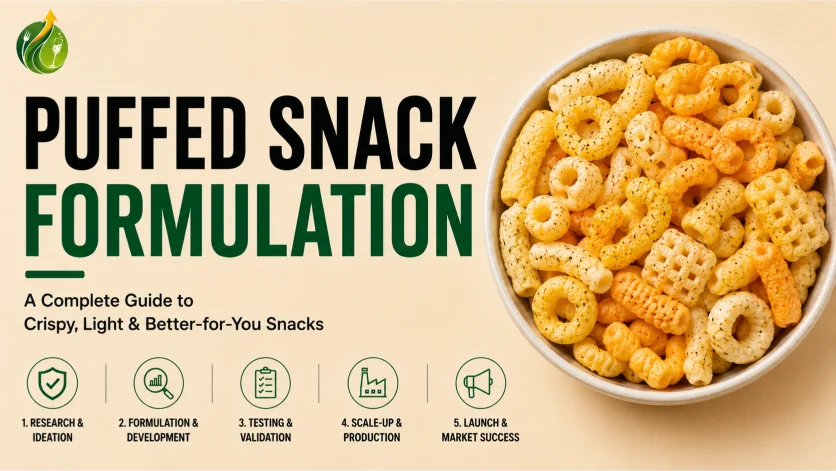
PUFFED SNACK FORMULATION 2026
Develop Puffed Snacks with Better Expansion, Texture, and Taste
Flavor Catalystz develops puffed snack formulations with optimized ingredient blends, extrusion parameters, expansion, texture, seasoning, shelf life, and commercial manufacturing support.
How Puffed Snacks Are Made: A Quick Process Overview
Industrially, puffed snacks are produced using one of four core methods. Each gives a different texture, cost profile, and label-claim potential, which is why choosing a method is itself part of formulation, not just an equipment decision.
| Method | How it works | Typical products | Formulation implication |
| Extrusion (direct expansion) | Dough is cooked under heat and pressure inside a screw extruder, then flashes into steam as it exits the die | Corn curls, cheese balls, rice/lentil puffs | The most common route; supports wide flavor coating options and shape variety |
| Frying (direct expansion) | Low-moisture pellets expand in hot oil at 160–200°C | Prawn crackers, some fried corn puffs | Richer mouthfeel and higher fat; shelf life is sensitive to oil quality |
| Baking / oven-puffing | Pre-formed pellets or dough pieces expand in hot-air ovens | Baked cheese puffs, rice cakes, better-for-you puffs | Supports lower-fat and clean-label claims; needs tighter moisture control |
| Pellet (third-generation) technology | Dense pellets are made first, dried, then expanded later by frying, baking, or hot air | Private-label and export-friendly formats | Separates production from expansion – useful for co-manufacturing and long-distance supply |
Core Ingredients in Puffed Snack Formulation
Every puffed snack formulation is built around a base starch system, a moisture level, and a flavor delivery layer. The table below summarises the ingredient roles most formulators start from.
| Ingredient | Function | Typical inclusion | Notes |
| Corn grits / corn meal | Primary starch base; drives expansion and bite | 60–85% | High-amylopectin (waxy) corn gives a larger, softer puff |
| Rice flour | Neutral-flavour base; lighter texture | 10–40% | Popular for premium and low-allergen positioning |
| Pulse flours (lentil, pea, chickpea) | Protein and fibre boost; clean-label appeal | 10–30% | Above 8–10% inclusion, it can restrict expansion and needs process tuning |
| Wheat / potato / tapioca starch | Texture modifier; binds structure | 5–20% | Affects crispness and how quickly the puff softens after opening |
| Water | Plasticiser; converts starch during cooking | 12–18% of mix | The single most sensitive variable in the whole formulation |
| Salt, sugar, malt extract | Base flavour precursors | 1–5% | Also influence browning and moisture pick-up |
| Oil / flavour slurry | Carrier for seasoning adhesion | 8–20% post-expansion | Oil type affects shelf life and mouthfeel more than most brands expect |
| Dry seasoning blends | Final flavour layer | 3–12% post-expansion | Particle size must match the puff’s surface texture for adhesion |
Key Formulation Variables That Decide Texture and Crunch
Two puffed snack formulations can use almost identical ingredients and still produce very different textures. The variables below are usually where the real difference comes from.
| Variable | Effect on final product | Typical working range |
| Moisture content of the mix | Too low gives a hard, dense puff; too high gives uneven expansion and a hardened surface | 12–18% |
| Amylose : amylopectin ratio | Higher amylopectin gives larger, softer bubbles; higher amylose gives a harder, crisper bite | Varies by starch source |
| Protein inclusion level | Improves nutrition claims but can suppress expansion above 8–10% | 0–10% |
| Barrel temperature | Drives gelatinisation and expansion force at the die | 150–190°C |
| Die and cutter design | Determines shape, wall thickness, and expansion ratio | Product-specific |
| Post-puff moisture | Determines shelf stability and whether additional drying is needed | 6–8% at die exit |
Puffed Snack Formulation Process: Step by Step
A structured food product development process for a puffed snack typically runs through six stages. Skipping any of these is usually where brands end up reformulating after a failed production trial.
- Concept and target definition – positioning, target consumer, price point, and label claims (protein, baked, clean-label, gluten-free) are locked before any recipe work begins.
- Base formulation and bench trials – starch blend, moisture, and inclusion levels are tested at small scale to hit the target texture and bite.
- Flavor system development – dry seasoning and/or oil-slurry systems are matched to the puff’s surface area and porosity so flavor adheres and survives the pack’s shelf life.
- Pilot-scale extrusion or frying trials – the bench recipe is run on production-representative equipment to confirm expansion, color, and texture hold up outside the lab.
- Stability and shelf-life testing – moisture pick-up, rancidity, and texture loss are tracked under accelerated and real-time storage conditions.
- Commercial scale-up and handover – the final formulation is documented with specifications and tolerances so it runs consistently on the client’s or co-manufacturer’s line.
Common Puffed Snack Formulation Challenges
A few issues come up repeatedly across puffed snack and related extruded snack formulation projects:
- Inconsistent expansion between batches, usually traced back to moisture variation in incoming raw material lots.
- Seasoning that tastes strong on day one but flat by week four, caused by flavor volatiles migrating into the porous puff structure.
- Protein or fibre fortification collapsing the puff structure because inclusion levels weren’t re-balanced against moisture and starch ratio.
- A formulation that performs well in a lab extruder but underperforms on a client’s commercial line, due to differences in screw configuration or die geometry.
These issues are not unique to puffed snacks. Our related guide on extruded snack formulation looks at the same expansion and moisture challenges for stick and pellet-based formats, while our breakdown of cheese snack formulation covers how a dairy-based flavor system is layered onto an extruded or baked base.
Commercial and Cost Considerations for Scaling Puffed Snack Formulation
A lab-perfect puffed snack formulation still has to clear three commercial checks before it is production-ready: raw material cost per kilogram at target inclusion levels, compatibility with the intended extruder or fryer (screw type, die capacity, drying tunnel length), and packaging that can protect the target shelf life without over-specifying barrier film costs. Formulations built without checking these early usually need a second round of rework once a co-manufacturer or plant engineer reviews them, which adds weeks to a launch timeline.
Latest Trends Shaping Puffed Snack Formulation in 2026
- Protein and pulse-forward puffs (lentil, pea, chickpea) formulated to hold expansion despite higher protein levels.
- Baked and air-puffed formats replacing fried puffs to support lower-fat label claims without losing crunch.
- Vacuum frying for premium puffed snacks, preserving color and nutrients while reducing oil content.
- Multi-sensory flavor layering – combining a base seasoning with a finishing dust or spray for a more complex taste profile.
- Sustainable and traceable sourcing of corn, rice, and pulse flours as a purchasing requirement for larger retail buyers.
How Professional Food Product Development Support Improves Puffed Snack Formulation
Most brands don’t fail at puffed snack formulation because of a bad idea – they fail because a workable bench recipe was never validated against real production conditions. A structured food product development process brings in sensory testing, shelf-life validation, and process engineering alongside the recipe work itself, so the formulation that leaves the lab is the same one that performs on a commercial line. It also connects formulation decisions to compliance and labeling early, instead of discovering a claim can’t be substantiated after the packaging is already printed.
For a deeper look at how formulation fits into the broader development pipeline – from ingredient science to sensory validation – see our detailed resource on food formulation.
Conclusion
Puffed snack formulation rewards teams that treat it as food science first and recipe writing second. Moisture control, starch selection, and flavor system design decide whether a product survives contact with a real production line and a real retail shelf – not just a tasting panel in a lab. Whether you are building a first product or reformulating an existing one, working through ingredients, process variables, and stability testing in that order will save far more time than it costs. Flavor Catalystz supports food brands through exactly this stage of development, from early formulation trials to commercial scale-up.
Frequently Asked Questions
What is puffed snack formulation?
Puffed snack formulation is the process of selecting ingredients – typically cereal flours, starches, proteins, and seasonings – and setting process parameters like moisture and temperature to produce a light, porous, crisp snack through steam expansion.
What ingredients are used in puffed snacks?
Most puffed snacks are based on corn grits, rice flour, or pulse flours, combined with starches for texture, water as a plasticiser, and a flavor layer of oil or dry seasoning applied after expansion.
What is the difference between extruded and puffed snacks?
All puffed snacks are extruded or otherwise expanded, but “extruded snacks” is a broader category that also includes denser, non-puffed shapes such as sticks and pellets that don’t expand the same way.
How much protein can be added to a puffed snack formulation?
Protein or fibre-rich flours can typically be included up to 8–10% before they begin to restrict expansion; higher levels usually require process adjustments such as increased moisture or modified screw configuration.
Are puffed snacks healthy?
This depends entirely on the formulation. Baked or air-puffed versions with pulse flours and reduced sodium can support better-for-you claims, while fried, high-sodium versions sit closer to indulgent snacking.
How long does it take to develop a puffed snack formulation?
A typical project runs three to eight weeks from initial bench trials to a pilot-ready formulation, depending on complexity, the number of flavor variants, and how many rounds of sensory testing are needed.
What causes puffed snacks to go stale quickly?
Staling is usually caused by moisture pick-up through inadequate packaging barriers, incomplete drying after expansion, or oil rancidity in the flavor coating.
Can puffed snacks be made without frying?
Yes. Extrusion followed by hot-air baking is a common route to a fried-free puffed snack, and it is increasingly used to support lower-fat and cleaner label claims.