Jul 2026 · 7 min read
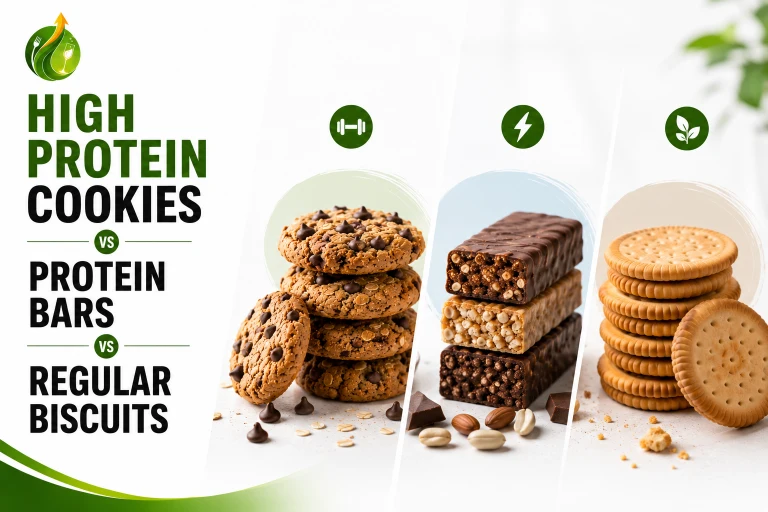
Walk into the health snacking aisle of any Indian supermarket or open any quick-commerce app today, and you’ll find three overlapping categories competing for the same spot in your bag: high protein cookies, protein bars, and the regular biscuits many of us grew up with. They look similar, they’re often shelved next to each other, and marketing across all three leans heavily on the word “protein.” But they’re built differently, they behave differently in your body, and they solve different problems. This guide compares them head-to-head on the things that actually matter — protein density, sugar load, cost efficiency, shelf stability, and which real-life situations each one is genuinely built for — so you can stop guessing at the shelf.
The Quick Verdict
| If You Need… | Best Pick |
|---|---|
| Maximum protein density in the smallest format | Protein Bar |
| A satisfying, dessert-like snack that still delivers meaningful protein | High-Protein Cookie |
| The most budget-friendly option without needing extra protein | Regular Biscuit |
| Something to eat immediately after a workout | Protein Bar |
| An everyday desk or travel snack that doesn’t feel like traditional supplement food | High-Protein Cookie |
| A snack for children or casual, non-fitness-focused eating | Regular Biscuit (in moderation) |
Head-to-Head: Protein Cookies vs Protein Bars vs Regular Biscuits
| Attribute | High-Protein Cookie | Protein Bar | Regular Biscuit |
|---|---|---|---|
| Protein per Serving | 8–15g (typical) | 15–25g (typical) | 1.5–3g (typical) |
| Added Sugar | Low to moderate; often formulated with reduced sugar | Low; frequently sweetened with sugar alcohols or alternative sweeteners | Moderate to high |
| Calories per Serving | 120–200 kcal | 150–250 kcal | 60–140 kcal |
| Texture / Mouthfeel | Soft, bakery-style, familiar | Dense, chewy, sometimes gritty | Crisp and light |
| Shelf Stability | Weeks to a few months | Several months; formulated for long shelf life | Several months |
| Cost per Gram of Protein | Moderate | Often the lowest due to high protein density | Highest, since protein is not the primary focus |
| Portability | Good | Very good | Very good |
| Best Occasion | Everyday snacking or as a dessert alternative | Post-workout nutrition and on-the-go fueling | Tea-time, casual snacking, or a budget-friendly option |
When High Protein Cookies Win
High protein cookies close the gap between “something that satisfies a sweet craving” and “something that actually contributes to your day’s protein target.” They tend to work best for people who want a snack that feels like an indulgence but is formulated with intent — an afternoon office snack, a post-dinner treat that doesn’t derail a protein goal, or an easy way to make an existing biscuit habit more nutritionally useful without switching to something that tastes overtly like a supplement.
Want to Create the Next Best-Selling High-Protein Snack?
At Flavor Catalystz, we help food brands develop high-protein cookies, protein bars, and functional snacks with custom formulations, premium ingredients, nutrition optimization, shelf-life testing, and commercial manufacturing support.
When Protein Bars Win
Bars are built for protein density first and everything else second, which makes them the stronger choice immediately before or after a workout, when you need a large, fast dose of protein in a compact format and taste is a secondary consideration. Their denser, chewier texture and typically lower relative sugar content also make bars a better fit for structured fitness routines where macros are being tracked closely.
Where Regular Biscuits Still Make Sense
Regular biscuits aren’t obsolete just because “protein” has become the dominant snacking narrative. For casual snacking, for children, for anyone not specifically tracking protein intake, or simply for cost-conscious buyers, a well-made regular biscuit remains a perfectly reasonable choice — the mistake is only in assuming it delivers a nutritional benefit it was never designed to.
Also read: High Protein Cookie Formulation | From Lab to Launch
Scenario-Based Picks
| Scenario | Recommended Pick | Why |
|---|---|---|
| Post-Gym Recovery Snack | Protein Bar | Provides the highest protein density in a compact, convenient format for post-workout recovery. |
| Mid-Afternoon Office Craving | High-Protein Cookie | Offers a dessert-like experience while delivering a meaningful amount of protein. |
| Long Travel Day (Need Something Shelf-Stable) | Protein Bar or High-Protein Cookie | Both are designed for extended shelf life and are easy to carry on the go. |
| Snack for Kids | Regular Biscuit (in Moderation) | Children’s protein needs are generally lower, and fortified adult protein snacks are not necessary as an everyday choice. |
| Managing Weight on a Calorie Budget | High-Protein Cookie | Provides better satiety per calorie than a regular biscuit, without the potentially higher calorie content of some protein bars. |
| Diabetic-Friendly Snacking | High-Protein Cookie or Protein Bar (Sweetened with Sugar Alternatives) | Suitability depends on the sweetener used, so always check the nutrition label and ingredient list. |
The Cost-Per-Gram-of-Protein Reality Check
Sticker price is a poor way to compare these categories, since serving sizes, protein density, and calories all differ. A simple worked example using representative, non-brand-specific numbers illustrates why:
| Product Type | Price per Serving | Protein per Serving | Cost per Gram of Protein |
|---|---|---|---|
| High-Protein Cookie | ₹40 | 10g | ₹4.0 |
| Protein Bar | ₹60 | 20g | ₹3.0 |
| Regular Biscuit | ₹10 | 2g | ₹5.0 |
Counter-intuitively, the cheapest snack on the shelf (the regular biscuit) is often the most expensive way to actually buy protein, while the pricier protein bar can turn out to be the best per-gram value — the only way to know for certain is to run this simple calculation before comparing products by sticker price alone.
Building a Smarter Snacking Stack
The most practical approach for most people isn’t picking a single winner — it’s using each format for what it’s actually good at: a protein bar around training sessions when density and speed matter most, a high protein cookie for everyday snacking where satisfaction and moderation matter more than raw protein grams, and an occasional regular biscuit when cost or simplicity is the priority. Industry data on India’s functional snacking segment consistently shows this kind of category-blending behaviour among consumers, rather than complete replacement of one format by another — a trend that food and beverage consultants such as Flavor Catalystz have tracked as brands increasingly launch across more than one of these formats rather than committing to just one.
Frequently Asked Questions
Are high protein cookies healthier than protein bars?
Neither is universally healthier — protein bars generally offer more protein per serving, while cookies often have a softer, more familiar texture and moderate sugar content. The better choice depends on your goal: density and speed favour bars, everyday satisfaction favours cookies.
Which has less sugar, a protein cookie or a protein bar?
It varies significantly by brand and formulation in both categories, so checking the actual nutrition panel matters more than assuming one format is inherently lower in sugar than the other.
Can protein cookies replace protein bars for post-workout recovery?
They can contribute to post-workout protein intake, but bars are generally formulated to deliver protein more densely in a smaller serving, which usually makes them the more efficient post-workout choice.
Is it worth paying more for a protein bar or cookie compared to a regular biscuit?
It depends on whether you actually need the extra protein. If you’re already meeting your daily protein target through meals, the premium may not add meaningful value; if you’re protein-deficient in your diet, the added cost is often justified.
Do high protein cookies or protein bars have a longer shelf life?
Both are typically engineered for several months of shelf stability, though the exact figure depends on the specific formulation, packaging, and storage conditions used by the brand.
Which snack is better for weight loss, a protein cookie or a protein bar?
High protein cookies often have a better calorie-to-satiety ratio for casual snacking, while protein bars can be higher in calories depending on the format — checking total calories alongside protein content is the more reliable approach than assuming either category is automatically “diet-friendly.”
Are regular biscuits bad for you compared to protein-fortified options?
Not inherently — regular biscuits simply aren’t designed to deliver a protein benefit. They remain a reasonable casual snack in moderation; the issue only arises when they’re mistaken for a protein source.
How do I decide between these three options at the store?
Compare protein per serving against total calories, check the sugar and sweetener type used, and calculate cost per gram of protein rather than comparing prices at face value — that combination answers most of the “which one is better” question on the spot.