Jul 2026 · 11 min read
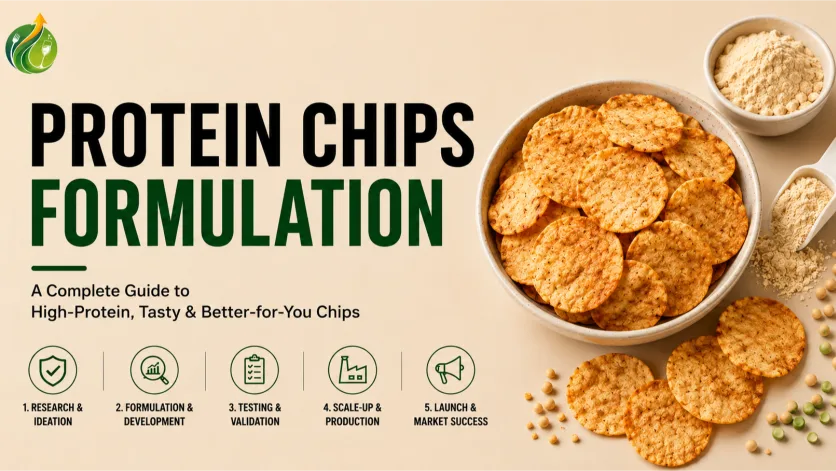
Protein chips look simple on a shelf — a thin, crisp, savoury piece with a bold “high protein” claim on the front. Behind that simplicity sits one of the more technically demanding categories in snack food science. Getting a protein chips formulation right means solving a conflict at the centre of the category: the more protein you add, the harder it becomes to keep the crunch, colour, and taste that make a snack enjoyable to eat. This guide breaks that process down in detail — the topic our team at Flavor Catalystz gets asked about most often by founders and manufacturers entering the high-protein snacking space.
The category is growing fast enough that getting this balance right is now a genuine commercial opportunity. Industry market research places the global protein crisps market at roughly USD 1.53 billion in 2025, rising to around USD 2.47 billion by 2031 — a compound annual growth rate near 8.3%. A related segment, extruded protein crispies and inclusions used across bars, cereals, and snacks, is separately estimated to grow from about USD 0.29 billion in 2026 to USD 0.46 billion by 2031.
Quick Answer: A protein chips formulation is the specific combination of protein source (soy, pea, whey, or milk protein), starch base, moisture, fat, and processing parameters used to produce a crisp snack piece with a materially higher protein content than a standard potato or corn chip, without sacrificing crunch, taste, or shelf stability.
What Is Protein Chips Formulation? (Quick Definition)
Protein chips formulation is the food science process of engineering protein into a chip’s base recipe — beyond what a conventional starch snack naturally contains — while keeping expansion, crunch, colour, and flavour within an acceptable range. Conventional chips typically carry 6–10% protein from the base ingredient itself. A product marketed as a protein chip generally needs to sit well above that, which means protein has to be deliberately engineered into the base rather than simply present as a background nutrient.
The technical difficulty is that protein and starch behave very differently under heat and shear. Starch granules gelatinise and expand cleanly, which creates the light, crisp structure people expect from a chip. Protein does not expand the same way — at high inclusion levels, it disrupts the starch matrix and can leave the piece hard, brittle, or gummy instead of crisp.
PROTEIN CHIPS FORMULATION 2026
Develop Commercial-Ready Protein Chips
Develop protein chips with optimized ingredients, texture, protein content, seasoning, shelf life, and scalable manufacturing support from Flavor Catalystz.
Protein Chips Recipe Formulation: Core Ingredients Explained
A protein chips recipe formulation is built around five functional ingredient groups: a protein source, a starch base, fat, process water, and functional additives, each playing a distinct structural or sensory role. The table below summarises the function and trade-off of each group.
| Ingredient Group | Typical Inclusion | Function | Formulation Trade-off |
| Protein source (soy, pea, whey, milk protein concentrate, rice, yeast protein) | 10–40% of dry mix | Raises finished protein content and label claim | Higher inclusion reduces expansion and can introduce beany or chalky notes |
| Starch base (corn, potato, rice, tapioca flour) | 40–70% of dry mix | Provides expansion, crispness, and bite | Too little starch and the piece will not puff or crisp properly |
| Fat / oil | 2–15% | Carries flavour, softens bite, aids sheen | Excess fat slows drying and can shorten shelf life via rancidity |
| Moisture (process water) | 12–30% during processing | Controls gelatinisation and expansion behaviour | Small changes shift density, crunch, and piece uniformity significantly |
| Functional additives (emulsifiers, fibre, seasoning carriers) | 1–5% | Improves texture consistency and flavour adhesion | Needs to be food-safe, FSSAI-permitted, and declared correctly on label |
Whey Protein Chips Formulation vs Pea Protein Chips Formulation vs Soy Protein Chips Formulation
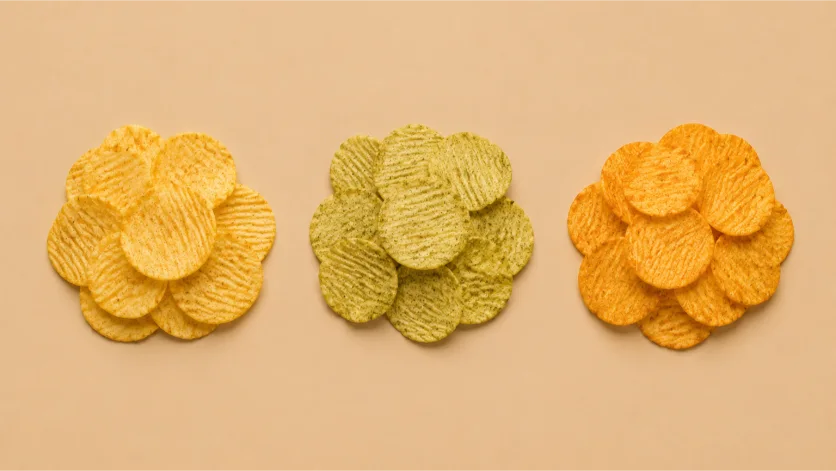
Soy protein generally gives the best expansion and crunch for chip formulation, pea protein suits plant-based and allergen-conscious positioning but needs more formulation work, and whey protein chips formulation requires careful temperature control because whey is more heat-sensitive than plant proteins. No single protein source is universally “best” — the right choice depends on positioning, allergen strategy, and target texture.
| Protein Source | Texture Performance | Best-Fit Positioning | Formulation Watch-Out |
| Soy protein | Strong expansion, cohesive matrix, easiest to extrude at high inclusion | Mainstream high-protein snacks | Common allergen — needs clear label declaration |
| Pea protein | Moderate expansion; needs formulation adjustment to match soy | Plant-based, vegan, soy-free brands | Can carry a beany or chalky note at higher inclusion |
| Whey protein / milk protein concentrate | Good nutrition profile; heat-sensitive during processing | Dairy-friendly, fitness-focused brands | Can brown or denature if extrusion temperature runs too high |
| Yeast protein | Workable with formulation adjustment; newer to snack applications | Sustainability-led, novel-ingredient brands | Distinct flavour profile needs masking or blending |
Extruded Protein Chips Formulation: Manufacturing Methods Compared
Extrusion is the most common commercial method for protein chips manufacturing because it gives the tightest control over expansion, shape, and throughput, though baking, frying, and air-puffing are also used depending on the brand’s texture and label goals. The table below compares the four dominant methods.
| Method | Texture Outcome | Protein Retention | Relative Capex |
| Extrusion (single or twin-screw) | Uniform expansion, consistent crunch, scalable | Good, if temperature is controlled | High |
| Baking | Denser, cracker-like bite | High — lower thermal stress | Moderate |
| Frying (deep or vacuum) | Very crisp, richer flavour, shorter shelf life risk | Moderate — some loss at high oil temperatures | Moderate to High |
| Air-puffing / hot-air popping | Light, airy, lower fat | Good | Moderate |
Protein Chips Manufacturing Process: Step-by-Step Formulation Method
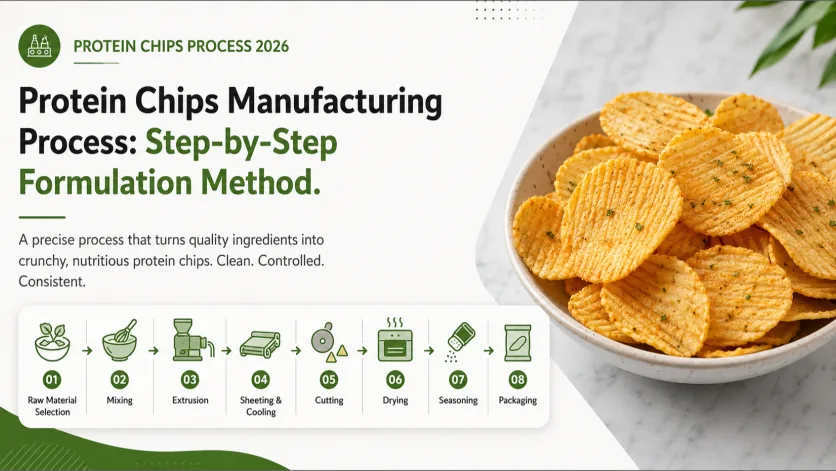
The protein chips manufacturing process typically runs through eight stages, from defining the protein target through to lab-verifying the finished product’s nutritional claim. Each stage is outlined below.
- Define the protein and nutrition target — decide the finished-product protein percentage the claim will be built around, since this drives every downstream ingredient decision.
- Select the protein-starch ratio — start from a baseline (commonly 15–25% protein inclusion for a first prototype) and adjust based on texture testing.
- Balance moisture content — typically held in a 12–20% range during extrusion or mixing, fine-tuned in trials since it directly controls expansion and density.
- Set thermal and mechanical parameters — die temperature, screw speed, and specific mechanical energy (SME) determine whether the protein matrix expands cleanly or turns dense and hard.
- Trial, taste, and texture-test — run small batches and evaluate crunch, colour, mouthfeel, and off-notes before committing to a formulation.
- Apply seasoning and coating — test seasoning adhesion separately from the base formulation, since oil level and surface texture both affect how well coatings stick.
- Validate shelf life and stability — run accelerated shelf-life and moisture-uptake testing, since higher-protein products can behave differently in humidity than standard chips.
- Confirm nutritional and regulatory compliance — lab-test the finished product’s actual protein content before finalising any “high protein” claim on the pack.
Common Protein Chips Formulation Problems and How They Are Fixed
The most common protein snack formulation problems are dense texture, off-flavours, poor seasoning adhesion, and fast moisture pickup — nearly all trace back to the protein-to-starch ratio or moisture control. The table below maps each problem to its usual cause and fix.
| Problem | Common Cause | Typical Fix |
| Dense, hard texture with poor expansion | Protein inclusion too high relative to starch, or insufficient moisture control | Rebalance protein-to-starch ratio; adjust moisture and screw speed |
| Beany, chalky, or bitter off-flavour | Protein source with strong inherent flavour (common with pea or soy at high inclusion) | Blend protein sources; add masking flavours; adjust roasting/toasting step |
| Excess friability (crumbles too easily) | Over-expansion or insufficient binding at the given moisture level | Fine-tune die temperature and moisture; review starch type |
| Uneven seasoning adhesion | Surface oil level too low, or piece surface too smooth | Adjust oil-spray step; review piece surface texture from the die |
| Fast moisture pickup / loss of crunch in shelf life | High-protein matrix is more hygroscopic; packaging barrier insufficient | Improve packaging barrier; re-test shelf life at target humidity |
Protein Chips Formulation Cost: What Drives the Price
Protein chips formulation costs more than conventional chip development mainly due to specialty protein ingredient pricing, longer trial cycles, tighter process control, and mandatory lab testing for label claims. Four factors typically drive the cost structure:
- Protein ingredient cost: specialty proteins (whey isolate, yeast protein, functional pea protein) cost meaningfully more per kilogram than commodity starches.
- Trial and development cycles: because protein behaves unpredictably under heat and shear, most formulations require more prototype rounds than a standard chip before they are production-ready.
- Equipment and process control: achieving consistent expansion at higher protein loads often needs tighter extrusion control, which can mean more downtime and calibration during scale-up.
- Testing and compliance: lab verification of protein content, shelf-life studies, and label claim substantiation add cost that a standard snack formulation may not require.
FSSAI High Protein Claim Rules for Protein Chips Formulation in India
Any “high protein” claim on a protein chips formulation sold in India must be substantiated with lab-verified data on the finished product under FSSAI’s Food Safety and Standards (Labelling and Display) Regulations — formulation math on paper is not sufficient. FSSAI has also been tightening enforcement through 2026, including movement toward Front-of-Pack Nutrition Labelling (FOPNL) requirements expected to phase in through 2026–27 for products high in fat, sugar, or salt.
Formulators should treat regulatory verification as part of the formulation process itself, not a step that happens after the recipe is finalised. This is one of the reasons structured food formulation work typically runs testing and compliance checks in parallel with texture and taste development, rather than sequentially.
How Professional Food Formulation Support Improves Protein Chips Outcomes
Working with a dedicated food formulation team shortens the number of trial cycles needed to reach a production-ready protein chips recipe, because specialised teams already have extrusion experience, protein-ingredient relationships, and lab access for claim substantiation. This matters most for founders and manufacturers entering the category for the first time.
This overlaps closely with broader food product development work, where formulation, sensory testing, and regulatory planning are managed together rather than as separate, disconnected steps, and with focused food formulation support for brands that already have a manufacturing route but need the recipe itself engineered and validated.
Conclusion
A successful protein chips formulation comes down to managing one core trade-off — protein content versus crunch, taste, and shelf stability — through disciplined ingredient selection, process control, and lab-verified compliance, rather than treating it as a standard chip recipe with protein powder added on top. Brands that budget properly for trial cycles, choose the right protein source for their positioning, and validate claims before printing them tend to avoid the repeat-purchase and compliance problems that sink many first attempts in this category. Flavor Catalystz works with food brands on exactly this kind of formulation challenge, helping take a protein chips concept from early prototype through to a stable, compliant, production-ready product.
Frequently Asked Questions
What percentage of protein should a protein chips formulation contain?
There is no single fixed number, but commercial formulations typically use 10–40% protein ingredients in the dry mix, depending on the target label claim and category positioning. The finished-product protein percentage should always be confirmed through lab testing rather than calculated on paper.
Is pea protein or soy protein better for protein chips formulation?
Neither is universally “better.” Soy protein generally provides stronger expansion and crunch during extrusion, while pea protein is often preferred for plant-based, soy-free, or allergen-conscious positioning, even though it usually needs more formulation adjustment to match soy’s texture performance.
Can whey protein be used in an extruded protein chips formulation?
Yes, but whey and other dairy proteins are more heat-sensitive than plant proteins. Extrusion temperatures need to be controlled carefully in a whey protein chips formulation to avoid excessive browning, denaturation, or off-flavour development.
Why do high-protein chips often turn out dense instead of crisp?
Protein disrupts the starch matrix responsible for expansion. As protein inclusion increases, expansion typically decreases, which is why balancing the protein-to-starch ratio is the central challenge in any protein chips recipe formulation.
What is the typical protein chips manufacturing process?
It generally follows defining the protein target, setting the protein-starch ratio, controlling moisture and thermal parameters, running texture and taste trials, applying and testing seasoning, and finally validating shelf life and nutritional compliance before commercial scale-up.
Do protein chips need FSSAI approval for a “high protein” claim?
Any high-protein or similar nutrient claim on a packaged food sold in India must meet FSSAI’s nutritional standards and be substantiated with lab-verified data on the finished product, in line with the Food Safety and Standards (Labelling and Display) Regulations.
How much does protein chips formulation typically cost to develop?
Cost varies by protein source, trial rounds needed, and testing requirements, but specialty protein ingredients, extended prototyping cycles, and mandatory lab verification for claims are the main factors that make protein chips formulation more expensive than a standard chip recipe.
What causes an off-flavour or bitter taste in protein chips?
This is most commonly linked to the inherent flavour profile of the protein source itself — pea and soy proteins in particular can carry beany or bitter notes at higher inclusion levels — and is usually addressed through protein blending, flavour masking, or adjustments to roasting and seasoning steps.