Jul 2026 · 12 min read
A protein biscuit and a protein brownie may share a marketing shelf, but they are built on almost opposite formulation logic. A brownie is a moist, high-fat batter where the entire goal is retaining water and fat to stay soft. A biscuit — whether it’s a crisp digestive-style biscuit, a savory cracker, or a soft American-style buttermilk biscuit — depends on controlling gluten development, fat distribution, and final moisture content to get a completely different texture outcome: crisp, short, or tender rather than fudgy.
Adding a meaningful dose of protein to that system changes almost every one of those variables at once. This article breaks down what actually happens inside a protein biscuit formulation, why so many high-protein biscuits turn out hard, crumbly, or gritty, and what food scientists and manufacturers do differently to get it right.
Disclaimer
This guide was compiled by reviewing published food science research on whey protein incorporation in baked goods, dough rheology, and biscuit manufacturing, alongside practical formulation perspectives from Flavor Catalystz that work directly with brands developing protein-fortified bakery products.
What Counts as a “Protein Biscuit”?
The term “protein biscuit” covers more ground than most people realize, and the formulation approach changes depending on which type is being built.
| Biscuit Type | Regional Meaning | Typical Texture Goal | Typical Protein Range (Fortified) |
| Hard-dough biscuit (digestive/cracker style) | Common in India, UK, most of Asia | Crisp, low moisture, long shelf life | 10–20g per 100g |
| Short-dough biscuit (cookie style) | Global | Tender, “short,” melt-in-mouth | 8–15g per 100g |
| American-style biscuit | US-specific | Soft, flaky, layered | 8–12g per biscuit |
| Cracker-style savory biscuit | Global | Crisp, low sugar, savory | 12–22g per 100g |
For most commercial “protein biscuit” products on shelves — the ones fortifying a familiar snack format with added protein — the hard-dough and cracker-style categories are the most common formulation target, since they’re built for shelf stability and mass production. That is the primary focus of this guide, though many of the same principles apply across categories.
The Structural Challenge: Why Biscuits Don’t Respond to Protein the Way Brownies Do
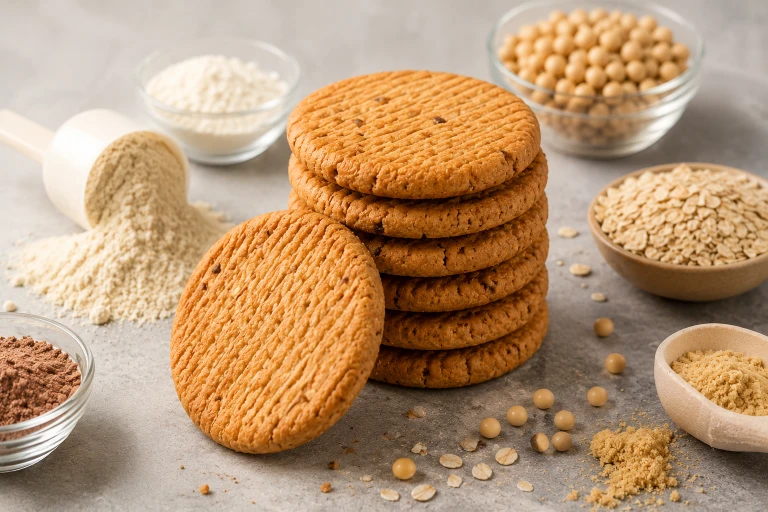
A brownie batter is held together mostly by egg proteins, starch gelatinization, and fat — there’s little to no gluten development involved, since the goal is a soft, moist crumb. A biscuit dough, by contrast, is deliberately engineered around limiting gluten development just enough to get a specific texture, a concept bakers and food technologists call “shortness.”
Shortness is controlled largely by the ratio of fat and sugar to flour. High fat and sugar levels physically coat flour particles and interfere with gluten strand formation, which is why traditional short-dough biscuits use fat levels between roughly 20% and 60% of flour weight. When a formulator adds protein powder — which behaves nothing like flour once hydrated — that carefully balanced fat-sugar-flour ratio gets disrupted, and the dough can either become too tough (if the added protein promotes unwanted structure) or too crumbly (if it interferes with the fat-coating mechanism that creates shortness).
This is the central reason a straight substitution of protein powder for flour so often fails in biscuit formulation, even when the same swap works reasonably well in a brownie or muffin batter.
Looking to Develop a High-Quality Protein Biscuit?
At Flavor Catalystz, we help food brands formulate protein biscuits with the ideal balance of taste, texture, nutrition, shelf-life, and manufacturing efficiency. From concept development and ingredient selection to pilot trials and commercial-scale production, we support every stage of your product journey.
Protein Source Selection: Why Whey Behaves Differently From Plant Proteins in Biscuit Dough
Food science research on whey protein concentrate (WPC) in baked goods consistently points to several functional benefits that make it a favored ingredient in biscuit and cookie formulation: it improves water binding for a finer, more even crumb, acts as a natural emulsifier due to its amphiphilic structure, and — because it’s rich in free amino acids and reducing sugars — actively enhances the Maillard browning reaction that gives biscuits their golden color and characteristic baked flavor.
| Protein Source | Effect on Biscuit Dough | Browning/Flavor Impact | Best Fit |
| Whey protein concentrate | Improves water binding, finer crumb | Enhances Maillard browning, clean neutral flavor | Most versatile default for fortified biscuits |
| Whey protein isolate | Can reduce “shortness,” firmer bite | Slightly less browning than WPC (lower lactose/reducing sugar content) | Higher protein-per-gram targets |
| Soy protein isolate | Can create noticeable off-flavors, especially in fillings | Neutral to slightly beany flavor | Cost-driven plant-based formulations |
| Pea protein | Earthier flavor, can add grittiness at higher inclusion | Neutral browning contribution | Vegan and allergen-free product lines |
| Egg white protein | Adds structure, can dry the crumb if overused | Mild flavor impact | Small-ratio blending for structure support |
Interestingly, food science literature also notes that flavor defects from a given protein source are often more noticeable in soft fillings than in a baked, solid crumb structure — which is one reason many protein biscuit and cracker formulations can tolerate a higher inclusion of soy or pea protein than a filled or cream-style version of the same product could.
Dough Development and Mechanical Processing: The Manufacturing Variable Most Recipes Ignore
Home baking recipes rarely account for what happens when a dough has to survive industrial mechanical handling — sheeting between rollers, rotary molding, wire-cutting, or stamping — before it ever reaches the oven. Adding protein powder changes dough extensibility and elasticity, and a dough that handles fine by hand can tear, stick to rollers, or lose its shape entirely on a production line.
This is one of the more overlooked reasons commercial protein biscuit development takes longer than expected: a formulation has to be validated not just for taste and nutrition, but for machinability at the exact mixing, sheeting, and baking parameters used on the actual production equipment, not just in a test kitchen.
Moisture Content and Water Activity: The Shelf-Life Variable Most Recipes Get Wrong
This is one of the sharpest differences between protein biscuits and other protein bakery products like brownies or muffins. A biscuit’s crisp texture and long shelf life depend on driving moisture content down to a very low level — typically under 3–5% — during baking, and keeping water activity low enough afterward to prevent microbial growth and staling.
| Product Type | Typical Final Moisture Content | Typical Shelf Life (Ambient) | Primary Spoilage Risk if Formulated Poorly |
| Hard-dough / cracker-style protein biscuit | 2–4% | 6–12 months | Moisture uptake causing loss of crispness |
| Short-dough / cookie-style protein biscuit | 3–6% | 3–6 months | Fat rancidity, softening |
| Protein brownie (for comparison) | 12–18% | Days to a few weeks (often refrigerated) | Staling, mold growth |
| American-style soft biscuit | 25–35% | 1–3 days | Rapid staling, moisture loss |
Adding hygroscopic (moisture-attracting) protein powders or fiber ingredients can quietly raise a finished biscuit’s water activity if the baking process isn’t adjusted to compensate, which is a common reason some high-protein biscuits go soft or lose their snap faster than their conventional counterparts, even when packaging looks identical.
Protein Quality Matters as Much as Protein Quantity
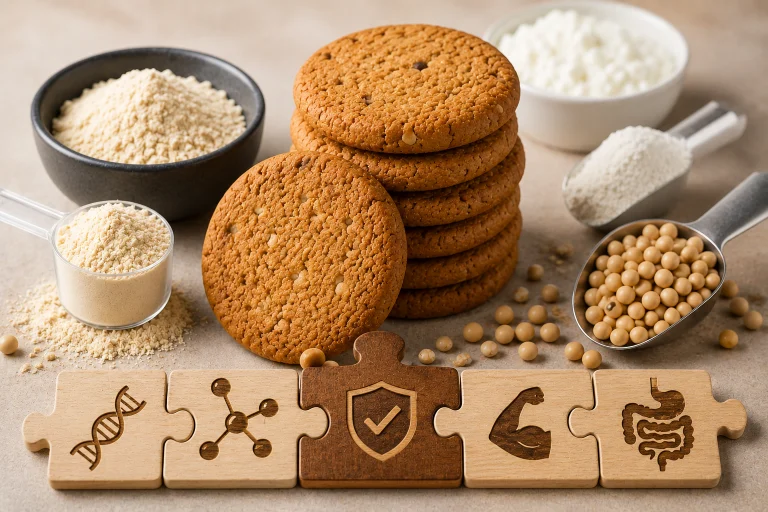
A formulation detail that rarely makes it onto packaging, but matters enormously for how “high-protein” claims actually perform nutritionally, is protein quality — not just the gram count on the label. The human body needs nine essential amino acids it cannot produce on its own, and different protein sources deliver very different amounts of each.
Whey and egg white proteins tend to score highly on the Protein Digestibility-Corrected Amino Acid Score (PDCAAS), a standard measure of how completely a protein source covers the body’s essential amino acid needs, often reaching the maximum score of 1.0. Single plant-based sources like pea or rice protein typically score lower on their own, though blending complementary plant proteins together can raise the overall amino acid completeness closer to that of animal-based sources. This matters for formulation because a biscuit listing “12g of protein” from a single, incomplete plant protein source isn’t nutritionally equivalent to the same gram count from whey or a well-blended plant protein combination, even though both would show the identical number on a nutrition label.
| Protein Source | Typical PDCAAS Range | Formulation Note |
| Whey protein (concentrate/isolate) | Up to 1.0 (complete) | Gold standard for both nutrition and baking function |
| Egg white protein | Close to 1.0 (complete) | Complete amino acid profile, can dry crumb if overused |
| Pea + rice protein blend | 0.8–0.9 when combined | Blending offsets each source’s individual amino acid gaps |
| Single-source soy protein isolate | Generally high, but flavor trade-offs apply | Complete profile, but off-flavor risk in delicate formulations |
| Single-source pea protein (alone) | Lower than blended | Best used in combination with a complementary plant protein |
For brands making protein claims on packaging, this is worth factoring into formulation decisions early, since a nutritionally complete protein source is a genuine, defensible quality differentiator — not just a marketing preference.
Common Formulation Failures in Protein Biscuits
- Hard, dense texture — usually caused by too much protein isolate disrupting the fat-sugar-flour “shortness” balance without a corresponding fat adjustment.
- Excessive spread or loss of shape during baking — can happen when protein alters dough elasticity in ways that aren’t accounted for in mixing time or resting period.
- Gritty or chalky mouthfeel — most common with high inclusion levels of pea or soy protein, especially in cracker-style biscuits with minimal fat to mask texture.
- Bitter or “off” aftertaste — often traced to protein isolate quality or insufficient flavor masking (cocoa, cheese powder, herbs, or spices, depending on sweet or savory formulation).
- Reduced shelf life versus the standard product — typically caused by higher final moisture content or water activity than the original recipe, often introduced unintentionally by hygroscopic protein or fiber ingredients.
- Inconsistent texture between batches — a strong signal that a formulation was validated on a small scale but never properly tested for consistency at full production volume.
From Formulation to Production: What Scaling a Protein Biscuit Actually Involves
Very few successful protein biscuit products are the direct result of a single winning test-kitchen batch. Getting from a promising prototype to a shelf-stable, mass-produced product involves a structured food formulation process: systematically testing protein-to-fat-to-flour ratios, validating dough machinability on real production equipment, running accelerated shelf-life testing under different humidity and temperature conditions, and confirming the final texture and moisture profile holds steady across multiple production runs, not just the first one. Food R&D teams such as Flavor Catalystz spend the bulk of their time exactly here, since a protein biscuit that tastes right in a small test batch can behave very differently once dough sheeting, oven dwell time, and packaging are all running at commercial scale.
Choosing or Formulating the Right Protein Biscuit for Your Purpose
| Your Priority | What to Look For or Formulate Toward | What to Avoid |
| Maximum protein per serving | Whey isolate or blended protein, 15g+ per 100g | Formulations relying only on egg or dairy solids for protein |
| Best texture/crispness | Whey concentrate, careful fat-to-flour ratio | High isolate ratio without a fat adjustment |
| Plant-based / vegan | Pea + rice protein blend with added flavor masking | Single-source soy or pea with no flavor adjustment |
| Long ambient shelf life | Low final moisture (under 5%), minimal hygroscopic additions | High-fiber or high-fiber-plus-protein formulations without moisture testing |
| Savory / cracker-style | Neutral-flavor protein (whey isolate, egg white) with herbs/cheese powder | Strongly flavored plant proteins without masking agents |
Final Thoughts
Protein biscuit formulation is a genuinely different technical problem from protein brownie formulation, even though both fall under the same “high-protein baked snack” umbrella that’s reshaping the wider snacking aisle. Getting a biscuit’s crisp texture, shelf stability, and protein content to all work together takes a deliberate, tested approach to fat ratios, protein source selection, and moisture control — the same formulation discipline that separates a protein biscuit that holds its snap for months from one that goes soft, dense, or gritty within weeks. For a deeper look at how these same formulation principles play out in a moisture-retaining format instead of a crisp one, see our companion guide on the food science behind high-protein brownies.
Frequently Asked Questions
Why do homemade protein biscuits often turn out hard or dry?
This usually happens because protein powder disrupts the fat-to-flour balance that keeps a biscuit dough “short” and tender. Adding a bit more fat or a small amount of liquid (like yogurt or milk) alongside the protein powder can help restore the intended texture.
Is whey protein or plant protein better for biscuit formulation?
Whey protein concentrate is generally the more forgiving option for biscuit and cookie formulation because it supports water binding, contributes to Maillard browning, and has a clean, neutral flavor. Plant proteins like pea or soy can work well but often need extra flavor masking to avoid grittiness or an earthy aftertaste.
Why do some high-protein biscuits lose their crispness faster than regular biscuits?
This is often a moisture and water activity issue. Protein powders and added fiber can be hygroscopic, meaning they attract moisture from the air, which can soften a biscuit’s texture over time if the formulation and packaging aren’t adjusted to compensate.
Can I just add protein powder to any biscuit or cookie recipe?
Not directly, without adjustments. Because biscuit texture depends on a specific balance between fat, sugar, and flour, adding protein powder on top of an unmodified recipe usually throws that balance off, resulting in a harder or more crumbly result than intended.
What’s the difference between formulating a protein biscuit and a protein brownie?
A protein brownie formulation is centered on retaining moisture and fat to stay soft, while a protein biscuit formulation is centered on controlling gluten development and driving moisture down for a crisp, shelf-stable result — meaning the two require almost opposite formulation strategies despite both being “protein bakery” products.
How much protein can be added to a biscuit before texture and taste suffer?
There’s no universal number, since it depends on the protein source and the rest of the formulation, but many well-formulated protein biscuits successfully reach 15–20 grams of protein per 100 grams without major taste or texture compromise when the fat and moisture balance is adjusted accordingly.
Do protein biscuits have a shorter shelf life than regular biscuits?
Not necessarily, if formulated correctly. Well-made hard-dough protein biscuits can achieve shelf lives comparable to conventional biscuits, provided moisture content and water activity are properly controlled during formulation and packaging.
Are gluten-free protein biscuits harder to formulate?
Yes, generally. Removing gluten removes one of the key structural elements in biscuit dough, so gluten-free protein biscuit formulations typically need additional binders (like xanthan gum, tapioca starch, or psyllium husk) to hold their shape, on top of the adjustments already required for the added protein.