May 2026 · 16 min read
Most food startup founders come to us with a good idea, a clear consumer insight, and a burning urgency to launch. What they are less prepared for is the process between having the idea and holding a finished, market-ready product in their hands.
Private label food product development is both more accessible and more complex than most people expect. It is more accessible because India has a vast and capable manufacturing ecosystem willing to produce under your brand. It is more complex because formulation, compliance, packaging, quality systems, and supply chain decisions all need to come together, and the sequence in which you do them matters a lot.
This guide gives you a step-by-step breakdown of how private label food product development actually works in India in 2025. Not a generic overview. A practical, honest account of each stage and what you need to do right to move through it efficiently.
What Private Label Actually Means in the Food Context
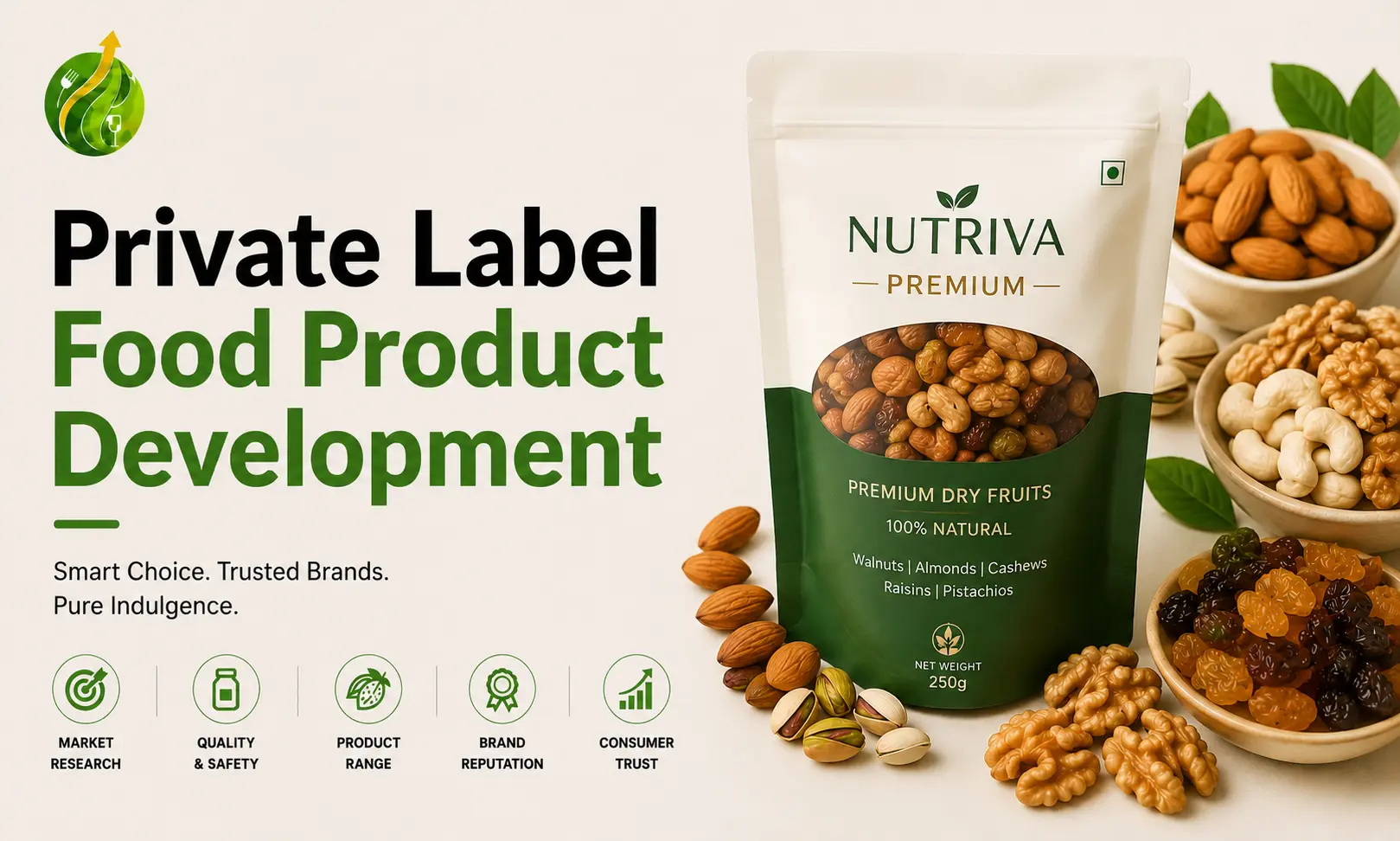
Private label food means you sell a product under your own brand name that is manufactured by a third-party manufacturer. The product may use the manufacturer’s existing formulation (white-label), a formulation you have developed, or something co-developed between you and the manufacturer.
Private label is not a shortcut or a compromise. Many of India’s most successful D2C food brands, including brands you shop regularly on platforms like Blinkit, Amazon Fresh, and BigBasket, operate exactly this way. They own the brand, the customer relationship, and the product specifications. They partner with manufacturers for production.
The model works because it separates brand-building (your strength) from manufacturing (the manufacturer’s strength). Done right, it lets you scale faster, maintain quality, and protect your margins.
Private Label Food Product Development: From Idea to Shelf
The journey from concept to a product sitting in a customer’s hands in India typically involves eight distinct stages. Skipping or rushing any of them creates problems downstream that are expensive to fix.
Stage 1: Market Research and Product Concept Validation
Before you formulate anything, you need to validate that your product concept has a real market. The best product development starts not in a kitchen or a lab but in the market.
What you are looking for is an unmet need, a verifiable trend, or a white space that competitors have not yet occupied. Good research at this stage answers three questions: Who specifically will buy this product? Why will they choose it over what is already available? What price are they willing to pay?
India’s food startup ecosystem has grown rapidly. The sector saw over USD 4.16 billion in total funding in the last decade, with 842 food and beverage product startups founded in 2020 alone. This means competition is real, and the ‘good enough’ product that could have succeeded in 2018 may not find enough white space today.
Validation tools at this stage include: consumer surveys (online and in-person), testing with target customer groups, competitor product analysis, retail audits of existing products in your category, and trend analysis using data from platforms like Blinkit, Swiggy Instamart, and Amazon.
Stage 2: Product Formulation and Recipe Development
Once you know what you want to make and for whom, formulation is the next step. In private label, you have three routes.
- Use an existing manufacturer’s standard formulation: Fastest route to market. Lower upfront cost. You have less control over the recipe. Good for testing a concept before investing in custom development.
- Co-develop with a manufacturer or food R&D firm: You specify the functional and sensory requirements, and a food technologist develops a formulation to meet them. Takes 4-12 weeks typically. Gives you more differentiation.
- Bring your own proprietary recipe: You own the formulation. The manufacturer only processes it. Best for protecting your IP, but requires formulation to be kitchen-tested and scalable before the manufacturer sees it.
Professional food R&D organizations in India, including contract R&D firms and integrated partners, can support food formulation. Key considerations during formulation include ingredient compatibility, processability at scale, shelf stability, taste profile at commercial batch size (which often differs from kitchen scale), and nutritional profile.
Stage 3: Regulatory Check and Compliance Planning
Every food product sold in India must comply with FSSAI regulations. This is not a formality. Getting your regulatory status wrong can mean your product cannot legally be sold, or worse, gets pulled from shelves after launch.
Regulatory considerations at this stage include:
- Which FSSAI category does your product fall under, and what are the permitted ingredients and standards for that category?
- Does your product make any health or nutritional claims? These require specific evidence and compliance with FSSAI’s advertising and claims regulations.
- Are any of your ingredients novel or not yet approved under FSSAI? Novel ingredients require a separate approval process.
- Does your product require any additional certifications, for example, organic certification from APEDA, or export certification if you plan to sell internationally?
Engage an FSSAI compliance consultant at this stage, not after formulation is finalized. Discovering a regulatory issue after you have already finalized your recipe and ordered packaging is a painful and expensive outcome.
Stage 4: Finding and Evaluating a Contract Manufacturer
Your private label product is only as good as the manufacturer producing it. This stage deserves more time than most founders give it.
What to look for in a private label food manufacturer in India:
- Valid FSSAI Central License for your product category
- Relevant processing equipment for your specific product (not just general food manufacturing capability)
- Experience with your product category or a closely related one
- Quality systems: in-house or NABL-accredited third-party lab access
- Willingness to do trial batches at your initial quantities
- Clear batch traceability and documentation practices
- References you can independently verify from current clients
Always visit the facility in person before signing any agreement. The facility visit is the single best due diligence activity you can do. What you see on the factory floor tells you more than any document or presentation.
Stage 5: Trial Production and Sensory Testing
The first commercial-scale batch is almost never perfect. Plan for a minimum of one to three trial batches to stabilize the product at manufacturing scale. This is normal and expected.
Trial batches serve to: confirm the formulation behaves correctly at commercial batch size, identify processing parameters that need adjustment, generate samples for consumer testing and sensory evaluation, and produce samples for initial shelf life testing.
Do not skip sensory testing with your actual target consumers. A product that performs well with the founders and the development team may not resonate the same way with a fresh consumer panel. This is particularly true for flavour-forward products like snacks, beverages, and condiments.
Stage 6: Packaging Design and Development
Packaging is not just a container. It is the primary communication channel between your product and the consumer at the moment of purchase. Private label food brands that invest in good packaging design consistently outperform those that treat packaging as an afterthought.
At this stage, you are working in parallel on two things: structural packaging (the format, material, and functional design of the package) and graphic design (the visual identity, information hierarchy, and brand communication).
FSSAI labelling requirements must be met on every product, including: product name, ingredients list in descending order of weight, nutritional information per serving and per 100g, FSSAI license number, manufacturer name and address, net quantity, MRP, batch number, date of manufacture and best before date, vegetarian/non-vegetarian symbol, and any mandatory warnings.
Custom packaging minimum print runs in India typically start at 5,000 to 10,000 units. This is a significant upfront cost for very small startups, and it is worth factoring into your launch budget realistically.
Stage 7: Shelf Life Testing and Product Approval
Before you launch, your product needs validated shelf life data. This is done through two methods: real-time shelf life studies (storing product at intended conditions and testing at defined time points) and accelerated shelf life testing (ASLT, which uses higher temperature and humidity to predict shelf life in shorter time).
FSSAI requires that shelf life claims be substantiated. For most dry food products, manufacturers have enough historical data to support standard claims. For new product types or novel formulations, proper shelf life testing is necessary.
The approval process also includes a final product specification sign-off between you and the manufacturer, which becomes the reference document for all future production batches.
Stage 8: Launch Readiness and Go-to-Market Execution
With product ready, compliant, and tested, you are now moving into go-to-market. Private label brands in India have more channel options than ever. D2C through your own website, quick commerce platforms (Blinkit, Zepto, Swiggy Instamart), marketplace selling (Amazon, Flipkart), offline general trade, modern trade (supermarkets), or institutional sales.
Each channel has different margin structures, listing requirements, and operational demands. Starting with one or two channels and doing them well is consistently a better approach than trying to be everywhere at launch.
Private Label Food Product Development: Stage-by-Stage Timeline and Cost
| Stage | Typical Timeline | Estimated Cost Range | Who Does the Work |
| Market research and concept validation | 2 – 4 weeks | Rs 0 – Rs 50,000 | Founder + market data |
| Formulation development | 4 – 12 weeks | Rs 15,000 – Rs 1.5 lakh | R&D partner / manufacturer |
| Regulatory review and compliance planning | 2 – 4 weeks | Rs 10,000 – Rs 50,000 | FSSAI consultant |
| Manufacturer identification and vetting | 3 – 6 weeks | Rs 0 – Rs 20,000 (travel, audits) | Founder + sourcing partner |
| Trial production (2-3 batches) | 4 – 10 weeks | Rs 20,000 – Rs 2 lakh | Manufacturer + founder QC |
| Packaging design and production | 6 – 10 weeks | Rs 30,000 – Rs 3 lakh | Design agency + printer |
| Shelf life testing | 4 – 16 weeks (real-time) / 2-4 weeks (ASLT) | Rs 15,000 – Rs 60,000 | NABL lab |
| First commercial production | 2 – 4 weeks post approval | Depends on MOQ and pricing | Manufacturer |
| Total (concept to first sale) | 6 – 12 months | Rs 1 lakh – Rs 10+ lakh | Full team |
What Makes a Private Label Product Actually Succeed in India?
The Indian food startup ecosystem has seen enough launches to identify clear patterns in what works and what does not.
Differentiation is not optional
If your product is the same as three other brands already on the shelf, price becomes the only differentiator. That is a race to the bottom. The best private label food products in India have a clear, specific reason to be chosen: a better-for-you formulation, a heritage ingredient used innovatively, a superior taste profile in a familiar format, or a meaningful story that resonates with a specific consumer tribe.
Start focused, then expand
The temptation to launch with a wide SKU range is real but dangerous. Most successful Indian food startups launched with one or two hero products, validated demand, refined the product based on real feedback, and then expanded. More SKUs mean more manufacturing complexity, more packaging costs, and more working capital tied up in inventory.
Quality consistency is a brand asset
One inconsistent batch that reaches your customers costs you far more than the batch itself. Reviews, returns, and lost trust are expensive. This is why your manufacturing agreement, quality specifications, and batch testing protocol matter as much as the product itself.
Unit economics before scale
Know your cost of goods sold at your current MOQ before committing to larger volumes. Know what your COGS will be at 10x volume. Know your target retail price and work backwards to determine whether the margins make sense for your chosen channels. Many food brands discover their unit economics are broken only after they have scaled.
Private Label vs White Label vs Fully Custom: Understanding Your Options
| Model | What It Means | Time to Market | IP Ownership | Cost | Best For |
| White Label | Manufacturer’s standard product, your branding only | 4 – 8 weeks | None (recipe belongs to manufacturer) | Lowest | Testing a concept, fast launch, commodity categories |
| Co-developed Private Label | Formulation developed jointly between brand and manufacturer | 10 – 20 weeks | Negotiated. Should be documented in contract. | Moderate | Brands wanting differentiation without full R&D investment |
| Fully Custom / Proprietary | Brand owns the complete recipe and process spec | 16 – 40 weeks | 100% owned by brand | Highest | Established brands, unique products, export-focused businesses |
Common Mistakes in Private Label Food Product Development
- Choosing a manufacturer based on the lowest quote without verifying quality systems or capacity.
- Finalizing packaging before the formulation is stable. Packaging specifications depend on product format, moisture content, and shelf life requirements.
- Not protecting their recipe. If you have a proprietary formulation, it must be explicitly protected in your manufacturing agreement. Verbal assurances do not hold up.
- Underestimating working capital requirements. Between paying for first production batches, packaging materials, and inventory before first sale, working capital needs are significant.
- Skipping regulatory consultation early. Discovering a compliance issue after packaging is printed is expensive. It is far cheaper to verify regulatory status before artwork is finalized.
- Not planning for return merchandise. What happens to expired, damaged, or rejected inventory? Your supply chain and financial model need to account for this.
- Launching in too many channels simultaneously. Each channel has its own terms, fulfilment requirements, and margin structures. Starting focused is almost always more effective.
Pre-Launch Checklist: What You Need Before Your First Commercial Batch
| Checklist Item | Status Check | Notes |
| FSSAI license (manufacturer) | Verify on fssai.gov.in directly | Do not rely on copies shared by manufacturer |
| FSSAI registration (your brand) | Must be in place before product goes to market | Required for label compliance |
| Final formulation sign-off | Written approval of product specification | Becomes the quality reference document |
| Manufacturing agreement signed | Covers IP, pricing, MOQ, quality, exit | Engage a lawyer for this |
| Packaging artwork approved | FSSAI-compliant label reviewed | Include all mandatory declarations |
| Shelf life data validated | Real-time or ASLT results on file | Must support the ‘best before’ claim |
| Raw material sourcing confirmed | Know where key ingredients come from | Especially important for seasonal items |
| Certificate of Analysis (CoA) for trial batch | From NABL-accredited lab | Baseline quality data for your product |
| Logistics and warehousing plan | Where does inventory go after production? | Critical for D2C and quick commerce |
| First order and payment terms agreed | Clear payment schedule with manufacturer | Typical: 30-50% advance, balance on delivery |
The Role of a Development Partner in Private Label
Many successful food brands in India do not manage the entire development process themselves. They work with development partners who know the manufacturing ecosystem, understand compliance requirements, and can accelerate the process by connecting brands directly with the right manufacturers.
The value of a good development partner is not just speed. It is the mistakes they help you avoid. An experienced partner has seen which manufacturers consistently deliver quality, which ones struggle with small-batch clients, which ones have the right equipment for specific product types, and which ones are genuinely startup-friendly versus those who say they are.
How Flavor Catalystz Helps Private Label Food Brands Launch in India
At Flavor Catalystz, we exist to help food founders move from concept to market-ready product without the painful, expensive trial-and-error that most brands experience when navigating India’s contract manufacturing landscape alone.
Our process is hands-on from the start. We help you define your product specifications clearly, identify and vet the right manufacturing partner for your category and scale, structure a manufacturing agreement that protects your IP and your brand, and support you through trial batches to first commercial production.
We do not believe in one-size-fits-all advice. Every product and every brand is different. A founder launching a first SKU in the D2C snacking space has very different needs from a mid-market brand adding a new category to an established portfolio. We start with your specific situation, not a generic framework.
If you are at any stage of the private label development process and want an honest conversation about what your next step should be, we are easy to reach and genuinely interested in the challenge.
Frequently Asked Questions
How much does it cost to develop a private label food product in India?
Total costs vary significantly based on product complexity, the route to formulation, and your packaging choices. For a relatively straightforward product like a dry snack or spice blend using a co-developed formulation and standard packaging, you can expect to spend Rs 1.5 lakh to Rs 5 lakh from concept to first commercial batch. More complex products, custom formulations, or premium packaging can take total development costs to Rs 10 lakh or higher before first sale. Working capital for inventory is separate from development costs.
Who owns the recipe in a private label arrangement?
This depends entirely on what your manufacturing agreement says. By default, if a manufacturer develops the formulation, they may claim ownership. If you bring your own recipe or pay for a co-developed formulation, you should document ownership explicitly in the manufacturing agreement. Never assume verbal assurances about recipe ownership are sufficient. A clear IP clause in your contract is non-negotiable if you want to protect your product from being replicated under another brand.
Can I register a private label food product on quick commerce platforms in India?
Yes, platforms like Blinkit, Zepto, and Swiggy Instamart accept private label food products. You need a valid FSSAI registration, GSTIN, a trademarked or registered brand name (recommended), and product listings with complete nutritional and ingredient information. Quick commerce platforms often have specific requirements around packaging size, weight, and barcode format. Review the seller documentation for each platform before finalizing your packaging specs.
How do I protect my food product formula?
In India, food formulations are typically protected through a combination of contractual confidentiality clauses, manufacturing agreements with non-disclosure provisions, and practical secrecy (not sharing the full recipe with any single party). Food formulations cannot be patented in most cases because they typically do not meet the ‘inventive step’ criterion under Indian patent law. Your strongest protection is a well-drafted manufacturing agreement that explicitly restricts the manufacturer from using your formulation for any other client and from sharing it with third parties.
What is the minimum order quantity for private label food in India?
This varies by product and manufacturer. Dry blends and spice mixes often have MOQs starting at 100-300 kg. Snacks, biscuits, and extruded products typically start at 500-2,000 kg per batch. Beverages and liquid products often have higher MOQs due to manufacturing economics. If you are a startup, seek manufacturers who are genuinely open to working with smaller initial batches, because not all manufacturers are equally startup-friendly. A trial batch at 100-200 kg before committing to full production is a reasonable ask from most reputable manufacturers.
How long does it take to get a product to market through private label in India?
The shortest realistic timeline for a product using an existing formulation and standard packaging is 10-12 weeks. For a co-developed product with custom formulation, expect 4-6 months from concept to first commercial batch. For complex products requiring specialized equipment, extensive shelf life testing, or regulatory approvals beyond standard FSSAI, 6-12 months is more realistic. Planning your launch date backwards from these timelines helps you avoid the pressure of trying to rush a process that has natural minimum durations at each stage.
Do I need to be present in India to launch a private label food brand?
Not necessarily, but it makes the process significantly more manageable. The most important in-person activity is the manufacturer facility visit, which is strongly recommended before signing any agreement. If you are based outside India, working with a development partner who can conduct due diligence on your behalf and manage day-to-day communication with the manufacturer is highly advisable. Remote brands have successfully launched Indian private label products, but they typically work with trusted local partners to manage quality oversight and logistics.