May 2026 · 21 min read
India’s gut health revolution is no longer a niche wellness conversation — it has entered the mainstream. From urban millennials managing IBS and bloating to health-conscious parents looking for natural immunity support for their families, the demand for functional gut health beverages has never been higher. Prebiotic and probiotic drink formulation is now one of the fastest-growing product development categories in India’s functional beverage industry.
Global brands like Yakult, Kevita, and GoodBelly have already built billion-dollar businesses on the back of gut health science. In India, the market is at an inflection point — growing domestic awareness, rising disposable incomes, and a cultural affinity for fermented foods like curd, lassi, and kanji have created the perfect environment for a new generation of science-backed, ready-to-drink (RTD) gut health beverages.
This guide provides a complete, research-backed deep dive into prebiotic probiotic drink formulation — covering ingredient science, formulation challenges, stability protocols, FSSAI regulatory compliance, manufacturing requirements, and commercial strategy for beverage brands targeting India’s gut health market.
What Is Prebiotic and Probiotic Drink Formulation?
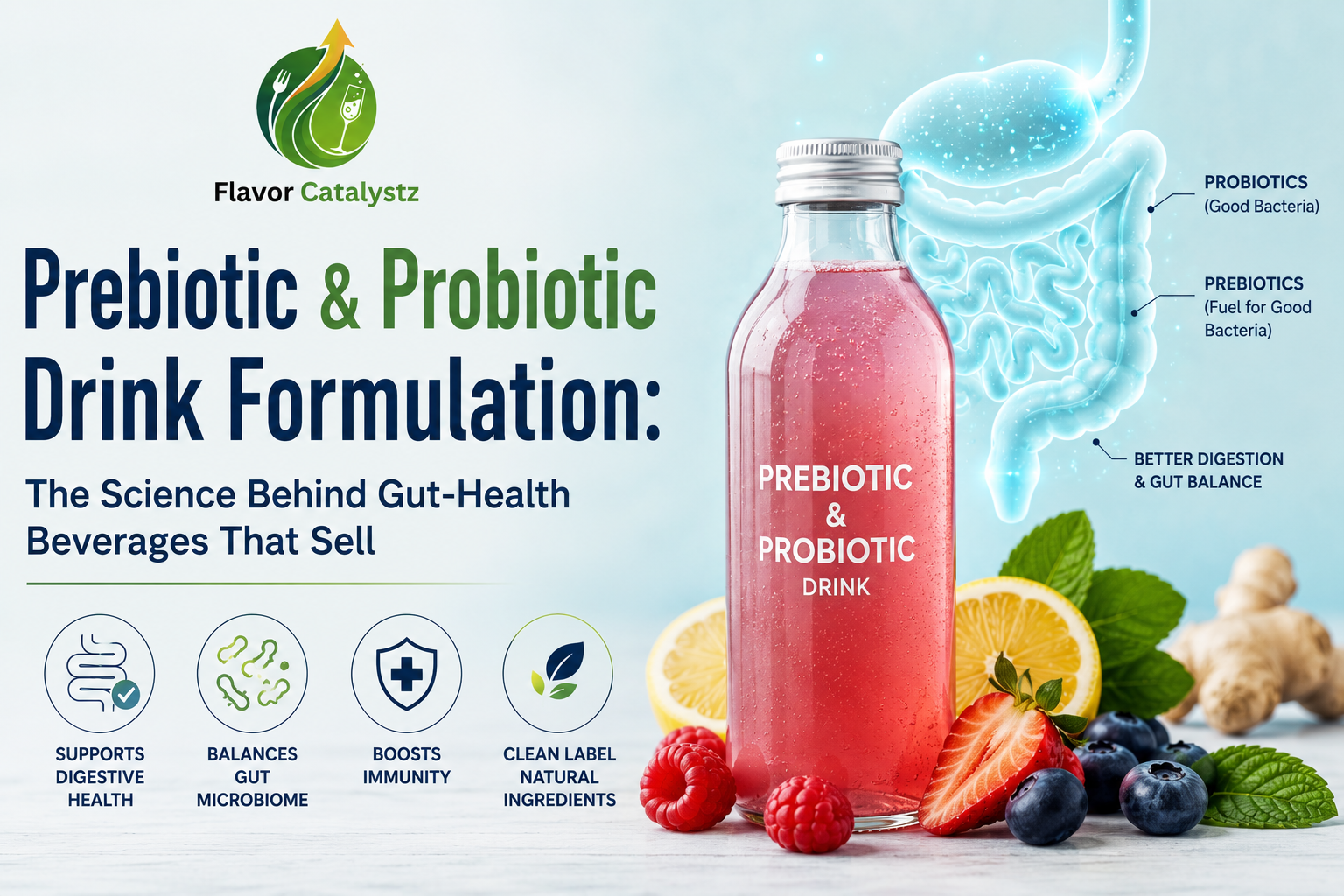
Before entering the formulation process, it is essential to understand the precise scientific distinction between prebiotics and probiotics — and why combining them in a single beverage format creates what the industry calls a ‘synbiotic’ product.
Probiotics: The Live Microorganisms
Probiotics are live, beneficial microorganisms that, when consumed in adequate quantities, confer a measurable health benefit on the host. In beverage formulation, the most commercially used probiotic strains include:
- Lactobacillus acidophilus — most widely researched, strong association with digestive comfort and lactose tolerance.
- Lactobacillus rhamnosus GG (LGG) — clinically proven for diarrhoea prevention, one of the most studied strains globally.
- Bifidobacterium longum — supports colon health, immunity modulation, particularly effective in older consumers.
- Bifidobacterium lactis BB-12 — excellent heat tolerance relative to other strains, ideal for certain processing conditions.
- Lactobacillus plantarum — naturally present in Indian fermented foods; high robustness, excellent acid tolerance.
- Saccharomyces boulardii — yeast-based probiotic, exceptionally stable at room temperature, ideal for RTD applications.
Prebiotics: The Fuel That Feeds the Good Bacteria
Prebiotics are non-digestible dietary fibres and compounds that selectively stimulate the growth and activity of beneficial gut microorganisms. Key prebiotic ingredients used in gut health beverage formulation include:
- Inulin (from chicory root) — most widely used prebiotic globally; sweet taste profile, partially soluble, bifidogenic effect.
- Fructooligosaccharides (FOS) — short-chain prebiotic, very soluble, mildly sweet, compatible with most flavour systems.
- Galactooligosaccharides (GOS) — derived from lactose, excellent for infant-adjacent and adult gut health products.
- Resistant Dextrin (Fibersol) — heat-stable, transparent in solution, ideal for clear RTD beverage formats.
- Partially Hydrolyzed Guar Gum (PHGG) — excellent solubility, neutral taste, clinically backed for IBS management.
- Pectin (Apple/Citrus) — dual function as prebiotic and natural stabiliser; ideal for fruit-based gut health drinks.
Synbiotics: The Premium Formulation Category
When you combine a validated probiotic strain with a specific prebiotic that selectively feeds that strain, you create a synbiotic formulation. The synergistic effect of synbiotics produces measurably superior gut health outcomes versus either ingredient alone — and commands a significant premium in the market. Most of India’s next-generation gut health beverage brands are targeting this synbiotic positioning.
Key Insight: The global synbiotic beverage market was valued at USD 42 billion in 2023 and is projected to grow at a CAGR of 8.3% through 2030. India’s share is still nascent — presenting a massive first-mover advantage for well-formulated brands.
How Are Gut Health Beverages Made? The Core Formulation Science
The formulation of a prebiotic probiotic beverage is fundamentally different from any other functional drink category. The presence of live microorganisms introduces constraints that touch every aspect of the process — from water quality to filling technology to packaging material.
The Four Core Formulation Challenges
Every beverage formulation consultant working in this category must solve four non-negotiable technical problems:
- Probiotic Viability: Maintaining minimum 10^6 to 10^9 CFU (Colony Forming Units) per ml through the entire shelf life — not just at production.
- Oxygen Sensitivity: Most Lactobacillus and Bifidobacterium strains are anaerobic or microaerophilic — oxygen exposure rapidly kills them.
- pH Tolerance: Probiotic organisms generally prefer pH 4.0–4.5; going below 3.8 causes rapid die-off in most strains.
- Temperature Sensitivity: Most strains require cold-chain storage below 8°C. Only specifically encapsulated or robust strains (like S. boulardii) are genuinely ambient-stable.
The Role of Water Quality
The base water for probiotic beverage production must be free of chlorine and chloramine — both are bactericidal and will kill your probiotic culture immediately. Use RO-treated water with activated carbon filtration to ensure zero residual disinfectants. Conductivity should be below 20 microsiemens per cm. Total dissolved solids (TDS) below 50 mg/L is ideal for a clean base.
pH Engineering for Probiotic Survival
The product pH must be carefully balanced between two competing requirements: food safety (pH below 4.5 to inhibit pathogen growth) and probiotic survival (pH above 3.8 to maintain cell viability). The sweet zone is pH 4.0–4.3. Acidulants of choice are lactic acid (most compatible with probiotic organisms — it’s their natural metabolic product), malic acid, and citric acid as a minor adjunct for flavour brightness. Avoid phosphoric acid — it is toxic to most probiotic strains at beverage concentrations.
Helpful Guide:- Energy Drink Formulation: The Complete Guide to Crafting a Market-Ready Beverage
Probiotic Strain Selection: The Most Critical Decision in Gut Health Beverage Formulation
Your probiotic strain is your product’s core scientific asset. Strain selection determines not only the efficacy profile of your product but also its formulation compatibility, shelf-life performance, regulatory status, and marketing claims. This is not a decision to make based on cost alone.
| Probiotic Strain | CFU Target | Temp. Stability | Acid Tolerance | Key Health Benefit | Best Beverage Format |
| L. acidophilus NCFM | 10^8–10^9/ml | Cold chain | Moderate | Digestive comfort, lactose tolerance | Dairy-based RTD, lassi-style |
| L. rhamnosus GG (LGG) | 10^8–10^9/ml | Cold chain | High | Diarrhoea prevention, immunity | Fruit-based RTD, kids drinks |
| L. plantarum 299v | 10^8/ml | Cold chain | Very High | IBS relief, bloating reduction | Low-pH fruit beverages |
| B. longum BB536 | 10^7–10^8/ml | Cold chain | Moderate | Colon health, allergy modulation | Dairy-free wellness drinks |
| S. boulardii CNCM I-745 | 10^8–10^9/ml | Ambient stable | Very High | Antibiotic-associated diarrhoea | Ambient RTD, travel packs |
| B. lactis BB-12 | 10^8/ml | Cold chain | High | Gut transit, immunity | Fermented dairy alternatives |
Expert Note: Always source patented, clinically documented strains from verified suppliers such as Chr. Hansen, IFF-DuPont Danisco, Lallemand, or Morinaga. Generic strains from unverified sources may not survive to the end of shelf life — destroying your product’s efficacy claim and brand credibility.
Step-by-Step: Prebiotic Probiotic Drink Formulation Process
Here is a professional-grade formulation workflow for a ready-to-drink synbiotic beverage targeting India’s gut health market. Each stage must be executed in sequence with strict quality controls.
Stage 1: Base Liquid Selection and Preparation
Your base liquid defines the product’s category, texture, and consumer positioning. Common base options for gut health beverages in India include:
- Coconut water base — naturally isotonic, culturally familiar in India, excellent electrolyte profile, clean taste that doesn’t compete with probiotic culture notes.
- Apple juice base (clarified) — compatible pH range, prebiotic pectin naturally present, high consumer acceptance.
- Plant-based milk base (oat, almond, rice) — ideal for dairy-free probiotic drinks, growing demand in urban India.
- Water base with flavour system — lowest cost, cleanest label, maximum formulation flexibility.
- Fermented base (kombucha, water kefir, jun) — carries inherent probiotic culture, tangy flavour profile, authentic fermentation story.
Stage 2: Prebiotic Ingredient Integration
Add your prebiotic ingredient to the base liquid under gentle agitation at 20–25°C. For inulin and FOS, ensure complete hydration before proceeding — undissolved prebiotic particles cause haze and sedimentation. Optimal prebiotic dose for efficacy: 3–5g per serving (as per ISAPP — International Scientific Association for Probiotics and Prebiotics guidelines). For clear beverages, use Resistant Dextrin (Fibersol-2) or PHGG — both produce water-clear solutions. For slightly opaque beverages, inulin and FOS provide a richer mouthfeel that consumers associate with a more ‘functional’ product.
Stage 3: Flavour and Sweetener System
Gut health beverages must avoid high sugar — both for health positioning and because high sucrose concentrations can inhibit probiotic growth. Target sugar content: below 5g per 100ml. Recommended sweetener system:
- Stevia (RA-97 grade): 0.02–0.04% — clean sweetness, FSSAI approved, compatible with probiotic cultures.
- Erythritol: 1–3% — provides mouthfeel, non-cariogenic, does not feed competing bacteria.
- Monk fruit extract: 0.01–0.02% — premium, natural, increasingly demanded in urban India.
For flavour, India-specific options that work exceptionally well in gut health positioning include: Raw Mango (Aam Panna angle), Turmeric-Ginger (immune-gut crossover), Kokum-Hibiscus (natural fermented note), Amla-Berry (Vitamin C + gut health story), and Jeera-Mint (digestive cultural heritage association).
Stage 4: pH Adjustment and Acidification
After integrating prebiotic, sweetener, and flavour components, adjust pH to the target range of 4.0–4.3 using lactic acid as the primary acidulant. Measure pH with a calibrated benchtop pH meter — never rely on litmus strips for this precision work. Allow the product to equilibrate for 30 minutes before final pH verification. Minor citric acid additions (0.05–0.1%) can be used for flavour brightness without significantly affecting probiotic viability at the quantities used.
Stage 5: Probiotic Inoculation — The Most Sensitive Stage
Probiotic cultures must be added at the very last stage, after all other ingredients are combined and temperature-stabilised. Critical parameters for this stage:
- Temperature at inoculation: strictly 20–25°C — never above 30°C.
- Agitation: gentle paddle or low-RPM agitation only — high-shear mixing kills probiotic cells.
- Oxygen exposure: minimise by using nitrogen-blanketed mixing vessels.
- Inoculation dose: add 10–20% excess CFU above label claim to account for die-off during shelf life.
- Always use freeze-dried Direct Vat Set (DVS) cultures from your supplier — these offer maximum shelf stability compared to liquid cultures.
Stage 6: Encapsulation Technology (for Ambient Stability)
If your product requires ambient (non-refrigerated) distribution — which is critical for India’s vast semi-urban and rural markets where cold chain infrastructure is unreliable — you must use microencapsulated probiotic cultures. Microencapsulation involves coating probiotic cells in a protective matrix (typically alginate, gelatin, or modified starch) that shields them from heat, oxygen, acid, and moisture. Encapsulated probiotics can extend viability at 25–30°C ambient storage by 6–12 months versus non-encapsulated strains. This is a significant investment but is non-negotiable for ambient RTD formats.
Stage 7: Filling and Packaging
Packaging for probiotic beverages is not a cosmetic decision — it is a scientific one. Key requirements:
- Oxygen Barrier Packaging: Use multilayer PET with EVOH (Ethylene Vinyl Alcohol) barrier layer, or Tetra Pak multilayer cartons. Standard PET bottles allow oxygen ingress that kills probiotic cells within weeks.
- Nitrogen Flushing: Flush headspace with food-grade nitrogen before capping to eliminate residual oxygen.
- Fill Temperature: Cold-fill at 4–8°C for refrigerated products; ambient fill for encapsulated ambient-stable products.
- Seal Integrity: 100% seal testing is mandatory — any micro-leak allows oxygen ingress and microbial contamination.
Critical Rule: Never hot-fill a live probiotic beverage. Temperatures above 45°C during filling will kill your entire probiotic culture. Hot-fill is only suitable for prebiotic-only (no live culture) gut health drinks.
Helpful Guide:- Sparkling Protein Water Formulation: How to Build India’s Next Trending Health Drink
Are Probiotic Drinks Good for Digestion? The Evidence Base
This is the most frequently searched consumer question in India’s gut health beverage category — and getting the answer right is critical for your brand’s credibility and marketing strategy.
What the Clinical Evidence Shows
The scientific evidence for probiotic benefits is strong in specific, well-defined conditions. Here is what is clinically substantiated at meaningful dosage levels (10^8–10^9 CFU per day):
- Antibiotic-Associated Diarrhoea (AAD): Strong evidence. L. rhamnosus GG and S. boulardii reduce AAD incidence by 40–50% in randomised controlled trials.
- IBS Symptom Management: Moderate-to-strong evidence. L. plantarum 299v clinically reduces bloating, flatulence, and abdominal pain in IBS patients.
- Lactose Intolerance: Strong evidence. L. acidophilus and B. longum improve lactose digestion significantly.
- Immune Modulation: Emerging strong evidence. Multiple Lactobacillus and Bifidobacterium strains reduce duration and severity of upper respiratory infections.
- Gut Microbiome Diversity: Consistent evidence that regular probiotic consumption, especially synbiotic combinations, increases beneficial bacteria species diversity.
What the Evidence Does NOT Support (Yet)
Responsible marketing requires equally knowing what claims you cannot make. Current evidence is insufficient or mixed for: significant weight loss directly attributable to probiotics alone; mental health improvement (the gut-brain axis research is promising but not yet label-claim grade); and cancer prevention. FSSAI and ASCI (Advertising Standards Council of India) require substantiation for any health claim — never overclaim.
| Health Benefit | Evidence Level | Recommended Strain | Minimum CFU/Serving |
| Digestive comfort / bloating | Strong | L. plantarum 299v | 10^8 CFU |
| Diarrhoea prevention | Strong | L. rhamnosus GG | 10^9 CFU |
| Lactose intolerance | Strong | L. acidophilus NCFM | 10^8 CFU |
| Immune support | Moderate-Strong | B. lactis BB-12 | 10^8 CFU |
| IBS management | Moderate | L. plantarum + FOS | 10^8–10^9 CFU |
| Gut microbiome diversity | Moderate | Multi-strain synbiotic | 10^9 CFU total |
Low Sugar Gut Health Beverage Formulation: Meeting India’s Clean Label Demand
India’s health-conscious consumer in 2025 reads labels with a level of scrutiny that was unimaginable five years ago. Sugar is the number one ingredient that modern gut health beverage buyers actively avoid. Here is how to formulate a genuinely low-sugar, clean-label gut health beverage without compromising taste, mouthfeel, or probiotic viability.
Why Low Sugar Matters for Probiotic Formulation — Beyond Marketing
High sucrose concentration (above 8% w/v) actively suppresses the metabolic activity of Lactobacillus strains and can shift the microbiome balance toward less beneficial organisms in the consumer’s gut. So low sugar formulation is not just a marketing label decision — it is also better science.
Clean Label Sweetener Stack for India Market
- Stevia (RA-97, RA-100 grade): Primary sweetener. FSSAI approved. Produces zero glycaemic response. Use 150–400 ppm for beverage applications. Source certified non-GMO variants for premium positioning.
- Erythritol: Secondary sweetener for mouthfeel and bulk. 70% the sweetness of sugar. Zero glycaemic index. Fermentation-derived — clean label story. Use at 2–4% w/v.
- Allulose: Emerging premium option. 70% sweetness of sugar, 0.2 kcal/g (versus 4 kcal/g for sugar). Not yet widely available in India but gaining regulatory traction.
- Monk Fruit (Luo Han Guo Extract): Premium positioning ingredient. 200x sweeter than sugar. Excellent in combination with stevia to mask green/bitter notes.
Prebiotic as Natural Sweetness Contributor
FOS (Fructooligosaccharides) and inulin both have a mild, clean sweetness — approximately 30–50% the sweetness intensity of sucrose. Incorporating 3–5g of FOS per serving contributes measurable prebiotic benefit AND reduces the quantity of additional sweetener needed. This is a formulation strategy that simultaneously improves nutrition and simplifies your ingredient label.
Target Nutritional Profile for Low-Sugar Gut Health Beverages
| Parameter | Target per 250ml Serving | Benchmark Comparison |
| Total Calories | 25–50 kcal | Regular fruit juice: 110–130 kcal |
| Total Sugar | 2–5g | Yakult: 10.8g per 65ml bottle |
| Dietary Fibre (Prebiotics) | 3–5g | Daily adequate intake: 25–38g |
| Probiotic Count | 10^8–10^9 CFU | Minimum efficacy threshold |
| Sodium | 50–100mg | Electrolyte balance support |
| Protein | 0–3g | Optional — adds value |
FSSAI Regulatory Framework for Probiotic Beverages in India
Regulatory compliance is not optional, and in the probiotic beverage category, the rules are more specific than many brands realise. India’s FSSAI has issued specific guidelines for probiotic products that every manufacturer and brand must follow.
FSSAI Probiotic Guidelines — Key Requirements
- Probiotic products in India must comply with FSSAI Gazette Notification dated March 2011 and subsequent updates under FSS (Health Supplements, Nutraceuticals, Food for Special Dietary Use, Functional Food and Novel Food) Regulations 2022.
- Minimum viable probiotic count at end of shelf life must be declared on label — not just at time of manufacture. Minimum acceptable count: 10^6 CFU per gram or ml (FSSAI specification).
- Strain identity must be declared at genus, species, AND strain level — e.g., ‘Lactobacillus rhamnosus GG’ not just ‘Lactobacillus rhamnosus’ or ‘probiotic culture’.
- The term ‘PROBIOTIC’ may only appear on the label if the product meets the minimum CFU count throughout shelf life as verified by third-party lab testing.
- All health claims must comply with FSSAI Health Claims Regulations — only pre-approved claims are permitted. Custom claims require scientific dossier submission.
- FSSAI Central License mandatory for interstate distribution. State license for single-state operations.
Label Compliance Checklist
- Nutritional Information Table (per 100ml and per serving).
- Probiotic strain name at genus, species, strain designation level.
- Viable count at end of shelf life (e.g., ‘Contains minimum 10^8 CFU L. rhamnosus GG per serving at best before date’).
- Prebiotic ingredient name and quantity declared in ingredient list.
- Storage conditions clearly stated (e.g., ‘Refrigerate at 2–8°C. Do not freeze.’).
- Allergen declaration — dairy, soy, and gluten are common in probiotic carrier systems.
- Best Before Date with day, month, year format.
Regulatory Alert: FSSAI actively inspects and tests probiotic products in the market. Products found below their declared CFU count are subject to product recall, license suspension, and financial penalties under FSS Act 2006. Lab-verified shelf life testing is mandatory, not optional.
Manufacturing Requirements for Probiotic Beverage Production in India
Setting up or selecting a probiotic beverage manufacturing facility requires specialised infrastructure that goes significantly beyond standard beverage production requirements. This applies whether you are establishing your own plant or selecting a contract manufacturer.
Facility Requirements
- GMP (Good Manufacturing Practice) certified facility — FSSAI Schedule 4 compliance mandatory.
- Separate, climate-controlled microbiology laboratory for culture preparation, inoculation, and quality testing.
- Cold room storage for raw cultures and finished products: 2–8°C, 24/7 monitored with automated temperature alarms.
- Nitrogen generation or supply system for vessel blanketing and headspace flushing.
- Oxygen-barrier filling and capping line — standard beverage lines are inadequate.
- CIP/SIP (Clean-in-Place/Sterilise-in-Place) system with validated sanitation protocols — cross-contamination control is critical.
- Cleanroom or low-bioburden inoculation area: minimum ISO Class 7 (Class 10,000) environment.
Quality Control Testing Requirements
- CFU count testing (standard plate count on MRS agar for Lactobacillus, BL agar for Bifidobacterium) at production and at 1, 3, 6, 9, 12-month intervals.
- pH monitoring every batch — minimum 3 measurements at start, middle, and end of production run.
- Microbial contamination testing: Total Plate Count, Yeast and Mould Count, Coliform, E. coli, Salmonella, Listeria — per FSSAI microbiological standards.
- Prebiotic content verification via HPLC or enzymatic assay per batch.
- Packaging seal integrity testing — 100% leak testing or validated statistical sampling.
Contract Manufacturing Route for Startups
If establishing your own facility is not viable at your current stage, India has a small but growing network of probiotic-capable contract beverage manufacturers in Pune, Hyderabad, Bengaluru, and the Delhi NCR region. When evaluating a contract manufacturer for probiotic beverages, verify: FSSAI license covers nutraceuticals and health supplements category; existing cold chain filling line with oxygen barrier capability; dedicated microbiology lab with CFU testing capability; and prior experience with at least 2–3 probiotic beverage products. Always request a facility audit before signing any contract manufacturing agreement.
Market Strategy: Positioning and Launching a Gut Health Beverage Brand in India
Target Consumer Segments for India 2025
- Urban health-conscious millennials (25–38 years) — primary segment, highly educated on gut health, willing to pay premium for science-backed products.
- Post-antibiotic recovery consumers — significant opportunity, especially in Tier 1 and Tier 2 cities where antibiotic use is high.
- Women’s wellness segment — gut health, hormonal balance, and skin health connections are driving strong female consumer interest.
- Active ageing population (50+ years) — immunity, digestion, and gut microbiome decline concerns are driving this segment’s growth.
- Parents of young children — probiotic drinks for kids is a fast-growing subcategory with high repeat purchase rates.
Pricing Architecture
| Product Tier | Format | Price Range (INR) | Target Channel |
| Mass Accessible | 65ml bottle (Yakult-style) | ₹25–₹40 | Modern trade, kiranas |
| Mid-Premium | 250ml RTD bottle/carton | ₹60–₹100 | Pharmacy, health stores, D2C |
| Premium Synbiotic | 330ml with multi-strain formula | ₹120–₹180 | Gyms, D2C, premium grocery |
| Ultra-Premium | 500ml with clinical-grade strains | ₹200–₹350 | D2C, wellness clinics, exports |
Distribution Strategy
- D2C Website and Amazon/Flipkart Health: Fastest route to market, highest margin, direct consumer relationship — ideal first channel.
- Pharmacies and Medical Stores (Netmeds, Apollo Pharmacy, 1mg): High credibility for health products, strong probiotic category awareness.
- Quick Commerce (Blinkit, Zepto, Swiggy Instamart): Strong for impulse purchase and trial in urban markets.
- Health Food Stores and Organic Retailers (Nature’s Basket, Organic World): Premium positioning, educated consumer base.
- Gym and Wellness Centre Retail: Captive audience of health-committed consumers, high willingness to try functional beverages.
Brand Positioning Framework
The most successful gut health beverage brands in global markets share three positioning pillars: science credibility (specific strain names, CFU counts, clinical references), taste democratisation (proving that healthy doesn’t mean unpleasant), and lifestyle integration (making gut health a daily habit rather than a medical intervention). Your brand story must authentically connect all three. In India, additionally weaving in cultural references — the heritage of fermented foods, Ayurvedic digestive wisdom — creates powerful differentiation versus international brands entering the market.
>Helpful Guide:- Beverage Formulation Cost India: Complete 2026 Guide
Conclusion: The Gut Health Beverage Opportunity India Is Waiting For
The global gut health beverage market has been built on decades of clinical research, evolving consumer awareness, and increasingly sophisticated formulation science. India is now at exactly the same inflection point that the US and European markets were at 15 years ago — with one critical advantage: India’s consumer already has a deep cultural relationship with fermented, probiotic-rich foods. The journey from curd and kanji to science-backed RTD probiotic beverages is a natural one for the Indian consumer.
But the technical barriers to this category are real and significant. Probiotic viability, oxygen control, cold chain management, pH engineering, strain selection, and FSSAI regulatory compliance are not areas where improvisation works. The brands that will win India’s gut health beverage market will be those that invest in formulation science from day one — building products that genuinely deliver what they promise on the label.
The science is proven. The market is ready. The regulatory framework is in place. What India’s gut health beverage category needs now is brands with the technical depth to build products that work — and the commercial intelligence to make those products accessible to every consumer who needs them.
Frequently Asked Questions (FAQs)
Q: What is prebiotic and probiotic drink formulation and how is it different from regular beverages?
A: Prebiotic probiotic drink formulation is the science-based process of creating a functional beverage that contains live beneficial bacteria (probiotics) and the dietary fibres that feed them (prebiotics). Unlike regular beverages, this formulation requires managing live microorganism viability, precise pH engineering, oxygen exclusion during production, barrier packaging, and cold-chain logistics — making it one of the most technically demanding beverage categories to develop successfully.
Q: Are probiotic drinks good for digestion? What does the science actually say?
A: Yes, the clinical evidence is strong for specific digestive benefits at adequate dosage levels. Probiotics at 10^8–10^9 CFU per serving have been shown to reduce antibiotic-associated diarrhoea by 40–50% (L. rhamnosus GG), manage IBS symptoms including bloating and abdominal pain (L. plantarum 299v), and improve lactose digestion (L. acidophilus NCFM). The key is strain specificity and adequate dosage — a generic ‘probiotic’ at 10^6 CFU is not clinically equivalent to a validated strain at 10^9 CFU.
Q: How are gut health beverages made? What is the basic manufacturing process?
A: The manufacturing process involves seven key stages: preparation of high-purity base water (RO + carbon filtration, zero chlorine), integration of prebiotic ingredients under gentle agitation, pH adjustment to 4.0–4.3 using lactic acid, addition of flavour and sweetener system, probiotic inoculation at 20–25°C in nitrogen-blanketed vessels, filling into oxygen-barrier packaging with nitrogen headspace flushing, and cold storage at 2–8°C throughout distribution. Each stage must be carefully controlled to maintain probiotic viability from production through the end of shelf life.
Q: Which probiotic strain is best for a gut health beverage in India?
A: The best strain depends on your product’s health benefit positioning. For general digestive health and the broadest consumer appeal, Lactobacillus acidophilus NCFM or Lactobacillus plantarum 299v are excellent starting points. For diarrhoea prevention claims and paediatric positioning, Lactobacillus rhamnosus GG is the global gold standard. For ambient (non-refrigerated) distribution critical in India’s market, Saccharomyces boulardii is the most robust option. Always source patented strains from verified global suppliers — strain identity is your product’s scientific foundation.
Q: What is the FSSAI regulatory requirement for probiotic beverages in India?
A: Under FSSAI’s Health Supplements and Nutraceuticals Regulations, probiotic beverages must declare the probiotic strain at genus, species, and strain level; guarantee a minimum viable count of 10^6 CFU per ml at end of shelf life (not just at manufacture); hold a valid FSSAI Central License for interstate distribution; and substantiate any health claims made with scientific evidence. The term ‘probiotic’ on the label is only legally permissible if the product meets the minimum viable count criteria at the declared best-before date as verified by accredited lab testing.
Q: How long is the shelf life of a probiotic drink and how do I extend it?
A: Refrigerated (non-encapsulated) probiotic beverages typically achieve a shelf life of 2–4 months at 4–8°C. With microencapsulated probiotic cultures, oxygen-barrier packaging, nitrogen flushing, and pH control at 4.0–4.3, ambient shelf life of 9–12 months is achievable. The critical variables are: packaging oxygen barrier quality (EVOH multilayer is superior to standard PET), inoculation of 10–20% excess CFU above label claim to account for die-off, and maintaining cold chain integrity if using non-encapsulated strains. Always validate shelf life through third-party accredited lab testing before market launch.
Q: What does a gut health beverage formulation consultant do and do I need one?
A: A gut health beverage formulation consultant provides end-to-end technical expertise covering strain selection and sourcing, prebiotic ingredient pairing, pH and stabiliser engineering, flavour system development, shelf life protocol design, FSSAI regulatory dossier preparation, and contract manufacturer selection and qualification. For startups and brands new to functional beverage product development, working with a specialist consultant typically reduces total development costs by 30–50% by avoiding costly reformulation cycles, regulatory non-compliance issues, and manufacturing errors that are extremely common in the probiotic category without expert guidance.