Jul 2026 · 8 min read
India’s popcorn category is now growing faster than almost any other packaged snack segment, and a large part of that growth is coming from gourmet and D2C brands that built their entire identity around one thing: a seasoning nobody else has. A founder usually starts with a flavor idea — a childhood memory of roadside masala corn, or a bag tasted on a trip abroad — and quickly runs into a wall of unfamiliar questions. How much seasoning does one kilogram of popcorn actually need? What is a sensory panel, and is it really necessary for a snack this simple? How does a recipe that tastes right in a kitchen behave in a 200-kilogram production batch? Custom popcorn seasoning powder development answers exactly these questions through a structured process, and this guide walks through it stage by stage, the way a food formulation and food product development team such as Flavor Catalystz would run it for a new snack brand.
CUSTOM POPCORN SEASONING DEVELOPMENT 2026
Create Custom Popcorn Seasonings That Consumers Remember
Flavor Catalystz develops custom popcorn seasoning powders with optimized flavor profiles, ingredient blends, adhesion, flowability, shelf life, and commercial manufacturing support for snack brands.
The Clean-Label Shift Driving Custom Popcorn Seasoning Powder Development in 2026
Several consumer trends are shaping what “custom” now means in this category. Shoppers increasingly read ingredient panels before buying, gourmet and regional flavor variants are outgrowing plain salted popcorn, and sustainable packaging formats are becoming a purchase driver in their own right — all of which feed directly back into how a seasoning powder needs to be built.
| Trend | What It Means for the Seasoning | Example |
| Clean label | Fewer, more recognizable ingredients on pack | Yeast extract in place of MSG |
| Better-for-you / functional | Reduced sodium, added protein or fibre dusting | Potassium chloride salt blends, whey protein dusting |
| Regional and fusion flavors | Localized taste profiles beyond butter and cheese | Tandoori, Schezwan and curry-seasoned popcorn gaining traction in India |
| Premium / gourmet | Layered, more complex flavor construction | Caramel sea salt, truffle, matcha profiles |
| Sustainable packaging | Seasoning must remain stable in new pack formats | Compostable or mono-material pouches with different moisture barriers |
Stage-by-Stage: How Custom Popcorn Seasoning Powder Development Actually Works
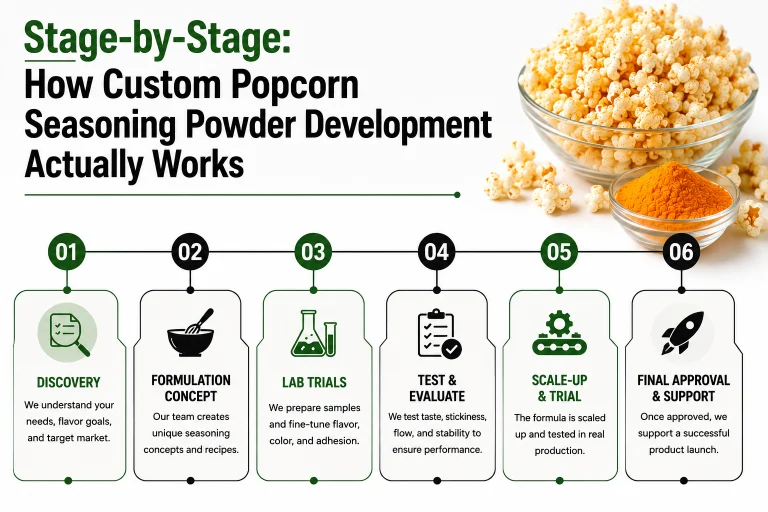
Unlike a home recipe, a commercial seasoning is built through a sequence of checkpoints, each producing a specific deliverable before the next stage begins.
| Stage | What Happens | Typical Output |
| 1. Concept & brief | Target consumer, flavor direction, price band and pack format defined | Written product brief |
| 2. Ingredient sourcing & costing | Carrier, flavor house samples and cost modeling gathered | Shortlisted ingredient set |
| 3. Bench trial | Small-batch blending, sieving and application testing | 3–5 prototype variants |
| 4. Sensory evaluation | Trained or consumer panel scoring and feedback | Ranked variant with refinement notes |
| 5. Stability & shelf-life testing | Accelerated storage, moisture pickup and color/flavor retention checks | Shelf-life estimate |
| 6. Pilot batch & scale-up | Commercial mixer trial and packaging line trial | Production-ready recipe and SOP |
Related Blog: Popcorn Seasoning Formulation | Expert Flavor Development
Natural and Clean-Label Ingredient Alternatives Used in Development
A large share of custom popcorn seasoning powder development work today involves substituting conventional functional ingredients with clean-label equivalents, without losing the intensity or stability the brand needs.
| Conventional Ingredient | Clean-Label Alternative | Formulation Consideration |
| MSG | Yeast extract, mushroom powder | Umami is slightly softer; inclusion level often needs a small increase |
| Synthetic Yellow 5/6 color | Turmeric oleoresin, beta-carotene | Less heat- and light-stable; may fade faster under retail lighting |
| Artificial cheese flavor | Fermented dairy powder, aged cheddar powder | Higher cost and more batch-to-batch flavor variation |
| Synthetic antioxidant (BHA/BHT) | Mixed tocopherols, rosemary extract | Shorter oxidative protection window; needs stronger packaging support |
| Refined sugar (caramel variants) | Jaggery powder, coconut sugar | Changes browning and caramelization behavior during processing |
Sensory Testing and Consumer Panels: The Step Most Founders Skip
A seasoning that tastes right to the person who created it is not the same as a seasoning validated to taste right to the target consumer. Structured sensory work typically uses a triangle test — where panelists are given three samples, two identical and one different, and asked to identify the odd one out — to confirm whether a reformulation is actually perceptible, followed by a 9-point hedonic scale to score liking on attributes such as saltiness, aftertaste and aroma. Skipping this step is one of the most common reasons a seasoning that seemed finished in the lab needs a costly reformulation after the first consumer batch reaches the market.
Packaging, Moisture Barriers and Distribution Realities
A seasoning formulation cannot be finalized without testing it inside its intended pack, since humidity, transit heat and shelf handling all affect flavor and texture retention differently across India’s climate zones. Metalized BOPP laminates and nitrogen flushing remain the standard barrier solution for maintaining crunch and seasoning potency over a typical 9–12 month shelf life, though newer sustainable pack formats sometimes require adjusted barrier layers to hit the same performance. This overlap between recipe design and packaging performance is exactly why food formulation work rarely stops at getting the flavor right — it has to be validated inside the pack the product will actually ship in.
In-House R&D vs an Outsourced Formulation Partner: What Should a Snack Brand Choose?
| Factor | In-House R&D | Outsourced Formulation Partner |
| Upfront investment | High — lab, panel and equipment costs | Lower — typically project-based fee |
| Speed to first prototype | Slower, especially for a first product | Faster, using an established process |
| Category breadth | Limited to the team’s existing expertise | Cross-category food science exposure |
| Regulatory support | Usually needs a dedicated hire | Often bundled into the project scope |
| Best suited for | Larger brands with a recurring innovation pipeline | Startups and first-time product launches |
Cost, MOQ and Budgeting Considerations for Custom Popcorn Seasoning Powder Development
- Natural and encapsulated flavor systems generally cost more per kilogram than conventional synthetic flavors, which affects both trial and production budgets
- Flavor house minimum order quantities for custom flavor compounds can be a limiting factor for very early-stage brands and are worth clarifying before finalizing a formulation direction
- Trial-stage costs (small-batch ingredients, panel sessions, lab testing) are a separate line from production-stage costs, and budgeting for both prevents mid-project surprises
- Reformulating after launch, because a cost-driven shortcut was taken during development, is almost always more expensive than budgeting correctly the first time
Conclusion
Custom popcorn seasoning powder development is less about finding one clever flavor idea and more about running that idea through a disciplined sequence — sourcing, bench trials, sensory validation, shelf-life testing and pilot-scale production — before it ever reaches a retail shelf. Brands that skip stages usually end up reformulating after launch, at a higher cost than doing it properly the first time. Teams such as Flavor Catalystz work through this exact sequence with snack brands, and for readers who want to go deeper into the adhesion science, particle-size engineering and regulatory checkpoints behind the seasoning itself, that ground is covered in more technical depth in a companion guide to popcorn seasoning formulation.
Frequently Asked Questions
How long does custom popcorn seasoning powder development typically take?
Most projects move from initial brief to a pilot-ready recipe in roughly 6 to 10 weeks, depending on flavor complexity, the number of prototype rounds needed and how quickly sourced ingredient samples arrive. Simpler flavor updates to an existing base can move faster; entirely new flavor systems with natural ingredient sourcing usually take longer.
What is the minimum order quantity for a custom popcorn seasoning blend?
MOQs vary by flavor house and ingredient type, and are often the deciding factor between using a fully custom flavor compound versus a semi-custom blend built from existing flavor house components. It is worth clarifying MOQs early, since they can shape which flavor direction is realistic for a brand’s current order volume.
Can popcorn seasoning powder be made vegan?
Yes. Cheese and butter notes can be recreated using plant-based fermented or yeast-derived flavor systems instead of dairy derivatives, though the flavor profile usually needs a few additional rounds of sensory refinement to match the intensity of a dairy-based original.
How is popcorn seasoning made lower in sodium without losing taste?
Common approaches include partial replacement of sodium chloride with potassium chloride blends, using acidulants and umami sources to boost perceived flavor intensity, and adjusting particle size so the salt that remains is perceived faster on the tongue. Sensory testing is used to confirm the reduction does not create a noticeable bitter or metallic aftertaste.
What is a triangle test, and why does it matter for flavor development?
A triangle test presents panelists with three samples — two identical, one different — and asks them to identify the odd one out. It is used to confirm whether a reformulation change is actually detectable by consumers before a brand commits to it, rather than relying on the development team’s own judgment alone.
Does popcorn seasoning development need a food scientist, or can a chef handle it?
A chef can guide flavor direction and taste balance well, but scaling a recipe to a stable, shelf-stable, mass-produced powder — including carrier selection, adhesion, particle size and shelf-life validation — typically needs food science and food technology expertise working alongside the culinary input.
What certifications matter most for exporting seasoned popcorn from India?
Beyond domestic FSSAI compliance, export shipments are usually checked against the destination market’s additive and labeling rules, since permitted colors and preservatives differ — for example, between Indian, EU and US regulations — along with any required food safety or plant certifications specific to the importing country.