May 2026 · 14 min read
The Indian nutraceutical industry has crossed USD 8 billion in 2024 and is projected to touch USD 21.48 billion by 2033, growing at a CAGR of 11.6 percent (IMARC Group, 2025). With lifestyle diseases like diabetes, obesity, and cardiovascular conditions on the rise, Indian consumers are spending more on preventive health than ever before. This shift is opening real space for new brands across dietary supplements, functional foods, herbal formulations, and protein products.
Starting a nutraceutical business in India is not just about picking a product and printing labels. You need the right product category, food product development expertise, an FSSAI Central License, a reliable manufacturing setup, scientific backing for your health claims, and a clear plan for distribution across modern trade, D2C, quick commerce, and pharmacy networks.
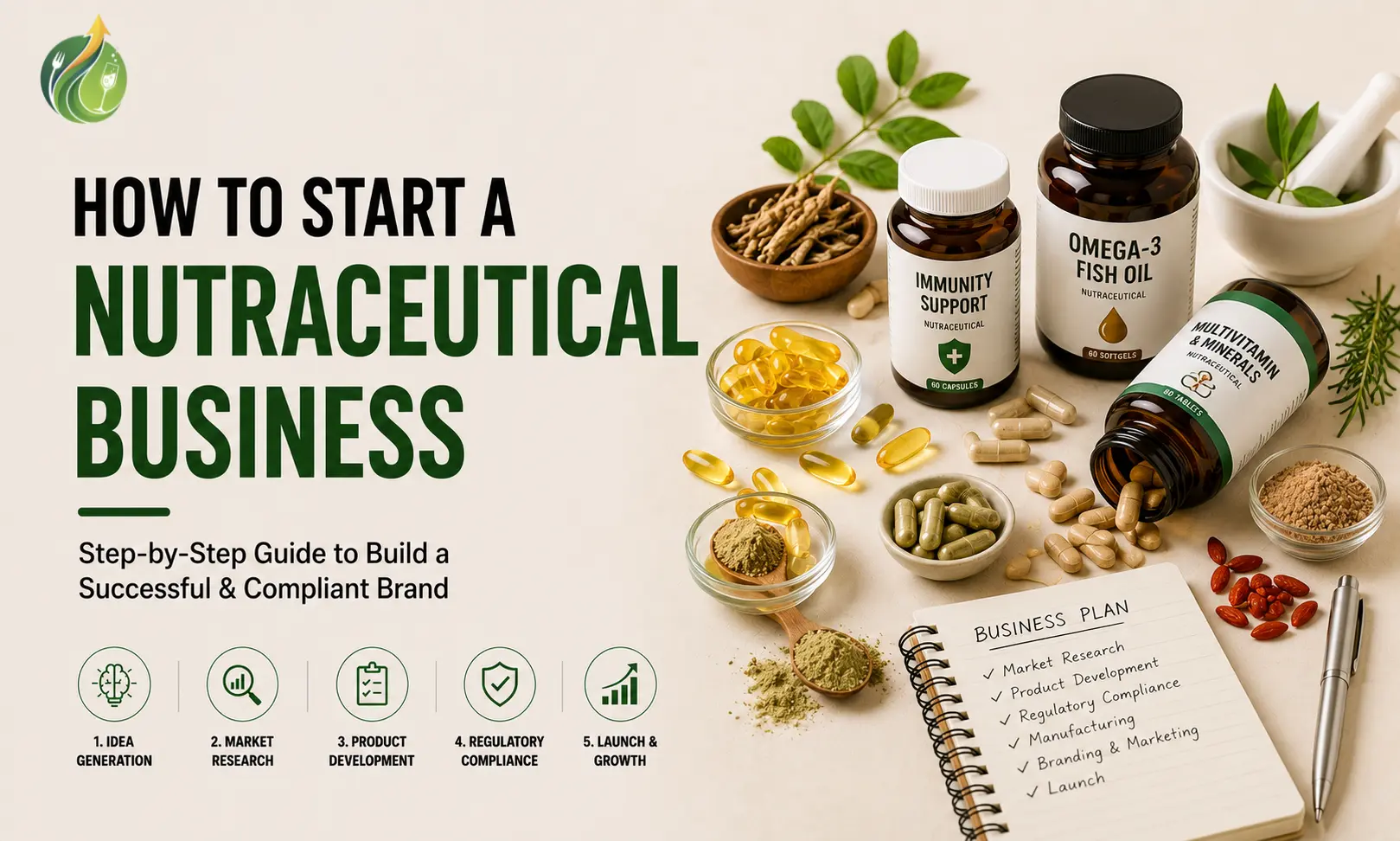
This guide breaks down every step, document, cost, and decision you need to make before launching your brand in 2026.
Start NUTRACEUTICAL BRAND
Build Your Nutraceutical Brand in India From Idea to Shelf
From recipe formulation and FSSAI Central License to GMP manufacturing, compliant packaging, and quick commerce launch, our food product development team helps you build a market ready nutraceutical brand.
What is a Nutraceutical Business
A nutraceutical business deals in food products that offer health benefits beyond basic nutrition. The word combines nutrition and pharmaceutical. Under the Food Safety and Standards (Health Supplements, Nutraceuticals, Food for Special Dietary Use, Food for Special Medical Purpose, and Prebiotic and Probiotic Food) Regulations, 2022, the FSSAI groups these products into eight categories:
- Health Supplements
- Nutraceuticals
- Food for Special Dietary Use
- Food for Special Medical Purpose
- Specialty Food containing plant or botanical ingredients
- Foods containing probiotics
- Foods containing prebiotics
- Novel Foods
Each category has its own ingredient list, dosage limits, and labelling rules. Picking the right category is the first compliance decision you will make, and it affects everything from your license to your packaging.
Why Start a Nutraceutical Business in India in 2026
The numbers tell the story. According to Grand View Research, the Indian nutraceutical market is set to reach USD 75.81 billion by 2033 at 10 percent CAGR. Functional foods alone hold 47.9 percent of the share. The Ministry of Food Processing Industries reports that the global nutraceutical market is moving from USD 503 billion in 2025 to USD 772 billion by 2029.
Three forces are driving this growth in India:
- Preventive health spending: Consumers between 18 and 35 years now form the largest buyer group for supplements, according to Seven Q Nutrition (2026).
- E commerce expansion: India’s online consumer market is set to grow from USD 70 billion to USD 163 billion by 2026 (India Brand Equity Foundation).
- Lifestyle disease load: Rising rates of diabetes, obesity, and cardiac conditions are pushing demand for immunity boosters, gut health products, collagen, and protein supplements.
The men’s health, women’s health, and sports nutrition sub categories are growing the fastest, with men’s wellness expected to clock the highest CAGR through 2033.
Types of Nutraceutical Products You Can Launch
Picking a category that matches your investment, target buyer, and distribution plan saves months of trial and error. Here are the most active product categories in India right now.
| Product Category | Common Products | Typical Buyer |
| Dietary Supplements | Multivitamins, biotin gummies, omega 3 capsules, calcium, iron, zinc | Working adults, women 25 to 45, elderly |
| Protein and Sports Nutrition | Whey protein, plant protein, mass gainers, BCAA, pre workout | Gym goers, men 18 to 35, athletes |
| Functional Foods | Fortified atta, protein noodles, millet snacks, drinking yogurt | Health conscious families, urban households |
| Herbal and Ayurvedic | Ashwagandha, shilajit, giloy, triphala, turmeric extracts | Traditional medicine users, wellness buyers |
| Probiotics and Gut Health | Probiotic capsules, fermented drinks, fibre supplements | Adults with digestive concerns, post antibiotic users |
| Women’s Wellness | PCOS support, prenatal vitamins, hair and skin gummies | Women 20 to 45 |
| Children’s Nutrition | Growth supplements, immunity drops, DHA syrups | Parents of kids 3 to 14 |
| Functional Beverages | Electrolyte drinks, protein water, plant milks, kombucha | Young urban consumers, fitness buyers |
Functional beverages held 76.4 percent of the volume share in 2024 (FoodSure, 2026), but the highest margins still sit in capsules, gummies, and specialised formulations.
Step by Step Process to Start a Nutraceutical Business in India
Follow this sequence to move from idea to shelf. Skipping or reshuffling steps is the most common reason brands face delays or license rejections.
1. Pick a Product Category and Niche
Look at three things: market demand, your knowledge, and competition. Avoid overcrowded segments like generic multivitamins unless you have a real differentiator. Niche openings like menopause support, prediabetes nutrition, or gut focused gummies still have room.
2. Conduct Market and Ingredient Research
Study top selling SKUs on Amazon, Flipkart, Nykaa, HealthKart, and quick commerce apps. Note their MRP, key ingredients, dosage, claims, and customer reviews. Cross check ingredient permissibility with Schedule I to VIII of the FSSAI Nutra Regulations.
3. Register Your Business Entity
Most nutraceutical brands operate as Private Limited or LLP for liability protection and easier funding. Get a PAN, TAN, GST number, and Udyam registration. Trademark your brand name and logo early to avoid disputes later.
4. Decide Your Manufacturing Model
You have three options: own manufacturing unit, third party contract manufacturing, or relabeller. Third party is the most common starting point because it cuts capital costs by 70 to 80 percent. We compare these models in detail below.
5. Apply for FSSAI Central License
Since September 2021, all nutraceutical businesses, regardless of turnover, fall under Central Licensing. Apply through the FoSCoS portal. The license fee is Rs 7,500 plus GST per year. Most approvals take 30 to 60 working days if documents are complete.
6. Develop and Formulate Your Product
This is where most first time founders underestimate effort. A nutraceutical formulation needs the right active ingredient ratios, bioavailability data, stability testing, and dosage justification. Many brands work with food product development teams who handle recipe creation, prototype testing, and scale up trials. Flavor Catalystz is one such partner that supports nutraceutical formulation, taste masking, and FSSAI compliant labelling for emerging brands.
7. Test the Product
Send samples to a NABL accredited lab for nutritional analysis, microbiological testing, heavy metal testing, and shelf life studies. For health claims, you may also need clinical or efficacy data. Keep all test reports filed for at least three years.
8. Design Compliant Packaging and Labelling
FSSAI labelling rules require the product name, FSSAI license number, list of ingredients, nutritional information, allergen declarations, batch number, manufacturing date, best before date, net quantity, dosage, warnings, and the green or brown veg or non veg dot. Front of pack labelling for added sugar, sodium, and saturated fat is now mandatory for many categories.
9. Build Your Distribution Plan
Decide upfront whether you will sell through pharmacies, supermarkets, gyms, clinics, your own website, marketplaces, or quick commerce. Each channel has different margin, MOQ, return policy, and listing fee structures.
10. Launch with a Marketing Plan
Use content marketing, doctor endorsements, influencer reviews, and performance ads. Avoid making drug like claims (cure, treat, prevent disease) as these are banned for nutraceuticals.
FSSAI License for Nutraceuticals: What You Need to Know
The FSSAI Central License is mandatory for every manufacturer, importer, marketer, and relabeller in the nutraceutical space. It is issued under the Food Safety and Standards Act, 2006, and you cannot legally manufacture, store, distribute, or sell a single bottle without it.
Documents Required
- Form B application filled on the FoSCoS portal
- Photo identity and address proof of the proprietor or directors
- Proof of premises ownership or rent agreement
- List of products to be manufactured with category classification
- Manufacturing process flow chart and equipment layout
- Source of raw material and water analysis report
- NOC from local municipality or panchayat
- Food Safety Management System plan
- Authority letter and form IX for nominee
License Fee and Validity
The Central License fee is Rs 7,500 plus 18 percent GST per year. You can apply for 1, 3, or 5 years at a time. Most consultants charge an additional Rs 15,000 to Rs 40,000 for end to end handling, depending on case complexity.
Other Licenses You Will Need
- GST registration
- Trade license from local municipal body
- Factory license under the Factories Act (for own units)
- GMP certification (Schedule M aligned)
- Pollution Control Board NOC and Effluent Treatment Plant clearance for larger units
- Import Export Code (IEC) if exporting
- AYUSH license if you are positioning the product as Ayurvedic
Investment Required to Start a Nutraceutical Business in India
Investment ranges widely based on your model. A relabeller or contract manufacturing brand can launch under Rs 10 lakh. A small own manufacturing unit needs Rs 1.8 crore to Rs 2.5 crore, and medium scale plants run between Rs 5 crore and Rs 7 crore (NIIR Project Consultancy Services).
| Expense Head | Contract Manufacturing Model | Own Small Unit Setup |
| Company registration and trademark | Rs 25,000 to Rs 60,000 | Rs 25,000 to Rs 60,000 |
| FSSAI Central License | Rs 8,850 per year | Rs 8,850 per year |
| Product development and lab testing | Rs 50,000 to Rs 2 lakh | Rs 1.5 lakh to Rs 4 lakh |
| Land and civil work | Not needed | Rs 40 lakh to Rs 1 crore |
| Machinery and equipment | Not needed | Rs 80 lakh to Rs 1.5 crore |
| First batch production (MOQ) | Rs 1 lakh to Rs 5 lakh | Rs 8 lakh to Rs 20 lakh |
| Packaging design and inventory | Rs 50,000 to Rs 2 lakh | Rs 1 lakh to Rs 4 lakh |
| Marketing and launch budget | Rs 2 lakh to Rs 10 lakh | Rs 5 lakh to Rs 25 lakh |
| Working capital (3 to 6 months) | Rs 3 lakh to Rs 10 lakh | Rs 15 lakh to Rs 40 lakh |
| Estimated total range | Rs 8 lakh to Rs 30 lakh | Rs 1.8 crore to Rs 3 crore |
Gross margins in well positioned nutraceutical brands sit between 55 and 65 percent, with net margins of 25 to 35 percent achievable once you cross the first 12 to 18 months (Manufacturing Plant India, 2026).
In House Manufacturing vs Contract Manufacturing
This is one of the biggest decisions you will make. Both models have a place, but most new brands start with contract manufacturing and graduate to a hybrid model after they cross Rs 5 to 8 crore in revenue.
| Parameter | In House Manufacturing | Contract Manufacturing |
| Capital requirement | Rs 1.8 crore and above | Rs 5 lakh to Rs 15 lakh |
| Time to launch | 8 to 18 months | 2 to 4 months |
| Formulation control | Full control | Shared with manufacturer |
| MOQ flexibility | Any quantity | Usually 1,000 to 10,000 units per SKU |
| Regulatory burden | High (you own everything) | Shared (manufacturer holds GMP) |
| Profit margin | Higher (no third party markup) | Lower (margin shared) |
| Best suited for | Established brands, exporters | New entrants, D2C startups |
How to Develop a Nutraceutical Product
Product development is what separates a successful brand from a forgettable label. It covers four parts:
Formulation
Choose actives that meet FSSAI dosage limits. Balance them with carriers, binders, sweeteners, and flavours that mask any bitterness. Make sure ingredient interactions do not reduce shelf life or absorption.
Prototype Testing
Run small batches of 1 to 5 kg. Test taste, texture, dissolution time, and stability. For gummies and powders, check for moisture absorption and clumping after 30, 60, and 90 days.
Compliance Validation
Cross check every ingredient against the FSSAI positive list. New ingredients need Non Specified Food (NSF) approval, which can take six to twelve months. Validate health claims against ICMR limits.
Scale Up and Pilot Production
Once the prototype passes internal and lab tests, run a pilot batch at your manufacturer. Confirm yield, packaging fit, and final cost per unit before placing your full production order.
Labelling, Packaging, and Claim Compliance
FSSAI rejects more nutraceutical applications for labelling errors than for any other reason. The label must carry:
- Product name and FSSAI logo with 14 digit license number
- Net quantity, batch number, and manufacturing date
- Best before or expiry date
- Complete list of ingredients with allergen warnings
- Nutritional information per serving and per 100 g or 100 ml
- Storage instructions and recommended dosage
- Name and full address of manufacturer or marketer
- Veg or non veg dot symbol
- Country of origin (mandatory for imports)
- Warning statement: Not for medicinal use, Not to be used as a substitute for a balanced diet
Avoid drug like claims. Words like cures, treats, prevents disease, or replaces medicine can trigger an FSSAI notice. Stick to permitted claims like supports immunity, supports digestion, or contributes to normal energy metabolism, backed by data.
Where to Sell Nutraceutical Products in India
Indian consumers buy nutraceuticals through six main channels. Choose two or three at launch and add more as you scale.
- Marketplaces: Amazon, Flipkart, Nykaa, Tata 1mg, HealthKart. Faster reach but higher commission (15 to 30 percent) and intense competition.
- Quick commerce: Blinkit, Zepto, Swiggy Instamart. Strong for impulse items, gummies, immunity products, and protein bars.
- D2C website: Highest margin and best for building loyalty, but needs strong content, performance marketing, and retention play.
- Modern trade: Reliance, DMart, Spencer’s, Star Bazaar. Requires distributor tie ups, listing fees, and slotting charges.
- Pharmacy chains: Apollo, Wellness Forever, MedPlus. Strong trust signal but slower payment cycles.
- Doctor and clinic networks: Best for therapeutic products. Build a medical representative team for direct outreach.
Common Mistakes to Avoid
- Picking a category without checking FSSAI ingredient lists
- Using drug like claims on packaging or ads
- Skipping stability testing to save 30 days
- Choosing a contract manufacturer based only on price, not GMP record
- Underpricing because of competition and bleeding margin within six months
- Ignoring nutritional labelling rules and getting marketplace listings pulled
- Launching too many SKUs at once and losing focus
- Not building scientific or clinical backing for the hero product
Starting Your Nutraceutical Journey
The Indian nutraceutical industry has moved past its experimental phase. Buyer demand is real, distribution infrastructure is ready, and regulatory clarity is stronger than it was even three years ago. The brands winning today are the ones that pick a sharp category, invest in real formulation work, follow FSSAI rules to the letter, and build distribution one channel at a time.
If you are at the formulation or product development stage, working with experienced food formulation teams can shorten your launch timeline by months and help you avoid the most common compliance pitfalls. Validate the recipe, test the product, file the right license, and build a brand that consumers and regulators both trust.
Frequently Asked Questions
How much does it cost to start a nutraceutical business in India?
A contract manufacturing brand can launch with Rs 8 lakh to Rs 30 lakh. A small own manufacturing unit needs Rs 1.8 crore to Rs 3 crore, while medium scale plants cost Rs 5 crore to Rs 7 crore.
Is a nutraceutical business profitable in India?
Yes. Gross margins range from 55 to 65 percent and net margins from 25 to 35 percent for well positioned brands. The Indian market is growing at 10 to 11.6 percent CAGR through 2033.
What license is required for a nutraceutical business?
An FSSAI Central License is mandatory for every manufacturer, importer, marketer, and relabeller. The fee is Rs 7,500 plus GST per year, applied through the FoSCoS portal.
Can I start a nutraceutical business from home?
Not as a manufacturer. Manufacturing premises must meet GMP and Schedule 4 hygiene standards. However, you can operate as a marketer or relabeller from a small office and outsource production to a licensed third party manufacturer.
How long does it take to get an FSSAI nutraceutical license?
If documents are complete and ingredients are pre approved, the process takes 30 to 60 working days. Applications involving novel ingredients or Non Specified Food approvals can take six to twelve months.
Which nutraceutical product has the highest demand in India?
Protein supplements, multivitamin gummies, immunity boosters, and women’s wellness products lead the market. The protein supplement segment alone is expected to touch USD 1.52 billion by 2033.
Do I need a doctor or scientist on the team?
Not legally, but it helps. Most successful brands work with a nutritionist, food technologist, or formulation scientist either in house or on consult. This builds credibility with consumers and regulators.
Can I sell nutraceuticals on Amazon and Flipkart?
Yes, once you have a valid FSSAI Central License, GST number, and proper labelling. Marketplaces verify FSSAI numbers and reject listings with incomplete labels or banned claims.
Is GMP certification mandatory for nutraceuticals in India?
Yes. FSSAI requires manufacturers to follow Good Manufacturing Practices aligned with Schedule M. Many marketplaces and exports also require WHO GMP or ISO 22000 certification.
How do I export nutraceutical products from India?
You need an Import Export Code (IEC), the destination country’s regulatory clearance (FDA, EFSA, etc.), and often a WHO GMP certificate. The most active export markets for Indian nutraceuticals are the US, UAE, UK, Africa, and Southeast Asia.