Apr 2026 · 15 min read
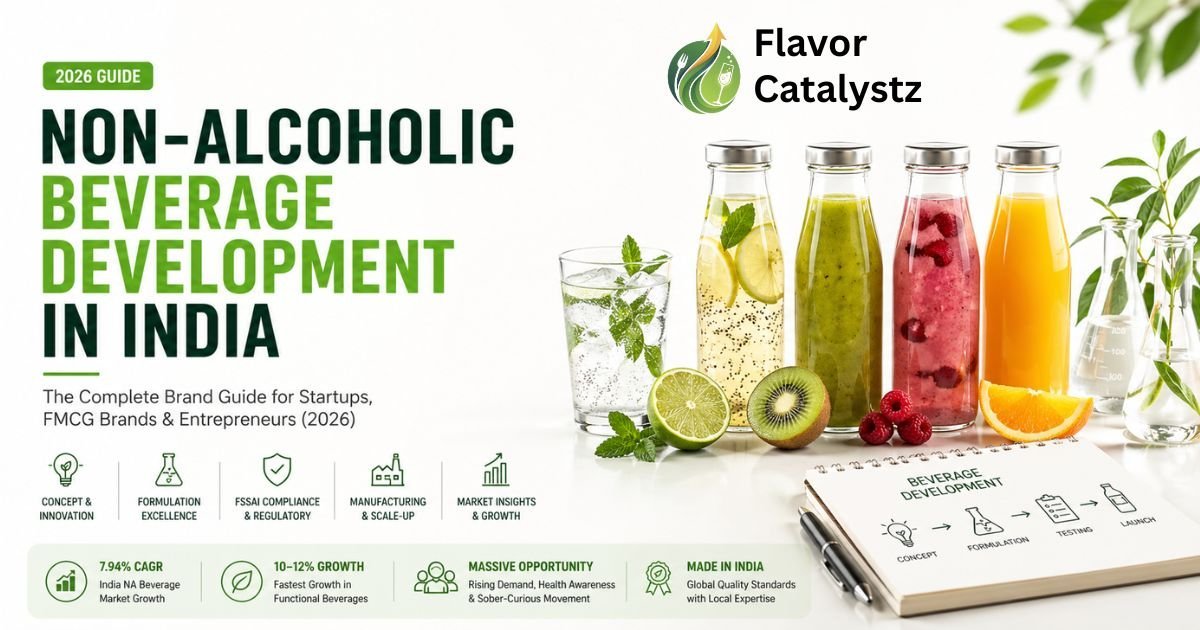
The non-alcoholic beverage market in India is no longer a secondary category. It has become the single fastest-growing segment in the entire F&B industry, and 2026 is shaping up to be its most defining year yet. India’s non-alcoholic beverage market was valued at USD 34.71 billion in 2025 and is projected to nearly double — reaching USD 69.04 billion by 2034 — growing at a CAGR of 7.94%.
For entrepreneurs, FMCG brands, and beverage startups in India, this growth represents a massive window of opportunity. But turning a product idea into a market-ready, shelf-stable, FSSAI-compliant beverage requires deep technical expertise, a clear development roadmap, and the right partners.
This guide covers everything you need to know about non-alcoholic beverage development in India — from market opportunity and product categories to formulation science, FSSAI regulations, and the step-by-step process of launching your drink brand successfully.
| Quick Stat: India’s non-alcoholic beverages segment is growing at 7.94% CAGR (2026–2034). Functional beverages — the fastest-growing sub-segment — are expanding at 10–12% annually. The sober-curious movement has driven NA beer/spirit volume up 111% in just four years globally. |
What is Non-Alcoholic Beverage Development?
Non-alcoholic beverage development is the end-to-end process of creating a drink product that contains less than 0.5% alcohol by volume — from initial concept and formulation all the way through to regulatory approval, packaging, and commercial launch.
According to FSSAI guidelines, a non-alcoholic beverage is defined as any water-based or ingredient-based drink with alcohol content at or below 0.5% ABV. This includes a vast spectrum: packaged juices, carbonated soft drinks, RTD teas and coffees, functional waters, probiotic drinks, herbal beverages, energy drinks, mocktails, and plant-based milks.
Non-alcoholic beverage development is a multi-disciplinary process that brings together food science, flavor chemistry, nutrition, packaging technology, and regulatory knowledge. It is not simply a matter of mixing ingredients — it requires rigorous formulation science to ensure taste consistency, shelf stability, microbiological safety, and scalability from lab to factory floor.
| FSSAI Definition: Non-alcoholic beverages are drinks with alcohol content at or below 0.5% ABV. They must meet all standards of FSSR 2011 regulations including composition, microbiological safety, additive limits, and labeling requirements. |
Why 2026 is the Best Time to Launch a Non-Alcoholic Drink Brand in India
Several powerful macro forces have converged to make 2026 the most promising year yet for non-alcoholic beverage development in India:
1. The Sober Curious Movement is Mainstream
Globally, Gen Z alcohol consumption has declined 25% over four years. Nearly 49% of Gen Z consumers say reducing alcohol is a health priority in 2026. In India, this wellness-first mindset is driving demand for sophisticated non-alcoholic alternatives that don’t feel like a compromise — mocktails, botanical sodas, zero-proof spirits, and functional RTDs are filling this gap.
2. The Functional Beverage Boom
Consumers are no longer satisfied with drinks that just hydrate — they want beverages that work. Products with probiotics for gut health, adaptogens for stress, electrolytes for performance, and vitamins for immunity are seeing 10–12% annual growth in India. The line between beverages and nutraceuticals is dissolving, creating exciting new product development opportunities.
3. India’s Distribution Infrastructure Has Evolved
The rise of quick commerce (Blinkit, Zepto, Swiggy Instamart), direct-to-consumer D2C channels, and improved cold chain logistics means that new beverage brands can now reach Tier 2 and Tier 3 cities faster than ever. Early movers in non-alcoholic beverage development gain significant shelf access and brand loyalty advantages.
4. Traditional Indian Beverages Going Premium
India has a rich heritage of functional non-alcoholic drinks — kokum, jaljeera, aam panna, buttermilk, sattu, and herbal kadhas. In 2026, these are being reimagined in hygienic, convenient, premium formats with modern packaging. This ‘modern traditional’ convergence is one of the strongest product innovation opportunities in Indian non-alcoholic beverage development — and a core area of expertise at Flavor Catalystz.
5. Regulatory and Tax Environment Improving
GST 2.0 introduced a simplified three-tier tax structure for beverages and removed the compensation cess, improving the business economics of non-alcoholic beverage brands. Meanwhile, FSSAI compliance frameworks have become more standardized, making the path to market clearer for new entrants.
| Market Snapshot 2026: India NA beverage market = USD 34.71B (2025) → USD 69.04B (2034) | CAGR 7.94% | Functional beverages growing 10–12% annually | RTD tea + coffee among fastest-growing formats | Non-metro markets opening via quick commerce |
7 High-Growth Non-Alcoholic Beverage Categories in India (2026)
Understanding which product categories offer the best market entry points is essential before beginning non-alcoholic beverage development. Here are the seven highest-opportunity categories:
1. Functional & Wellness Beverages
This is the fastest-growing category in India’s beverage market. Functional beverages are engineered with specific health-active ingredients — adaptogens (ashwagandha, tulsi, brahmi), probiotics, vitamin complexes, plant proteins, and botanical extracts. The consumer proposition is clear: every sip serves a purpose. For brands with a strong wellness narrative, functional beverage development offers premium pricing and strong repeat purchase rates. Flavor Catalystz’s functional drink development team delivers formulations rooted in both Ayurvedic science and modern nutrition.
2. RTD (Ready-to-Drink) Tea & Coffee
RTD tea and coffee are surging across urban India, driven by convenience, cold-brew culture, and cafe-quality flavor at retail prices. The format is ideal for modern distribution — cans, PET bottles, and Tetra Pak work across modern trade, general trade, and quick commerce. Cold brew, kombucha, and nitro tea are sub-categories gaining premium positioning. Flavor Catalystz’s RTD tea and coffee formulation expertise helps brands develop these technically complex products efficiently.
3. Probiotic & Fermented Drinks
Kombucha, water kefir, fermented lemon ginger shots, and probiotic lassi are gaining serious traction in India. Consumer awareness of gut health has exploded post-pandemic — and the market has responded. Probiotic beverages require highly specialized formulation expertise to maintain live culture viability through shelf life, which makes professional beverage formulation support essential.
4. Natural Juices & Cold-Pressed Beverages
100% natural, cold-pressed juices made from Indian fruits — amla, pomegranate, jamun, kokum, raw turmeric — represent a powerful ‘made in India’ positioning opportunity. India has abundant raw material access to these ingredients, giving domestic brands a significant cost and freshness advantage. Clean-label, no-added-sugar juice formats are in high demand across premium retail and D2C channels.
5. Plant-Based Milk Alternatives
Oat milk, almond milk, soy milk, coconut milk — India’s plant-based milk market is growing 15–18% annually, driven by lactose intolerance awareness, veganism, and urban wellness trends. Beverage formulation for plant-based milks requires careful management of emulsification, protein stability, and mouthfeel — areas where expert development support from Flavor Catalystz is critical.
6. Energy & Sports Drinks
India’s energy drink market is expanding rapidly alongside gym culture and esports. Both carbonated and non-carbonated formats are growing. FSSAI has specific rules for caffeinated beverages (145–300 mg/L caffeine range, mandatory high-caffeine warnings). Energy drink formulation requires regulatory-first thinking from day one, making this a category where expert guidance from Flavor Catalystz is non-negotiable.
7. Mocktails & Zero-Proof Spirits
The premium mocktail category is growing as Indian consumers seek sophisticated, adult non-alcoholic options for social occasions. Zero-proof spirits with botanical complexity (using elderflower, hibiscus, cardamom, and citrus) represent a high-margin product format. Premixed mocktail pouches and RTD mocktail cans are gaining shelf space in modern retail.
| Category | Key Examples | Growth Driver |
| Functional Wellness | Adaptogen drinks, probiotic sodas, vitamin water | Health-first consumers |
| RTD Tea & Coffee | Cold brew, kombucha RTD, nitro tea | Convenience + cafe culture |
| Probiotic Fermented | Kombucha, kefir, probiotic lassi | Gut health awareness |
| Natural Juices | Amla, pomegranate, cold-pressed | Clean label demand |
| Plant-Based Milk | Oat, almond, coconut milk | Lactose intolerance + veganism |
| Energy & Sports | Caffeinated RTD, electrolyte drinks | Fitness culture boom |
| Mocktails / Zero-Proof | Botanical sodas, RTD mocktail cans | Sober curious movement |
The Non-Alcoholic Beverage Development Process: Step by Step
Successful non-alcoholic beverage development follows a structured process. Skipping any stage leads to costly rework, regulatory delays, or market failure. Here is the complete roadmap Flavor Catalystz follows with every client:
Step 1: Market Research & Concept Validation
Before a single ingredient is chosen, your product concept must be validated against market demand, consumer behavior, and competitive landscape. This includes identifying your target consumer segment, understanding current shelf offerings in your category, mapping price points, and defining your unique selling proposition (USP). For India, regional flavor preferences, pack-size economics, and channel distribution must all factor into concept development.
Step 2: Ingredient Selection & Recipe Development
This is the core of non-alcoholic beverage development — and the most technically demanding phase. A skilled beverage consultant will help you select the right base liquid, primary functional ingredients, flavor systems, sweetener profile (sugar, stevia, monk fruit, or a blend), acidulants for pH control, preservative systems, stabilizers and emulsifiers, and color and cloud agents. Every ingredient must be FSSAI-approved and sourced at commercial-grade quality.
Step 3: Prototype Development & Sensory Evaluation
Lab-scale prototypes are developed and evaluated through rigorous sensory testing — taste panels, pH analysis, Brix measurement, viscosity testing, and color consistency checks. Multiple iterations are normal at this stage. The goal is to achieve a product formula that delivers a consistent, appealing sensory experience that aligns with consumer expectations for the category.
Step 4: Stability & Shelf Life Testing
This is a critical and often underestimated stage. Your beverage must maintain safety, sensory quality, and claimed nutrition for its entire intended shelf life — typically 6 to 18 months for most non-alcoholic beverages in India. Accelerated shelf life testing (ASLT) is conducted at elevated temperature and humidity to predict real-world shelf life. Microbiological testing (for E. coli, Salmonella, yeast, mold) is mandatory under FSSAI microbiological standards.
Step 5: FSSAI Compliance & Label Development
All non-alcoholic beverages in India must comply with the Food Safety and Standards (Food Products Standards and Food Additives) Regulations, 2011, and the FSSAI Labelling & Display Regulations, 2020. Label compliance includes: ingredient list, nutritional information panel, FSSAI license number, vegetarian/non-vegetarian mark, batch number, best before date, manufacturer address, and any mandatory warnings. Flavor Catalystz builds compliance requirements into product development from day one.
Step 6: Pilot Production & Process Validation
Before full commercial production, a pilot batch is produced at a contract manufacturing facility to validate that the lab-scale formula translates correctly at production scale. Equipment compatibility, fill weight accuracy, CIP hygiene protocols, and packaging seal integrity are all verified at this stage.
Step 7: Commercial Launch & Scale-Up
With a validated formula, compliant label, and production-ready process, your beverage is ready for commercial launch. At this stage, decisions around beverage contract manufacturing partners, packaging formats, MOQs, and distribution channels must be finalized. Post-launch, ongoing quality audits, market feedback loops, and iterative reformulations are part of maintaining a competitive beverage brand.
| Pro Tip from Flavor Catalystz: Brands that invest in FSSAI compliance-first development from Stage 1 avoid the most expensive mistake in non-alcoholic beverage development — product recalls and reformulations after launch. Our experts ensure your product is built right from the very first prototype. |
FSSAI Compliance for Non-Alcoholic Beverages: Key Regulations
Navigating FSSAI regulations is one of the most complex aspects of non-alcoholic beverage development in India. Here are the key compliance checkpoints every brand must address:
1. Product Classification Under FSSAI
FSSAI classifies non-alcoholic beverages into multiple categories: carbonated soft drinks, non-carbonated water-based beverages, fruit juices and nectars, energy drinks, sports drinks, functional foods and nutraceuticals, and health supplements. The correct classification determines which specific standards, additive tables, and claim regulations apply to your product. Misclassification is one of the most common — and costly — compliance errors.
2. Non-Carbonated Water-Based Beverage Standards
FSSAI’s July 2021 amendment requires that: the base water must meet standards for packaged drinking water or mineral water; mandated ingredients must be present; and the term ‘water’ must not be used inappropriately in product names or labels. Table 7 of FSSR 2011 outlines microbiological requirements.
3. Additive & Preservative Limits
FSSAI specifies strict limits for food additives in non-alcoholic beverages. Key limits include: aspartame at or below 600 mg/kg; benzoic acid in carbonated drinks at or below 250 ppm; only FSSAI-approved colors and flavors permitted. Herbs not listed in FSSAI’s 2016 Health Supplement Regulations require toxicological data submission before use.
4. Labeling Requirements (FSSAI Labelling Regulations 2020)
Every packaged non-alcoholic beverage in India must display: product name, complete ingredient list (descending order by weight), nutritional information per 100ml and per serving, FSSAI logo and license number, green/red dot (veg/non-veg), batch/lot number, best before date, manufacturer name and address, country of origin, and net quantity. For caffeinated beverages above 145 mg/L, a ‘High Caffeine’ warning is mandatory.
5. Functional Claim Regulations (FSSAI 2018)
If your non-alcoholic beverage makes health claims (e.g., ‘boosts immunity’, ‘supports gut health’, ‘enhances energy’), these claims must comply with FSSAI Advertising & Claims Regulations, 2018. Claims must be truthful, substantiated by scientific evidence, and not mislead consumers. Flavor Catalystz guides brands through the complete health claim approval process.
| Compliance Area | Requirement |
| Alcohol Content | At or below 0.5% ABV for all non-alcoholic beverages |
| Caffeine (Energy Drinks) | 145–300 mg/L; ‘High Caffeine’ warning above 145 mg/L |
| Aspartame | At or below 600 mg/kg |
| Benzoic Acid (CSDs) | At or below 250 ppm |
| Microbiological | Free of E. coli, Salmonella; must comply with FSSR Table 7 |
| Label | FSSAI logo + license, veg/non-veg mark, nutritional info, batch no., best before |
| Health Claims | Must comply with FSSAI Advertising & Claims Regulations 2018 |
Key Challenges in Non-Alcoholic Beverage Development — and How to Overcome Them
Challenge 1: Achieving Taste Parity with Established Brands
Consumers have high taste expectations, especially when comparing new entrants to established CSD or juice brands. The challenge is amplified when reducing sugar, removing artificial ingredients, or incorporating functional actives. Professional sensory evaluation, natural taste maskers (lemon oils, vanilla esters), and texture optimization through emulsifiers (acacia gum, pectin) are essential.
Challenge 2: Shelf Life Without Synthetic Preservatives
Clean-label consumers demand no artificial preservatives. But achieving 9–12 months shelf life without benzoates or sorbates requires a multi-hurdle approach: pH control (typically below 4.2 for acid stability), water activity management, hot-fill or retort processing, aseptic packaging, and microbiological validation. This is a complex technical challenge that requires experienced beverage formulation expertise.
Challenge 3: FSSAI Compliance for Novel Ingredients
India’s functional beverage boom has brought a wave of novel ingredients — adaptogens, nootropics, collagen, and specialized plant extracts. For herbs and bioactives not already on FSSAI’s approved ingredient lists, brands must submit toxicological data for approval — a process that can take months if not planned early. Flavor Catalystz helps clients identify and navigate these regulatory pathways proactively.
Challenge 4: Scaling from Lab to Commercial Production
A formula that performs perfectly at 10-liter lab scale can behave very differently at 10,000-liter commercial production. Carbonation levels, emulsion stability, color consistency, and fill weight accuracy all require careful process validation during pilot production. Brands that skip this step often face expensive batch failures.
Challenge 5: Market Segmentation and Demand Forecasting
Non-alcoholic beverage categories are highly segmented. A premium functional drink positioned for metro fitness enthusiasts requires a completely different formulation, packaging, and pricing strategy than an affordable herbal RTD for Tier 2 consumers. Poor market segmentation leads to product-market mismatch — one of the leading causes of beverage brand failures in India.
How Flavor Catalystz Accelerates Your Brand Launch
A professional beverage consultant is the single most important investment a new beverage brand can make. Here is the specific value Flavor Catalystz brings to non-alcoholic beverage development:
- Formulation Expertise: Developing FSSAI-compliant recipes using the right functional ingredients, flavor systems, and preservation technology — optimized for taste, stability, and cost.
- Regulatory Navigation: Ensuring product classification, label compliance, health claim approvals, and ingredient authorizations are handled correctly from day one.
- Pilot Batching & Scale-Up: Managing the transition from lab prototype to commercial production, including process validation and contract manufacturer selection.
- Stability Testing Design: Designing and interpreting accelerated shelf life studies to ensure your product meets retail distribution requirements.
- Speed to Market: Flavor Catalystz’s existing supplier relationships, lab infrastructure, and regulatory experience can cut your development timeline by 40–60% compared to in-house teams starting from scratch.
Conclusion: Build Your Non-Alcoholic Beverage Brand the Right Way
Non-alcoholic beverage development in India has never offered greater opportunity — or demanded higher standards. The consumers of 2026 expect beverages that taste exceptional, deliver real health benefits, carry clean-label credentials, and meet the highest safety standards. Meeting all these expectations simultaneously requires professional-grade formulation, regulatory expertise, and strategic market positioning.
Whether you are a startup with an idea for a functional wellness drink, an FMCG brand looking to expand into the non-alcoholic space, or an entrepreneur inspired by India’s traditional beverage heritage — the path to success begins with the right development partner.
Frequently Asked Questions
FAQ 1: What is non-alcoholic beverage development?
The process of creating a drink (≤0.5% ABV) from concept to launch, including formulation, testing, and compliance.
FAQ 2: What are the main types of non-alcoholic beverages in India?
Water, juices, RTD tea/coffee, energy drinks, probiotics, plant-based milk, functional drinks, traditional beverages, and mocktails.
FAQ 3: What are the FSSAI regulations for non-alcoholic beverages in India?
≤0.5% ABV, approved additives, mandatory labeling, and safety standards as per FSSAI.
FAQ 4: How long does non-alcoholic beverage development take in India?
Usually 3–9 months depending on product complexity.
FAQ 5: What is beverage formulation and how is it different from a recipe?
A recipe is basic; formulation is precise, scalable, and production-ready.
FAQ 6: How much does non-alcoholic beverage development cost in India?
Depends on complexity, testing, and iterations; varies case to case.
FAQ 7: Can I use Ayurvedic herbs in non-alcoholic beverages in India?
Yes, if FSSAI-approved; otherwise requires pre-approval.
FAQ 8: What are the best non-alcoholic beverage categories to launch in India in 2026?
Functional drinks, RTD tea/coffee, probiotics, traditional beverages, and mocktails.
FAQ 9: What is the difference between an energy drink and a functional beverage?
Energy drinks use caffeine; functional drinks offer broader health benefits.
FAQ 10: Do I need a beverage consultant to launch a non-alcoholic drink in India?
Not required, but helpful for faster, compliant, and quality launch.