Jul 2026 · 9 min read
Nacho cheese sauce formulation is the process of combining cheese solids, emulsifying salts, starch, fat, and acid in precise ratios so a sauce stays smooth, pourable, and stable across storage, transport, and reheating. It is the difference between a sauce that separates into an oily, grainy mess after one reheat cycle and one that performs the same way in bag one and bag ten thousand. For any brand building a cheese-based snack, dip, or QSR topping, this is the technical backbone the whole product depends on.
Most people who search for this topic have already hit a wall – a sauce that breaks in the chafing dish, a formula that works in a home kitchen but curdles on a production line, or a private-label partner who cannot explain why batches vary. This guide, put together with input from the food R&D team at Flavor Catalystz, walks through the science, the build process, the common failure points, and the compliance checks that matter in the Indian market, so you know exactly what a working nacho cheese sauce formulation needs before you commission one.
What Is Nacho Cheese Sauce Formulation, and Why Does It Matter for Food Brands?
Nacho cheese sauce is not simply melted cheese. Regulators classify most commercial versions as a “cheese sauce” or “cheese product” rather than natural cheese, because the final mix includes water, starch, oil, and functional salts alongside cheese solids. That distinction matters for labeling, but it also explains why the sauce behaves so differently from a block of cheddar melted in a pan.
A cheese block on its own does not want to stay smooth once heated past a certain point. Its proteins (casein) are bound tightly to calcium, and as heat rises, the fat separates from the protein network faster than it re-emulsifies. Nacho cheese sauce formulation exists to solve exactly this problem – to keep fat, water, and protein locked together through repeated heating, cooling, pumping, and holding, which is exactly what a foodservice line, a vending machine, or a retail pouch demands.
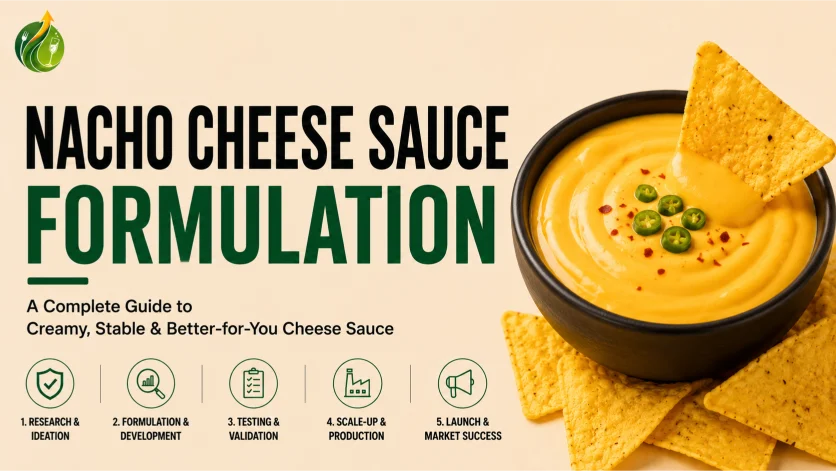
NACHO CHEESE SAUCE FORMULATION 2026
Develop Creamy, Shelf-Stable Nacho Cheese Sauce for Commercial Production
Flavor Catalystz develops nacho cheese sauce formulations with optimized cheese systems, emulsifiers, viscosity, heat stability, shelf life, FSSAI compliance, and commercial manufacturing support.
The Food Science Behind Every Nacho Cheese Sauce Formulation
The single most important ingredient category in this nacho formulation is the emulsifying salt group, commonly sodium citrate, sodium phosphate, or sodium hexametaphosphate. These salts work by exchanging sodium ions for the calcium ions that hold casein proteins bundled together. Once that swap happens, the protein loosens, becomes water-soluble, and gains the ability to wrap around fat droplets – creating a stable oil-in-water emulsion instead of a broken, greasy pool.
This is also why professional formulators keep a close eye on pH. Emulsifying salts nudge the pH of the mix upward, which further improves protein flexibility and the final mouthfeel. A formulation that ignores this chemistry usually shows up in the finished product as one of three defects: syneresis (watery pooling), oil-off (a greasy film on top), or a grainy, chalky bite instead of a silky one.
| Ingredient Category | Function in the Formulation | Typical Examples |
| Cheese solids | Carries dairy flavor, some emulsifying protein | Cheddar, processed cheese, cheese powder |
| Emulsifying salts | Rebuilds protein-fat-water bond under heat | Sodium citrate, sodium phosphate |
| Starch/thickener | Builds body and cling without separating | Modified food starch, corn starch |
| Fat/oil | Mouthfeel, flavor carrier, richness | Vegetable oil, milk fat |
| Acid | Tang, pH balance, microbial hurdle | Citric acid, vinegar/acetic acid |
| Dairy proteins | Water-holding, heat-stable texture | Whey protein concentrate, sodium caseinate |
| Color and flavor | Visual appeal, spice profile | Annatto/paprika extract, jalapeño, natural flavor |
Building a Nacho Cheese Sauce Formulation Step by Step
A working formulation is rarely finished on the first trial. Most food R&D teams move through the same broad sequence, whether the end product is a foodservice pump-pack, a retail jar, or a shelf-stable can.
| Stage | What Happens | Typical Focus |
| Bench trial | Small-batch cook to fix the cheese-to-water-to-starch ratio | Flavor, viscosity, mouthfeel |
| Emulsion optimization | Adjusting salt type/level and heating profile | Preventing oil-off and syneresis |
| Pilot run | Scaling the bench recipe on production-style equipment | Consistency across a larger batch |
| Shelf-life and stability testing | Heating, cooling, freeze-thaw, and storage trials | Texture and microbial stability over time |
| Packaging trial | Matching the sauce viscosity to pump, pouch, or can format | Flowability, fill consistency |
| Commercial scale-up | First full production runs with process adjustments | Batch-to-batch reliability |
Fresh, Refrigerated, or Shelf-Stable: Choosing the Right Formulation Route
Not every nacho cheese sauce needs the same shelf life, and choosing the wrong route early is one of the most expensive mistakes a founder can make.
| Route | Process | Typical Shelf Life | Best Use Case |
| Fresh/refrigerated | Pasteurized, cold-chain distributed | 2-4 weeks | Premium retail, restaurant supply |
| Ambient pouch/cup | Retort or aseptic processing | 6-12 months | Modern trade, vending, QSR |
| Shelf-stable can | High-temperature retort processing | 9-12+ months | Foodservice, bulk institutional supply, export |
Retort-processed, shelf-stable versions typically use a higher starch and emulsifying-salt load to survive the additional heat treatment without breaking, which is one reason a formulation built for the refrigerated aisle rarely transfers directly to a canned or export product without rework.
Common Nacho Cheese Sauce Defects and How to Fix Them
| Defect | Likely Cause | Formulation Fix |
| Oil separates on top | Insufficient emulsifying salt or overheating | Increase salt level, control cook temperature |
| Watery pooling (syneresis) | Weak starch system or storage temperature swings | Adjust starch type/level, stabilize cold-chain |
| Grainy or chalky texture | Poor casein hydration, too little water-holding protein | Add whey protein concentrate, review heat-hold time |
| Over-thick, won’t pour | Excess starch or under-hydration | Rebalance water ratio, review shear during cooking |
| Color fading over shelf life | Light or heat-sensitive color source | Switch to a more stable natural color system |
FSSAI and Compliance Checkpoints for Indian Manufacturers
For any nacho cheese sauce sold in India, compliance sits inside the formulation stage, not after it. FSSAI maintains positive lists for permitted additives, meaning any emulsifying salt, color, or preservative used must be within its approved category and maximum permitted level, and must be declared correctly on the label along with allergen information for milk. Products carrying claims like “no added preservatives” or “clean label” need the formulation itself – not just the marketing copy – to support that claim during any FSSAI inspection.
This is also where the two disciplines meet: getting the recipe right day-to-day means choosing and balancing ingredients so the product holds its taste, texture, and nutrition through storage and transport while staying within a workable cost of goods. That work typically sits inside a broader food formulation process that also covers labeling, stability testing, and scale-up planning.
From Bench Recipe to Commercial Scale
A sauce that tastes right in a test kitchen is only the starting point. Moving it to commercial scale means validating it on real equipment, under real heat-hold times, packed into the actual container it will ship in – because a formulation is only proven once it performs identically across a thousand batches, not one. Founders evaluating this path are often better served by treating it as part of a wider food product development process rather than a single recipe hand-off, since packaging fit, cost of goods, and regulatory sign-off all shape the final formula.
Getting the Formulation Right the First Time
A nacho cheese sauce formulation is ultimately a chemistry problem wearing a flavor problem’s clothes: get the emulsifying salt, starch, and acid balance right, and the taste, texture, and shelf performance tend to fall into place together. Get it wrong, and no amount of seasoning or marketing can mask an oily, watery, or grainy sauce on the shelf. Working through bench trials, pilot runs, and stability testing methodically – rather than guessing at ratios – is what separates a sauce that survives one photoshoot from one that survives a year on retail shelves. Flavor Catalystz works with food and beverage brands on exactly this kind of technical build-out, from bench trial through pilot validation and commercial scale-up.
Frequently Asked Questions
What is nacho cheese sauce made of?
Commercial nacho cheese sauce typically combines cheese solids or cheese powder, water, vegetable oil, modified starch, emulsifying salts such as sodium citrate, and acids or flavorings. Regulators usually classify it as a cheese product rather than natural cheese because of these added functional ingredients.
Why does nacho cheese sauce separate or turn oily?
Separation usually points to insufficient emulsifying salt, overheating during cooking, or an underpowered starch system. Emulsifying salts rebuild the bond between fat, water, and protein; without enough of them, the fat breaks away from the rest of the mix.
Is nacho cheese sauce actually cheese?
Most commercial versions are a cheese-based product rather than pure cheese, since they include water, starch, oil, and emulsifying salts to keep the sauce pourable and stable. This is standard across the category and is disclosed through the ingredient list.
What is sodium citrate and why is it used in cheese sauce?
Sodium citrate is a food-grade emulsifying salt that swaps sodium ions for the calcium ions binding casein proteins in cheese. This makes the protein water-soluble and lets it wrap around fat droplets, producing a smooth, stable sauce instead of a curdled one.
How long does a commercial nacho cheese sauce formulation last?
Shelf life depends on the processing route: refrigerated versions typically hold for 2-4 weeks, while retort-processed ambient or canned versions can hold from 6 months to over a year, depending on the formulation and packaging format.
Can nacho cheese sauce be formulated without artificial preservatives?
Yes, but it requires rebalancing the acid level, water activity, and processing method (such as retort heat treatment) to control microbial risk without synthetic preservatives – this is a formulation and process decision, not just an ingredient swap.
What is the difference between nacho cheese sauce and queso?
The terms overlap heavily, but “queso” often implies a more chunky, restaurant-style dip with visible peppers or tomato, while “nacho cheese sauce” more often refers to the smooth, pourable, pump- or can-format product used in foodservice and retail.
How much does it cost to develop a commercial nacho cheese sauce formulation?
Cost depends heavily on complexity – a straightforward single-recipe project sits at the lower end of typical food formulation budgets, while products needing extended shelf life, clean-label claims, or export compliance require more R&D trials, stability testing, and lab work, which raises the investment.