Apr 2026 · 12 min read
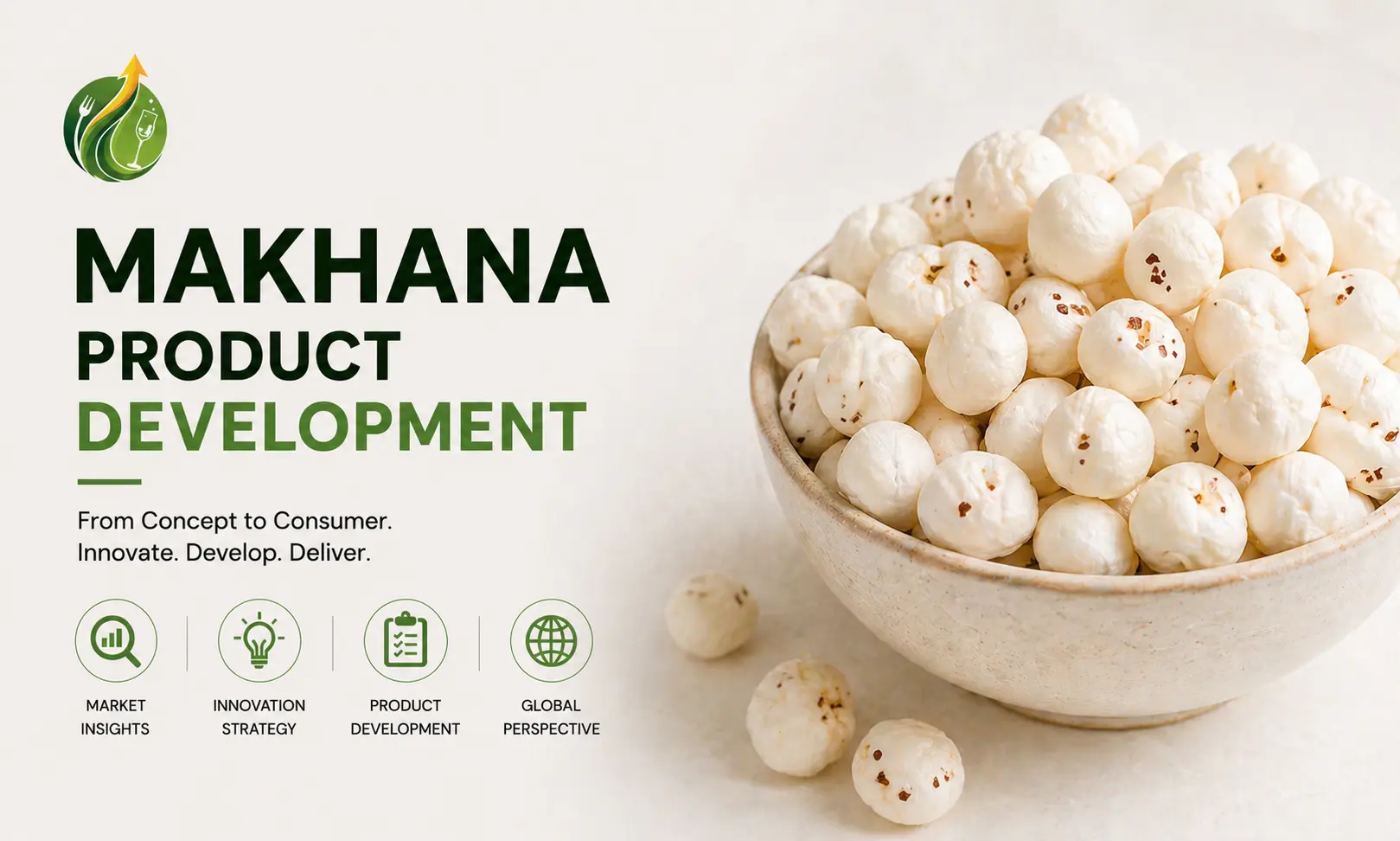
Makhana is no longer just a fasting food or a temple prasad. It has become one of the most commercially exciting ingredients in the Indian food industry. In 2026, makhana sits at the intersection of three of the most powerful consumer trends: healthy snacking, clean label eating, and premium gifting.
If you are a food entrepreneur, D2C brand, FMCG company, or an investor exploring the snack space, new makhana product development offers one of the most compelling opportunities in the Indian market today. India produces over 90 percent of the world’s makhana supply, almost entirely from Bihar, which gives domestic brands a serious cost and freshness advantage over any global competition.
This guide covers everything you need to know about food product development for a new makhana product in India, from market opportunity and trending formats to the development process, compliance requirements, and what to look for in a manufacturing partner.
Why Makhana Is the Right Product to Build in 2026
The makhana market in India has gone through a structural shift in the last three years. What was once a niche health food sold in loose form at local stores is now a branded, flavored, premium snack driven by advanced food formulation, available across D2C platforms, quick commerce, airports, and modern retail.
The global fox nuts market was valued at USD 28.5 million in 2024 and is projected to grow at a CAGR of over 8 percent through 2030. In India, the search volume for makhana products hit an all-time high in 2025 and has remained strong through 2026. The category is being driven by a consumer base that is actively looking for snacks that are low in calories, high in protein, naturally gluten-free, and rooted in Indian food culture.
Several macro factors are making this the right time to develop a makhana product.
- India controls global supply, which means raw material is available at competitive prices compared to any other geography
- The product is naturally allergen-friendly, making it suitable for a wide consumer base including children, fitness enthusiasts, and elderly buyers
- Makhana fits the clean label trend perfectly with a short, recognizable ingredient list
- The category still has significant white space in flavors, formats, and positioning compared to mature snack categories like chips or namkeen
- Quick commerce and D2C channels have dramatically lowered the barrier to entry for new makhana brands
Makhana Market Overview in India
| Metric | Data |
| Global Fox Nuts Market (2024) | USD 28.5 million |
| Projected CAGR (2024 to 2030) | Over 8 percent |
| India’s Share of Global Production | Over 90 percent (primarily Bihar) |
| Fastest Growing Segment | Flavored and functional makhana |
| Top Sales Channels in 2026 | D2C, Blinkit, Zepto, Amazon, Modern Trade |
| Peak Search Season | Navratri, Diwali, January (fitness resolution season) |
| Average Retail Price (50 gm) | Rs. 80 to Rs. 200 depending on positioning |
Types of Makhana Products You Can Develop
Makhana is versatile as a food ingredient, which means there are multiple product formats you can build around it. Each format has a different consumer, different price point, and different manufacturing requirement.
Roasted and Flavored Makhana
This is the core and most popular format. Raw makhana is roasted, then flavored with dry seasoning blends. The market has moved well beyond basic salt and pepper. Popular formats in 2026 include single-flavor premium variants, regional Indian flavor collections, and functional seasoned makhana with added herbs or adaptogens.
Coated and Glazed Makhana
Dark chocolate coated makhana, caramel glazed makhana, and honey and nut coated variants are a growing premium segment. These products command higher margins and are popular in the gifting and premium retail space.
Makhana Trail Mix
Combining makhana with nuts, seeds, dried fruits, and dark chocolate chips creates a trail mix product that targets health-conscious consumers and corporate gifting buyers. This format allows higher price points and can justify premium packaging.
Makhana Flour and Ingredient Products
Makhana flour is gaining traction as a gluten-free baking ingredient. Products like makhana kheer mixes, makhana porridge, and makhana-based baby food are emerging categories that have very low competition and strong search demand.
Functional and Fortified Makhana
Adding functional ingredients to makhana opens up a premium health segment. Products fortified with protein powder, collagen, ashwagandha, or gut health ingredients are being developed by brands that want to move beyond snacking and position makhana as a functional food.
Trending Makhana Flavors and Formats in 2026
| Flavor Category | Specific Variants | Target Consumer |
| Classic Indian Masala | Tandoori, Pudina, Peri Peri, Chaat | Mass market, family snacking |
| Wellness and Functional | Turmeric Black Pepper, Ashwagandha Cocoa, Moringa Sea Salt | Health-conscious, 25 to 40 age group |
| Premium and Indulgent | Dark Chocolate, Salted Caramel, White Cheddar | Urban, gifting, premium retail |
| International Fusion | Sriracha Lime, Truffle Salt, Korean BBQ | Young urban consumers, D2C |
| Unflavored and Minimalist | Himalayan Pink Salt, Plain Roasted | Diet-conscious, keto consumers |
The Makhana Product Development Process
Developing a makhana product from concept to shelf involves several stages. Understanding each stage helps you plan your budget, set realistic timelines, and make informed decisions at each step.
Stage 1: Concept and Brief (1 to 3 days)
Define your target consumer, positioning, price point, flavor direction, and intended distribution channel. The more specific your brief, the faster and more accurately your formulation team can develop the right product.
Stage 2: Raw Material Sourcing and Grading (3 to 7 days)
Makhana quality varies significantly by grade. Large, uniform, dense makhana (Grade A) roasts evenly and delivers the best product. Your manufacturer should source from trusted suppliers in Darbhanga, Madhubani, and Saharsa districts of Bihar. Moisture testing and density checks should be performed on incoming raw material.
Stage 3: Flavor Development and R&D (7 to 14 days)
Food scientists develop your flavor blend, calibrate roasting temperature and time, and test coating adhesion. Multiple sample iterations are common at this stage. Each sample should be evaluated for taste, crunch, texture after cooling, and shelf stability at ambient temperature.
Stage 4: Shelf Life and Stability Testing (14 to 30 days)
Makhana absorbs moisture quickly, so packaging selection and shelf life testing are critical. Accelerated shelf life testing tells you how your product performs over time in different humidity and temperature conditions. This determines your best before date and packaging specifications.
Stage 5: Packaging and Label Development (5 to 10 days)
Packaging must balance visual appeal, moisture barrier properties, and FSSAI compliance. Stand-up pouches with metalized film or kraft paper laminate are the most common formats. Your label must carry the nutritional information panel, ingredient list, allergen declaration, FSSAI license number, and all mandatory markings.
Stage 6: Pilot Batch and Approval (5 to 10 days)
A small pilot batch is produced under full production conditions, not lab conditions. This is your final approval sample. Review it carefully for consistency across pieces, uniform coating, absence of broken pieces, correct seasoning intensity, and packaging integrity.
Stage 7: Full Production and Dispatch (5 to 15 days)
Once you approve the pilot batch, full production begins. A good manufacturer provides batch production records, quality test reports, and dispatch documentation with every order.
Cost of Developing a New Makhana Product
|
Cost Component |
Typical Range |
Notes |
|
Per-Kg Manufacturing Cost |
Rs. 300 to Rs. 700 per kg |
Depends on flavor complexity and coating type |
|
Minimum Order Quantity |
100 kg to 500 kg per batch |
Lower MOQ available for first launch batches |
|
Flavor and R&D Development |
Rs. 50,000 to Rs. 1,50,000 |
Custom flavor creation and multiple sample rounds |
|
Packaging Design and Print |
Rs. 20,000 to Rs. 80,000 |
Label design, pouch design, print-ready files |
|
Shelf Life and Lab Testing |
Rs. 15,000 to Rs. 50,000 |
Moisture, microbiological, nutritional panel testing |
|
FSSAI Registration |
Rs. 5,000 to Rs. 25,000 |
Brand owner license, separate from manufacturer |
|
Total First Launch Budget |
Rs. 2,00,000 to Rs. 5,00,000 | Approximate all-in for one SKU first batch |
FSSAI and Regulatory Requirements for Makhana Products
Packaged makhana products are regulated under FSSAI’s food standards. Before you go to market, your product must meet several compliance requirements.
- Your brand must hold its own FSSAI registration or license. Basic registration covers turnover below Rs. 12 lakh, State License covers Rs. 12 lakh to Rs. 20 crore, and Central License is required above Rs. 50 crore
- Your manufacturing partner must also hold a valid FSSAI license, and both license numbers must appear on the packaging
- A mandatory nutritional information panel showing energy, protein, fat, carbohydrates, sugar, and sodium per 100 gm and per serving is required
- All ingredients must be listed in descending order by weight
- Allergen declarations are mandatory if the product contains any of the 14 major allergens recognized under FSSAI
- If you make health claims like high protein or low fat, the product must meet the FSSAI-defined nutrient thresholds for those claims. Violations can result in product recall
- Best before date, batch number, and manufacturing date must appear on every pack
- For export products, destination-country labelling and food safety laws apply and may differ from FSSAI requirements
Choosing the Right Makhana Manufacturing Partner
The quality of your makhana product depends heavily on your manufacturing partner, especially in contract manufacturing of roasted makhana. Here is what to evaluate before you commit.
- Verify FSSAI license number directly on the FSSAI portal. Do not accept screenshots or verbal confirmations
- Check whether the facility has experience specifically in makhana processing, not just general snack manufacturing
- Ask about raw material sourcing. The best manufacturers source directly from Bihar and have grading processes in place
- Ask about roasting equipment and temperature control. Consistent roasting requires industrial-grade equipment with precise temperature calibration
- Confirm MOQ and whether they offer flexibility for first-batch launches
- Ask for 2 to 3 client references in the makhana category and contact them directly
- Evaluate their R&D and food science team. A strong flavor development capability is essential for creating differentiated products
- Understand how they handle moisture control and packaging sealing, as these directly affect shelf life
- Ask for sample batches before committing to a production order. A serious manufacturer will provide this
Who Should Develop a Makhana Product
Makhana product development is relevant for a wide range of businesses and individuals.
- D2C food brands looking for a healthy snack product with strong repeat purchase potential and premium positioning
- FMCG companies wanting to add makhana to their healthy snack portfolio to capture health-conscious consumers
- Corporate gifting companies developing premium snack hampers with branded makhana as a centrepiece product
- Export-oriented businesses targeting Indian diaspora markets in the USA, UK, UAE, and Canada where demand for Indian health foods is growing
- Ayurvedic and wellness brands that want to add a snack product to their product range
- Retail chains developing private label makhana products to offer a healthier snacking alternative at competitive prices
- Entrepreneurs and startup founders who want to enter the food business with a product that has low competition and strong organic search demand
What Makes a Makhana Brand Stand Out in 2026
The makhana market has grown, which means competition has also increased. Brands that stand out in 2026 are doing a few things consistently well.
Clear positioning is the first differentiator. The most successful makhana brands own a specific consumer territory, whether that is gym nutrition, office snacking, premium gifting, or kids’ healthy snacking. Trying to be everything to everyone rarely works in this category.
Packaging design has become a critical purchase driver in this category. Consumers browsing on quick commerce or D2C platforms make decisions in seconds. Clean, minimal, premium-looking packaging consistently outperforms cluttered, discount-looking designs.
Consistency is what drives repeat purchase. If your makhana tastes different from batch to batch, your return rate will be high and your ratings will suffer. Working with a manufacturer that has strong quality control processes is not optional.
Storytelling around sourcing is a growing differentiator. Brands that communicate where their makhana comes from, how it is processed, and why it is better than what is available in the market build stronger consumer trust.
Ready to Develop Your Makhana Product
The makhana category in India is at an inflection point. The consumer is ready, the supply chain is in place, and the opportunity to build a branded makhana product that dominates a specific segment has never been clearer.
What separates the brands that succeed from those that struggle is the quality of execution from day one. That starts with the right formulation, the right manufacturing partner, and the right go-to-market plan.
Whether you are developing your first makhana product or expanding an existing range, Flavor Catalystz brings deep category expertise, strong raw material sourcing relationships in Bihar, and end-to-end product development capability under one roof.
Contact us today at +91 9711730492 to discuss your makhana product idea, get a transparent development plan, and take the first step toward building a makhana brand that earns real market share in 2026.
Frequently Asked Questions
What is the minimum order quantity for makhana product development?
MOQ for makhana products typically ranges from 100 kg to 500 kg per batch depending on the flavor variant, coating complexity, and packaging format. Many manufacturers offer lower MOQs for first-batch launches to help new brands test the market before scaling.
How long does it take to develop a new makhana product?
From concept to first production batch, makhana product development typically takes 30 to 60 days. This includes flavor development and sampling (7 to 14 days), packaging finalization (5 to 10 days), regulatory work (7 to 15 days), and production (5 to 15 days). Simple flavors and standard packaging can move faster.
Which makhana flavors are most popular in India in 2026?
Himalayan pink salt, peri peri, cheese and herbs, black pepper, pudina, and tandoori masala are among the top-selling flavors in 2026. Functional variants like turmeric and ashwagandha are gaining strong traction in the health segment. Dark chocolate and caramel glazed makhana are leading in the premium gifting segment.
What certifications are needed to sell makhana products in India?
Your brand needs its own FSSAI registration or license. The manufacturing facility must hold a valid FSSAI Central License. ISO 22000, GMP, and HACCP certifications add credibility and are often required for modern trade listings and export shipments.
Can I develop a private label makhana product without my own factory?
Yes. Contract manufacturing allows you to develop and sell makhana products under your own brand without owning a production facility. A good manufacturing partner handles formulation, processing, packaging, and compliance from start to finish. You focus on building the brand and driving sales.