Jul 2026 · 10 min read
Cutting carbohydrates out of a snack sounds simple on paper — swap the flour, drop the sugar, done. In a lab, it almost never works that way. Remove the carbohydrate load from a recipe and you also remove the ingredient that was quietly doing three or four other jobs: holding moisture, creating structure, browning the surface, carrying sweetness, and giving the product its shelf life. Low carb snack formulation is really the science of replacing all of those functions at once, without the finished product tasting like a compromise.
This guide walks through how low carb snack formulation actually works in practice — the ingredient systems involved, where most reformulation projects run into trouble, what Indian food safety rules currently allow you to claim on pack, and the process brands typically follow to move from a working recipe to a commercially manufacturable product.
What Does Low Carb Snack Formulation Involve?
Low carb snack formulation is the process of rebuilding a snack recipe — bar, chip, cookie, or extruded format — so that its digestible carbohydrate content is reduced, usually by replacing wheat flour, sugar, and starches with alternative flours, fiber systems, protein, and functional sweeteners, while still controlling texture, taste, browning, and shelf stability. It requires food science input, not just ingredient substitution, because sugar and starch perform structural roles that a single replacement ingredient rarely covers on its own.
Every Successful Low-Carb Snack Starts With the Right Formula.
Whether you’re creating a baked snack, protein crisp, seed mix, or functional bite, the formulation determines everything from texture and taste to nutrition claims and shelf life. Flavor Catalystz partners with food brands to transform product ideas into commercially scalable low-carb snacks that are ready for manufacturing and retail launch.
Why Low Carb Snacks Have Become a Serious Commercial Category
Low carb was once a niche diet trend confined to bodybuilding forums and keto blogs. That is no longer the market reality. Consumer interest has broadened into a wider “metabolic health” conversation — people tracking blood sugar response, not just calories — and packaged food companies across bars, chips, biscuits, and confectionery have responded by building dedicated low carb lines rather than treating it as a side variant.
For a food brand, that shift changes the calculation. A low carb SKU is no longer a defensive move to avoid losing keto shoppers; it is increasingly a growth line in its own right, sitting alongside high-protein and high-fiber claims as one of the fastest-growing positioning angles in modern snacking. That also means competition on the shelf is tighter than it was even two years ago, and a product that tastes “diet-y” gets punished quickly by repeat-purchase data.
What Actually Breaks When You Remove Carbohydrates From a Snack
Most first-attempt low carb reformulations fail sensory testing for the same handful of reasons. The table below maps what carbohydrate ingredients were doing in the original recipe, and what tends to go wrong when they are simply removed rather than properly replaced.
| Function Carbs Were Performing | What Goes Wrong If Removed Without Replacement | Typical Fix |
| Bulk and volume (sugar, flour) | Product turns dense, small, or “shrunken” | Fiber or protein-based bulking agents |
| Moisture retention (sugar, starch) | Dry, crumbly, short shelf life | Humectant fibers, polyols, controlled hydration |
| Browning and flavor depth (Maillard reaction from sugar) | Pale, flat-tasting product | Small dose of reducing sugars, allulose, or protein-driven browning |
| Binding and structure (starch, gluten) | Product falls apart or won’t hold shape | Hydrocolloids, egg or plant protein binders |
| Sweetness and mouthfeel (sugar) | Thin, one-note sweetness, cooling aftertaste from bulk sweeteners | Stacked sweetening systems (see below) |
| Crisp/snap texture (starch gelatinization) | Tough or leathery bite in baked and extruded formats | Alternative starch blends, adjusted moisture content |
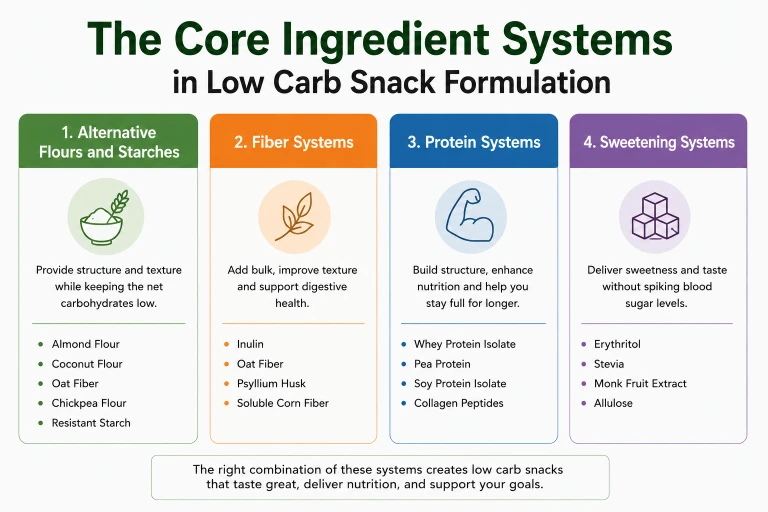
The Core Ingredient Systems in Low Carb Snack Formulation
Alternative Flours and Starches
Almond, coconut, lupin, and defatted soy flour are the most commonly used wheat-flour replacements, each with a different absorbency and binding behavior. They are rarely used alone — blending two flours (for example a starch-based flour with a protein-dense one) usually gets closer to a conventional crumb or bite than any single flour on its own.
Fiber Systems
Soluble fibers such as inulin, chicory root fiber, and resistant tapioca or corn dextrins are used to replace the bulk that sugar and flour used to provide, while also allowing the fiber content to be subtracted from total carbohydrate on a net carb calculation. Fiber “stacking” — combining a soluble fiber with a bulking insoluble fiber — is a common technique to rebuild chew and body in bars and cookies.
Protein Systems
Whey, pea, rice, and soy proteins contribute both nutritional positioning and structural function, but each interacts differently with heat and moisture. Protein levels have to be tuned carefully — pushed too high, a bar turns dry, dense, or develops an off-note during storage.
Sweetening Systems
This is usually the hardest part of low carb snack formulation, because sugar’s role goes far beyond sweetness. A well-built low carb sweetening system typically stacks two or three components rather than relying on one sweetener.
| Sweetening Component | Primary Role | Common Trade-off |
| Erythritol | Bulk sweetness, minimal calorie impact | Cooling aftertaste at high doses |
| Allulose | Sweetness plus browning and moisture behavior similar to sugar | Higher cost, sourcing variability |
| Stevia or monk fruit | High-intensity sweetness, small usage dose | Bitter or lingering aftertaste if not balanced |
| Soluble fiber syrups | Bulk, texture, mild sweetness | Adds cost, needs correct hydration |
Binders and Structural Agents
Xanthan gum, psyllium husk, and egg or plant-based proteins are used to hold the reformulated matrix together once its natural starch-and-gluten framework has been removed. Small changes in binder dosage have an outsized effect on final texture, which is why this stage usually needs several trial iterations rather than a single pass.
A Practical Process for Formulating a Low Carb Snack
Formulating a low carb snack from scratch generally follows the same underlying discipline as any structured food product development effort — moving from concept to a validated, scalable product — but with tighter technical constraints at each stage because there is less margin for error once carbohydrates are reduced.
- Define the product brief. Format, target net carb level, price point, and the claim you intend to make on pack are decided before any formulation work starts.
- Select the flour, fiber, and protein base. This sets the structural foundation before sweetness or flavor is addressed.
- Build the sweetening system. Sweeteners are stacked and tested at small batch scale to balance sweetness curve, aftertaste, and browning.
- Run sensory trials. Texture, taste, and aftertaste are evaluated against a conventional benchmark product, not in isolation.
- Test shelf stability. Moisture migration, staling, and oxidation are checked under accelerated storage conditions.
- Validate at pilot scale. A formulation that works in a 500g lab batch does not automatically behave the same way in a 50kg production batch — mixing time, heat transfer, and equipment all change outcomes.
- Finalize nutrition and compliance documentation before commercial production begins.
FSSAI, Net Carb Claims and Label Compliance in India
Unlike “low fat” or “high protein,” a “low carb” or “net carb” claim does not currently have a standardized, legally defined threshold under India’s food labelling regulations. This means brands need to be cautious about how such claims are worded on pack — a vague or unsubstantiated carbohydrate claim carries the same compliance risk as any other misleading nutrient claim under the Food Safety and Standards (Labelling and Display) Regulations, 2020.
Practical points to work through before finalizing packaging:
- Nutrition values on the panel must come from lab-tested results on the actual finished formulation, not theoretical recipe math.
- Any fiber-based “net carb” calculation used in marketing material should be backed by the lab-verified fiber and total carbohydrate figures, since regulators are tightening scrutiny on nutrition-related claims.
- Front-of-pack indicators for high fat, sugar, or salt (HFSS-style labelling) are moving toward stricter enforcement, so a low carb positioning needs to be checked against the full nutrient profile, not just carbohydrate content in isolation.
- Ingredient declarations for less common inputs (resistant dextrin, allulose, specific fiber syrups) need to be listed correctly and consistently across all product documentation.
Common Mistakes Brands Make When Formulating Low Carb Snacks
- Replacing sugar with a single high-intensity sweetener and expecting texture to hold up on its own.
- Skipping shelf-life testing because the lab sample “tasted fine” at day one.
- Finalizing packaging and claims before the formulation has been lab-tested at its final version.
- Treating flour replacement and sweetener replacement as two separate problems instead of one interacting system.
- Scaling directly from a kitchen recipe to a commercial production line without a pilot-batch step in between.
From Recipe to Commercial Batch: Where Reformulation Projects Usually Stall
The gap between a working kitchen-scale low carb recipe and a commercially manufacturable one is where most projects lose time and money. Ingredient behavior under industrial mixing, extrusion, or baking conditions is rarely identical to a small test batch, and formulators sometimes discover a texture or shelf-life issue only after a large production run has already been committed. This is the stage where food brands often bring in outside formulation expertise — consultancies such as Flavor Catalystz work through this exact transition with clients, aligning the recipe with actual machinery, batch size, and cost structure before a product goes to commercial scale.
Cost and Ingredient Sourcing Considerations
| Ingredient Category | Relative Cost Impact | Sourcing Note |
| Alternative flours (almond, coconut, lupin) | Medium to High | Import dependence is common; blending flours can offset cost |
| Fiber systems (inulin, resistant dextrin) | Medium | Dosage-sensitive; over-use affects digestibility tolerance |
| Functional sweeteners (allulose, erythritol) | Medium to High | Supply and price can vary by source and purity grade |
| Protein isolates (pea, whey, rice) | Medium to High | Quality variation affects flavor; test multiple suppliers |
| Binders and hydrocolloids | Low | Small dosage but critical to final texture |
Frequently Asked Questions
Is “net carbs” a term FSSAI officially recognizes?
No. Unlike some international markets, India’s food labelling regulations do not currently define a standardized “net carb” calculation, so brands should be cautious about how such figures are used in marketing claims.
What is the biggest formulation challenge in low carb snacks?
Texture. Removing sugar and starch affects moisture retention, browning, and structure simultaneously, which is why sweetener and flour replacement need to be solved together rather than separately.
Can a low carb snack still be clean label?
Yes, though it requires more careful ingredient selection — natural fiber sources, minimally processed alternative flours, and sweeteners like allulose or monk fruit are commonly used to keep the label recognizable.
How long does it take to formulate a low carb snack for commercial launch?
Formulation-to-pilot timelines typically run a few weeks to a couple of months depending on complexity, with additional time needed for shelf-life validation and regulatory documentation before commercial scale-up.
Do low carb snacks cost more to manufacture?
Generally yes, since alternative flours, fiber systems, and functional sweeteners tend to cost more than wheat flour and sugar, though blending ingredients strategically can help manage the overall cost impact.
Can an existing snack recipe be reformulated to lower carbs without changing its category?
In most cases yes, but it usually requires rebuilding the flour, fiber, and sweetening system together rather than making a single ingredient swap.
What causes an aftertaste in low carb snacks?
Aftertaste usually comes from relying on a single high-intensity sweetener at too high a dose. Stacking two or more sweeteners at lower individual doses generally reduces lingering aftertaste.
Is lab testing mandatory before making a low carb or reduced-sugar claim in India?
Yes. Any nutrient claim must be substantiated with lab-tested values from the finished product, since regulators require claim accuracy to match actual analyzed composition, not formulation estimates.