May 2026 · 12 min read
India’s snack market is one of the most dynamic food categories in the country. Indian consumers snack multiple times a day, and the range of snack formats, flavors, and occasions is enormous. What is changing in 2026 is what people want their snacks to be made from.
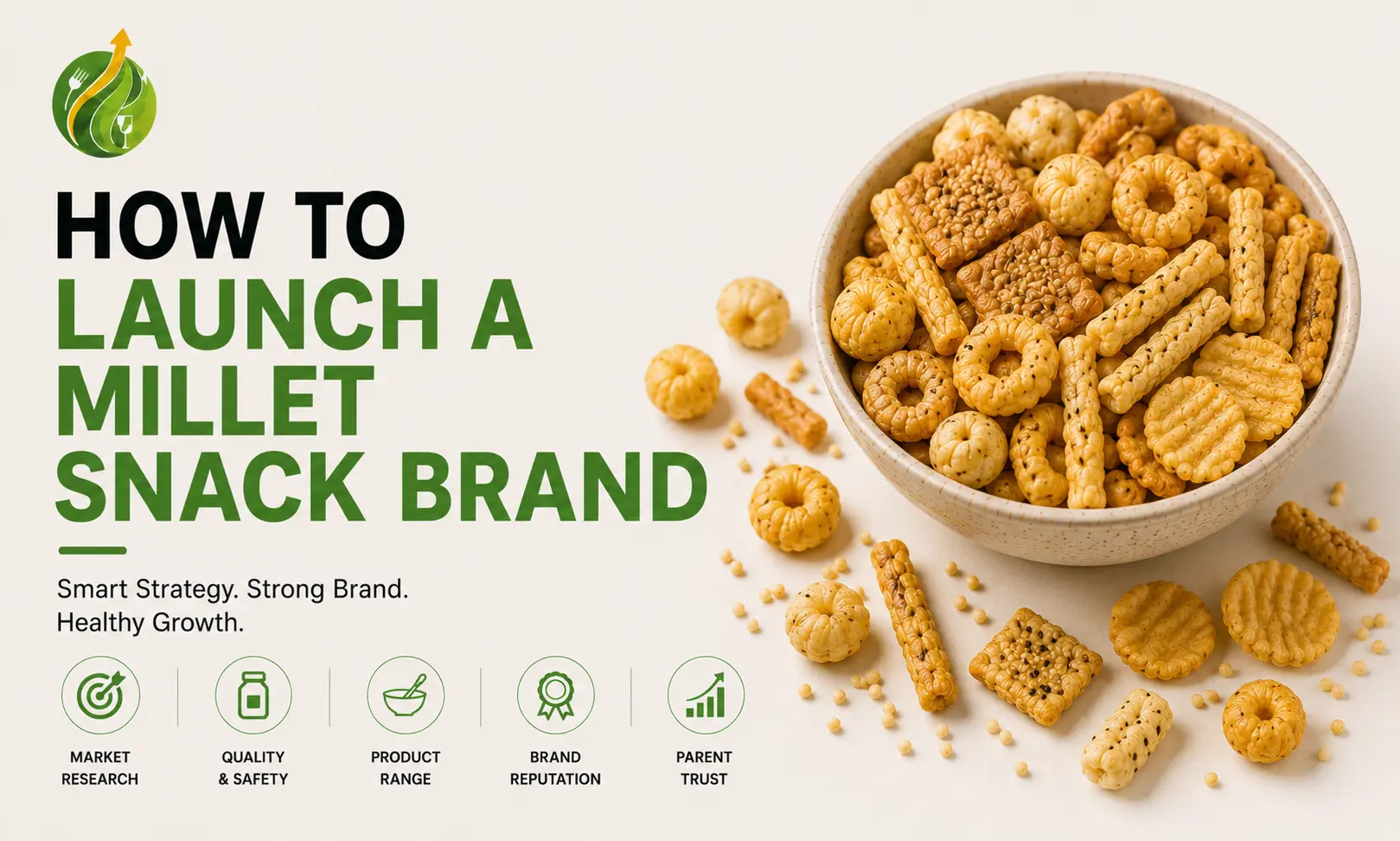
Millets are having their biggest commercial moment yet. Ragi puffs, jowar chips, bajra namkeen, and foxtail millet crackers are no longer niche products. They are showing up in quick commerce apps, airport lounges, school tiffins, and corporate snack boxes. The combination of government support, health awareness, and genuine consumer demand has created a real market for millet snack brands.
This guide is a complete roadmap for launching a millet snack brand in India in 2026. It covers the market opportunity, snack formats to consider, food product development, FSSAI compliance, packaging, cost planning, and how to build distribution that drives sales.
The Millet Snack Market in India 2026
India’s savory snack market is worth over Rs. 50,000 crore and growing at 12 to 15 percent annually. Within this, the health and better-for-you snack sub-segment is growing at over 20 percent. Millet snacks are part of this faster-growing sub-segment.
The International Year of Millets in 2023 created a wave of consumer awareness that has continued to build. Media coverage, government campaigns, and food influencer content have all contributed to a consumer base that now actively seeks millet-based products. Unlike many health food trends that fade, the millet movement in India has institutional backing and genuine nutritional credibility behind it.
- The Indian health snack segment is projected to reach Rs. 30,000 crore by 2028.
- Ragi-based snacks are the most commercially established millet snack format in India, led by brands like Soulfull.
- Quick commerce platforms are driving impulse purchase of health snacks in urban markets.
- School canteen health mandates in several states are creating institutional demand for millet snack brands.
- Export demand for Indian millet snacks is growing from the Indian diaspora market in the US, UK, UAE, and Australia.
Types of Millet Snacks You Can Build a Brand Around
Choosing your snack format is the most important early decision. Different snack types require different production equipment, have different production costs, and appeal to different consumer segments.
| Snack Type | Main Millet | Target Consumer | Best Channel | Retail Price Range (Rs.) |
| Millet puffs and extruded snacks | Jowar, ragi, bajra | Kids, families, all ages | Modern trade, quick commerce | 20 to 80 per pack |
| Millet cookies and biscuits | Ragi, jowar, foxtail | Kids, health-conscious adults | D2C, modern trade, gifting | 60 to 200 per pack |
| Millet namkeen and bhujia | Bajra, jowar, little millet | All Indian households | Kirana, modern trade, online | 30 to 120 per pack |
| Millet crackers and rice cakes | Foxtail, barnyard, ragi | Weight-conscious adults | D2C, health stores | 80 to 200 per pack |
| Millet granola and muesli bars | Foxtail, ragi, jowar | Fitness and breakfast segment | D2C, Amazon, gyms | 60 to 180 per bar/pack |
| Millet chips and crisps | Jowar, bajra, ragi | Urban snackers, chip lovers | Quick commerce, modern trade | 30 to 100 per pack |
| Millet instant snack mix | Multiple millets | Working professionals, hostel students | D2C, Amazon, quick commerce | 50 to 150 per pack |
Food Product Development for Millet Snacks
Good food product development balances taste, nutrition, shelf life, and cost. Here is what you need to think through for each of these.
Taste First, Always
This sounds obvious, but many health food brands get this wrong. If your millet snack does not taste good enough for consumers to buy it a second time, the health benefit does not matter. Taste drives trial and repeat purchase. Nutritional credentials justify the price premium. Focus on nailing the taste before anything else.
For millet puffs and extruded snacks, the base grain flavor is relatively neutral, which makes it easy to apply bold, familiar Indian flavors. For millet cookies and crackers, the ragi or jowar grain gives a distinct, slightly earthy flavor that works well with chocolate, vanilla, and dried fruit combinations.
Choosing Your Millets
Not all millets taste the same or behave the same way in processing. Here is a quick guide to the most commonly used millets in snack production.
- Ragi (Finger Millet): Deep, earthy flavor, high calcium, works well in cookies, dosas, and porridge-style snacks.
- Jowar (Sorghum): Mild flavor, pops well, ideal for puffs, chips, and extruded snacks.
- Bajra (Pearl Millet): Stronger flavor, works well in namkeen, bhakri-style snacks, and traditional Indian formats.
- Foxtail Millet: Light flavor, low glycemic index, good for crackers, rice cake substitutes, and weight management snacks.
- Barnyard Millet: Very mild, good for fasting snacks and low-calorie cracker formats.
Shelf Life Requirements
Most retail snack formats require a minimum shelf life of 6 months. Modern trade and export require 9 to 12 months. Achieving this depends on your packaging (oxygen barrier level, nitrogen flushing), your formulation (water activity, fat oxidation management), and your storage conditions.
Work with your contract manufacturer or a food technologist to specify and validate shelf life before your first production batch. Launching a snack with insufficient shelf life creates returns, wastage, and reputational damage that is very costly for a new brand.
Nutritional Positioning
Decide upfront whether your brand leads with taste or health as the primary consumer promise. Taste-forward brands emphasize flavor, snackability, and occasions. Health-forward brands lead with nutritional claims like high fiber, gluten-free, low calorie, or diabetic-friendly. Both approaches work, but they require different communication and different label design priorities. Many successful millet snack brands do both, leading with taste on the front of pack and letting nutritional credentials do the work on the back.
FSSAI Compliance for Millet Snack Brands
FSSAI compliance is non-negotiable for any packaged food brand selling in India. Here is the compliance checklist for a millet snack brand.
- FSSAI License: Your brand entity needs its own FSSAI license. Small businesses (turnover below Rs. 12 lakh) need basic registration. Mid-sized operations need a State License. Larger operations need a Central License.
- Manufacturing Facility License: Your contract manufacturer must hold a valid FSSAI license. Both numbers must appear on your label.
- Label Requirements: Ingredient list in descending order of weight, nutritional information panel per 100 gm and per serving, FSSAI license number, net weight, manufacturing date, best before date, and country of origin.
- Health Claims: Claims like high fiber, low fat, or source of protein must comply with FSSAI nutrient content claim thresholds.
- Allergen Declarations: Mandatory if your snack contains or may contain gluten, nuts, sesame, or other listed allergens.
- Lab Testing: Nutritional values on your label must be backed by testing from an NABL-accredited laboratory.
Cost Breakdown for Launching a Millet Snack Brand in India
| Cost Component | Estimated Range (Rs.) | One-time / Annual | Notes |
| Recipe and product development | Rs. 20,000 to Rs. 1,00,000 | One-time | Includes flavor testing and formulation |
| FSSAI license (brand entity) | Rs. 7,500 to Rs. 25,000 | Annual | State or Central based on scale |
| First production batch (5,000 packs) | Rs. 80,000 to Rs. 3,00,000 | Per batch | Depends on snack type and ingredients |
| Packaging (pouch per unit) | Rs. 3 to Rs. 15 per unit | Per unit | Stand-up foil pouch standard for snacks |
| Packaging design | Rs. 20,000 to Rs. 70,000 | One-time | Per SKU, professional branding |
| Lab testing (nutritional label, shelf life) | Rs. 15,000 to Rs. 40,000 | Per product | NABL-accredited lab required |
| FSSAI license for contract manufacturer | Already licensed | Not applicable | Manufacturer holds their own license |
| Marketing and launch budget | Rs. 2,00,000 to Rs. 8,00,000 | First year | Social, influencer, quick commerce |
| Total first-year estimated investment | Rs. 4 lakh to Rs. 15 lakh | All-in | Contract manufacturing, two to three SKUs |
Packaging for Millet Snacks
Snack packaging needs to do two things: protect the product and sell the product. Both are equally important.
Stand-Up Foil Pouches
The most common format for premium millet snacks. The foil lining provides excellent oxygen and moisture barrier properties, extending shelf life significantly. Stand-up pouches look good on a shelf and photograph well for e-commerce. Zip-lock closures are preferred for crackers and cookies where consumers do not finish the pack in one sitting.
Flexible Film for Multi-Pack
For smaller snack packs in the Rs. 10 to Rs. 30 range, simple printed flexible film pouches are the standard format. These work for impulse-purchase products in the kirana and modern trade impulse category.
Label Design for Millet Snacks
Your packaging design needs to immediately communicate what the snack is, what millet it is made from, and why that matters. The best millet snack packaging uses bold colors, clear millet ingredient callouts, and a flavor name that is easy to read at a glance. Avoid overcrowding the front of pack with health claims. Pick your most compelling one or two claims and make them prominent.
Building Distribution for Your Millet Snack Brand
Distribution is where most food brands struggle. Building the wrong distribution too early wastes money and margin. Here is a channel-by-channel strategy for millet snack brands.
| Channel | Best For | Key Requirement | Margin You Keep | Time to List |
| Own D2C website | Brand building, repeat buyers | Good product photography, SEO | 55 to 70 percent | 1 to 2 weeks |
| Amazon India | Volume and discovery | 3.8+ rating, FBA or FBM setup | 40 to 55 percent | 2 to 4 weeks |
| Blinkit and Zepto | Urban reach, impulse purchase | Consistent stock, competitive MRP | 35 to 50 percent | 4 to 8 weeks |
| BigBasket | Online grocery buyers, repeat purchase | Category listing approval | 30 to 45 percent | 6 to 12 weeks |
| Modern trade (supermarkets) | Shelf presence, new consumer trial | Listing fees, trade margins, co-op | 20 to 35 percent | 2 to 6 months |
| Kirana via distributor | Mass market reach, volume | Appointed distributor network | 15 to 25 percent | 3 to 12 months |
| Corporate gifting | Seasonal revenue, premium SKUs | B2B sales team, customization | 45 to 65 percent | 1 to 4 weeks |
The Right Launch Sequence
Most successful millet snack brands follow the same distribution sequence. Start with D2C and Amazon to validate product-market fit and build reviews. Add quick commerce (Blinkit, Zepto) once you have supply chain consistency. Then approach BigBasket and modern trade with demonstrated demand data. Kirana distribution through a distributor comes last, once you have enough brand awareness to support pull-through sales.
Building a Millet Snack Brand That Gets Noticed
Pick a Category and Own It
The biggest mistake new millet snack brands make is launching too many SKUs too early. Pick one snack format, one or two flavors, and one consumer segment. Own that space before you expand. Soulfull dominated ragi puffs before they added more products. True Elements dominated seed and millet trail mixes. Specialization creates the focused brand identity that consumers and retailers remember.
Create Content Around Your Millet Ingredients
Consumers are curious about millets but many are not familiar with the specific benefits of different types. Educational content about the millet you use, its origin, its nutritional profile, and ways to eat it builds brand authority and drives organic search traffic. Instagram Reels and YouTube Shorts about your millet sourcing story are highly shareable.
Use Sampling Aggressively
Trial is the biggest barrier for new snack brands. If consumers taste your product and love it, you win. Invest in sampling in gyms, offices, schools, and at food festivals. Partner with meal kit brands or corporate snack box services to get your product in front of new consumers at scale. Many snack brands report that sampling has the best return on investment of any marketing activity.
Price for the Right Position
Millet snacks can command a premium over conventional snacks because of the health and origin story. Do not underprice to compete with mass-market snack brands. Your consumer is not choosing between your jowar chips and a pack of Lay’s on price. They are choosing based on ingredients and health benefit. Price your product to reflect the quality of your ingredients and the strength of your positioning.
Launch Your Own Millet Snack Brand in India 2026
India’s millet snack market is growing rapidly as consumers shift toward healthy, high-protein, and clean-label snacking. In 2026, brands with strong food formulation, modern packaging, and scalable contract manufacturing have a major opportunity to capture this fast-growing category.
From millet chips to roasted snacks and protein puffs, demand is rising across D2C, retail, and quick commerce platforms.
Want to launch your own millet snack brand?
Connect with Flavor Catalystz for food product development, formulation, and manufacturing support. +91 9711730492
Frequently Asked Questions
Is a millet snack brand a good business to start in India?
Yes. The health snack segment in India is growing at over 20 percent annually, and millets are the fastest growing ingredient category within this segment. Consumer awareness is high, government support is strong, and the market is still early enough for new brands to establish themselves.
How much does it cost to launch a millet snack brand?
Launching through contract manufacturing typically requires Rs. 4 lakh to Rs. 15 lakh for the first year, covering product development, FSSAI licensing, first production batch, packaging, lab testing, and initial marketing for two to three SKUs.
What FSSAI license do I need for a millet snack brand?
Millet snacks fall under FSSAI’s cereal products or extruded snack food category. A State FSSAI License is required for operations with annual turnover up to Rs. 20 crore. Both your brand entity and your contract manufacturer must hold valid FSSAI licenses, and both numbers must appear on your product label.
Which millet snack format should I launch first?
If you want the largest addressable market, millet puffs and extruded snack formats have the widest consumer appeal and fit most easily into existing snacking habits. If you are targeting a premium segment with better margins, millet cookies, crackers, or granola bars are stronger choices. Starting with one format and two to three flavors is the most effective approach for a new brand.
How do I get my millet snack listed on quick commerce platforms?
To get listed on Blinkit or Zepto, you need a valid FSSAI license, GST registration, compliant packaging with barcodes, and competitive pricing. You apply through each platform’s seller or brand onboarding portal. Maintaining in-stock rates and achieving good customer ratings are critical for staying listed and improving placement on these platforms.