Jul 2026 · 13 min read
A keto snack that tastes great in a home kitchen and a keto snack that survives 200,000 units of commercial production are two very different engineering problems. Swapping sugar for erythritol or wheat flour for almond flour is the easy 10% of the work. The remaining 90% — net carb accuracy, shelf-stability, texture under mass production, and label compliance — is where most keto snack launches quietly fail before they ever reach a retail shelf.
The ketogenic food category has moved well past its early “recipe hack” phase. Global market sizing for the ketogenic diet segment now sits in the $13–17 billion range, with snacks consistently flagged as the fastest-growing product segment across major markets, ahead of supplements and beverages. That growth is exactly why formulation quality matters more today than it did five years ago — a crowded shelf punishes gritty texture, inconsistent net carbs, and vague “keto-friendly” claims far more harshly than an empty one did.
This guide breaks down keto snack formulation the way a food technologist would approach it: ingredient systems, the math behind “net carbs,” the specific failure points that show up during scale-up, and what a compliant, shelf-stable, production-ready formula actually requires. The formulation logic below draws on the same principles our team at Flavor Catalystz applies when developing the recipe and formulation behind a keto snack — building it to be market-ready and sellable from day one, not adjusted after the fact.
Keto Snack Formulation Starts With a Problem: There’s No Official Definition of Keto
Before touching a single ingredient, it’s worth knowing something most new brand owners don’t: neither the FDA in the US nor FSSAI in India has published an authorized regulatory standard defining what makes a food “ketogenic” or “keto-friendly.” In the US, keto is treated as a dietary descriptor rather than an authorized nutrient content claim, which means the burden of proof sits entirely on the manufacturer’s formulation and testing data, not on a government checklist. In India, FSSAI’s labelling regulations require accurate, lab-verified declarations of energy, carbohydrate, sugar, and fat — but there is no separate “keto” category to slot into.
Practically, this means two things for anyone doing food formulation for this category:
- Your “net carb” claim on the front of pack has to be defensible using the actual nutrition panel math, not marketing shorthand.
- Because there’s no external standard to lean on, your internal formulation discipline — consistent recipes, tested sweetener systems, and repeatable processing — becomes your only real safeguard against a mislabeled or recalled product.
From Kitchen Recipe to Commercial Keto Snack. Without Costly Reformulations.
Many keto snacks taste great in small batches but fail during commercial production due to texture changes, oil separation, moisture imbalance, or poor shelf life. Flavor Catalystz helps brands develop factory-ready keto snack formulations with optimized ingredients, stable processing, and scalable manufacturing solutions.
Net Carbs in Keto Snack Formulation: The Math That Decides If a Snack Is Really Keto
“Net carbs” isn’t a legal term, but it is the number every keto shopper mentally calculates in about three seconds while standing in the aisle. The commonly used formula is:
Net Carbs = Total Carbohydrates − Dietary Fiber − (Sugar Alcohols × their glycemic contribution)
Most sugar alcohols used in keto snacks (erythritol, allulose) are treated as contributing close to zero net carbs, while others (maltitol, in particular) carry a meaningfully higher glycemic impact and should not be subtracted out at the same rate. Getting this wrong is one of the most common reasons a “2g net carb” bar tests at 6–8g once it’s independently lab-verified — and under India’s nutrition testing and HFSS rules, or FDA nutrient content claim rules, that gap is a compliance risk, not just a marketing embarrassment.
| Carbohydrate source | Typical glycemic contribution | Net carb treatment |
| Dietary fiber (inulin, soluble corn fiber) | Negligible | Subtracted in full |
| Erythritol | ~0 | Subtracted in full (most labeling approaches) |
| Allulose | ~0 | Subtracted in full |
| Monk fruit / stevia (used at trace levels) | ~0 | Not usually a carb source at use-level |
| Maltitol | Moderate (roughly half of sucrose) | Only partially subtracted |
| Sorbitol / xylitol | Low–moderate | Partially subtracted, varies by market |
The takeaway for anyone doing serious food product development in this category: net carb accuracy is decided at the recipe stage, not the label design stage. If the sweetener blend isn’t locked before nutrition testing, the number on the pack is a guess.
The Building Blocks of Keto Snack Formulation: Four Ingredient Systems You Need to Balance
Every keto snack — bar, cookie, cracker, or bite — is really four interacting systems stacked on top of each other. Formulation problems almost always trace back to one of these being out of balance with the other three.
| System | Job it does | Common ingredients | What goes wrong when it’s off |
| Fat system | Carries flavor, replaces the calories sugar used to provide, drives mouthfeel | Coconut oil, MCT oil, nut butters, cocoa butter, ghee | Greasy mouthfeel, oil separation, rancidity |
| Structure/bulk system | Replaces the volume and bite that flour and sugar used to provide | Almond flour, coconut flour, whey/plant protein, fiber blends | Crumbly, dry, or dense texture |
| Sweetener/binder system | Provides sweetness, helps bind the mix, and controls water activity | Erythritol, allulose, monk fruit, glycerin | Gritty crystallization, weak binding, short shelf life |
| Moisture control system | Determines microbial safety and crunch vs. chew | Water activity depressants, humectants, drying/baking parameters | Mold risk if too high, staling if too low |
This four-system view matters because a fix applied to one system almost always creates a side effect in another. Adding more fat to improve mouthfeel raises water activity risk. Adding more fiber to cut net carbs can dry the product out and increase staling speed. Good formulation work is the discipline of tuning all four together rather than optimizing one system in isolation — which is the same principle that applies across food formulation for any reduced-sugar or reduced-carb snack category, not just keto specifically.
Sweetener Blending in Keto Snack Formulation: The Biggest Technical Risk You’ll Face
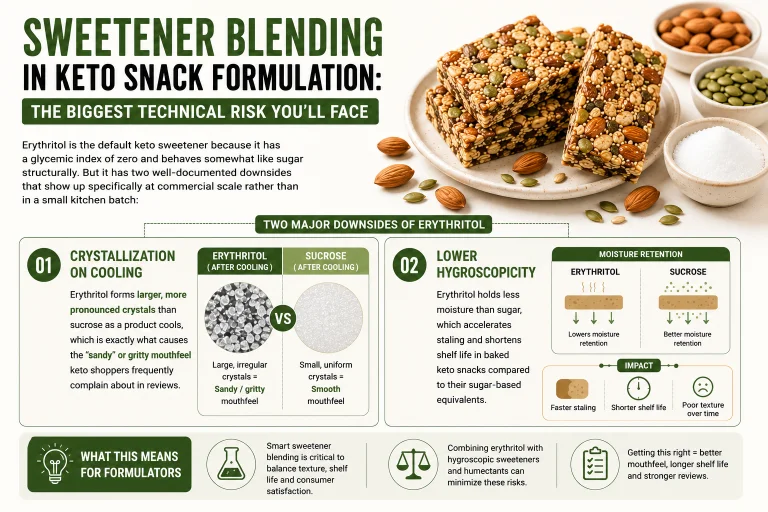
Erythritol is the default keto sweetener because it has a glycemic index of zero and behaves somewhat like sugar structurally. But it has two well-documented downsides that show up specifically at commercial scale rather than in a small kitchen batch:
- Crystallization on cooling — erythritol forms larger, more pronounced crystals than sucrose as a product cools, which is exactly what causes the “sandy” or gritty mouthfeel keto shoppers frequently complain about in reviews.
- Lower hygroscopicity — erythritol holds less moisture than sugar, which accelerates staling and shortens shelf life in baked keto snacks compared to their sugar-based equivalents.
The commercial fix, used by several private-label keto cookie and cluster lines already on shelf, is a blended binder system rather than a single sweetener: erythritol for bulk and structure, combined with a smaller proportion of allulose or a soluble fiber like inulin to soften the crystallization behavior and help retain moisture. This blended-binder logic is the same core principle used in sugar-reduced granola bar formulation more broadly — no single sweetener carries all three jobs (bulk, moisture control, sweetness) well on its own, so blending is the norm rather than the exception across low-sugar snack categories.
| Sweetener | Net carb impact | Cooling/crystallization risk | Best formulation role |
| Erythritol | Near zero | High (grittiness on cooling) | Primary bulk sweetener, blended with others |
| Allulose | Near zero | Low | Softens erythritol’s crystallization, adds chew |
| Monk fruit extract | Near zero | None (used at trace level) | Sweetness intensity booster |
| Stevia | Near zero | None (used at trace level) | Sweetness intensity booster, can carry bitterness at high use |
| Inulin/chicory fiber | Near zero (fiber) | None | Bulk + moisture retention + fiber claim |
Choosing the Base: Almond Flour, Coconut Flour, and Why the Ratio Matters More Than the Choice
Almond flour and coconut flour dominate keto snack bases, but they behave almost oppositely in a formulation:
- Almond flour is higher in fat, gives a closer 1:1 substitution for wheat flour, but has a shorter shelf life (roughly 2–4 months at room temperature) because its natural oils are prone to oxidation.
- Coconut flour is far more shelf-stable (up to two years unopened) but is extremely absorbent — using it as a direct substitute for wheat flour without adjusting liquid and egg content results in a dry, crumbly product almost every time.
Most commercially successful keto bakes don’t pick one — they blend both, using coconut flour in a smaller ratio (commonly around 1 part coconut flour to 3–4 parts almond flour) alongside a binding agent such as xanthan gum to hold structure without relying on gluten.
| Base flour | Net carbs per typical serving | Shelf stability | Formulation note |
| Almond flour | Low | 2–4 months (fat oxidation risk) | Needs antioxidant protection (tocopherols) for longer shelf life |
| Coconut flour | Low–moderate | Up to 24 months | Requires added liquid/egg; never a 1:1 flour swap |
| Flaxseed meal | Very low | Moderate (fat content) | Adds fiber and binding, strong flavor at high inclusion |
| Sunflower seed flour | Low | Moderate | Nut-free alternative, can react with baking soda (green tint) |
Shelf Stability: Where High-Fat Keto Snacks Quietly Fail
Because keto snacks lean on fat for calories rather than sugar, they carry a different spoilage risk profile than a conventional cookie or bar: oxidative rancidity, not just microbial spoilage or staling. Water activity (Aw) still matters — most shelf-stable baked or bar-format snacks are formulated to sit in the 0.60–0.85 Aw range to stay outside the zone where bacteria and mold can grow — but for high-fat keto formats, rancid off-flavors frequently show up before any microbial issue does, especially with almond flour, nut butters, or unrefined coconut oil.
A realistic shelf-life formulation checklist for a keto snack includes:
- Water activity testing at 0.60–0.85 Aw for room-temperature stability
- Oxygen barrier packaging and, where needed, nitrogen flushing to slow fat oxidation
- Natural antioxidants (mixed tocopherols, rosemary extract) in nut-flour or nut-butter-based formulas
- Accelerated shelf-life testing at elevated temperature/humidity before committing to a printed best-before date
Texture Failure Modes and Their Fixes
| Symptom | Likely cause | Formulation fix |
| Gritty/sandy mouthfeel | Erythritol crystallizing on cooling | Blend in allulose or inulin; control cooling rate |
| Crumbly, falls apart | Insufficient binder or over-dried mix | Add egg, xanthan/guar gum, or increase fat ratio slightly |
| Greasy or oily surface | Fat system too high relative to structure system | Rebalance fat-to-flour ratio; consider emulsifiers |
| Goes stale within days | Low water activity, low hygroscopicity of sweetener | Add humectant (glycerin) or rebalance sweetener blend |
| Loses crispness fast (crackers/clusters) | Poor moisture barrier or hygroscopic ingredients exposed to air | Improve packaging barrier; adjust drying/baking endpoint |
From Recipe to Production Line
A formula that works in a stand mixer at home doesn’t automatically survive a planetary mixer, a continuous baking line, or a 500 kg batch. Fat distributes differently at scale, moisture evaporates at a different rate across a larger surface area, and manual folding steps that control texture in a kitchen often have no direct industrial equivalent. This is the exact gap that structured food product development processes exist to close — validating a formula through pilot batches, sensory testing, and shelf-life trials before it’s locked for commercial-scale manufacturing.
At this stage, brands typically need support that goes beyond a single recipe fix: aligning the sweetener and fat systems with real processing equipment, re-validating net carb claims with lab testing rather than theoretical math, and building in the compliance documentation regulators expect. This is exactly the stage that structured food formulation support exists for — translating a working recipe into a scalable, compliant, shelf-stable product — because a formula that only works in a test kitchen isn’t a product yet; it’s a prototype.
Compliance Checklist Before You Print a Label
| Requirement | Why it matters for keto snacks |
| Lab-tested nutrition panel (not calculator-based) | Net carb and sugar claims must match Atwater-based lab results, not recipe math |
| Accurate sugar alcohol declaration | Regulators increasingly scrutinize “sugar-free” and “no added sugar” claims tied to polyol use |
| Allergen declarations for nut flours | Almond and other tree-nut flours are major allergens requiring clear labeling |
| Substantiated “keto-friendly” or “low-carb” claim | No official standard exists, so the claim must be defensible with your own formulation and test data |
| Shelf-life validation data | Best-before dates should be backed by real accelerated or real-time stability testing, not estimation |
Conclusion
A keto snack that holds its texture, its net carb claim, and its shelf life at commercial scale needs more than an idea — it needs a validated recipe and formulation built for production from the start. This is exactly what our team at Flavor Catalystz provides food brands: developing the recipe and formulation so the product is ready to manufacture and sell in the market.
Frequently Asked Questions
What makes a snack officially “keto”?
There is no single legal or regulatory definition of “keto” in most markets, including the US and India. In practice, a snack is generally considered keto-friendly when it delivers a very low net carb count per serving (commonly under 5g) alongside a high proportion of calories from fat, but the exact threshold is set by the brand’s own formulation and label claims rather than a government standard.
How many net carbs should a keto snack have per serving?
Most keto snack brands target 2–5g of net carbs per serving, calculated as total carbohydrates minus dietary fiber and minus the appropriate share of sugar alcohols. This isn’t a legal ceiling, but it reflects what most keto shoppers expect based on category norms.
Why does my keto snack turn gritty after a few days?
This is almost always erythritol recrystallizing as the product cools and sits in storage. Blending erythritol with allulose, monk fruit, or a soluble fiber, and controlling the cooling rate during production, significantly reduces this effect.
Can I use regular sugar substitutes interchangeably in keto snack formulation?
No. Sweeteners behave very differently in terms of net carb impact, crystallization, moisture retention, and aftertaste. Maltitol, for example, has a much higher glycemic impact than erythritol or allulose and can quietly push a product’s true net carbs higher than intended.
Is almond flour or coconut flour better for keto snacks?
Neither is universally better — they solve different problems. Almond flour gives a closer texture match to wheat flour but has a shorter shelf life due to oxidation risk. Coconut flour is far more shelf-stable but highly absorbent, requiring recipe-specific liquid and egg adjustments rather than a direct substitution.
How long do keto snacks typically stay fresh?
It depends heavily on the fat source and packaging. Nut-flour and nut-butter-based keto snacks are more prone to oxidative rancidity than to microbial spoilage, so shelf life is usually determined by oxygen exposure and fat quality rather than moisture alone. Proper barrier packaging and antioxidant use can meaningfully extend shelf life.
What is the biggest mistake brands make when scaling a keto snack recipe for manufacturing?
Locking the sweetener blend and net carb claim before validating them at commercial scale. Fat distribution, moisture evaporation, and mixing behavior change between a stand mixer and an industrial line, which can shift the actual nutrition panel away from what was tested at kitchen scale.
Do keto snacks need special regulatory approval?
There’s no separate regulatory category or approval process specifically for “keto” foods in most markets. What is required is standard, lab-verified nutrition labeling, accurate allergen declarations, and — if a “low-carb,” “sugar-free,” or “keto-friendly” claim is made — data that substantiates that claim under existing food labeling regulations.