May 2026 · 10 min read
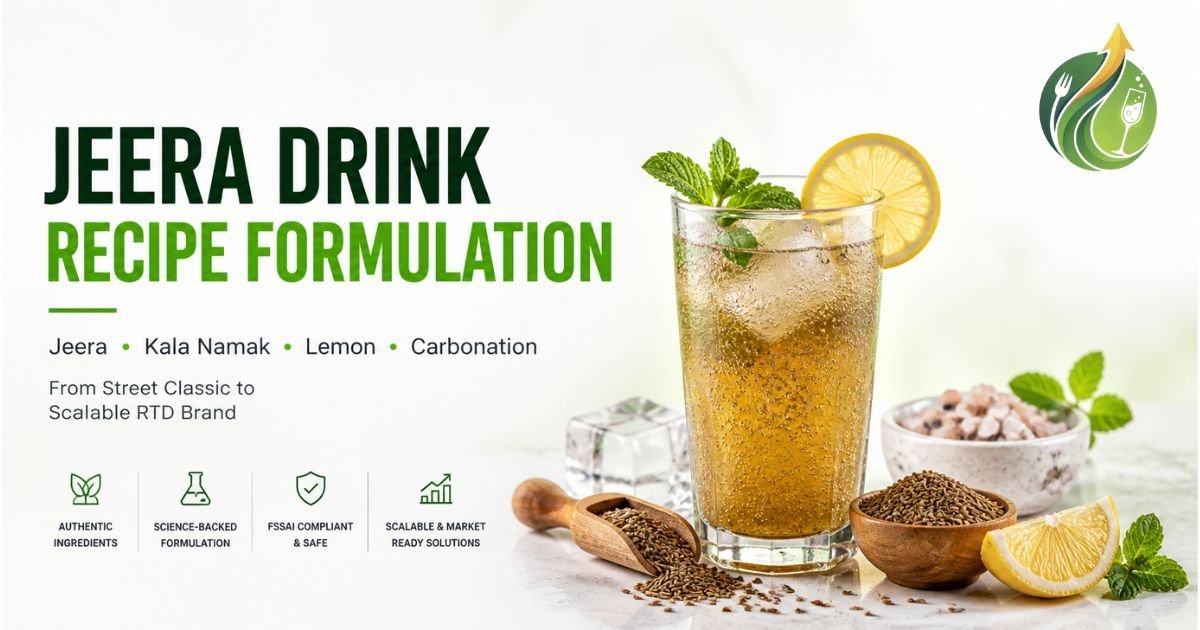
Walk into any dhaba, railway station, or street market in India and you’ll see it — a tall glass of jeera masala soda, fizzing with carbonation, spiked with kala namak and lemon. The jeera drink is one of India’s most beloved gut-friendly refreshers, consumed for centuries as both a thirst-quencher and a digestive tonic.
But here’s the untapped opportunity: the jeera drink category — which includes jeera cold drink, Jaljeera, Lahori Jeera, and Jeera Masala Soda — has a combined monthly search volume of over 15,000 in India alone, with low keyword difficulty (average KD: 22%). Yet the RTD (Ready-To-Drink) market for authentic jeera beverages remains significantly underdeveloped compared to lime sodas or energy drinks.
At Flavor Catalyst, we specialize in transforming culturally rooted Indian recipes into commercially viable, FSSAI-compliant beverages. This guide walks you through the science of jeera drink recipe formulation — from base recipe to production-ready product.
What Is a Jeera Drink? Understanding the Category
“Jeera drink” is not a single product — it’s a category. Before formulating, you need to understand the variants within it, because each has a different ingredient profile, sensory target, and commercial positioning:
| Variant | Core Character | Market Segment |
| Jeera Cold Drink | Carbonated jeera syrup — fizzy, spiced, sweet-sour | Mass market, pan-India |
| Jaljeera | Herb + tamarind + jeera water — no carbonation | Functional, health-conscious |
| Lahori Jeera | Stronger spice profile, black salt heavy, tangy | North India, street food |
| Jeera Masala Soda | Carbonated + chaat masala + kala namak | Urban youth, quick serve |
| Jeera Water (plain) | Soaked or boiled cumin water, no sugar | Wellness, D2C health brands |
The Authentic Jeera Drink Recipe Formulation: Base Formula
Before moving to commercial formulation, let’s lock in the authentic base recipe. This is the flavor benchmark that all industrial batches must replicate:
Jeera Masala Soda (Base Recipe — Per 300ml Glass)
| Ingredient | Quantity | Role in Formulation |
| Roasted Jeera Powder | 1–1.5 g | Primary flavor — earthy, warm, digestive |
| Kala Namak | 0.8–1 g | Sulphurous umami note, digestive character |
| Regular Salt | 0.2 g | Taste balance and electrolyte base |
| Lemon Juice | 15–20 ml | Acid source, citrus top note |
| Sugar / Jaggery | 15–18 g | Sweetness and mouthfeel body |
| Chaat Masala | 0.3–0.5 g | Complexity, amchur tang |
| Mint Extract / Fresh Pudina | 0.1 g / 4 leaves | Cooling freshness |
| Carbonated Water | 200–210 ml | Carrier + effervescence |
| Boondi (optional garnish) | 5–6 pieces | Texture, visual appeal |
Benefits of Drinking Jeera Water: The Science Behind the Sip
One of the biggest advantages of building a jeera-based beverage brand is the ingredient’s documented functional profile. Cumin (Cuminum cyminum) is not just a flavoring agent — it’s a nutritional powerhouse that gives your product a genuine health story to tell consumers and retailers.
Key functional benefits backed by research:
- Digestive Aid: Thymol and other volatile oils in jeera stimulate salivary glands and digestive enzymes, reducing bloating and gas — this is why jeera soda is a natural post-meal drink.
- Gut Microbiome Support: Cumin has prebiotic properties that support beneficial gut bacteria, giving jeera drinks a positioning advantage in the growing gut-health beverage segment.
- Anti-Inflammatory Properties: Cuminaldehyde, the primary bioactive in cumin, has demonstrated anti-inflammatory effects in multiple studies, making jeera a genuinely functional ingredient.
- Electrolyte Balance: Combined with kala namak (sodium, potassium, magnesium), jeera drinks naturally replenish electrolytes — a positioning opportunity against synthetic sports drinks.
- Weight Management Claims: Several studies have linked regular cumin consumption to reduced body fat — a claim that, if substantiated with FSSAI-compliant evidence, can elevate your product’s premium positioning.
This functional profile means a well-formulated jeera drink can be positioned as a digestive soda, a post-meal tonic, or an electrolyte replenisher — opening up multiple shelf placements and consumer segments simultaneously.
Jeera Drink Recipe Formulation Science: What Changes at Scale
The gap between a great street recipe and a commercially stable product is significant. Here’s what changes when you formulate jeera drink for 10,000+ unit batches:
1. Cumin Extraction & Standardization
Raw roasted jeera powder causes immediate sedimentation in a bottled product within 24–48 hours. In commercial formulation, you replace it with standardized cumin oleoresin or water-soluble cumin extract, ensuring consistent flavor delivery, no sedimentation, and controlled volatile oil content (typically 2–4% cuminaldehyde by assay).
2. Jeera Syrup vs. Dilute Formulation
For manufacturing efficiency, jeera drinks are typically produced as a concentrate syrup (5x or 10x) that is diluted at the bottling stage. The syrup must be formulated at the right Brix (typically 55–65° Brix for 5x concentrate) with all flavor compounds stable under high-sugar, low-pH conditions.
3. Carbonation Management
For Jeera Masala Soda variants, carbonation level of 2.8–3.2 volumes CO₂ is ideal. Higher carbonation suppresses the spice aroma; lower carbonation makes the drink feel flat. CO₂ also acts as an additional microbial inhibitor, reducing preservation requirements.
4. pH Control and Kala Namak Stability
Kala namak contains hydrogen sulfide compounds that give it its distinctive aroma — but at high pH or elevated temperatures, these compounds can cause off-notes. Target pH of 2.9–3.3 (citric acid as primary acidulant) stabilizes the kala namak character and inhibits microbial growth naturally.
5. Shelf Life & Preservation
For non-carbonated Jaljeera variants, hurdle technology (low pH + sodium benzoate ≤250 ppm + hot fill at 85°C for 20 seconds) achieves 6–9 months ambient shelf life. Carbonated variants achieve 9–12 months through CO₂ + low pH alone, with minimal preservative load — a strong clean-label positioning advantage.
Building a Jeera Drink Product Range for the Indian Market
The jeera category is rich enough to support a full portfolio. Here’s how a smart brand could structure their range:
- Jeera Masala Soda (Classic) — Core SKU — carbonated, spiced, 250ml glass/PET — mass market positioning
- Jaljeera Concentrate Syrup — 10x syrup for HoReCa, food service — restaurants, dhabas, caterers
- Lahori Jeera RTD — Strong kala namak forward, 200ml can — North India premium segment
- Digestive Jeera Soda — Functional positioning with probiotic fiber (FOS) + jeera — health/pharma retail
- Sugar-Free Jeera Cold Drink — Stevia-sweetened, for diabetic-friendly and keto market
- Jeera Electrolyte Water — Still, no carbonation, ORS-adjacent — fitness, post-workout hydration
FSSAI Compliance for Jeera Drink Products
Jeera drinks fall under different FSSAI categories depending on their format:
- Non-carbonated Jaljeera / Jeera water — Category 14.1.4 (Water-based flavoured drinks)
- Carbonated Jeera Soda — Category 14.1.3.3 (Carbonated flavoured water with sugar)
- Jeera drink with functional claims — May require Category 13.6 (Foods for Special Dietary Use) approval
For complete documentation requirements, label compliance, and license types, read our detailed FSSAI beverage compliance guide for India.
How Flavor Catalyst Helps You Build a Jeera Drink Brand
From recipe standardization to production-ready formulation, Flavor Catalyst is your end-to-end beverage development partner. Here’s our process for a jeera drink project:
- Flavor Profiling & Sensory Benchmarking — We map your target Jeera drink’s flavor profile against market leaders and define the sensory brief.
- Cumin Extract Sourcing & Oleoresin Selection — We identify FSSAI-approved, food-grade cumin extracts from certified Indian vendors.
- Prototype Development & Iteration — Multiple trial batches with consumer taste panels to nail the authentic street-taste in an industrial formula.
- Stability & Shelf Life Testing — Accelerated shelf life study (40°C/75% RH for 3 months = ~12 months real-time) with full microbiological and sensory evaluation.
- Contract Manufacturing Linkage — We connect you with FSSAI-licensed co-manufacturers across Maharashtra, Gujarat, and NCR.
- Label Design & FSSAI Label Compliance — Nutritional facts, claim verification, ingredient declaration — all compliant from day one.
Explore our full functional beverage development services to understand how we approach ingredient-forward formulation for Indian market brands.
What Does Jeera Drink Formulation & Production Cost?
For a standard jeera cold drink or masala soda product, here’s a realistic cost snapshot at a 10,000-unit pilot scale:
| Cost Head | Indicative Range |
| Formulation R&D | ₹40,000 – ₹1,20,000 |
| Lab Testing (micro + nutritional) | ₹15,000 – ₹40,000 |
| Raw Material (per 200ml bottle) | ₹2.5 – ₹5.0 |
| Contract Manufacturing (per unit) | ₹8 – ₹18 |
| Packaging + Label Printing (10K units) | ₹25,000 – ₹80,000 |
| FSSAI License + Compliance | ₹5,000 – ₹20,000 |
For a full investment breakdown, read our guide on beverage formulation cost in India.
Also Read: Related Guides From Flavor Catalyst
- Shikanji Recipe Formulation — Scale India’s Favourite Summer Drink
- Cold Drink Recipe Formulation
- Natural Electrolyte Drink Recipe Development
- Non-Alcoholic Beverage Development India
- Beverage Contract Manufacturing India
Conclusion: The Jeera Drink Is India’s Next Big RTD Opportunity
The jeera drink category sits at a powerful intersection: massive cultural familiarity, a proven functional ingredient, low keyword competition, and an RTD market that is still largely unorganized. The brand that gets the formulation right — authentic taste, clean label, stable shelf life — has a genuine first-mover opportunity across urban India and diaspora markets globally.
Flavor Catalyst has the formulation science, regulatory know-how, and manufacturing network to help you move from idea to market in 8–14 weeks. If you’re ready to build a jeera drink brand that India will reach for — let’s start the conversation.
Ready to Formulate Your Jeera Drink? Contact Flavor Catalyst for a free formulation consultation today.
FAQs: Jeera Drink Recipe & Formulation
Q1. What are the main ingredients in a commercial jeera drink formulation?
A commercial jeera drink formulation includes standardized cumin oleoresin or water-soluble cumin extract, kala namak, citric acid (as pH stabilizer), sugar or alternative sweeteners, mint flavor, and either carbonated or still water as the carrier. Raw jeera powder is not used at commercial scale due to sedimentation and inconsistency.
Q2. Can I drink jeera water daily? Is it safe?
Yes, jeera water is considered safe for daily consumption at normal culinary quantities (1–2g cumin per serving). In commercial beverages, the cumin content is standardized within safe limits. Jeera water supports digestion, reduces bloating, and provides trace minerals. However, very large doses can irritate the gut — a well-formulated product keeps jeera extract within the 0.5–1.5g equivalent per 300ml serving range.
Q3. How is jeera soda different from plain jeera water in terms of formulation?
Jeera water is a non-carbonated, often sugar-free preparation — closer to a functional water or wellness drink. Jeera soda (masala soda) is carbonated, contains sugar, kala namak, chaat masala, and lemon for a full street-food flavor profile. Formulation-wise, jeera soda requires CO₂ saturation, carbonation-stable flavor compounds, and acid-resistant packaging, while jeera water formulation focuses on extraction consistency and heat stability.
Q4. How to make homemade jeera soda that tastes like the street version?
The key to authentic jeera soda is threefold: use freshly roasted jeera (dry roast on tawa until aromatic, then grind fine), use kala namak generously (not just regular salt), and add chaat masala for the tangy complexity. Mix the dry blend into chilled carbonated water just before serving — never pre-mix and store, as carbonation and spice aroma degrade quickly. For a commercial version that maintains this taste over months, industrial formulation using cumin extracts and controlled pH is necessary.
Q5. Is jeera soda good for stomach gas and bloating?
Yes — cumin is one of the most well-researched digestive spices in Ayurveda and modern food science. It stimulates digestive enzyme secretion, reduces intestinal gas, and relaxes the smooth muscle of the GI tract. When combined with kala namak (which also has digestive properties), a jeera soda can genuinely help relieve post-meal bloating — making it a far more functionally honest digestive drink than many synthetic products.
Q6. Can jeera water reduce triglycerides?
Some clinical studies suggest that cumin supplementation can modestly reduce serum triglycerides and LDL cholesterol over a 6–8 week period. However, the amounts used in these studies (3g+ of cumin daily) are higher than a typical beverage serving. As an FSSAI-regulated product, you cannot make direct therapeutic claims — but you can market around digestive wellness and natural ingredients, which are permissible positioning strategies.
Q7. What is the shelf life of a bottled Jaljeera or Jeera Masala Soda product?
A properly formulated and hot-filled Jaljeera can achieve 6–9 months ambient shelf life. A carbonated Jeera Masala Soda in sealed PET or glass can achieve 9–12 months due to the combined preservation of CO₂ and low pH. Accelerated shelf life testing at 40°C and 75% relative humidity for 90 days is standard practice before product launch.
Q8. What FSSAI license is needed to manufacture and sell jeera cold drink commercially?
You need a State FSSAI Manufacturing License for up to ₹20 lakh annual turnover, or a Central FSSAI License for larger operations. Your product must be registered under the appropriate beverage category (14.1.3 for carbonated, 14.1.4 for non-carbonated). All additives must be FSSAI Schedule 7 compliant, and your label must carry the FSSAI license number, ingredients list, nutritional information, and best-before date.