May 2026 · 11 min read
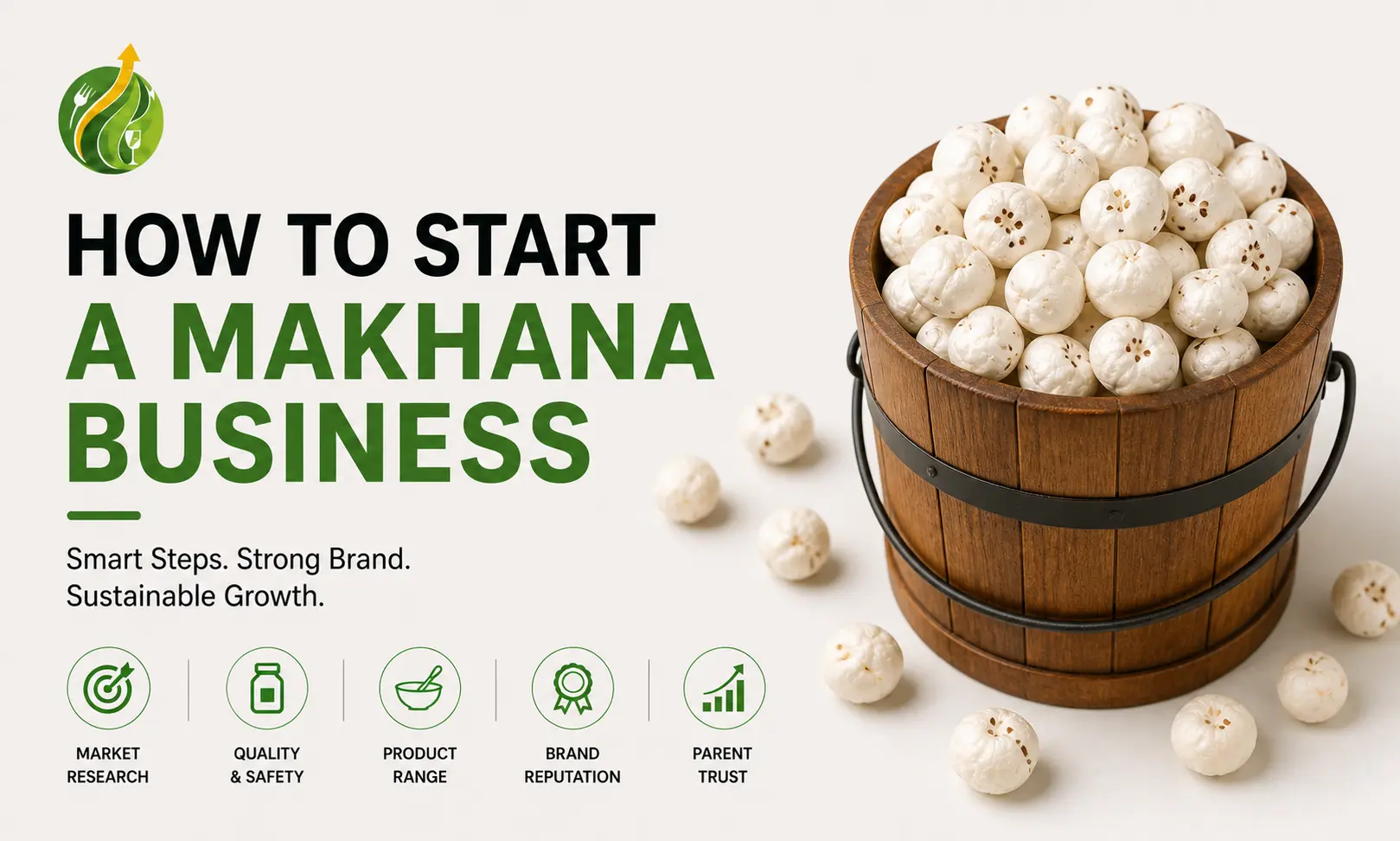
Makhana, also called fox nuts or lotus seeds, has become one of India’s most popular healthy snacks. A decade ago, makhana was mostly eaten during religious fasting. Today, it sits alongside nuts and seeds in the health snack aisles of every major supermarket and quick commerce app in the country.
The shift happened because makhana is genuinely nutritious. It is high in protein, low in calories, gluten-free, and has a satisfying crunch that works well with multiple flavor profiles. For consumers looking for a healthier alternative to chips and fried snacks, makhana fits the need perfectly.
This guide walks you through everything you need to know to start a makhana business in India in 2026. From sourcing raw makhana and setting up production to FSSAI compliance, packaging, and successful makhana launch in 2026.
The Makhana Market in India 2026
The Indian makhana market was valued at approximately Rs. 6,000 crore in 2024 and is growing at over 20 percent annually. The branded makhana segment is growing even faster than the overall market, as consumers shift from buying loose makhana to packaged, flavored products with clear branding and nutritional information.
Three consumer groups are driving makhana demand. First, urban health-conscious consumers who want a high-protein, low-calorie snack that they can eat guilt-free. Second, consumers who observe religious fasting and consider makhana a fasting-approved food. Third, parents who want to give their children a nutritious snack that is more interesting than plain roasted grains.
Makhana is also growing strongly in tier two and tier three cities, where awareness of healthy snacking is rising but the market is not as saturated as in metros. This represents a genuine opportunity for new brands that can distribute effectively.
- India produces over 85 percent of the world’s makhana, with Bihar as the primary growing state.
- The branded makhana market is expected to reach Rs. 15,000 crore by 2028.
- Quick commerce platforms like Blinkit and Zepto have made makhana one of their top-selling snack categories.
- Makhana has significantly higher protein per calorie compared to potato chips or fried snacks.
Makhana Business Models: Which One is Right for You
Before you start a makhana business, you need to decide which business model fits your capital, skills, and goals. There are five main ways to build a makhana business in India.
1. Build a Packaged Makhana Brand (D2C)
This is the most popular model for new entrepreneurs. You source raw makhana from Bihar, roast and season it yourself or through a contract manufacturer, pack it under your own brand name, and sell it directly to consumers through your website, Amazon, Flipkart, Blinkit, and Zepto. This model has the highest margins and the most brand-building potential.
2. Contract Manufacturing Brand
You outsource production entirely to a food contract manufacturer who roasts, seasons, and packs the makhana to your recipe and specifications. You focus entirely on sales, marketing, and distribution. This requires less capital for equipment but slightly lower control over production quality.
3. Wholesale Raw Makhana Trade
You buy raw makhana in bulk from Bihar farmers or mandis and sell it to retailers, food companies, and exporters. This is a volume business with thinner margins but simpler operations and no branding investment required.
4. Foodservice Supply (B2B)
You produce and supply roasted makhana to restaurants, cafes, cloud kitchens, and hotels. Foodservice buyers want consistent quality, bulk pack sizes, and competitive pricing. This is a lower-investment starting point that generates steady volume early on.
5. Private Label for Retailers
You manufacture makhana products for supermarkets or other brands who sell it under their own label. This requires production capacity and quality certifications but gives you stable, high-volume orders.
Makhana Business Models: Comparison
This table compares the five main makhana business models on investment, margins, and suitability.
| Business Model | Investment Level | Margins | Best For | Key Risk |
| Packaged makhana brand (D2C) | Rs. 3L to Rs. 12L | 35 to 55 percent | Brand builders, health food entrepreneurs | Brand building takes time and money |
| Contract manufacturing brand | Rs. 2L to Rs. 8L | 30 to 50 percent | Entrepreneurs wanting faster launch | Less control over production quality |
| Wholesale raw makhana trade | Rs. 5L to Rs. 20L | 8 to 15 percent | Traders, agri-entrepreneurs | Commodity pricing, low differentiation |
| Foodservice supply (B2B) | Rs. 1L to Rs. 5L | 20 to 35 percent | Local producers, small-scale operations | Price pressure from restaurants |
| Private label for retailers | Rs. 2L to Rs. 10L | 20 to 40 percent | Experienced food manufacturers | Dependent on retailer relationship |
How to Source Raw Makhana
Raw makhana sourcing is one of the most important decisions you will make. The quality of your raw material directly determines the quality of your final product.
Sourcing from Bihar Directly
Bihar produces over 85 percent of India’s makhana. The main growing districts are Darbhanga, Madhubani, Sitamarhi, and Saharsa. Sourcing directly from farmer groups or FPOs in Bihar gives you access to the freshest makhana at the best prices. Many successful makhana brands send buyers to Bihar at the start of each season to lock in supply.
Buying from Mandis
Agricultural markets in Patna, Darbhanga, and other Bihar towns have established makhana trading networks. You can buy from licensed traders who aggregate makhana from multiple farmers and sell in bulk quantities.
Grades of Makhana
Makhana comes in different grades based on size and quality. The grades typically used in the market are Sutta (large, round, premium), Thurri (medium grade), and Lawa (smaller, broken pieces). Premium branded products use Sutta grade. Lower grades are used in bulk foodservice or industrial applications.
- Grade 1 (Sutta): Largest, roundest, most uniform. Used in premium branded packs.
- Grade 2 (Thurri): Medium size. Suitable for mid-range branded products.
- Grade 3 (Lawa): Smaller and irregular. Used in bulk, blended, or powder applications.
Makhana Flavors That Sell Best
Flavor development is your biggest product decision. The right flavors can make your brand stand out in a crowded market. Here is what the market data says about which makhana flavors perform best.
| Flavor | Target Consumer | Best Channel | Price Point (Rs.) | Demand Level |
| Classic Salt and Pepper | All age groups, first-time buyers | Quick commerce, modern trade | 50 to 150 per pack | Very High |
| Peri Peri | Young adults, snack lovers | D2C, quick commerce | 60 to 180 per pack | High |
| Himalayan Pink Salt | Health-conscious premium buyers | D2C, premium retail | 80 to 200 per pack | High |
| Cheese and Herbs | Kids, families, casual snackers | Modern trade, gifting | 70 to 180 per pack | Medium-High |
| Masala and Chaat Flavor | Traditional taste seekers | Kirana, modern trade | 50 to 150 per pack | High |
| Caramel and Sweet | Kids, gifting market | D2C, gifting boxes | 80 to 220 per pack | Medium |
| Turmeric and Ginger | Wellness and immunity buyers | D2C, health stores | 80 to 200 per pack | Medium |
| Plain Roasted (No Flavor) | Diabetics, diet-conscious users | D2C, pharmacies, health stores | 60 to 160 per pack | Medium-High |
Cost Breakdown for Starting a Makhana Business in India
Here is a realistic cost estimate for launching a packaged makhana brand in India in 2026.
| Cost Component | Estimated Range (Rs.) | One-time / Annual | Notes |
| Raw makhana procurement (100 kg) | Rs. 8,000 to Rs. 15,000 | Per batch | Price varies by grade and season |
| Seasoning, oil, flavoring ingredients | Rs. 2,000 to Rs. 8,000 | Per batch | Depends on number of flavors |
| FSSAI registration or license | Rs. 100 to Rs. 25,000 | Annual | Basic registration for small batch; license for larger ops |
| Packaging (pouches, labels) | Rs. 5 to Rs. 20 per unit | Per unit | Stand-up pouches with zip-lock are standard |
| Packaging design (one-time) | Rs. 15,000 to Rs. 60,000 | One-time | Per SKU, professional branding |
| Roasting and processing equipment | Rs. 50,000 to Rs. 3,00,000 | One-time | For own production setup |
| Shelf life and lab testing | Rs. 10,000 to Rs. 30,000 | Per product | NABL lab required for FSSAI compliance |
| Marketing and launch budget | Rs. 1,00,000 to Rs. 5,00,000 | First year | Social, influencer, quick commerce |
| Total first-year estimated investment | Rs. 3 lakh to Rs. 12 lakh | All-in | Own production route, one or two SKUs |
FSSAI Compliance for Makhana Business
Any makhana business selling packaged products in India must comply with FSSAI regulations. Here is what you need.
- FSSAI Basic Registration: Required if your annual turnover is below Rs. 12 lakh. Apply online at FoSCoS portal.
- FSSAI State License: Required for businesses with turnover between Rs. 12 lakh and Rs. 20 crore.
- FSSAI Central License: Required if you operate in multiple states or have turnover above Rs. 20 crore.
- Label compliance: Your pack must show the FSSAI license number, ingredient list in descending weight order, nutritional information per 100 gm, manufacturing date, best before date, and net weight.
- Allergen declaration: If your makhana is processed in a facility that also handles nuts, gluten, or other allergens, this must be declared on the label.
- Country of origin: Must be clearly stated as India on all product labels.
Packaging for Makhana Products
Packaging is critical in the makhana business because the product is light, fragile, and susceptible to moisture. The wrong packaging leads to stale, broken product and unhappy customers.
Stand-Up Pouches with Zip-Lock
This is the most popular format for branded makhana. Stand-up pouches are lightweight, cost-effective, and photograph well. Zip-lock closure is important because makhana goes stale quickly once the pack is opened. Foil-lined pouches with nitrogen flushing extend shelf life significantly.
Rigid Box Gifting Formats
For gifting, festive packs, and premium positioning, rigid boxes or tins work well. These command higher price points and are popular during Diwali, Raksha Bandhan, and other festive seasons. Gifting formats can significantly increase average order value.
Nitrogen Flushing
Replacing oxygen in the pack with nitrogen before sealing prevents oxidation and keeps makhana crunchy for longer. This is essential for achieving a shelf life of 6 to 12 months, which is necessary for modern trade and e-commerce distribution.
Building a Makhana Brand That Sells
The makhana market is competitive, but there is still significant room for differentiated brands.
Tell a Sourcing Story
Makhana’s origin in Bihar’s wetlands is a genuinely compelling story. Brands that connect their product to a specific place, farming community, or traditional process create an authentic narrative that mass-market brands cannot easily copy. Consumers in the premium health food segment respond well to origin stories.
Start With Quick Commerce
Quick commerce platforms like Blinkit and Zepto are extremely effective launch channels for makhana brands. Their customers are exactly the health-conscious urban consumers most likely to discover and try a new makhana brand. Getting listed and maintaining good ratings on these platforms is often more valuable than modern trade listings in the early months.
Use Social Media Content
Makhana is highly shareable. Snack reviews, nutritional comparisons, flavor taste tests, and recipe content all work well for makhana brands on Instagram and YouTube. Many successful makhana brands grew primarily through consistent content creation before spending heavily on advertising.
How to Launch a Makhana Brand in India 2026
Launching a makhana brand in India in 2026 does not require a big budget.
We at Flavor Catalystz start with food product development, FSSAI compliance, and two to three winning flavors before moving to Amazon and quick commerce platforms. That is enough to get your first batch selling.
The brands that grow are the ones with a clear story. We help you source from Bihar, build your nutrition credentials, and get your packaging market-ready. If you are ready to launch, reach out to Flavor Catalystz at +91 9711730492.
Frequently Asked Questions
Is a makhana business profitable in India?
Yes. Branded makhana businesses can achieve margins of 35 to 55 percent on retail price. The market is growing at over 20 percent annually and consumer demand for healthy snacks continues to rise. The business is most profitable when you build a brand rather than trade commodity makhana.
How much investment is needed to start a makhana business?
Starting with contract manufacturing requires Rs. 2 lakh to Rs. 8 lakh for the first year. Setting up your own processing unit adds significant equipment costs. Most new entrepreneurs start with contract manufacturing and invest in their own equipment once they have validated the brand and achieved consistent sales volume.
What FSSAI license do I need for makhana?
Makhana is classified as a processed food product under FSSAI regulations. Small businesses with turnover below Rs. 12 lakh need a basic FSSAI registration. Businesses above this threshold need a State or Central License. All products sold commercially must display the FSSAI license number on the packaging.
Where can I source raw makhana?
Bihar is the primary source for raw makhana in India. You can source from farmer cooperatives and FPOs in Darbhanga and Madhubani districts, from mandis in Patna, or from established Bihar-based traders who supply makhana brands across India. Sourcing directly from Bihar typically gives the best price and quality.
What is the shelf life of packaged makhana?
Properly packaged roasted makhana with nitrogen flushing in a foil-lined stand-up pouch can achieve a shelf life of 6 to 12 months. Without nitrogen flushing, shelf life is typically 3 to 6 months. The key is keeping moisture out, which is why packaging quality is so important in this category.