Apr 2026 · 9 min read
India’s functional beverage market is undergoing one of its most significant structural shifts in decades. Consumers across metros and Tier-2 cities are actively moving away from sugary beverages toward drinks that deliver a measurable health outcome — and protein water sits at the intersection of that demand.
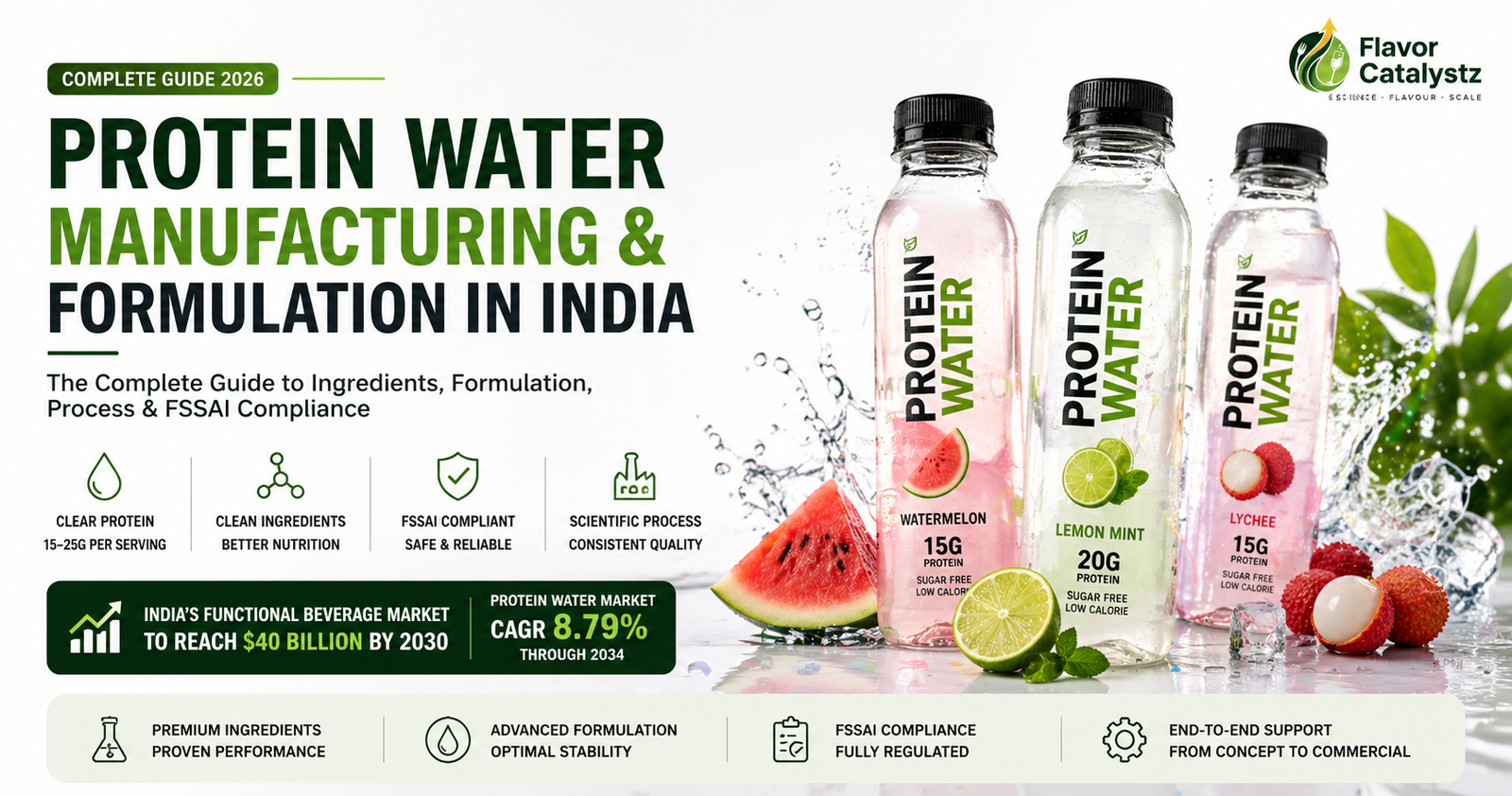
The numbers confirm the opportunity. India’s ready-to-drink non-alcoholic beverage market is projected to double from $20 billion in 2026 to $40 billion by 2030. The global protein water market alone was valued at over $1 billion in 2026 and is growing at a CAGR of 8.79% through 2034. Asia-Pacific is the fastest-growing region in this category, and India is one of its most active engines.
If you are a brand founder, food entrepreneur, or startup looking to launch a protein water product in India, this guide walks you through the complete formulation process — from ingredient selection to FSSAI-compliant production — the way Flavor Catalystz approaches it for every client.
What Is Protein Water — And Why Does It Matter Right Now?
Protein water is a clear, light, ready-to-drink (RTD) functional beverage that delivers a precise dose of protein — typically between 15g and 25g per serving — without the chalky texture, heavy mouthfeel, or high-calorie profile of a conventional protein shake.
Unlike meal-replacement shakes, protein water is designed for convenience and palatability. It hydrates while it nourishes. It fits into a gym bag, a desk drawer, or a quick-commerce delivery basket without any friction.
That design philosophy is precisely why the flavored protein water segment now commands over 80% of the global protein water market share. Consumers do not just want protein — they want a beverage experience that makes consistent consumption easy.
For India specifically, the conditions are ideal. Organized retail penetration grew from 12% to 18% between 2020 and 2025. Quick commerce platforms have scaled the RTD category by over 100% in the same period. Protein drinks and functional hydration are explicitly listed among the highest-demand categories in India’s current RTD growth cycle. The window for early-mover advantage is open — but formulation quality will determine which brands survive the shelf test.
The Core Ingredients of a Commercial Protein Water
Protein water formulation is a precision exercise. Getting even one variable wrong can result in a product that turns cloudy on the shelf, tastes unpleasant, or fails stability testing entirely.
1. The Protein Source
This is the single most consequential ingredient decision you will make. Not all proteins behave identically in an aqueous solution at commercial scale.
- Whey Protein Isolate (WPI) is the most widely used source for clear protein water. It offers high bioavailability, a mild flavour profile, and excellent solubility when used at the correct pH. WPI supports muscle protein synthesis and is widely trusted by fitness consumers.
- Hydrolyzed Whey Protein takes clarity a step further. Because the protein chains have already been enzymatically broken into shorter peptides, dissolution is superior and the risk of haze or sediment is minimal. This is the preferred choice for premium, crystal-clear protein water formulations.
- Collagen Peptides are the cleanest option from a visual standpoint — they produce a virtually transparent beverage — and they carry strong appeal for the beauty, skin health, and joint recovery segments. Women-focused wellness brands particularly benefit from collagen-based protein water positioning.
- Plant-Based Protein Isolates (primarily pea protein) are gaining traction with India’s growing vegan and flexitarian consumer base. They present greater formulation challenges — earthy off-notes, lower natural clarity — but with the right masking and acid systems, a commercially viable plant-based protein water is achievable.
2. pH Control — The Technical Foundation
Protein water must be maintained within a pH range of approximately 3.2 to 4.5. This is non-negotiable. At this acidic range, the protein remains fully soluble and does not aggregate or settle. It also creates a natural barrier against microbial growth without the need for aggressive preservatives, which matters greatly for a clean-label product.
Citric acid and malic acid are the most common acidulants. The specific acid system chosen also shapes the flavour profile — malic acid tends to produce a softer, rounder tartness, while citric acid delivers a crisper finish. Most commercial formulations use a blend of both.
3. Flavour Development
Protein has an inherent bitterness. Masking that off-note while delivering a clean, refreshing taste is where formulation artistry meets food science.
For the Indian market, flavour profiles that perform consistently well include watermelon, litchi, raw mango, kokum, and lemon-mint. These profiles align with existing sensory preferences while feeling distinctly functional and modern.
Sweetening systems must be chosen with equal care. A blend of stevia and monk fruit extract delivers adequate sweetness without the lingering aftertaste that high-stevia concentrations are known to produce. Erythritol can be added to round out the mouthfeel without contributing to sugar content.
4. Stability and Shelf Life
A protein water that looks cloudy after two weeks on shelf is commercially dead. Stability engineering begins at the formulation stage and extends through packaging selection.
Key tools include sodium hexametaphosphate (which improves mineral compatibility and prevents protein-mineral interactions), ascorbic acid as a natural antioxidant, and carefully calibrated gum systems that maintain mouthfeel without increasing viscosity to the point where the beverage no longer reads as “water.”
Stability testing should evaluate physical clarity, protein content stability, pH drift, and microbiological safety at minimum over a 12-month accelerated aging study.
5. Electrolyte Enhancement
Adding a calibrated electrolyte complex — sodium, potassium, magnesium — elevates a protein water from a simple protein delivery vehicle to a full post-workout recovery and hydration solution. This functional upgrade typically supports a premium price point and strengthens on-pack claims significantly.
Step-by-Step Formulation and Scale-Up Process
Stage 1 — Market and Consumer Brief
Define the target consumer, use case, price architecture, and distribution channel before a single lab trial begins. The entire formulation strategy flows from this brief.
Stage 2 — Protein Selection and pH Optimization
Lab-scale titration experiments identify the precise pH at which the chosen protein source delivers maximum clarity and acceptable taste. This is an iterative process that typically requires multiple sessions.
Stage 3 — Flavour Development and Sensory Panel Evaluation
Multiple flavour and sweetener combinations are prototyped and evaluated by trained sensory panels. Panelists assess clarity, aroma, sweetness balance, aftertaste, and overall acceptability. The winning formulation proceeds to stability trials.
Stage 4 — Accelerated Stability Testing
Physical, chemical, and microbiological stability are evaluated across temperature and light exposure conditions. The output of this stage determines the processing method (UHT, HTST, high-acid aseptic) and final packaging specification.
Stage 5 — FSSAI Compliance and Label Development
Every RTD protein water sold in India requires a valid FSSAI Food Business Operator licence. Claims such as “High in Protein” or “Source of Protein” must meet specific regulatory thresholds. Nutritional information per 100ml is mandatory on-pack. A regulatory consultant should review the label before production.
Stage 6 — Pilot Batch and Commercial Scale-Up
The validated formulation moves from lab scale (100–500ml) to pilot batch (100–500L) for production parameter confirmation, then to commercial manufacturing with a qualified co-packer.
Why Most Protein Water Launches Fail in India
Brands consistently fail at the same set of points:
Using Whey Protein Concentrate instead of Isolate — WPC is highly pH-sensitive and will cloud immediately in an acidic beverage.
Inadequate heat treatment — without UHT or HTST processing, shelf life does not exceed 15–20 days, making the product commercially unviable for modern retail and quick-commerce distribution.
Over-relying on Western formulations — Indian climatic conditions, water hardness profiles, and consumer taste sensitivities differ significantly from European or North American benchmarks. A formula built for a cold-chain market in Germany will not perform the same way in ambient storage in Chennai.
Skipping pilot testing — moving directly from lab scale to commercial production without an intermediate pilot run is one of the most expensive mistakes a beverage brand can make.
How Flavor Catalystz Approaches Protein Water Development
Flavor Catalystz is an India-based food and beverage R&D consultancy that specialises in concept-to-commercial product development across beverages, functional foods, and nutraceuticals. The team combines food science expertise with a deep understanding of the Indian regulatory landscape and consumer palate.
For protein water specifically, Flavor Catalystz provides:
- End-to-end formulation R&D — from ingredient sourcing brief to shelf-stable prototype
- Stability testing and accelerated shelf-life studies
- FSSAI compliance guidance and label review
- Flavour masking and acid system development calibrated for Indian taste preferences
- Co-packer identification and pilot-to-scale transition support
- Cost of Goods optimisation without compromise on product quality
If you are serious about launching a protein water brand in India, partnering with a formulation expert from the outset eliminates the trial-and-error cycle that costs most startups both time and capital.
Connect with Flavor Catalystz at www.flavorcatalyst.com to begin your formulation consultation.
Frequently Asked Questions-
1. What is protein water and how is it different from a protein shake?
Answer: Protein water is a clear, low-calorie drink with 15–25g protein per serving. Unlike protein shakes, it is light, non-creamy, and designed for hydration with protein — not as a meal replacement.
2. Which protein is best for clear protein water in India?
Answer: Whey Protein Isolate (WPI) and Hydrolyzed Whey are best for clear protein water. Collagen is also used for beauty-focused variants due to its clarity and neutral taste.
3. What is the ideal pH for protein water formulation?
Answer: The ideal pH is 3.2 to 4.5. This keeps protein stable, prevents cloudiness, and naturally improves shelf life by reducing microbial growth.
4. What FSSAI rules apply to protein water in India?
Answer: You need an FSSAI license and must follow labelling rules (nutrition, ingredients, allergens). “High protein” claims must meet FSSAI standards.
5. How much protein should a protein water contain?
Answer: A commercial protein water typically contains 15–25g protein per 500ml. This range balances effectiveness, taste, and stability.
6. What is the shelf life of protein water?
Answer: A properly formulated protein water lasts up to 12 months at room temperature with correct pH, heat treatment, and packaging.
7. Can plant-based (vegan) protein water be made in India?
Answer: Yes, using pea protein isolate. However, it is harder to formulate due to taste and clarity challenges compared to whey protein.
8. Which flavours work best for protein water in India?
Answer: Popular flavours include watermelon, litchi, raw mango, kokum, and lemon-mint. These match Indian taste preferences and work well with protein.
9. What is the cost of manufacturing protein water in India?
Answer: COGS typically ranges from ₹22–₹40 per 500ml bottle. Retail prices are usually ₹70–₹130 depending on positioning.
10. Do I need an R&D consultant to launch a protein water brand?
Answer: Not mandatory, but highly recommended. A consultant helps avoid formulation failures, ensures stability, and speeds up launch.