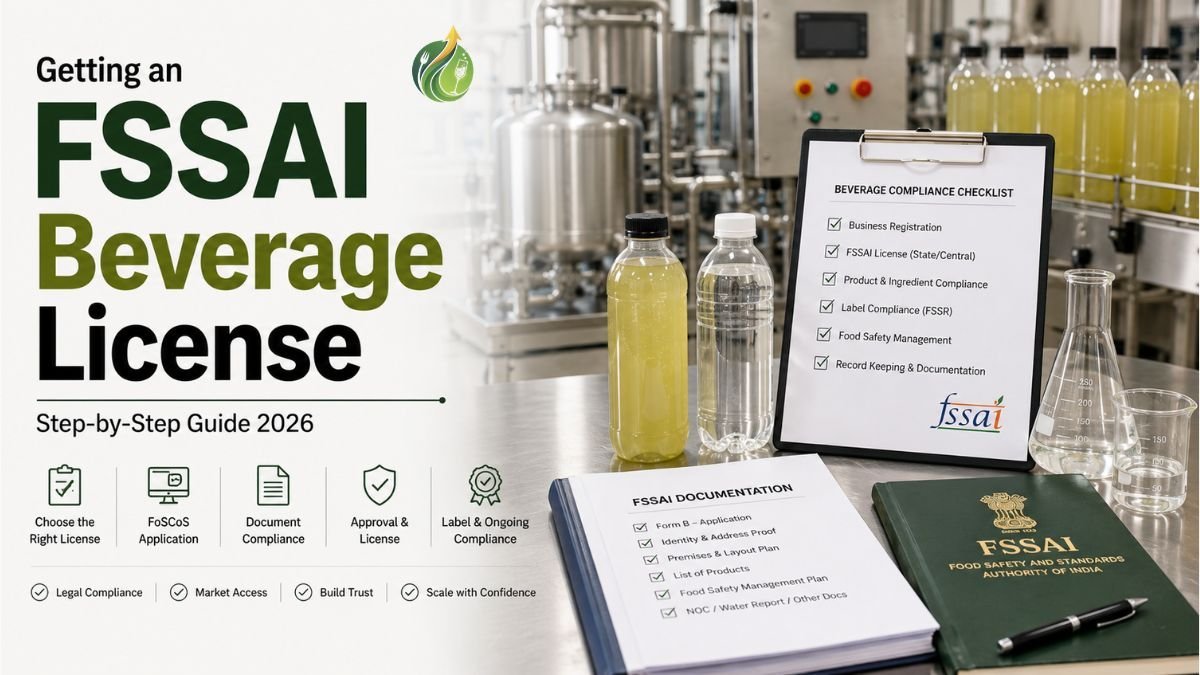
May 2026 · 10 min read
You have developed your beverage. The formulation is finalised. The packaging is designed. You are ready to go to market.
And then someone tells you: you need an FSSAI licence first.
For most first-time beverage entrepreneurs, FSSAI compliance is where the excitement of product development gives way to the anxiety of bureaucratic process. The questions pile up fast — what type of licence do I need? What documents are required? How long will it take? What happens if I get it wrong?
This guide gives you clear, practical answers. It covers the FSSAI beverage licence process specifically for beverage brands in India in 2026 — the types of licences, the step-by-step process through the FoSCoS portal, the documents you need, typical timelines, and the most common mistakes founders make.
Why FSSAI Licensing Matters for Beverage Brands
The Food Safety and Standards Authority of India (FSSAI) is the regulatory body that governs all food and beverage businesses in India. Every business that manufactures, processes, stores, distributes, or sells food or beverages — including startups — is required to be registered or licenced under the Food Safety and Standards Act, 2006.
For a beverage brand specifically, FSSAI licensing is not just a legal requirement. It is a commercial necessity:
- Modern trade retailers (DMart, Reliance, Big Bazaar) will not list your product without a valid FSSAI licence
- E-commerce platforms (Amazon, Flipkart, Blinkit) require FSSAI details for food and beverage listings
- Contract manufacturers will not produce your beverage without your FSSAI documentation
- Distributors, importers, and institutional buyers all verify FSSAI status before onboarding a new supplier
- The 14-digit FSSAI licence number must appear on every product label
In short: no FSSAI licence, no commercial business.
Flavor Catalystz
Need help getting your beverage brand FSSAI compliant?
From licence selection and FoSCoS applications to label review and beverage compliance — we help founders navigate FSSAI without delays or costly mistakes.
The Three Types of FSSAI Registration/Licence
FSSAI has three categories of licensing. The type you need depends on your business size and nature.
1. Basic FSSAI Registration
For: Very small food businesses with annual turnover below ₹12 lakh
Fee: ₹100/year
Validity: 1–5 years
Relevant for beverage brands? Only if you are a very small, local seller. Not appropriate if you have any intention of growth, modern trade listing, or online selling.
2. State FSSAI Licence
For: Medium-sized food businesses with annual turnover between ₹12 lakh and ₹20 crore
Fee: Varies by state — typically ₹2,000–5,000/year
Validity: 1–5 years
Relevant for beverage brands? Yes — most startup and growth-stage beverage brands fall in this category initially. Covers manufacturing within a single state.
3. Central FSSAI Licence
For: Larger food businesses with turnover above ₹20 crore, or businesses operating across multiple states, or importers/exporters
Fee: Varies by category and scale
Validity: 1–5 years
Relevant for beverage brands? Yes — once you scale, or if you are supplying to national chains or exporting. Also required if your contract manufacturer operates under Central licence and needs you to have one too.
For most beverage brand startups in 2026, a State FSSAI Licence is the right starting point.
State Licence vs. Central Licence: How to Decide
The most common source of confusion is whether you need a State or Central licence. Here is a simple decision framework:
Apply for Central FSSAI Licence if:
- Your annual turnover exceeds ₹20 crore
- You manufacture in one state and distribute nationally (multi-state operations)
- You are importing ingredients or exporting your product
- Your contract manufacturer is in a different state from your registered business
- You are supplying to large national retail chains that require Central licensing
Apply for State FSSAI Licence if:
- You are a startup or early-stage brand with turnover below ₹20 crore
- Your manufacturing and primary distribution are within one state
- You are selling locally, through D2C, or regional modern trade
Note: Many beverage brands start with a State licence and upgrade to Central as they scale. This is a normal and expected progression.
The FSSAI Licensing Process: Step by Step (FoSCoS Portal 2026)
FSSAI licensing in India is processed through the FoSCoS portal (Food Safety Compliance System) at foscos.fssai.gov.in. Here is the complete process:
Step 1 — Determine Your Licence Type
Based on your business size, location, and operations (using the framework above), determine whether you need Basic Registration, State Licence, or Central Licence.
Step 2 — Create Your FoSCoS Account
Go to foscos.fssai.gov.in and register as a new user. You will need a valid mobile number and email address. Keep your login credentials safe — all future FSSAI compliance interactions happen through this account.
Step 3 — Fill the Application Form
For a State Licence: Select “Apply for State/Central Licence” → State Licence → Form B
For a Central Licence: Select “Apply for State/Central Licence” → Central Licence → Form B
The application requires:
- Business name and address
- Type of food business (manufacturing/processing)
- Product category (beverages — specify subcategory: carbonated/non-carbonated/juices/etc.)
- Installed capacity (production capacity per day/month)
- Proprietor/Director personal details and KYC
- Premises details
Step 4 — Gather and Upload Documents
Common documents required for a beverage manufacturing licence:
- Identity proof of proprietor/directors (Aadhaar, PAN)
- Address proof of business premises
- Proof of possession of premises (rental agreement or ownership documents)
- Blueprint/layout plan of the manufacturing premises
- List of food products to be manufactured (your product list)
- List of machinery and equipment installed
- Water test report (ISI marked or lab-certified water source)
- NOC from local municipal body or panchayat (state-specific requirement)
- Partnership deed / incorporation certificate (if applicable)
- Form IX — declaration by proprietor/partner/director
- For Central Licence: IE Code (for importers/exporters)
Tip: Blueprint and water test report are two of the most commonly delayed documents. Start gathering them early.
Step 5 — Pay the Application Fee
Pay online through the FoSCoS portal. Fee depends on licence type and validity period chosen (1–5 years). Longer validity periods reduce per-year cost.
Step 6 — Application Review and Inspection
State Licence: The Designated Officer (DO) at your state’s food safety department reviews the application. An inspection of the manufacturing premises may be conducted (particularly for new manufacturing licences). The DO may raise queries — respond promptly through the portal.
Central Licence: Reviewed by FSSAI’s Central Authority. May involve more detailed scrutiny for complex product categories.
Step 7 — Licence Issuance
If the application is complete and no queries are outstanding, the licence is issued digitally through the FoSCoS portal. You can download it immediately. The 14-digit FSSAI licence number must appear on all product labels.
Typical timelines:
- Basic Registration: 7–10 working days
- State Licence: 30–60 days (can extend if inspection or queries are involved)
- Central Licence: 30–60 days (can extend for complex categories)
FSSAI Product Approval: What It Means for Beverage Brands
Beyond the business licence, certain beverage products require product-level approval from FSSAI before they can be manufactured and sold commercially. This applies to:
- Proprietary food products: Any beverage that does not fall within an existing FSSAI product standard (many functional beverages, novel ingredient combinations, fortified drinks)
- Health supplements in beverage form: Products making specific health or disease-related claims
- Energy drinks: Subject to FSSAI’s specific energy drink regulations (caffeine limits, taurine limits, mandatory warning labels)
If your product falls in these categories, you need to file a product approval application through FoSCoS in addition to your business licence. This is a separate process with its own documentation requirements (product specification, formulation details, safety data for novel ingredients).
Our FSSAI beverage compliance guide and beverage consultant team can help you determine whether your product needs approval and guide you through the process.
Common FSSAI Mistakes Beverage Brands Make
These are the errors that delay launches and create regulatory headaches:
Wrong licence category: Applying for the wrong type of licence wastes time. Determine your category correctly upfront.
Incomplete premises documentation: A missing layout plan or water test report causes the most common delays. Start these early.
Incorrect product category selection: Beverages are classified under multiple FSSAI categories. Selecting the wrong one leads to queries from the reviewing officer. A beverage consultant can help you identify the correct category for your specific product.
Label non-compliance: Getting the licence is step one. Your product label must also comply with FSSAI labelling regulations — mandatory declarations, font sizes, nutritional format, claims. Many brands get the licence but then print non-compliant labels.
Not checking if product approval is needed: Launching a proprietary food product or functional beverage without the required product approval is a significant regulatory risk.
Letting the licence lapse: FSSAI licences must be renewed before expiry. Selling products with an expired licence is a compliance violation. Set a calendar reminder well ahead of your expiry date.
FSSAI Labelling Requirements for Beverage Products
Every beverage sold commercially in India must display the following on its label:
- Name of the food product
- Ingredient list (in descending order by weight)
- Nutritional information per 100ml (energy, protein, carbohydrates including sugars, fat, sodium)
- Net contents (volume/weight)
- Name and address of manufacturer
- FSSAI licence number (14 digits)
- Best before / expiry date
- Batch/lot number
- Country of origin (if imported)
- Customer care contact
Additional mandatory elements for specific categories:
- Vegetarian/Non-vegetarian symbol (green dot / red dot)
- Allergen declarations (if applicable)
- Warning statements (for energy drinks: “Not suitable for children, pregnant women, persons sensitive to caffeine”)
- “Not for sale to persons under 18” (energy drinks)
Label design is a regulatory exercise as much as a creative one. Getting it reviewed before print saves costly reprints.
Related: beverage formulation cost.
Need Help With Your FSSAI Beverage Licence?
FSSAI compliance is a process that can be navigated efficiently with the right guidance — or one that can stall a launch for months without it. Most of the delays and mistakes we see are avoidable with proper preparation.
At Flavor Catalyst, our beverage consultant team handles FSSAI compliance as part of our end-to-end product development service. We help you determine the right licence type, prepare your documentation, navigate the portal, review your product label, and identify whether your product needs additional approval.
Get in touch today — and we will make sure compliance is sorted before it becomes a problem.
FAQs
What FSSAI licence do I need for a beverage startup?
Most beverage startups need a State FSSAI Licence (turnover below ₹20 crore, operations within one state). If you are manufacturing in multiple states or have turnover above ₹20 crore, a Central FSSAI Licence is required.
How long does it take to get an FSSAI licence for a beverage brand?
State licences typically take 30–60 days. Central licences also take 30–60 days but can be longer for complex product categories or if an inspection is scheduled.
What is the FoSCoS portal?
FoSCoS (Food Safety Compliance System) is FSSAI’s online portal for licence applications, renewals, and compliance management. All FSSAI licensing in India is processed through foscos.fssai.gov.in.
Do I need a separate licence for each beverage product?
No — your FSSAI business licence covers your manufacturing premises and lists all product categories you are approved to manufacture. However, proprietary food products and certain functional beverages require additional product-level approval.
What happens if I sell beverages without an FSSAI licence?
FSSAI violations can result in fines, product seizure, business closure orders, and in serious cases, criminal prosecution. No legitimate distributor, retailer, or e-commerce platform will work with an unlicensed food business.
Can I use my manufacturer’s FSSAI licence number on my product?
If you are a brand owner using a contract manufacturer, the manufacturer’s FSSAI licence number appears on the label as the “manufactured by” detail. However, if you are the licence holder for your brand (which is recommended for commercial control), your licence number should appear. A beverage consultant can advise on the correct arrangement for your business structure.
Do I need FSSAI product approval for an energy drink?
Yes — energy drinks in India are classified as proprietary food products and require FSSAI product approval in addition to the standard business licence. They are also subject to specific ingredient limits (caffeine, taurine) and mandatory warning label requirements.