May 2026 · 10 min read
Your beverage is ready. The formulation is finalised, the taste is dialled in, and you are about to send the label design to print. You have a great logo, a clean colour palette, and a compelling product story on the pack.
But before that file goes to the printer — does your label have everything FSSAI legally requires?
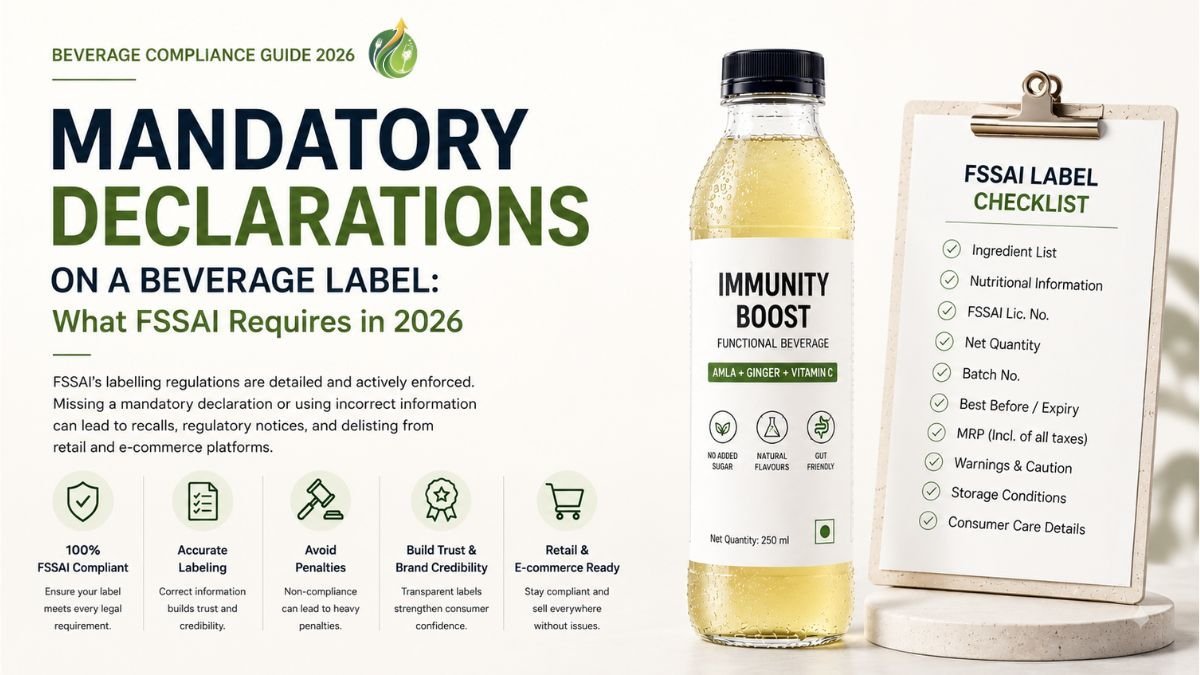
This is not a trivial question. FSSAI’s labelling regulations are detailed, specific, and actively enforced. Missing a mandatory declaration, using incorrect font size, or misstating nutritional information can result in product recall demands, regulatory notices, and being delisted from modern trade or e-commerce platforms.
This guide is a complete, up-to-date reference for mandatory beverage label requirements under FSSAI rules in 2026.
The Regulatory Framework: Which Rules Apply?
Beverage label requirements in India are governed primarily by:
- Food Safety and Standards (Labelling and Display) Regulations, 2020 — the primary labelling regulation, which came into full force replacing the older 2011 regulations
- Food Safety and Standards (Packaging) Regulations, 2018
- Food Safety and Standards (Advertising and Claims) Regulations, 2018
- Category-specific regulations — energy drinks, fruit beverages, dairy beverages, and other specific categories have additional requirements layered on top of the general labelling rules
All packaged food and beverages sold in India must comply with these regulations regardless of whether the product is manufactured domestically or imported.
Flavor Catalystz
Not sure if your beverage label is fully FSSAI compliant?
From nutritional panels and allergen declarations to warning labels and font-size compliance — we review beverage labels before they go to print.
Complete Checklist: Mandatory Declarations on a Beverage Label
Here is every mandatory element your beverage label must include under FSSAI rules in 2026.
1. Name of the Food / Product Name
The product name must clearly describe what the product is. It must be:
- Specific — “Mango Juice Drink” not just “Mango”
- Accurate — the name must reflect the actual product (e.g., a drink with less than the minimum fruit content cannot be called “juice”)
- In English — the product name must appear in English; it may also appear in other Indian languages
Common labelling violations here: calling a flavoured drink a “juice” when it does not meet FSSAI’s minimum fruit content threshold, or using a vague descriptor that does not match the actual product standard.
2. List of Ingredients
The ingredient list is one of the most regulated elements on a beverage label.
Rules:
- All ingredients must be listed in descending order of weight (highest weight ingredient first)
- Each ingredient must be identified by its common name (e.g., “Sugar,” not “Sweetener”)
- Compound ingredients (ingredients that are themselves made of multiple components, like a flavour blend) must be declared with their components in brackets if the compound ingredient makes up more than 5% of the product
- Food additives must be declared by their functional class name + either the specific name or INS number (e.g., “Acidity Regulator (330)” or “Acidity Regulator (Citric Acid)”)
- Flavours must be declared as “Natural Flavouring Substance,” “Nature-Identical Flavouring Substance,” or “Artificial Flavouring Substance” — the specific flavour name is optional but the category is mandatory
- Allergens must be highlighted in the ingredient list — bold, underline, or contrasting colour
What counts as an allergen under FSSAI: Cereals containing gluten, crustaceans, eggs, fish, peanuts, soybeans, milk (including lactose), tree nuts, and sulphites above 10mg/kg.
3. Nutritional Information
The nutritional information panel (NIP) is mandatory on all packaged beverages sold in India. It must declare:
Mandatory nutrients (minimum):
- Energy (in kcal AND kJ — both units required)
- Protein (in grams)
- Carbohydrates (in grams) — with sugars declared separately as a sub-category
- Total Fat (in grams) — with saturated fat and trans fat declared separately
- Sodium (in milligrams)
Format requirements:
- Declared per 100ml — mandatory reference quantity
- Also declared per serving — with the serving size clearly stated
- Presented in a tabular format
- Font must be legible (minimum 1.5mm character height)
Additional nutrients to declare if added or claimed:
- Dietary fibre (if making fibre claims)
- Any vitamin or mineral if added or if a claim is being made about it
- Any other nutrient specifically mentioned in claims on the pack
Common mistake: Declaring nutritional values only per serving without the per-100ml column — this is non-compliant. Both columns are mandatory.
4. Net Quantity / Net Contents
- Must state the volume (for liquids) in millilitres or litres
- Must appear on the principal display panel (the front or most visible face of the pack)
- Font size requirements vary by pack size — for packs above 200ml, the net quantity declaration must be in a minimum 3mm character height
5. Name and Address of Manufacturer / Packer / Importer
- Full legal name of the manufacturing company
- Complete registered address (not just city — full address with PIN code)
- For imported products: the importer’s name and address in India must also appear
- For contract-manufactured products: both the brand owner (“marketed by”) and the manufacturer (“manufactured by”) must be declared
6. FSSAI Licence Number
- The 14-digit FSSAI licence number of the manufacturer must appear on every label
- Must be clearly legible
- For contract-manufactured products, the manufacturer’s FSSAI licence number appears (not the brand owner’s, unless the brand owner is also the licence holder)
7. Batch Number / Lot Number
- A unique batch or lot identifier allowing traceability back to the specific production run
- Format is at manufacturer’s discretion but must be present
- Often declared as “Batch No.:” or “Lot No.:” followed by the identifier
8. Best Before / Expiry Date
- Must state the date before which the product is best consumed
- Format: DD/MM/YYYY or MM/YYYY (month/year is acceptable for products with shelf life greater than 3 months)
- Must appear on the label — not just on the outer carton
- For beverages with shelf life less than 3 months: “Best Before” date in DD/MM/YYYY format
- For beverages with shelf life greater than 3 months: “Best Before End” with month and year is acceptable
9. Country of Origin
- Mandatory for imported products — must state the country where the product was manufactured
- For domestic products, country of origin is not mandatory under labelling regulations, but is often included voluntarily
10. Vegetarian / Non-Vegetarian Symbol
- All packaged foods sold in India must carry either the green circle symbol (vegetarian) or the brown/red circle symbol (non-vegetarian)
- The symbol must be displayed in a specified size and colour
- For beverages: most will be vegetarian (green symbol). Non-vegetarian applies if the product contains any meat, fish, poultry, eggs, or animal-derived ingredients (note: certain colours like carmine are animal-derived and would make a product non-vegetarian)
11. Instructions for Use / Directions for Consumption
- Mandatory where the absence of this information would make correct use of the product difficult
- For concentrated beverages (squash, sharbat, premix): the dilution ratio must be stated
- For beverages requiring specific preparation: preparation instructions must be included
12. Storage Instructions
- Mandatory if the product requires specific storage conditions (refrigeration, away from direct sunlight, etc.)
- e.g., “Refrigerate after opening,” “Store in a cool, dry place,” “Best served chilled”
- Products that are ambient-stable but require refrigeration after opening must state this
Category-Specific Mandatory Additions
Beyond the general requirements above, certain beverage categories have additional mandatory label elements:
Energy Drinks
- Caffeine content per serving (in mg) — mandatory declaration
- “Not suitable for children, pregnant women, and persons sensitive to caffeine”
- “Not for sale to persons below 18 years”
- “Consume in moderation”
Carbonated Beverages
- “Contains added sugar” if sugar is present (per FSSAI’s front-of-pack labelling guidance)
Fruit Beverages
- Fruit content percentage must be declared (e.g., “Contains 20% mango pulp”)
- Product must meet minimum fruit content standards for the declared product name (juice vs. nectar vs. drink vs. squash — each has a different minimum)
Beverages with Added Vitamins/Minerals
- Each added vitamin or mineral must be declared in the NIP with its quantity per 100ml and per serving
- If making a “source of” or “high in” claim for the nutrient, the declared level must meet FSSAI’s threshold for that claim
Proprietary Food / Functional Beverages
- “This product is not intended to diagnose, treat, cure, or prevent any disease” — required for products making health function claims under the proprietary food pathway
Font Size and Label Layout Requirements
FSSAI’s labelling regulations specify minimum character heights for key declarations:
| Declaration | Minimum Character Height |
| Product name | Prominent — largest text on principal display panel |
| Net quantity | Minimum 3mm (for packs above 200ml) |
| Nutritional information | Minimum 1.5mm |
| Mandatory warnings | Minimum 1.5mm (energy drinks: prominent placement) |
| All other mandatory text | Minimum 1mm |
The label must be in English — declarations may additionally appear in Hindi or other Indian languages, but English is mandatory.
All text must be legible, prominent, and clearly contrasting with the background. White text on a light background, or tiny text in a corner, is non-compliant regardless of whether the information is technically present.
Front-of-Pack Labelling: The 2026 Update
FSSAI has been developing mandatory front-of-pack (FOP) labelling requirements for foods and beverages high in sugar, salt, and fat. As of 2026, finalized FOP labelling requirements require beverages exceeding defined thresholds for sugar, sodium, or saturated fat to carry a specific front-of-pack indicator.
If your beverage has significant sugar content, verify the current FOP labelling threshold applicable to your product category — this is one of the areas where regulations have been actively evolving and your label designer may not be up to date.
Our beverage consultant team stays current on FSSAI regulatory developments and reviews labels against the latest requirements before print approval.
Most Common Beverage Label Compliance Failures
These are the errors that show up most frequently in label reviews:
- Nutritional information missing per-100ml column — only per-serving declared
- Trans fat not declared separately in the fat section of NIP
- Sugars not declared as sub-category under carbohydrates
- Additive declared by INS number only without functional class name
- Allergen not highlighted in ingredient list
- Serving size not stated alongside per-serving nutrition values
- Best before format incorrect — wrong date format or only on outer carton
- FSSAI number missing or incorrect
- Veg/non-veg symbol absent or wrong colour
- Claims on pack that are not supported by actual nutrient content or not permitted under FSSAI claims regulations
Get Your Beverage Label Reviewed Before You Print
A label compliance review before printing saves the cost and time of reprinting — and protects you from regulatory action after launch. The most expensive label mistake is the one you discover after 50,000 units are already on shelf.
At Flavor Catalystz, our beverage consultant team reviews beverage labels against current FSSAI requirements — checking every mandatory element, verifying claim compliance, and confirming format requirements — before you commit to print.
Get your label reviewed today.
FAQs: FSSAI Beverage Label Mandatory Declarations
What must be written on a beverage label as per FSSAI rules?
Mandatory declarations include: product name, ingredient list, nutritional information (per 100ml and per serving), net quantity, manufacturer name and address, FSSAI licence number, batch number, best before date, veg/non-veg symbol, and storage/usage instructions where applicable.
Is nutritional information mandatory on all beverage labels in India?
Yes. The nutritional information panel is mandatory on all packaged beverages. It must declare energy, protein, carbohydrates (with sugars), total fat (with saturated and trans fat), and sodium — in a tabular format, per 100ml and per serving.
What is the minimum font size for beverage label text under FSSAI?
Nutritional information and mandatory warnings: minimum 1.5mm character height. Net quantity: minimum 3mm for packs above 200ml. All other mandatory text: minimum 1mm. All text must be legible and contrasting against the background.
Can I write the ingredient list in order of importance rather than weight?
No. FSSAI requires the ingredient list to be in descending order of weight — the heaviest ingredient first. This is mandatory and non-negotiable.
Do I need to declare allergens on my beverage label?
Yes — if your beverage contains any of the 11 FSSAI-listed allergens (including gluten-containing cereals, milk, soy, peanuts, tree nuts, eggs, fish, crustaceans, sulphites), they must be highlighted in the ingredient list using bold, underline, or contrasting colour.
What is the correct format for the best before date on a beverage?
For beverages with shelf life under 3 months: DD/MM/YYYY format. For shelf life over 3 months: MM/YYYY is acceptable. The date must appear on the label itself — not only on the outer shipping carton.