May 2026 · 20 min read
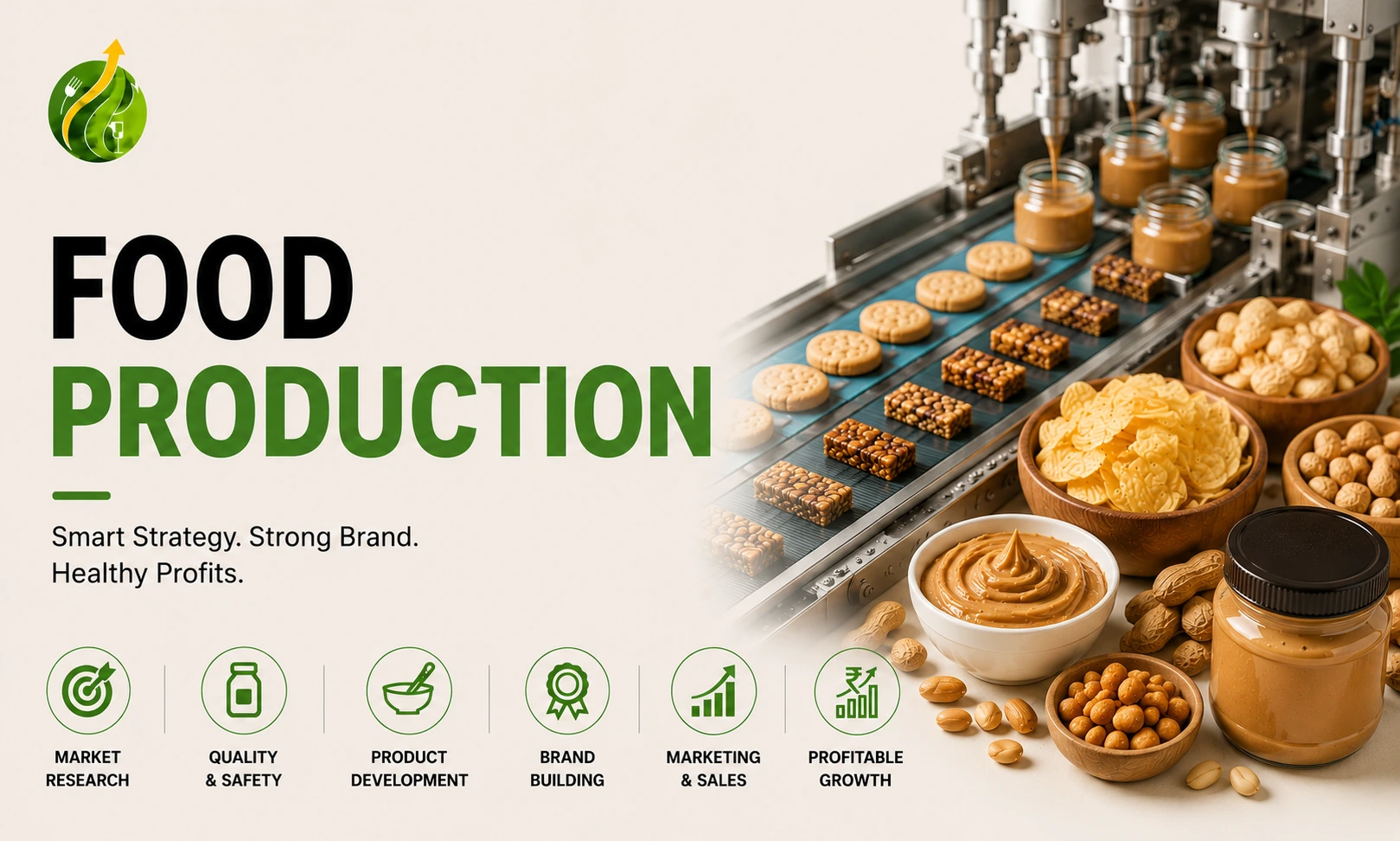
Food production is the process of converting raw agricultural materials into finished food products that are safe, ready to eat, and fit for sale and distribution. It covers every activity from growing crops and raising animals to processing ingredients, manufacturing products, packaging them, and delivering them to consumers.
Food production is one of the largest industries in the world. It sustains billions of people, powers national economies, and supports millions of businesses — from small food startups to global food consulting companies. Countries like India, the United States, China, and Brazil lead global food production, each with strengths in different categories.
This guide explains what food production is, how it works at a commercial level, the types and methods used across the industry, key challenges brands and manufacturers face, and what it takes to build a food production system that works.
What Is Food Production
Food production is best understood as a chain. It starts with raw materials — crops, animals, water, and natural ingredients — and ends with a finished product on a shelf, in a restaurant, or in a consumer’s hands. Every step in between is part of food production.
The chain has three broad phases. The first is primary production, which includes farming, fishing, dairy, and animal rearing. This is where raw ingredients come from. The second is secondary production, which covers processing and manufacturing — turning raw materials into food products such as flour, cooking oil, biscuits, packaged juices, dairy products, snacks, or ready-to-eat meals. The third is tertiary production, which includes packaging, logistics, retail distribution, and the commercial systems that move food from factories to consumers.
For food brands and businesses, food production means understanding how to take a product idea and build a reliable, scalable, and compliant food business, this includes from idea to conecpt by recipe formulation, food product development and manufacturing. This is where decisions about recipes, ingredients, facilities, equipment, regulatory approvals, and quality control are made. Getting these decisions right determines whether a product succeeds or fails in the market.
Why Food Production Matters for Food Brands and Startups
Food production is not just a concern for large companies. It is the foundation of every food brand, regardless of size. A startup launching a protein bar, a beverage brand entering retail, or a D2C food business scaling up all of them depend on a food production system that delivers consistent quality, meets safety standards, and operates at a cost that allows profit.
Poor production decisions are one of the most common reasons food businesses fail. A recipe that works perfectly in a home kitchen may behave completely differently when made in a 500-kilogram factory batch. Ingredients may react differently under industrial heat. Texture may change. Shelf life may be shorter than expected. These are not rare problems they are standard challenges that every food business must plan for.
Understanding food production also matters from a regulatory standpoint. In India, every food business must comply with FSSAI regulations. In the United States, the FDA sets the standards. In Europe, it is EFSA. No product can legally reach a consumer without meeting these requirements, and meeting them requires a production system designed with compliance built in from the start.
Food Production Around the World: A Quick Overview
Food production is a global industry with different countries leading in different areas. The table below shows where the world’s major food producers stand and what they produce.
| Country / Region | Key Strengths | Major Products |
| India | 2nd largest producer of fruits and vegetables. Largest milk producer. Major in grains and spices. | Rice, wheat, milk, sugar, mangoes, pulses, spices |
| United States | World’s largest agricultural exporter. Highly mechanized with advanced food technology. | Corn, soybeans, beef, poultry, dairy, packaged food |
| China | Largest total food producer globally. Dominates in grains, pork, and aquaculture. | Rice, wheat, pork, fish, vegetables, tea |
| Brazil | Dominant in tropical agriculture and animal protein exports. | Coffee, sugar, soybeans, beef, chicken, orange juice |
| European Union | Strong in quality food manufacturing, dairy, wine, and specialty food products. | Cheese, wine, chocolate, olive oil, packaged goods |
| Australia | Major exporter of beef, wheat, and premium dairy products. | Beef, wheat, dairy, wine, lamb |
Food Production in India
India is one of the most important food producing nations in the world. The country is the largest producer of milk globally, the second largest producer of fruits and vegetables, and a major producer of rice, wheat, tea, spices, and pulses. The food processing sector contributes around 8 to 10 percent of India’s GDP and is one of the largest employers in the country.
India’s food production landscape is shifting fast. There is growing demand for packaged food, functional beverages, health supplements, and nutraceuticals. Government support through schemes like PLI (Production Linked Incentive) for food processing is attracting investment into manufacturing infrastructure. At the same time, FSSAI regulations are becoming stricter, and brands that do not build compliance into their production system from the beginning face serious risks.
For food startups and brands in India, the opportunity is significant. But so is the complexity. Navigating raw material sourcing, manufacturing setup, regulatory approvals, and quality control requires expertise that most first-time founders do not have in-house.
Food Production in the United States
The United States is the world’s largest exporter of agricultural products and one of the most advanced food manufacturing nations. American food production is defined by scale, mechanization, and strong regulatory oversight through the FDA and USDA. The country leads globally in the production of corn, soybeans, beef, and poultry, and its packaged food industry sets global standards for safety, labeling, and shelf-life management.
American consumers increasingly demand clean-label products, functional ingredients, and transparent supply chains. These trends are pushing US food manufacturers to invest in reformulation, new processing technologies, and sustainable packaging. For international food brands looking to enter the US market, understanding FDA requirements and American consumer expectations around food production is essential.
Types of Food Production
Food production is not a single activity. It exists in many forms, and the type of production a brand or business uses depends on its goals, market, and resources.
Subsistence farming is the most basic form small-scale production by families or communities to meet their own food needs. There is no commercial intent and no industrial process involved. Most of the world’s food, however, is not produced this way.
Commercial farming operates at a much larger scale with the goal of producing food for sale. Large farms growing wheat in Punjab, corn in the American Midwest, or soybeans in Brazil are examples of commercial farming operations. These supply raw ingredients to food manufacturers around the world.
Industrial food production is where most packaged consumer products come from. It involves high-volume manufacturing using machinery, automation, and standardized processes. A biscuit factory, a beverage plant, an instant noodle manufacturing unit, or a dairy processing facility all represent industrial food production. The goal is consistent quality at high volumes with controlled costs.
Organic food production follows certified standards that prohibit synthetic pesticides, fertilizers, and genetically modified organisms. Organic products command premium prices and require third-party certification. This segment is growing globally as consumers become more aware of ingredient sourcing and agricultural practices.
Aquaculture and fisheries cover the farming of fish, shrimp, and other seafood in controlled environments. This is one of the fastest-growing areas of food production globally, driven by rising protein demand and the limitations of wild-catch fisheries.
Contract manufacturing is increasingly important for food brands and startups. Instead of building their own factory, brands hire a third-party manufacturing facility to produce products using the brand’s recipe and specifications. The brand owns the product and the brand identity. The manufacturer provides the equipment, labor, and production expertise. Contract manufacturing allows brands to launch faster and at lower capital cost, but requires careful partner selection to ensure quality and compliance.
The Seven Stages of Food Production
Whether a company is making a premium protein bar, a fruit juice, or a ready-to-eat meal, the food production process follows the same fundamental stages. Understanding each stage is critical for any food business.
Stage 1: Raw Material Sourcing
Food production begins with ingredients. The quality, safety, and consistency of raw materials directly determine the quality of the finished product. Good sourcing means identifying verified suppliers, checking ingredient certifications, understanding seasonal price variation, and building backup supply chains so that a single supplier disruption does not halt production.
Many food startups underestimate this stage. They find a cheap supplier, produce a few batches, and then discover that the ingredient quality varies between orders. This leads to inconsistent finished products and, in worst cases, safety risks.
Stage 2: Recipe Formulation and R&D
Once raw materials are identified, the product needs a recipe that works not just in a kitchen, but in a factory. Recipe formulation is a technical process that involves food scientists testing ingredient combinations, measuring how they interact under industrial processing conditions, checking stability over time, and making sure the final product meets its nutritional and sensory targets.
A good formulation considers taste, texture, appearance, shelf life, cost of goods, and regulatory compliance all at once. Cutting corners at this stage creates problems at every stage that follows.
Stage 3: Pilot Batching and Testing
Before committing to full-scale production, food businesses run pilot batches. A pilot batch is a small test run typically between 50 and 500 kilograms — that simulates commercial manufacturing conditions. It reveals how the recipe behaves in real industrial equipment, identifies any unexpected changes in texture, flavor, or appearance, and gives the team a chance to adjust before large volumes are produced.
Pilot batches are also where shelf-life testing begins. The product is stored under controlled conditions and tested at regular intervals to confirm that it remains safe and acceptable for the duration of its intended shelf life.
Stage 4: Manufacturing and Scale-Up
This is the core of food production. Manufacturing involves running the product through industrial processes — mixing, cooking, pasteurizing, filling, forming, or whatever the product requires at commercial scale. Equipment setup, batch records, process parameters, and operator training are all part of this stage.
Scale-up is one of the most technically demanding parts of food production. What works at 10 kilograms often does not work the same way at 1,000 kilograms. Heat distribution changes. Mixing dynamics change. Ingredient behavior changes. Experienced food technologists and process engineers are essential at this stage.
Stage 5: Quality Control and Food Safety
Every batch produced must be tested against defined quality standards before it is released. Quality control checks in food production include weight verification, texture and appearance assessment, flavor evaluation, pH and moisture measurement, microbiological testing, and packaging integrity inspection.
Food safety systems such as HACCP (Hazard Analysis and Critical Control Points) and standards like ISO 22000 and FSSC 22000 provide structured frameworks for identifying and managing food safety risks throughout production. In India, FSSAI compliance is mandatory. In the USA, FDA regulations apply. Brands selling internationally must often meet multiple regulatory frameworks simultaneously.
Stage 6: Packaging and Labeling
Packaging does more than hold the product. It protects against contamination, extends shelf life, communicates with the consumer, and demonstrates regulatory compliance. The choice of packaging material glass, PET, flexible film, Tetra Pak, or others — affects product safety, transportation costs, sustainability credentials, and consumer perception.
Labeling in food production is a legal requirement, not just a marketing exercise. In India, FSSAI mandates specific information on every label including the product name, ingredients list, nutritional information, allergen declarations, net weight, manufacturing and expiry dates, FSSAI license number, and manufacturer address. Non-compliance with labeling requirements can result in product rejection at retail, regulatory action, or product recalls.
Stage 7: Distribution and Supply Chain
The final stage is moving the product from the factory to the consumer. This involves warehouse management, inventory control, cold chain logistics for temperature-sensitive products, retailer distribution agreements, and in the case of D2C brands, e-commerce fulfillment systems.
A weak distribution system can undermine an otherwise excellent product. Food that sits in a hot warehouse loses quality. Products that arrive damaged at retail are pulled from shelves. Brands that run out of stock lose shelf space permanently. Distribution is the last mile of food production, and it demands the same level of attention as manufacturing.
Common Food Production Methods
The method used to produce a food product depends on the type of product, the required shelf life, the target consumer, and the available manufacturing technology. The table below explains the most widely used food production methods globally.
| Method | How It Works | Typical Products |
| Batch Production | Products are made in defined quantities. Each batch completes processing before the next begins. | Sauces, jams, beverages, snacks, confectionery |
| Continuous Production | An automated line runs non-stop at high volumes with no batch breaks. | Biscuits, noodles, carbonated drinks, breakfast cereals |
| Fermentation | Microorganisms convert sugars into acids, gases, or alcohol for preservation and flavor. | Yogurt, cheese, vinegar, beer, kombucha, kimchi |
| Extrusion | Food mixture is forced through a shaped die under heat and pressure to form consistent shapes. | Pasta, breakfast cereals, protein bars, puffed snacks |
| Pasteurization and UHT | Heat treatment kills harmful bacteria and significantly extends shelf life. | Milk, juices, soups, liquid dairy, plant-based drinks |
| Spray Drying | Liquid is atomized and dried rapidly into powder form. | Milk powder, protein powder, instant coffee, supplements |
| Aseptic Processing | Product and packaging are sterilized separately and filled in a sterile environment. | Tetra Pak juices, long-life dairy, soups, RTD beverages |
| Cold Pressing | Ingredients are pressed at low temperatures to preserve nutrients and natural flavors. | Cold-pressed juices, nut oils, raw plant-based oils |
| Freeze Drying | Products are frozen and moisture is removed under vacuum, preserving structure and nutrition. | Premium supplements, instant meals, specialty coffee |
Key Challenges in Food Production
Food production at any scale comes with serious operational, regulatory, and commercial challenges. Understanding these challenges before starting production — not after — is what separates food businesses that scale successfully from those that fail.
Raw Material Cost Volatility
Ingredient prices fluctuate constantly. Weather events, geopolitical disruptions, seasonal shortages, and currency changes can cause the cost of a key ingredient to spike significantly within weeks. A brand that has not planned for this through supplier diversification, forward contracts, or reformulation flexibility can find its margins wiped out suddenly.
Scale-Up Failures
One of the most common and costly problems in food production is a recipe that works in a small kitchen but fails in a commercial factory. Industrial equipment operates differently from domestic cooking equipment. Heat distribution is uneven. Mixing dynamics change at volume. Ingredient ratios that worked in a 2-kilogram batch may need adjustment in a 500-kilogram batch. Skipping the pilot batch stage to save time and money almost always costs more in the long run.
Regulatory Compliance
Food safety regulations are strict and non-negotiable. In India, FSSAI sets the standards. Any food business that produces, processes, stores, distributes, or sells food must be registered or licensed under FSSAI. Violations result in fines, product seizures, license cancellations, and in serious cases, criminal prosecution. Beyond India, brands exporting to the USA must meet FDA standards, and those selling in Europe must meet EU food safety regulations. Building compliance into the production system from the beginning is far less costly than retrofitting it after regulatory issues arise.
Shelf Life and Product Stability
A food product that tastes great on day one but changes flavor, texture, or appearance by day 30 will not succeed in retail. Shelf-life testing is a time-consuming but essential part of food production. Products must be tested under real and accelerated storage conditions to confirm that they remain safe and acceptable throughout their intended shelf life. This testing must happen before launch, not after.
Supply Chain Disruptions
Over-reliance on a single supplier for a key ingredient is a common and dangerous vulnerability in food production. A supplier who closes down, fails a quality audit, or faces a weather-related shortage can halt your entire production line. Building a network of backup suppliers and maintaining safety stock of critical ingredients reduces this risk.
Consistency Across Batches
Consumers expect the same product every time they buy it. Achieving batch-to-batch consistency requires precise ingredient measurement, standardized processes, calibrated equipment, and rigorous quality control at every stage. Without these systems in place, product variation is inevitable and consumer trust erodes quickly.
Food Production for B2B Brands: What You Need to Get Right
For food brands, importers, retailers, and foodservice businesses sourcing from food manufacturers, the production decisions made by your manufacturing partner directly affect your product quality, your brand reputation, and your regulatory standing. Whether you are building your own production system or sourcing from a co-manufacturer, the following factors determine success.
Choosing the Right Manufacturing Partner
A contract manufacturer or co-packer is only as good as their systems. Before committing to a manufacturing partner, verify their FSSAI license and relevant certifications such as ISO 22000, FSSC 22000, or HACCP. Visit the facility if possible. Ask to see batch records, QC reports, and previous third-party audit results. Understand their capacity, lead times, and minimum order quantities. A manufacturer who cannot provide this information transparently is a risk.
Owning Your Recipe and Specifications
Many food brands make the mistake of allowing their contract manufacturer to own or develop the recipe. When this happens, the brand has no leverage. If the manufacturer raises prices, delivers inconsistent quality, or terminates the relationship, the brand has nothing to take to a new manufacturer. Always ensure that your formulation, specifications, and process parameters are fully documented and owned by your brand.
Building Compliance from Day One
Regulatory compliance is not something to address after production begins. FSSAI licensing, label approval, ingredient permissibility checks, and nutritional claim substantiation all need to be completed before a product is manufactured at commercial scale. A product that has been manufactured without the correct approvals cannot legally be sold, and the cost of reworking or destroying non-compliant inventory is significant.
Costing Accurately
Many food businesses fail not because their products are bad, but because they underestimate the cost of production. The cost of goods sold (COGS) in food production includes raw material costs, packaging, manufacturing fees, quality testing, logistics, and regulatory compliance costs. Brands that model their unit economics accurately before production begins make better decisions about pricing, minimum order quantities, and retail margins.
Food Production Launch Checklist for Brands and Startups
The table below gives a practical checklist for food brands preparing to launch or scale production.
| Stage | What to Complete | Common Mistake |
| Product Concept | Market research, consumer validation, competitive gap analysis | Launching without confirming market demand |
| Recipe and R&D | Engage a food scientist, complete formulation, run stability studies | Using a home recipe directly for factory production |
| Regulatory Approvals | Obtain FSSAI license, complete label compliance review, verify ingredient permissibility | Starting production before all approvals are confirmed |
| Manufacturing Setup | Select and audit contract manufacturer, finalize batch records and QC protocols | Choosing cheapest option without checking certifications |
| Packaging | Select food-grade packaging, test compatibility with product, finalize compliant label design | Finalizing packaging artwork before testing it with the product |
| Cost Modeling | Calculate COGS including raw materials, manufacturing, packaging, logistics, and compliance costs | Underestimating production costs and pricing below margin |
| Market Launch | Finalize distribution channels, set opening order quantities, plan for restocking cycles | Overproducing before testing real market demand |
The Future of Food Production
Food production is changing faster than at any point in history. Several forces are reshaping how food is made, where it comes from, and what consumers expect from it.
Automation and artificial intelligence are transforming manufacturing floors. AI-driven quality control systems can detect defects, measure portion consistency, and flag contamination risks in real time with greater accuracy than human inspection. Automated packaging lines, robotic assembly, and predictive maintenance systems are reducing waste and downtime in high-volume food production facilities.
Consumer demand for functional and fortified foods is creating new production challenges and opportunities. Products enriched with vitamins, probiotics, adaptogens, plant-based proteins, and other bioactive ingredients require more complex formulation and more rigorous stability testing than conventional food products. The brands that can produce these products consistently and at scale are capturing significant market growth.
Clean-label manufacturing is no longer a niche trend. Consumers globally are reading ingredient lists and rejecting products with artificial additives, preservatives, and unrecognizable ingredient names. This is forcing food manufacturers to reformulate products, find natural alternatives to synthetic ingredients, and redesign production processes that relied on those additives for shelf life or texture.
Sustainability is entering the production floor. Pressure from regulators, retailers, and consumers is pushing food manufacturers to reduce plastic packaging, lower carbon emissions from processing, reduce water usage, and minimize food waste. Brands that build sustainable production systems now are building a competitive advantage for the future.
Vertical farming and controlled environment agriculture are changing primary production. Indoor farming allows year-round cultivation of fresh produce without dependence on weather, season, or geography. While still expensive at scale, the technology is improving rapidly and is already being used commercially for leafy greens, herbs, and certain fruits.
How We Supports Food Production
Flavor Catalystz is a food and beverage consulting company based in India that works with startups, growing brands, and established businesses across India and international markets. The team provides end-to-end support across the complete food production journey from the first product concept through to commercial manufacturing and market launch.
The Flavor Catalystz team includes food scientists, R&D specialists, regulatory experts, and commercial consultants who have direct experience building and scaling food production systems across multiple categories including beverages, snacks, dairy, nutraceuticals, bakery, ready-to-eat, and more.
Services include food formulation and scale-up, pilot batch management, FSSAI regulatory compliance, contract manufacturer selection and technical coordination, raw material sourcing support, packaging development, and food business strategy. Brands that work with Flavor Catalystz get a single experienced team that handles the technical, regulatory, and commercial aspects of food production reducing errors, accelerating timelines, and building production systems that are designed to grow.
Frequently Asked Questions
What is food production?
Food production is the process of converting raw agricultural materials into finished food products that are safe, ready to eat, and suitable for sale and distribution. It covers every stage from farming and ingredient sourcing to processing, manufacturing, packaging, and delivery.
What are the main types of food production?
The main types of food production are subsistence farming, commercial farming, industrial food production, organic food production, aquaculture and fisheries, and contract manufacturing. Each type serves a different purpose and operates at a different scale.
What are the stages of food production?
The key stages of food production are raw material sourcing, recipe formulation and R&D, pilot batching and testing, large-scale manufacturing, quality control and food safety, packaging and labeling, and distribution. Each stage must be completed correctly for a product to be safe, consistent, and commercially successful.
Which country produces the most food in the world?
China is the largest food producer in the world by total volume, particularly in grains, pork, and aquaculture. The United States is the world’s largest agricultural exporter. India is among the top producers globally in dairy, fruits, vegetables, rice, and wheat.
What is commercial food production?
Commercial food production is the large-scale manufacturing of food products intended for sale to consumers or businesses. It involves standardized processes, industrial equipment, regulatory compliance, and consistent quality control to produce food at volumes that can supply retail, food service, or export markets.
What is the difference between food production and food processing?
Food production is the broader term covering the entire chain from growing raw materials to delivering finished products to consumers. Food processing is one specific stage within food production where raw ingredients are transformed through methods such as cooking, mixing, pasteurization, or packaging. Processing is part of production, not the same as production.
What are the biggest challenges in food production?
The biggest challenges in food production include raw material cost volatility, scale-up failures when moving from small batches to factory production, food safety and regulatory compliance, shelf life and product stability, supply chain disruptions, and maintaining batch-to-batch consistency at commercial volumes.