May 2026 · 22 min read
Most food products fail between the kitchen and the consumer. Industry estimates suggest that between 70 and 90 percent of new food product launches do not achieve commercial success within their first two years. The primary causes are not bad ideas, they are structural problems in how the development process is executed: insufficient consumer validation before manufacturing investment, formulation choices that do not survive commercial processing conditions, regulatory non-compliance that delays launch by months, and pricing structures that cannot sustain marketing investment.
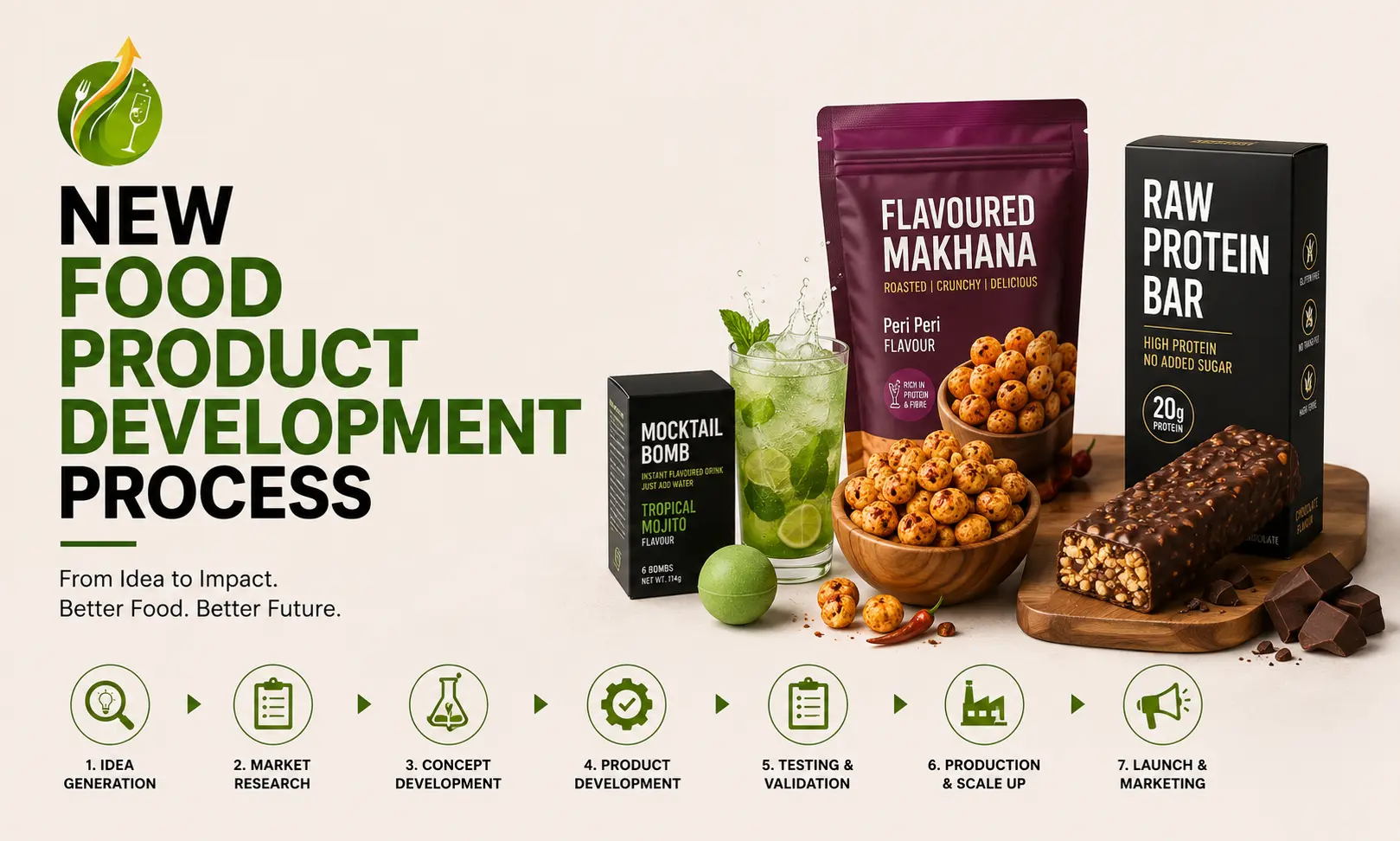
This guide covers the complete food product development process from concept to launch, in the sequence that a methodical and well-run food product development project actually follows. It is written for founders, food technologists, brand managers, and food formulation teams who need to understand what each stage requires, what outputs it should produce, and what risks it is designed to mitigate.
What is Food Product Development?
Food product development is the step-by-step process of turning a food idea into a market-ready product through research, formulation, testing, FSSAI compliance, packaging, manufacturing scale-up, and commercial launch. It combines food science, consumer insights, regulatory expertise, production planning, and business strategy to create commercially successful food products.
The process is inherently iterative rather than linear. Formulation decisions are revisited when consumer testing reveals palatability issues. Regulatory review sometimes requires reformulation. Manufacturing scale-up reveals process inconsistencies that require recipe adjustment. The most effective food product development teams build iteration cycles into their timeline rather than treating each stage as a one-time checkpoint.
The 8 Stages of Food Product Development
| Stage | Key Output | Typical Duration | Primary Risk if Skipped |
| 1. Market and Consumer Research | Product brief and validated opportunity | 2 to 6 weeks | Building a product no one needs |
| 2. Concept Generation and Screening | Prioritised concept shortlist | 1 to 3 weeks | Investing in the wrong concept |
| 3. Feasibility Assessment | Business case with cost and margin model | 2 to 4 weeks | Launching a product that cannot be profitable |
| 4. Recipe Formulation and Prototyping | Validated formulation specification | 4 to 16 weeks | Product that fails shelf life or scale-up |
| 5. Consumer Testing and Sensory Evaluation | Optimised recipe with consumer data | 3 to 8 weeks | Launching a product consumers will not repurchase |
| 6. Shelf Life Testing and Safety Validation | Shelf life certificate and safety data | 6 to 26 weeks | Safety incidents, regulatory rejection, recall |
| 7. Regulatory Compliance and Packaging | Approved labelling and compliance file | 4 to 12 weeks | Launch delay, retailer rejection, penalty |
| 8. Manufacturing Scale-Up and Commercial Launch | Consistent commercial product | 4 to 16 weeks | Quality inconsistency, production failure at scale |
Stage 1: Market Research and Consumer Opportunity Identification
Every successful food product development project begins with a clearly articulated consumer need and a documented market opportunity. This stage is where the product’s reason to exist is established, and where the scope of the project is defined before any financial commitment to development.
What Market Research Should Answer
At this stage, the team needs answers to four core questions. What specific consumer need or frustration does this product address? What does the competitive landscape look like in the category, and what is currently available that addresses a similar need? What is the realistic target price point the consumer will pay, and does that price point generate a viable gross margin? And what distribution channels are relevant for this product category and consumer, and what do those channels require of the product?
Research Methods
Quantitative market data from industry research sources provides the macro context: category size, growth rate, segment performance, and consumer spending trends. Consumer interviews with 20 to 40 members of the target consumer profile provide qualitative insight into purchase behaviour, unmet needs, and reactions to category options. Quick-commerce review mining, social listening across Instagram and Reddit, and retail audits (assessing what is on shelf and at what price) complete the picture. Competitive product purchase and evaluation provides direct insight into the sensory, nutritional, and packaging benchmarks you are competing against.
Output of Stage 1
A product brief that defines the target consumer, the consumption occasion, the functional and emotional need being addressed, the competitive set, the target retail price, the target gross margin, and the key product attributes that must be true for the product to win with the target consumer. This brief becomes the reference document against which every subsequent development decision is evaluated.
Stage 2: Concept Generation and Idea Screening
Given the product brief from Stage 1, the concept generation phase produces multiple product concept options and applies a structured screening process to identify the one or two concepts most worth pursuing through development.
Idea Generation Sources
Concepts emerge from multiple sources: consumer research insights (what gap did consumers articulate during interviews), trend analysis (what adjacent product trends suggest a flavour, format, or functional direction), technical capability (what can the available manufacturing infrastructure produce efficiently), and competitive analysis (what exists and how could a new entry be genuinely differentiated).
Concept Screening Criteria
A structured scoring matrix applies weighted criteria to each concept. Typical criteria include: strength of consumer insight (is the need real and underserved), commercial viability (is the estimated gross margin achievable at a realistic price point), technical feasibility (can the product be formulated and manufactured to specification), regulatory complexity (are there novel ingredient or claim approval requirements that add significant time or cost), and competitive differentiation (is this genuinely distinct from what exists or a marginal variation of a current product).
Output of Stage 2
A shortlist of one to three concepts validated against the product brief, with documented rationale for why each was selected and why rejected concepts were screened out. This documentation protects against revisiting rejected options later in the development process and maintains the team’s focus on the highest-potential direction.
Stage 3: Feasibility Assessment and Business Case
Before any laboratory or kitchen work begins, a feasibility assessment confirms that the selected concept can be profitably manufactured, distributed, and marketed at the intended price point. Many product development projects fail commercially not because of a product quality failure but because the economics were never properly modelled.
Cost Structure Modelling
The feasibility assessment builds a detailed cost model covering: raw material cost per unit at projected production volumes, packaging cost per unit at projected order quantities, processing and manufacturing cost per unit (whether own manufacturing or co-packing), logistics cost per unit to the primary distribution channel, channel margin or platform fee, and the residual gross margin available to fund marketing and overhead. If the gross margin at the realistic selling price is below 30 to 35 percent for a retail product or 40 to 50 percent for a D2C product, the economics require reconsideration before proceeding.
Regulatory Pre-Assessment
A regulatory pre-assessment at this stage identifies whether any ingredients in the concept require novel food approval, whether any intended nutritional claims require substantiation that the product can realistically achieve, and what labelling obligations apply. Discovering a regulatory blocker at Stage 6 after full formulation work has been completed is far more expensive than identifying it at Stage 3.
Output of Stage 3
A business case document that includes the projected cost structure and gross margin at target volume, the estimated regulatory timeline and compliance cost, the proposed manufacturing approach (own production or co-packing), and a preliminary launch timeline. This document forms the basis for the investment decision to proceed with full product development.
Stage 4: Recipe Formulation and Prototype Development
Stage 4 is where the product concept becomes a physical product. A food technologist or development chef translates the product brief and concept specification into a recipe that achieves the desired flavour profile, texture, nutritional targets, and processing compatibility.
Formulation for Processing Conditions
Food products are not eaten fresh from the recipe. They are manufactured under industrial conditions, packaged, stored, and eaten after periods ranging from days to years. Formulation must account for the specific processing conditions the product will undergo: heat treatment (pasteurisation, retort, baking), any physical processing (extrusion, blending, coating), and the packaging and storage environment.
A curry sauce that tastes perfect when freshly made may develop off-flavours after retort processing at 121 degrees Celsius. A biscuit that achieves the right texture in a bench-scale oven may be softer or crunchier when produced in a commercial tunnel oven. A protein bar with the right protein-to-sugar ratio may become unacceptably sticky in humid storage conditions. All of these processing effects must be anticipated and tested during prototype development, not discovered after commercial production has begun.
Ingredient Specification and Sourcing
Every ingredient in the formulation must have a full technical specification: supplier name, grade, allergen status, permitted additives, microbiological specification, and moisture or fat content range. Ingredient variability is a major source of batch-to-batch product inconsistency. A formulation that uses a raw material with wide compositional variability will produce inconsistent product characteristics unless the specification controls for that variability.
Iteration and Refinement
Multiple prototype iterations are normal and expected. A typical protocol involves producing three to five distinct formulation variants for initial evaluation by the development team, selecting the most promising one to two for refinement, refining through two to four additional iterations, and then producing a submission prototype for formal consumer testing. Maintaining detailed records of every formulation change and its sensory impact is essential for rebuilding a formulation that achieves the target character after scale-up changes.
Output of Stage 4
A validated formulation specification that includes all ingredients, quantities, processing parameters, and quality control checkpoints. This specification is the master recipe from which all subsequent batches will be produced and against which all product samples will be evaluated.
Stage 5: Consumer Testing and Sensory Evaluation
Consumer testing is the stage most commonly abbreviated or skipped by early-stage food brands, and it is the stage where the most commercially costly mistakes are most effectively prevented. The purpose of consumer testing is not to validate that the development team’s product is good. It is to determine whether the target consumer will buy it once, and whether they will buy it again.
Types of Consumer Testing
Central location testing (CLT) gathers a defined panel of target consumers in a controlled environment to evaluate products against blind and branded comparisons. This format provides controlled conditions and allows comparison against competitor products. Home-use testing (HUT) places products with consumers for use in their normal environment over a defined period, typically one to two weeks, providing data on real-world eating context and repeat use behaviour. Online consumer research uses panels to evaluate product concepts, packaging designs, or flavour preferences before physical prototypes are produced, enabling faster iteration at lower cost.
Sensory Evaluation Protocol
Sensory evaluation by a trained panel provides more precise technical data than consumer panels. Trained sensory evaluators assess specific attributes: overall aroma intensity, specific off-note identification, texture firmness and cohesiveness, saltiness, sweetness, acidity, bitterness, and aftertaste. This data enables specific formulation adjustments rather than general consumer feedback like ‘it tastes a bit off’. Combining trained panel evaluation for technical precision with consumer panel evaluation for commercial preference provides the most complete picture of product performance.
What to Do with Consumer Feedback
Consumer feedback must be interpreted rather than followed literally. Consumers can tell you what they experienced, but they cannot tell you how to fix it. ‘Too sweet’ from a consumer panel translates into a sucrose level reduction, possibly combined with a flavour masking or acid addition, but the specific formulation adjustment requires the food technologist’s translation. Consumer feedback is the compass direction; formulation expertise is the navigation.
Output of Stage 5
A consumer-validated formulation with documented test results including hedonic scores, purchase intent ratings, and specific attribute improvement areas identified. A repeat purchase intent rate above 40 to 50 percent from target consumer panels is the minimum threshold for commercial confidence in the product’s market viability.
Stage 6: Shelf Life Testing and Food Safety Validation
A food product cannot be sold commercially without demonstrated shelf life at the claimed storage conditions. Shelf life testing is one of the longest lead-time activities in the entire development process and must begin as early as Stage 4, not after everything else is finalised.
Real-Time Shelf Life Testing
Real-time shelf life testing stores product samples at the intended commercial storage conditions (ambient temperature and humidity, refrigerated, or frozen) and evaluates them at defined intervals against microbiological, chemical, sensory, and packaging integrity criteria. The test must run for the full intended shelf life claim plus a safety margin. A product claiming 12 months shelf life must be tested for at least 12 months, often 14 to 16 months to account for distribution time.
Accelerated Shelf Life Testing
Accelerated shelf life testing (ASLT) uses elevated temperature and humidity conditions to simulate long-term storage in a compressed timeframe. Testing at 40 degrees Celsius and 75 percent relative humidity, for instance, is used to predict ambient shelf life in a shorter study period. ASLT results are used to support product launch while real-time testing continues, but they do not replace real-time validation and should be labelled clearly as predictive data in regulatory submissions.
Food Safety Documentation
A HACCP (Hazard Analysis and Critical Control Points) analysis identifies all biological, chemical, and physical hazards associated with the product’s ingredients, processing steps, packaging, and storage. Critical control points where hazards can be eliminated or reduced to acceptable levels are identified, monitored, and documented. HACCP documentation is required for FSSAI State and Central licenses in India, for FDA registration in the United States, for EFSA compliance in the EU, and is required by virtually all modern trade retailers globally as a supplier qualification requirement.
Output of Stage 6
A shelf life certificate supported by testing data, a complete HACCP study, microbiological and nutritional analysis results from an accredited laboratory, and a food safety management system appropriate to the manufacturing scale and regulatory jurisdiction.
Stage 7: Regulatory Compliance and Packaging Development
Regulatory compliance is not a final checkpoint. It is a process that runs in parallel with development from Stage 3 onward. However, Stage 7 is where compliance is finalised, labelling is approved, and packaging is produced for commercial use.
Labelling Compliance Requirements
In India, FSSAI regulations require: product name, FSSAI license number, list of ingredients in descending order by proportion, nutritional information in the prescribed format per 100g or 100ml, allergen declarations, net quantity, batch or lot number, manufacturing date, best before or expiry date, manufacturer name and complete address, and country of origin for imported ingredients. Regulations updated for 2026 require front-of-pack nutritional information in a standardised format and more prominent allergen declarations.
In the United States, FDA regulations for food labelling under 21 CFR require a Nutrition Facts panel, complete ingredient list, allergen declarations under FALCPA, and compliance with nutrient content claim and health claim regulations if any such claims are made. In the European Union, EU Regulation 1169/2011 on food information to consumers applies, with mandatory nutrition declarations, allergen declarations in bold or italic type, and country of origin declarations for specific food categories.
Packaging Design and Technical Compliance
Packaging development for a food product must satisfy four simultaneous requirements: functional protection (barrier properties against oxygen, moisture, light, and physical damage appropriate to the product and shelf life), regulatory compliance (all mandatory labelling information correctly formatted), consumer communication (USP, nutritional claims, usage instructions, brand identity), and supply chain requirements (barcode type and placement, case dimensions, pallet configuration).
Packaging decisions at this stage also have long-term sustainability implications. Single-use plastic packaging is under increasing regulatory scrutiny across the EU, UK, and several Indian states. Mono-material recyclable packaging, compostable materials, and reusable formats are increasingly required by retailer sustainability policies and in some jurisdictions by regulation. Choosing a packaging format that will require replacement due to regulatory change within two to three years is a significant hidden cost.
Output of Stage 7
Approved packaging artwork with confirmed regulatory compliance, a complete regulatory compliance file (license numbers, claims substantiation, labelling review sign-off), and production-ready packaging specifications ready for the commercial print run.
Stage 8: Manufacturing Scale-Up and Commercial Launch
The transition from bench-scale or pilot production to commercial manufacturing volume is one of the highest-risk stages in the entire development process. Products that perform perfectly at small scale frequently exhibit quality differences at commercial scale due to equipment differences, ingredient batch size variation, processing parameter changes, and operator variation.
Pilot Production Run
A pilot production run at commercial scale, typically 10 to 20 percent of the first commercial batch size, is conducted to identify and resolve scale-up issues before committing to a full commercial batch. The pilot run evaluates: processing parameter optimisation (time, temperature, mixing speed, pressure) at commercial equipment scale, batch-to-batch consistency for key quality attributes, filling accuracy and pack weight consistency, and equipment cleaning and changeover requirements.
Quality Control Systems
Commercial production requires documented quality control procedures at every critical processing step. These include incoming ingredient inspection against specification, in-process checks at defined intervals (weight, temperature, moisture, colour), finished product inspection before release, and retained sample programme for traceability and complaint investigation. Without a functioning quality control system, a brand cannot identify the source of a consumer complaint, cannot recall a specific batch if a safety issue is identified, and cannot improve product consistency over time.
Go-to-Market Launch Planning
A food product launch plan defines: the sales channels that will be activated at launch and in which sequence, the target distribution reach within the first 90 days, the consumer awareness strategy (digital advertising, influencer sampling, social media content), the launch pricing strategy and any introductory promotional pricing, the customer service infrastructure for complaint and query handling, and the performance metrics that will be tracked to evaluate launch success (trial rate, repeat purchase rate, distribution reach, and revenue against plan).
Post-Launch Monitoring and Optimisation
A product’s commercial development does not end at launch. Post-launch monitoring collects data on: sales performance by channel and geography, consumer reviews and complaint patterns, production yield and quality consistency data, and ingredient and packaging cost movement. These data streams inform the continuous improvement agenda that keeps a product competitive over its commercial life. Products that are not actively monitored and improved after launch gradually lose ground to competitors who are.
Common Reasons Food Product Development Projects Fail
| Failure Point | Cause | How to Prevent It |
| Product no one buys | Insufficient consumer validation before manufacturing investment | Conduct structured consumer research in Stage 1 and Stage 5 before committing to production |
| Formulation fails at scale | Bench recipe not tested under commercial processing conditions | Test formulation under pilot-scale equipment conditions in Stage 4 |
| Shelf life shorter than claimed | Testing began too late or used accelerated data without real-time confirmation | Start shelf life studies in Stage 4 as soon as a stable formulation exists |
| Regulatory rejection at launch | Labels reviewed only at the end of development | Conduct regulatory pre-assessment at Stage 3 and labelling review at Stage 7 before print run |
| Gross margin insufficient for marketing | Cost model not validated until after formulation was finalised | Build full cost model in Stage 3 before committing to formulation investment |
| Inconsistent quality at commercial scale | No pilot production run before first commercial batch | Always conduct a documented pilot run at commercial scale before the first full batch |
How Long Does Food Product Development Take?
Timeline varies significantly by product category, regulatory jurisdiction, shelf life claim, and the team’s prior experience. Below are realistic estimates by product type for a well-resourced team with regulatory expertise from the outset.
- Dry ambient products (spice blends, dry snacks, instant mixes): 3 to 4 months from concept to launch
- Chilled ready meals and prepared foods: 4 to 5 months
- Shelf-stable retort packaged products: 5 to 6 months due to extended shelf life testing requirements
- Frozen products: 6 to 12 months
- Beverages (ambient): 6 to 10 months
- Functional foods or novel ingredient formulations: 12 to 24 months due to regulatory approval complexity
The longest single lead-time item in most food product development projects is real-time shelf life testing. A product claiming 12 months shelf life cannot receive its shelf life certificate in less than 12 months of testing, regardless of how quickly everything else proceeds. Planning the launch timeline from the start of shelf life testing, rather than from the end of formulation, is essential for an accurate go-to-market date.
Food Product Development Tools and Software
Modern food product development is increasingly supported by digital tools that improve efficiency and reduce error rates across formulation, regulatory compliance, and project management.
Recipe and formulation management software such as Genesis R and D, Nutrition Pro, and Esha Food Processor enable nutritional analysis of formulations against regulatory labelling requirements, allergen flagging, and cost-per-unit calculation as ingredients and quantities change. These tools reduce the manual effort of nutritional compliance review significantly and reduce labelling error risk.
Regulatory intelligence platforms provide updated requirements across multiple jurisdictions for food companies developing products for international markets. They track changes in permitted additive lists, claim regulations, and labelling requirements by country, reducing the risk of non-compliance in export markets.
Project management platforms adapted for food product development track stage gates, document version control, supplier qualification records, testing results, and approval workflows, enabling cross-functional teams to stay aligned on progress and decision points throughout a development project.
Flavor Catalystz supports food brands through every stage of this process, from feasibility assessment and formulation development to regulatory compliance review and co-packer selection, for brands developing food products in India and for international markets. The structured approach described in this guide is not a guarantee of success, but skipping any of its stages is a statistically reliable predictor of expensive problems that emerge at the worst possible moment.
Frequently Asked Questions
What are the stages of food product development?
The complete food product development process consists of 8 stages: market research and consumer opportunity identification, concept generation and screening, feasibility assessment and business case, recipe formulation and prototype development, consumer testing and sensory evaluation, shelf life testing and food safety validation, regulatory compliance and packaging development, and manufacturing scale-up and commercial launch. Each stage produces defined outputs that form the input to the next stage.
How much does it cost to develop a new food product?
The cost of developing a new food product varies significantly by product complexity, regulatory jurisdiction, and whether development is conducted in-house or through external specialists. A simple ambient dry food product developed through a food technology consultant can cost between USD 15,000 and USD 60,000 for formulation, consumer testing, shelf life testing, labelling compliance, and pilot production. A complex chilled ready meal with novel ingredients and international regulatory requirements can cost USD 100,000 to USD 300,000 or more. Government schemes in India including PMFME provide capital subsidies for micro food processing enterprises that can partially offset development costs.
What is the difference between a food technologist and a food scientist?
Food scientists study the physical, biological, and chemical properties of food and the principles underlying food processing and preservation. Food technologists apply that scientific knowledge to the practical development, production, and quality assurance of food products. In practice, food product development teams use both skill sets: food scientists provide knowledge of ingredient chemistry and food safety principles, while food technologists translate those principles into commercial formulations and manufacturing processes.
What is HACCP and is it required for food businesses?
HACCP stands for Hazard Analysis and Critical Control Points. It is a systematic approach to food safety that identifies biological, chemical, and physical hazards in food production and establishes critical control points where those hazards can be prevented, eliminated, or reduced to acceptable levels. HACCP is legally required for food manufacturers seeking FSSAI State or Central licenses in India. It is required by FDA for most food facilities in the United States. It is the basis of ISO 22000 food safety management systems and is required by virtually all major global retailers and food service operators as a supplier qualification requirement.
What is the difference between shelf life testing and expiry date?
Shelf life testing is the scientific process of determining how long a food product maintains its safety and quality characteristics under defined storage conditions. It involves microbiological testing, chemical stability analysis, and sensory evaluation at defined time intervals throughout the intended shelf life. The expiry date or best before date printed on the product is the outcome of this testing: it represents the point up to which the manufacturer guarantees the product will meet its safety and quality specifications when stored as directed. The expiry date cannot be determined without shelf life testing data, and a manufacturer cannot legally claim a shelf life that is not supported by testing.
When should I hire a food product development consultant?
A food product development consultant is most valuable at three specific points in the process: at the start, to assess the technical and commercial feasibility of a concept before significant investment is committed; during formulation, to bring food science expertise that the founding team may not have and to avoid common formulation errors; and during regulatory compliance, to ensure labelling and claim requirements are met before packaging is printed. Founders who attempt to navigate all three areas without specialist input consistently take longer, spend more on reformulation, and face more launch delays than those who bring in specialist expertise at the appropriate stages.
What is co-packing and how does it work in food product development?
Co-packing (contract packaging or contract manufacturing) is an arrangement where a third-party food manufacturer produces a food brand’s products to the brand’s specification. The brand owns the formulation, the recipe, and the product specification. The co-packer provides the manufacturing facility, equipment, labour, and production management. For early-stage food brands, co-packing avoids the capital cost of setting up a manufacturing facility and allows production to scale incrementally with sales volume. When choosing a co-packer, verify their FSSAI license coverage for your product category (India), FDA registration (US), or relevant national license, their HACCP certification, their minimum order quantities, their ability to meet your product specification, and their payment terms.
Can I develop a food product at home and sell it commercially?
In most jurisdictions, commercially sold food products must be manufactured in a licensed commercial facility that meets food safety hygiene and good manufacturing practice requirements. In India, this means FSSAI licensing. In the United States, most states have Cottage Food Laws that permit home production of specific low-risk food categories (baked goods, jams, certain dry goods) for direct sale to consumers up to defined annual revenue limits. These cottage food exemptions vary by state and do not typically permit sale through retail stores or online interstate commerce. For any product intended for commercial retail, restaurant supply, or online sale beyond cottage food limits, a licensed commercial kitchen or co-packer is required.