May 2026 · 9 min read
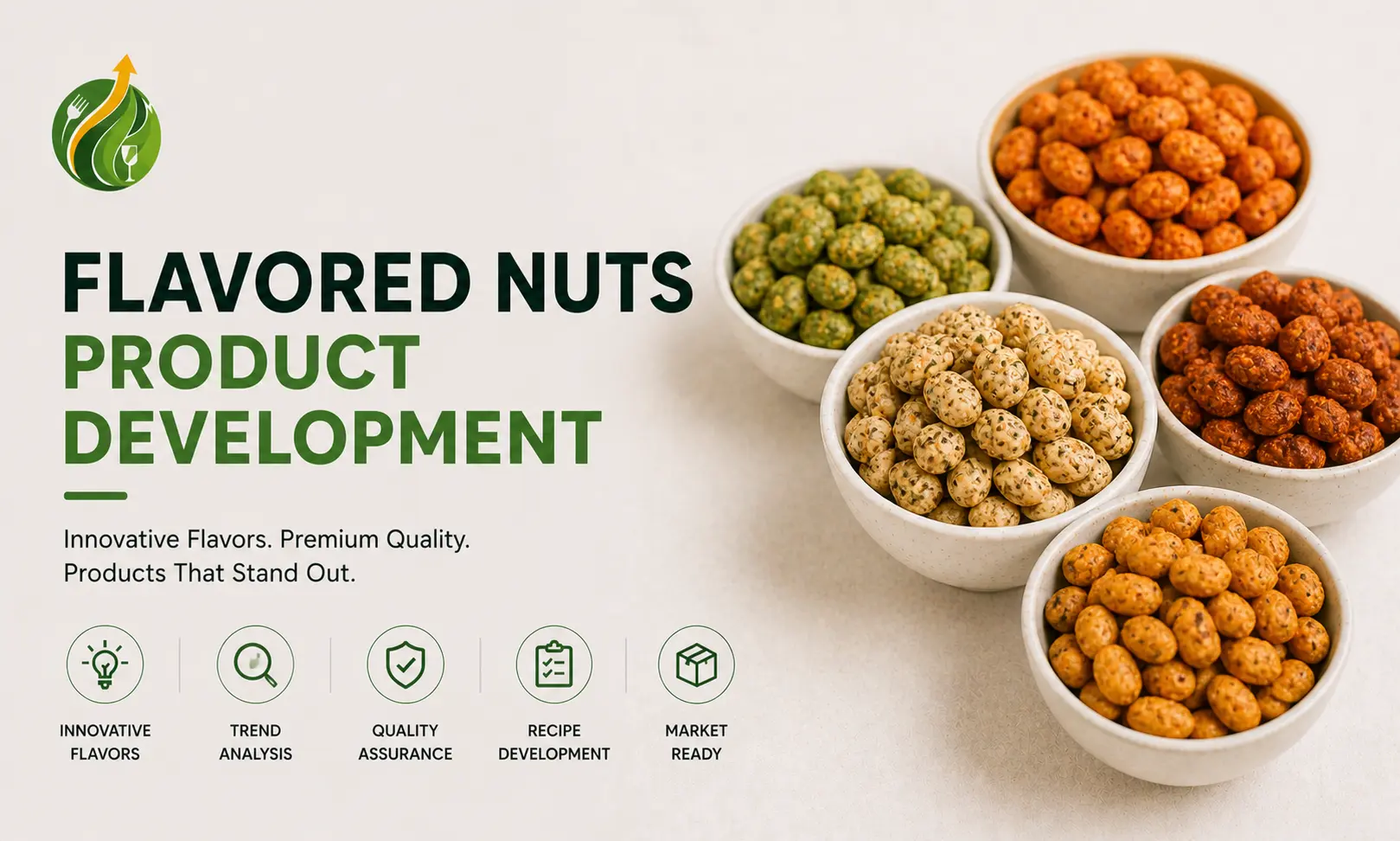
Flavored nuts are one of the most commercially successful product categories in Indian healthy snacking today. From airline lounges to office pantries and Blinkit carts, premium flavored nuts have found their way into everyday consumption occasions that were previously dominated by biscuits, chips, and namkeen.
India’s nuts and dry fruit snack market is growing at a compound annual growth rate of over 10 percent and is expected to cross Rs. 8,000 crore by 2027. Consumer preferences have shifted significantly. People are not just buying raw or salted cashews anymore. They are actively looking for interesting flavor combinations, clean ingredients, premium packaging, and products that justify a higher price point.
This guide is a practical reference for food entrepreneurs, D2C brands, FMCG companies, and investors who want to develop a flavored nuts product in India. It covers the food product development and food formulation process from concept to production, costing, compliance, and what it takes to build a successful brand in this category.
India’s Flavored Nuts Market: Key Numbers
| Metric | Data |
| India Nuts and Dry Fruit Snack Market (2024) | Rs. 5,500 to Rs. 6,000 crore |
| Projected Market Size (2027) | Rs. 8,000+ crore |
| CAGR (2024 to 2027) | 10 to 12 percent |
| Fastest Growing Segment | Flavored premium nuts (cashew, almond, pistachio) |
| Top Sales Channels in 2026 | D2C, Blinkit, Amazon, Modern Trade, Corporate Gifting |
| Average Retail Price (100 gm) | Rs. 120 to Rs. 400 depending on nut type and positioning |
| Peak Season | Diwali, Corporate Gifting Season (Oct to Dec), New Year |
| Dominant Nut Types by Value | Cashew, Almond, Pistachio, Mixed Nuts |
Which Nuts to Build Your Product Around
Each nut type has a different procurement source, cost structure, flavor compatibility, and consumer perception. Understanding this helps you choose the right base for your product.
- Cashew (Kaju): Sourced from Goa, Kerala, Andhra Pradesh and Vietnam/Africa imports. Raw cost Rs. 600 to Rs. 900 per kg. Pairs well with masala, cheese, chocolate, honey flavors. Ideal for premium gifting and daily snacking.
- Almond (Badam): Primarily imported from California. Raw cost Rs. 800 to Rs. 1,200 per kg. Pairs well with honey roast, chili lime, rosemary, BBQ. Best for health and nutrition, office snacking.
- Pistachio (Pista): Imported from Iran and USA. Raw cost Rs. 1,200 to Rs. 2,000 per kg. Best with salted, masala, light flavors. Ultra-premium gifting segment.
- Peanuts (Mungfali): Sourced from Gujarat and Andhra Pradesh. Raw cost Rs. 80 to Rs. 150 per kg. Pairs well with masala, chocolate, pudina, garlic. Best for mass market affordable snacking.
- Walnut: From Jammu & Kashmir, Himachal Pradesh and imports. Raw cost Rs. 600 to Rs. 1,000 per kg. Works well with honey, cinnamon, light spice. Health segment, brain health positioning.
- Mixed Nuts: Blended cost based on mix ratio. Customizable per mix. Ideal for gifting and premium variety packs.
Trending Flavors for Flavored Nuts in 2026
Flavor selection is a strategic decision. It determines your target consumer, competitive positioning, and long-term brand identity. The following categories represent the highest-performing flavor directions in the Indian market as of 2026.
- Classic Indian: Pudina, Chaat, Peri Peri, Tandoori, Chili Lime. Best with Cashew and Peanut. Mass market and family snacking.
- Cheese and Herbs: Cream Cheese, Parmesan Herb, Garlic Cheese, Cheddar Jalisco. Best with Cashew and Almond. Young urban office snacking.
- Sweet and Indulgent: Dark Chocolate, Honey Roast, Cinnamon Sugar, Caramel Sea Salt. Best with Almond, Walnut, Cashew. Premium gifting and dessert occasion.
- Functional and Wellness: Turmeric Black Pepper, Ashwagandha, Himalayan Pink Salt. Best with Almond and Mixed Nuts. Health-conscious 28 to 45 age group.
- International Fusion: Sriracha, Korean BBQ, Truffle, Za’atar. Best with Cashew and Almond. Young D2C consumer and foodie segment.
- Minimalist and Clean: Lightly Salted, Unsalted Natural, Smoked Sea Salt. Works with all types. Keto, diet-conscious, premium positioning.
The Flavored Nuts Product Development Process
Developing a flavored nut product involves several distinct stages. Each stage has its own timeline, cost, and decision points.
Stage 1: Product Concept and Brief (1 to 3 days)
Define your product clearly before approaching any manufacturer. Specify the nut type, target flavor profile, intended pack size, price point, distribution channel, and target consumer. The more specific your brief, the faster and more accurately your R&D partner can develop the product.
Stage 2: Raw Nut Procurement and Grading (5 to 10 days)
Raw nut quality is the foundation of your product. Grade W240 and W320 cashews, Grade 1 almonds, and premium-grade walnuts deliver consistent sizing, even roasting, and the best sensory result. Inconsistent raw material leads to uneven roasting, flavor inconsistency, and high rejection rates in production.
Always ask for a certificate of analysis (COA) for pesticide residues and aflatoxin testing, especially for peanuts and almonds.
Stage 3: Flavor Development and R&D (7 to 14 days)
This is where your product is created. A food scientist or flavor technologist develops the seasoning blend, tests coating adhesion on the roasted nut, calibrates roasting temperature and drum speed, and produces multiple sample iterations.
Key variables include the seasoning application method (dry tumbling, liquid spray, coating), oil type and quantity, salt and spice balance, color of finished product, and flavor intensity after packaging.
Stage 4: Shelf Life and Stability Testing (14 to 30 days)
Nuts are high in natural oils and prone to oxidation. Shelf life testing determines how your product performs over time in different temperature and humidity conditions. The packaging type, oxygen barrier properties of the film, and the use of nitrogen flushing or oxygen scavengers all directly impact shelf life.
Most well-packaged flavored nut products achieve a shelf life of 6 to 12 months. Accelerated shelf life testing (ASLT) gives you a reliable estimate within 2 to 4 weeks.
Stage 5: Packaging and Label Finalization (5 to 10 days)
Packaging material selection is critical for nuts. A good moisture and oxygen barrier is non-negotiable. Common formats include metalized stand-up pouches with zipper, kraft paper laminate pouches for premium or clean-label positioning, rigid boxes for gifting collections, and tins for ultra-premium products.
Your label must carry the FSSAI license number, ingredient list, nutritional information panel, allergen declaration, best before date, batch number, and net weight.
Stage 6: Pilot Batch and Approval (5 to 10 days)
A pilot batch under full production conditions is produced. This is your final approval sample. Check for flavor consistency across pieces, uniform coating, absence of broken or discolored nuts, packaging seal integrity, and seasoning adhesion after 48 hours in closed packaging.
Stage 7: Full Production and Dispatch (7 to 20 days)
After pilot approval, full production begins. A good manufacturing partner provides batch production records, quality check reports, and COA for the finished product with each order.
Cost of Developing a Flavored Nuts Product
| Cost Component | Typical Range | Notes |
| Raw Nut Cost (per kg) | Rs. 80 to Rs. 2,000 per kg | Depends on nut type and grade |
| Manufacturing Cost (per kg) | Rs. 80 to Rs. 200 per kg | Roasting, flavoring, packaging line |
| Minimum Order Quantity | 50 kg to 200 kg per batch | Varies by manufacturer |
| Flavor R&D and Development | Rs. 30,000 to Rs. 1,00,000 | Custom flavor, multiple sample rounds |
| Packaging Design and Print | Rs. 20,000 to Rs. 80,000 | Artwork, print-ready files, first print run |
| Shelf Life Testing | Rs. 10,000 to Rs. 40,000 | NABL lab, per formulation |
| FSSAI Registration | Rs. 5,000 to Rs. 25,000 | Brand and manufacturer both needed |
| Total First Launch Budget (1 SKU) | Rs. 2,00,000 to Rs. 5,00,000 | Approximate all-in for first batch |
FSSAI and Regulatory Requirements
Packaged flavored nuts fall under FSSAI’s regulations for processed foods. Here are the mandatory compliance requirements before you sell a single pack.
- Your brand must have its own FSSAI registration or license. Basic registration covers turnover below Rs. 12 lakh annually. A State License covers Rs. 12 lakh to Rs. 20 crore. A Central License is required above Rs. 20 crore.
- The manufacturing facility must hold a valid and current FSSAI license. Both license numbers must appear on every pack.
- Nutritional information panel showing energy, protein, fat, carbohydrates, sugar, dietary fiber, and sodium per 100 gm and per serving is mandatory.
- Tree nuts (cashew, almond, walnut, pistachio) are recognized allergens under FSSAI. An allergen declaration is mandatory on every label.
- If your product contains peanuts alongside tree nuts, both allergen declarations are required as peanuts and tree nuts are treated as separate allergens.
- Health claims like ‘high protein’ or ‘source of vitamin E’ must meet FSSAI-defined thresholds and must not be misleading.
What Separates Winning Flavored Nut Brands
The flavored nuts market in India has grown significantly, but the gap between average products and excellent ones remains wide. Brands that are growing consistently in 2026 share a few characteristics.
They use genuinely high-quality raw nuts. The difference between W320 and W240 grade cashews is immediately obvious to a consumer. Using better raw material is the single highest-leverage investment in product quality.
Their flavors are distinctive and well-executed. Not just peri peri like everyone else, but a version of peri peri that is noticeably better in heat balance, crunch, and aftertaste. Flavor differentiation is the most common white space in this category.
Their packaging communicates premium quality. In quick commerce and D2C, packaging design drives click-through and initial trial. Clean, minimal, honest design consistently outperforms.
Build a Successful Flavoured Nuts Brand in India
Launching a profitable flavoured nuts brand requires more than attractive packaging. The fastest-growing snack brands focus on strong food formulation, consistent seasoning quality, shelf stability, clean ingredients, and repeat-worthy taste.
At Flavor Catalystz, we help brands with expert food product development support for flavoured nuts, including seasoning formulation, flavor optimization, shelf-life stability, and scalable manufacturing solutions designed for long-term brand growth in India’s competitive snack market.
Frequently Asked Questions
What is the shelf life of flavored nuts?
Most well-packaged flavored nuts have a shelf life of 6 to 9 months with nitrogen flushing and proper metalized packaging. Dark chocolate-coated nuts typically have a shorter shelf life of 3 to 6 months due to fat migration. Shelf life testing from a NABL lab is mandatory before you print any best before date.
Can I develop a flavored nuts product without my own factory?
Yes. Contract manufacturing is the standard model for most Indian flavored nut brands. Your manufacturing partner handles roasting, flavoring, packaging, and quality control. You focus on brand development, marketing, and distribution.
Which nut is most profitable for a flavored nuts business?
Cashew offers the best combination of high perceived premium value, favorable flavor compatibility, and consumer familiarity in India. Almonds have strong health positioning and command premium prices. For mass-market or high-volume products, peanuts offer the lowest raw material cost with strong flavor versatility.
Do I need separate FSSAI licenses for different nut products?
No. Your FSSAI food business operator license covers your brand as a whole, not individual products. You need one license for the brand and the manufacturing facility needs its own separate FSSAI license. Both must appear on your product label.
What certifications help in modern trade listings for flavored nuts?
ISO 22000, HACCP, and GMP certifications for your manufacturing partner are commonly required by modern trade buyers. For export, an APEDA registration and destination-country compliance is needed. Organic certification is increasingly requested by premium domestic buyers and D2C consumers.