Jul 2026 · 10 min read
Extruded snack formulation is the science of choosing ingredient ratios and processing conditions so a starch-and-protein mix cooks, expands, and holds its shape correctly inside an extruder. It combines starch and protein chemistry, moisture control, and precise temperature, pressure, and shear settings across single-screw or twin-screw extrusion equipment. A formulation only counts as “working” if it performs identically in a 5 kg trial batch and a 5,000 kg commercial run.
Walk down any snack aisle and you will see hundreds of crunchy, puffed, curled, and coated shapes — and almost every one of them started as a science problem before it became a flavour. Extruded snack formulation sits exactly where food chemistry meets machine engineering: get the starch-to-protein ratio wrong, or the barrel temperature off by ten degrees, and a product that looked perfect on paper turns out dense, greasy, or stale within days. At Flavor Catalystz, we regularly see founders lose months chasing a “recipe” instead of a formulation, without realising that extrusion behaves nothing like cooking on a stovetop. This guide breaks down how extruded snack formulation actually works — the ingredients that matter, the process itself, the parameters worth watching closely, and the mistakes that quietly sink most first attempts.
What Is Extruded Snack Formulation? Understanding the Basics
Extrusion cooking applies heat, moisture, pressure, and mechanical shear to a raw ingredient mix as it is pushed through a barrel and forced out through a shaped die. Inside the barrel, starch granules gelatinise, proteins denature, and the mixture becomes a viscous, cooked “melt.” The moment this melt exits the die into normal atmospheric pressure, trapped steam flashes off instantly, and the product expands into the light, porous structure we recognise as a puffed or crisp snack.
This is why extrusion is fundamentally a formulation problem rather than a recipe problem. A home recipe tolerates small variations — a formulation cannot. Every ingredient’s starch damage level, protein solubility, particle size, and moisture content changes how the mix behaves under heat and shear, and that behaviour has to be locked down so the product comes out the same way every single time, at any scale.
EXTRUDED SNACK FORMULATION 2026
Develop Market-Ready Extruded Snacks with the Right Formulation
Flavor Catalystz develops extruded snack formulations with optimized ingredient blends, extrusion parameters, texture, expansion, seasoning, shelf life, and commercial manufacturing support.
Key Ingredients in Extruded Snack Formulation and Their Role
Most extruded snacks are built from a handful of functional ingredient categories, each contributing something specific to expansion, texture, nutrition, or flavour. The table below outlines the core building blocks used across corn, rice, potato, multigrain, and high-protein snack formulations.
| Ingredient Category | Common Sources | Function in the Formulation | Typical Inclusion Level |
| Base starch | Corn grits, rice flour, potato starch, tapioca | Provides structure and drives expansion through gelatinisation | 50% – 85% |
| Protein sources | Pea protein, soy protein, whey protein, chickpea flour | Adds nutrition, affects texture and browning, reduces expansion if overused | 5% – 25% |
| Fibre / whole grain | Oat bran, whole wheat, millet, sorghum | Improves nutrition profile, can toughen bite if not balanced | 5% – 20% |
| Fat / oil | Vegetable oil, palm oil alternatives | Lubricates the barrel, carries flavour, affects mouthfeel | 0% – 8% (in-barrel) |
| Sugars / reducing sugars | Dextrose, malt, fruit powders | Supports Maillard browning and flavour development | 0% – 5% |
| Emulsifiers | Mono- and diglycerides | Controls expansion and reduces stickiness in the die | 0.3% – 1% |
| Water | Process water, steam (preconditioning) | Enables starch gelatinisation; the single biggest lever in the formula | 12% – 20% in-barrel |
Of all these variables, moisture content is the one worth the most attention early on. A change of even one or two percentage points in in-barrel moisture can shift a snack from crisp and well-expanded to dense and chewy — long before you touch temperature or screw speed.
The Extrusion Process, Step by Step
Regardless of the final snack shape, most extrusion lines follow a similar sequence of operations:
- Dry mixing / premix: base flours, proteins, and dry additives are blended to a uniform mix.
- Preconditioning (optional): steam and water are added ahead of the barrel to pre-hydrate the mix and improve cook consistency.
- Feeding: the mix is metered into the extruder barrel at a controlled, consistent rate.
- Cooking zone: temperature, pressure, and shear increase along the barrel, gelatinising starch and denaturing protein.
- Die forming: the cooked melt is forced through a shaped die to create the snack’s cross-section.
- Expansion (flash-off): trapped steam releases instantly at the die exit, creating the puffed, porous structure.
- Drying: excess surface moisture is removed to reach a stable final moisture level, usually below 5%.
- Coating and seasoning: oil, salt, spice blends, or sweet coatings are applied, typically in a tumbling drum.
- Cooling and packaging: the finished product is cooled before it enters moisture-barrier packaging.
Each of these steps is a control point. A defect that appears to be a “coating problem” is very often actually a moisture or temperature problem three steps earlier in the line.
Single-Screw vs Twin-Screw Extruders: Which One Fits Your Product?
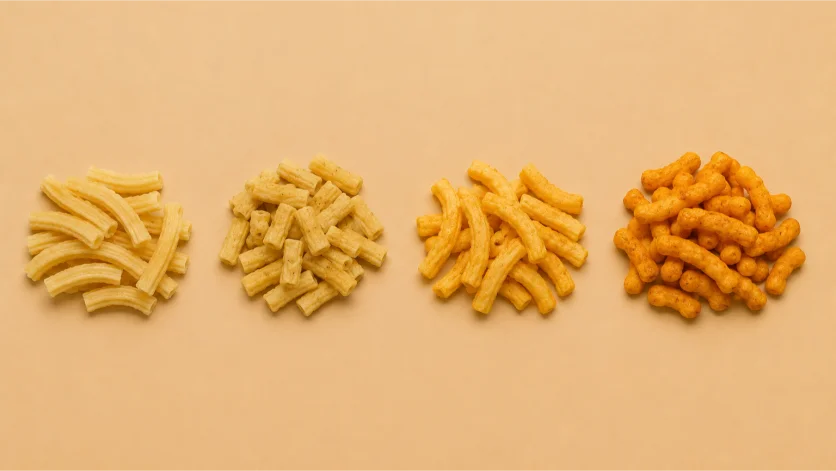
Extruder selection depends heavily on formulation complexity, ingredient variety, and the level of process control the product needs.
| Factor | Single-Screw Extruder | Twin-Screw Extruder |
| Best suited for | Simple corn or cereal-based expanded snacks | Complex, high-fat, high-fibre, or multi-ingredient formulas |
| Ingredient flexibility | Lower; sensitive to fat and moisture variation | Higher; handles wet, sticky, and high-fat mixes reliably |
| Mixing and shear control | Fixed by screw design | Independently adjustable; self-wiping screw elements |
| Capital investment | Lower | Higher |
| Typical applications | Basic puffed corn curls, direct-expanded snacks | High-protein snacks, gluten-free multigrain blends, filled or co-extruded snacks |
As a general rule, single-screw extruders suit high-volume, simple formulations where cost efficiency matters most. Twin-screw systems earn their higher price tag when a formulation includes multiple protein sources, higher fat levels, or ingredients that need precise, independent control over mixing and residence time.
Extrusion Parameters That Control Texture, Expansion, and Crunch
The same ingredient formulation can produce very different snacks depending on how the extruder is run. These ranges are illustrative starting points — actual settings depend on the specific formulation, equipment, and target product, and are typically fine-tuned through trial runs rather than applied as fixed rules.
| Parameter | Typical Range | Effect on the Final Snack |
| Barrel temperature | 120°C – 180°C | Higher temperatures increase expansion but raise the risk of scorching or off-flavours |
| In-barrel moisture | 12% – 20% | Lower moisture generally increases crispness and expansion; too low harms cohesion |
| Screw speed | 200 – 500 rpm | Higher shear refines cell structure but can degrade starch or protein if excessive |
| Die opening diameter | 2mm – 6mm (product-dependent) | Smaller openings typically increase the expansion ratio |
| Feed rate | Product and line specific | Affects residence time in the barrel and final product density |
Formulating for 2026 Snacking Trends: Protein, Clean Label, and Better-for-You
Current demand in the extruded snack category is being driven by a few consistent themes: higher protein content, gluten-free and multigrain blends, lower sugar and fat, and clean-label ingredient lists with fewer synthetic additives. Each of these trends creates a specific formulation challenge rather than a simple ingredient swap. Adding pea or whey protein, for example, changes water absorption and can suppress expansion if the base starch ratio is not adjusted to compensate. Removing synthetic preservatives to meet clean-label expectations often shortens shelf life unless oxidation and moisture barriers are addressed elsewhere in the formulation or the packaging.
This is exactly where formulation work connects to the wider food product development process — trend research, ingredient sourcing, feasibility assessment, and scale-up all need to move together rather than in isolation, or a technically sound formula can still fail commercially.
Common Extruded Snack Formulation Challenges (and Practical Fixes)
Most extrusion defects trace back to a small set of root causes. The table below maps the symptoms teams see most often to their likely cause and a practical first fix to try.
| Problem | Likely Cause | Fix to Try First |
| Dense, hard snack (poor expansion) | Moisture too high, cook temperature too low, or worn die | Reduce moisture by 1–2%, raise cook-zone temperature, inspect die for wear |
| Greasy or oily surface | Fat added too early, or fat level too high in-barrel | Move oil addition to post-extrusion coating; reduce in-barrel fat |
| Inconsistent shape or breakage | Uneven feed rate or die design mismatch | Recalibrate the feeder; review die land length and cutter timing |
| Off or burnt flavour notes | Excess shear or overheating, long residence time | Lower screw speed; review barrel zone temperature profile |
| Short shelf life / staling | Fat oxidation or weak packaging moisture barrier | Review antioxidant strategy and packaging OTR/WVTR specifications |
| Gritty or gummy mouthfeel | Incomplete starch gelatinisation or unsuitable flour blend | Adjust starch-to-protein ratio; trial alternate flour blends |
Taking Your Formulation From Lab Trial to Commercial-Scale Production
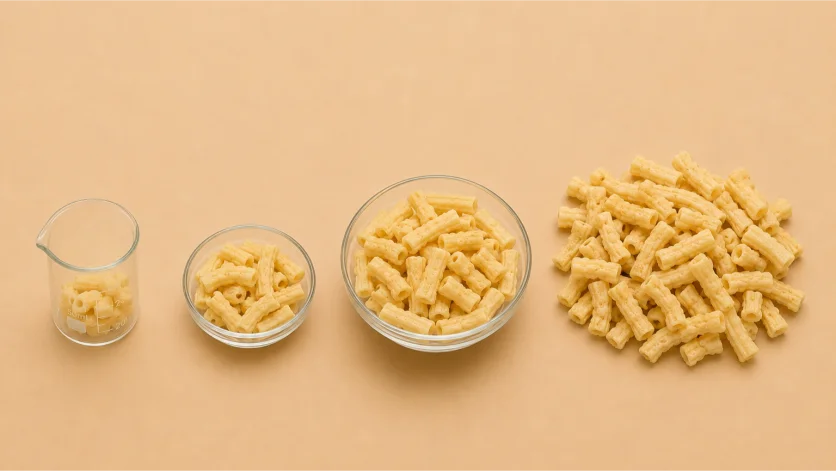
A formulation that performs well on a small lab extruder does not automatically translate to a commercial line. Barrel length-to-diameter ratios, die design, cooling capacity, and even ambient humidity at the factory can all shift outcomes. Scale-up typically involves structured pilot runs, sensory panel evaluation across batches, accelerated shelf-life testing, and finalising labels, nutrition panels, and health claims in line with FSSAI requirements before commercial launch.
Moving a working sample into a repeatable, sellable product is, at its core, a food formulation exercise — locking every ingredient ratio, process parameter, and specification so the product performs identically whether it is batch one or batch one thousand, on the lab extruder or the factory floor.
Bringing It All Together
Getting extruded snack formulation right is rarely about one perfect ingredient swap. It comes down to understanding how starch, protein, moisture, and machine settings interact, and then testing changes deliberately instead of guessing. Whether the goal is refining a classic corn curl or building a high-protein, gluten-free snack from scratch, treating it as a formulation problem — not a recipe — is what separates a product that survives contact with a factory floor from one that does not. Teams like Flavor Catalystz work through exactly this kind of structured trial-and-error on a daily basis, but the core principles above hold true whether the formulation work happens in-house or with outside support.
Frequently Asked Questions
What is extrusion in snack food manufacturing?
Extrusion is a continuous cooking process where a moistened ingredient mix is pushed through a heated barrel under pressure and shear, then forced through a shaped die. Rapid pressure release at the die exit causes the cooked mix to expand into a light, porous snack structure.
What ingredients are used to make extruded snacks?
Most formulations combine a base starch (corn, rice, or potato), a protein source, water, and small amounts of fat, sugar, emulsifiers, and seasoning. The exact ratio depends on the target texture, nutrition profile, and whether the snack needs to be gluten-free or high-protein.
What is the difference between single-screw and twin-screw extruders?
Single-screw extruders are simpler and more cost-effective, suited to basic corn or cereal-based snacks. Twin-screw extruders offer independent control over mixing and shear, making them better suited to complex, high-fat, or high-fibre formulations.
How do you make extruded snacks high in protein?
Protein is typically added as pea, soy, whey, or chickpea flour, replacing part of the base starch. Because protein absorbs water differently than starch and can suppress expansion, moisture levels and cook temperature usually need re-balancing to maintain texture.
Can extruded snacks be made gluten-free?
Yes. Corn, rice, tapioca, chickpea, and pulse-based flours are commonly used for gluten-free extruded snacks. Starch gelatinisation behaves differently without gluten’s binding structure, so formulations are usually adjusted for starch damage and moisture to maintain cohesion.
What causes poor expansion in extruded snacks?
Poor expansion is most often caused by excess in-barrel moisture, insufficient cook temperature, high fat or fibre levels, or a worn die. Reviewing moisture and temperature settings together is usually the fastest way to diagnose the issue.
How long is the shelf life of extruded snacks?
Shelf life typically ranges from three to nine months, depending on fat content, packaging barrier properties, and whether antioxidants or clean-label alternatives are used to slow oxidation. Higher-fat and clean-label formulations generally need stronger packaging barriers to compensate.
How much does it cost to formulate and manufacture extruded snacks in India?
Formulation development costs vary widely based on complexity, number of trial iterations, and lab versus pilot-scale testing required, while commercial manufacturing costs depend on contract manufacturer rates, batch size, and packaging format. Early-stage brands typically benefit from a feasibility and costing exercise before committing to full-scale production.