May 2026 · 10 min read
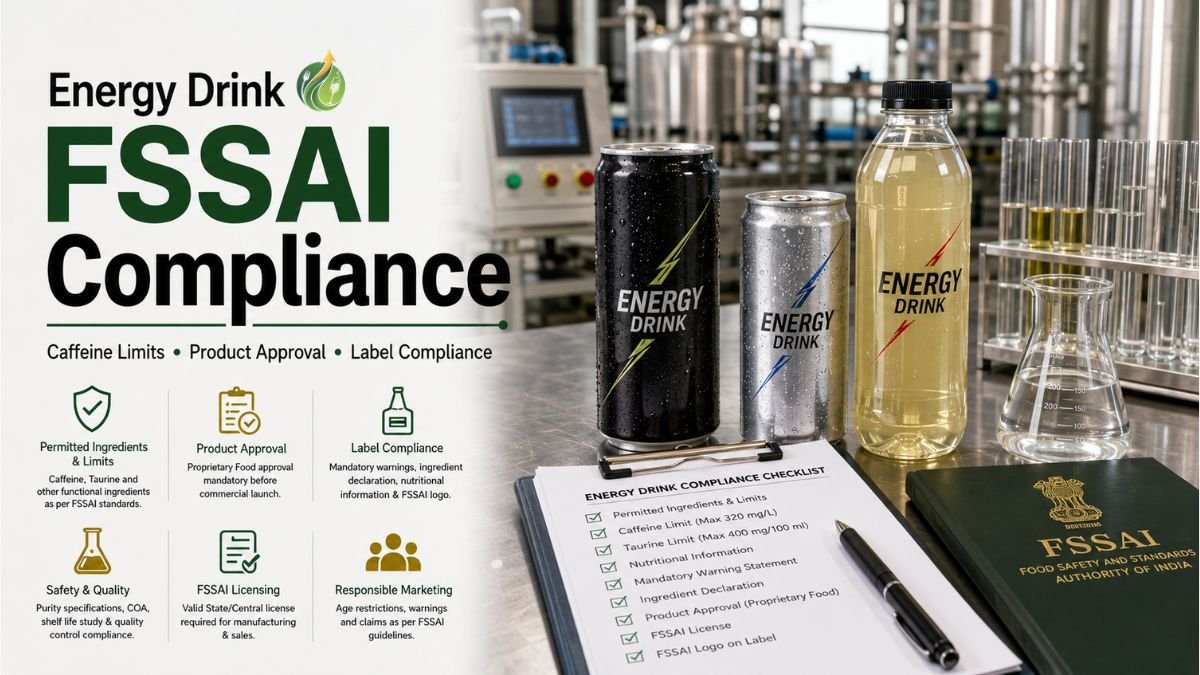
Energy drinks are one of the fastest-growing beverage categories in India. With brands like Red Bull, Monster, Sting, and a growing wave of Indian challengers competing in this space, the market is expanding rapidly. But energy drinks are also one of the most regulated beverage categories under FSSAI — and one of the most common areas where new brands make costly compliance mistakes.
If you are developing an energy drink brand in India, understanding FSSAI compliance is not optional, and it is not something to figure out after formulation. The regulatory framework defines what you can put in your product, how much of it you can use, what you must say on the label, and who you can sell it to.
This guide covers everything you need to know about energy drink FSSAI compliance in 2026 — from permitted ingredients and caffeine limits to product approval, label requirements, and the common pitfalls that delay launches.
How FSSAI Classifies Energy Drinks
Under Indian food law, energy drinks are classified as “Proprietary Food” under the Food Safety and Standards (Food Products Standards and Food Additives) Regulations. This classification applies to any food or beverage that does not conform to a standard specified elsewhere in FSSAI regulations — and energy drinks, with their specific functional ingredient combinations, fall squarely in this category.
The proprietary food classification has two critical implications:
- Product approval is mandatory. Unlike standard fruit juices or carbonated beverages, energy drinks require a specific product approval from FSSAI before they can be manufactured and sold. This is in addition to (not instead of) your standard FSSAI business licence.
- You must adhere to FSSAI’s energy drink-specific ingredient limits. FSSAI has issued specific guidance on permitted ingredients and their maximum levels in energy drinks. These are not suggestions — they are regulatory limits.
Flavor Catalystz
Need help making your energy drink FSSAI compliant?
From caffeine limits and ingredient review to product approval and warning label compliance — we help founders launch energy drinks without regulatory mistakes.
FSSAI Permitted Ingredients in Energy Drinks: What’s Allowed
FSSAI’s regulations for energy drinks permit the following functional ingredients within defined limits:
Caffeine
Maximum permitted level: 320 mg/litre (approximately 80mg per 250ml can)
This is one of the most important numbers in energy drink FSSAI compliance. Red Bull’s standard 250ml can contains 80mg — right at the per-serving limit calculated from this standard.
Sources of caffeine: Natural caffeine (from coffee, tea, guarana, kola nut) or synthetic caffeine — both are permitted, but the source must be declared on the label.
Important: The 320mg/litre limit applies to the total caffeine content, including caffeine from all sources in the formulation (caffeine from guarana + added caffeine, for example, must not collectively exceed this limit).
Taurine
Maximum permitted level: 400 mg per 100ml (4,000 mg/litre)
Taurine is an amino acid commonly included in energy drinks for its purported performance and endurance benefits. A standard 250ml can typically contains 1,000mg — within the FSSAI permitted limit.
Glucuronolactone
Maximum permitted level: 2.4 mg per ml (2,400 mg/litre)
Used in many international energy drink formulations. Permitted under FSSAI within the stated limit.
B Vitamins
B vitamins (B3/Niacin, B5/Pantothenic acid, B6, B12) are commonly included in energy drink formulations. FSSAI permits their addition as per the Food Fortification Regulations, with maximum levels specified per vitamin.
Inositol
Permitted as a functional ingredient in energy drinks. Typical inclusion rate in international formulations is 50mg per 250ml.
Guarana Extract
Permitted as a natural caffeine source. The caffeine contribution from guarana must be counted toward the total caffeine limit of 320mg/litre.
Ginseng Extract
Permitted as a herbal functional ingredient. No specific FSSAI maximum limit published — must be included at safe and customary levels with supporting safety data.
What is NOT Permitted
The following are commonly found in international energy drinks but require careful FSSAI review:
- Ephedrine / Synephrine: Not permitted in food products in India
- Yohimbine: Regulatory status uncertain — requires product approval review
- High-dose amino acid combinations: Novel amino acids or unusual combinations require safety data submission
- Adaptogens at pharmacological doses: Ashwagandha, tulsi at high doses cross into Ayurvedic medicine territory and require separate regulatory pathway
If you are considering any ingredient not clearly listed in FSSAI’s permitted additives schedule, treat it as requiring product approval review before including it in your formulation.
FSSAI Energy Drink Product Approval Process
Since energy drinks are classified as proprietary food, a product approval application must be filed with FSSAI through the FoSCoS portal. This is a mandatory step before commercial launch.
What the Application Requires
Product details:
- Complete product formulation (all ingredients with percentage/quantity)
- Proposed product name and description
- Product category
- Proposed label (draft)
Technical documentation:
- Specification of each functional ingredient (purity, source, supplier)
- Certificate of Analysis (CoA) for each ingredient
- Safety data for any novel or unusual ingredient
- Nutritional composition analysis
- Proposed shelf life and basis for shelf life claim
Manufacturing details:
- Manufacturing process description
- Quality control measures
- Manufacturer details and FSSAI licence
For novel ingredients or unusual formulations, FSSAI may require:
- Toxicological safety data
- Clinical/human safety data
- Literature review on safety at the proposed inclusion level
Timeline
Product approval timelines vary significantly — from 2–3 months for straightforward formulations to 6–12 months for novel ingredient combinations requiring committee review. Plan your launch timeline accordingly.
Mandatory FSSAI Label Requirements for Energy Drinks
Energy drink labelling in India is more strictly regulated than most beverage categories. Every energy drink label must include:
Standard Mandatory Elements (All Beverages)
- Product name
- Ingredient list (descending by weight, with all functional ingredients declared)
- Nutritional information per 100ml AND per serving (with serving size stated)
- Net volume
- Manufacturer’s name and address
- FSSAI licence number (14 digits)
- Best before date
- Batch/lot number
- Vegetarian symbol (green dot — energy drinks are typically vegetarian unless animal-derived taurine is used)
Energy Drink-Specific Mandatory Warnings
These are non-negotiable and must appear on every energy drink label sold in India:
Warning 1 — Caffeine disclosure:
“Contains caffeine: [X] mg per [serving size]”
The exact caffeine content per serving must be declared. This is mandatory, not optional.
Warning 2 — Not suitable for vulnerable groups:
“Not suitable for children, pregnant women, and persons sensitive to caffeine”
This warning must appear prominently on the label.
Warning 3 — Age restriction:
“Not for sale to persons below 18 years”
Warning 4 — Consumption guidance:
“Consume in moderation” or equivalent language advising against excessive consumption.
Font and placement: Warning statements must be in a legible font size (minimum 1.5mm character height per FSSAI labelling regulations) and placed prominently — not buried in fine print.
Nutritional Declaration Specifics for Energy Drinks
The nutritional panel must declare:
- Energy (kcal and kJ)
- Protein
- Carbohydrates (including sugars)
- Total fat
- Sodium
- All declared functional ingredients (caffeine, taurine, B vitamins, etc.) with per-serving quantity
A common mistake is declaring functional ingredients in the ingredient list but not in the nutritional panel. Both declarations are required.
Energy Drink Formulation Considerations for FSSAI Compliance
Getting the formulation right from a compliance perspective means more than just staying within ingredient limits. Here is what experienced beverage formulators consider:
Total caffeine calculation: If using guarana (which contains caffeine), the caffeine contribution from guarana must be added to any directly added caffeine. The combined total must not exceed 320mg/litre. Many founders miss this and unknowingly exceed the limit.
Taurine source: Synthetic taurine and naturally derived taurine are both permitted. Synthetic is more commonly used in commercial energy drinks for consistency and cost. If your brand claims “natural ingredients,” the taurine source matters for label claims.
Sugar and calorie content: FSSAI does not restrict sugar in energy drinks specifically, but “low calorie” or “sugar-free” claims trigger additional requirements. If making these claims, ensure the formulation meets FSSAI’s threshold definitions and the nutritional panel accurately reflects the claimed status.
Carbonation: Most energy drinks are carbonated. Carbonation levels (CO₂ volume) must be within the range appropriate for your packaging. This affects both consumer experience and packaging specification.
Colour and flavour: Use only FSSAI-permitted synthetic food colours and flavours (natural or artificial as declared). Several colours permitted in other markets are not on India’s permitted list — verify against the current FSSAI Food Additives schedule.
Our energy drink formulation guide covers the technical formulation side in detail. Our beverage formulation service helps brands build FSSAI-compliant energy drink formulations from the ground up.
Energy Drink Distribution and Retail Compliance
Beyond product approval and labelling, energy drink brands need to understand channel-specific compliance requirements:
E-commerce: Platforms like Amazon and Flipkart require FSSAI product approval documentation and compliant labels before listing. Age verification requirements (not sold to under-18) must be implemented in the listing.
Modern trade: Large format retailers often have their own vendor compliance requirements on top of FSSAI — specific nutritional data formats, supplier audit requirements, and sometimes their own energy drink category policies.
Vending machines and open retail: Some state governments have issued guidelines restricting sale of energy drinks to minors in specific settings. Stay updated on state-level regulations relevant to your distribution geography.
Building an FSSAI-Compliant Energy Drink Brand
Navigating FSSAI compliance for an energy drink is genuinely more involved than it is for most other beverage categories. The proprietary food classification, specific ingredient limits, mandatory product approval, and strict labelling requirements create a compliance workload that is easy to underestimate.
But getting it right is entirely achievable — and the brands that invest in compliance early are the ones that build sustainable market positions. A regulatory rejection or product recall is far more expensive than getting professional guidance upfront.
At Flavor Catalystz, our beverage consultant team works with energy drink founders through every stage of the compliance process — from formulation review against FSSAI ingredient limits to product approval documentation and label sign-off.
Get in touch today — and build your energy drink brand on a solid regulatory foundation.
FAQs
What is the caffeine limit for energy drinks in India as per FSSAI?
FSSAI permits a maximum of 320mg of caffeine per litre in energy drinks — equivalent to approximately 80mg per 250ml serving. This includes caffeine from all sources in the formulation (added caffeine + caffeine from guarana or other natural sources).
Do I need FSSAI product approval for an energy drink?
Yes. Energy drinks are classified as proprietary food under FSSAI regulations, which means product-level approval is mandatory in addition to your standard FSSAI business licence. Launching without product approval is a significant regulatory violation.
Is taurine permitted in energy drinks in India?
Yes. FSSAI permits taurine in energy drinks at up to 400mg per 100ml (4,000mg per litre). A standard 250ml can with 1,000mg of taurine is within this limit.
What warnings must appear on an energy drink label in India?
Mandatory warnings include: caffeine content per serving, “not suitable for children, pregnant women, and persons sensitive to caffeine,” “not for sale to persons below 18 years,” and consumption moderation guidance.
How long does FSSAI energy drink product approval take?
Typically 2–6 months for standard formulations. Novel ingredients or unusual combinations requiring committee review can take longer. Plan your product launch timeline with this in mind.
Can I sell an energy drink without FSSAI approval while the approval is in process?
No. Selling a proprietary food product without FSSAI product approval is a violation of the Food Safety and Standards Act. Do not launch commercially until approval is in hand.
What happens if my energy drink exceeds the caffeine limit?
Products exceeding FSSAI’s permitted caffeine limit cannot be sold legally in India. If a product in the market is found to be non-compliant, it can be recalled and the manufacturer faces regulatory action. Caffeine content must be verified by third-party lab testing.
Can I use adaptogens like ashwagandha in an energy drink?
Adaptogenic ingredients like ashwagandha at low, food-safe inclusion levels can be included, but the regulatory pathway is complex. High-dose adaptogens may fall under AYUSH/Ayurvedic medicine regulations rather than FSSAI food regulations. Seek specific guidance before including novel botanical ingredients.