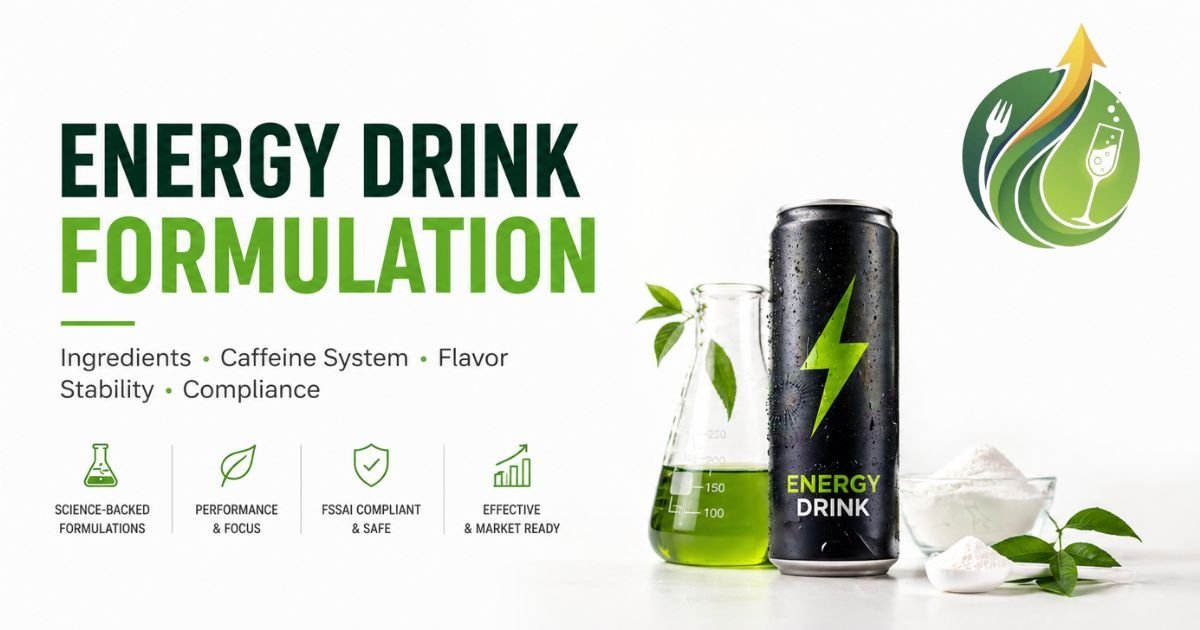
Apr 2026 · 12 min read
Introduction: Why Energy Drink Formulation Is More Than Just Mixing Ingredients
The energy drink market in India is exploding. From gym bags to office desks, from Tier 1 cities to Tier 3 towns — the can of energy has become a daily ritual. But here’s what most people don’t see: behind every can that actually works and actually sells, there’s a precise, science-backed energy drink formulation process.
If you’re a brand founder, a startup in the beverage space, or a manufacturer looking to launch your own energy drink — you’ve likely asked: “Where do I even begin?”
This guide covers everything — ingredients, functional systems, flavor strategies, regulatory compliance, and the step-by-step process to take your energy drink from idea to shelf. And we’re not just giving you surface-level advice. We’re giving you what competitor blogs won’t: the actual formulation logic behind a drink that performs AND sells.
What Is Energy Drink Formulation?
Energy drink formulation is the systematic process of selecting, combining, and optimizing ingredients to create a beverage that delivers consistent energy, mental alertness, and physical performance — while tasting great, staying shelf-stable, and meeting food safety standards.
Unlike making a simple juice or flavored water, energy drink formulation involves balancing multiple functional systems simultaneously:
- Stimulant system (caffeine, guarana, green tea extract)
- Amino acid system (taurine, L-carnitine, L-theanine)
- Vitamin and mineral system (B-vitamin complex, electrolytes)
- Flavor and sensory system (masking bitterness, building profile, carbonation balance)
- Preservation and stability system (pH control, antioxidants, shelf life)
Getting even one of these wrong can result in a product that tastes bitter, loses efficacy, or fails regulatory review. That’s exactly why professional energy drink formulation expertise matters.
Core Ingredients in Energy Drink Formulation
1. Caffeine — The Primary Stimulant
Caffeine is the non-negotiable anchor of any energy drink. It blocks adenosine receptors in the brain, reducing fatigue and increasing alertness. In commercial energy drink formulation:
- Typical dosage: 80–150 mg per 250 ml serving
- India (FSSAI) limit: 145 ppm (approximately 145 mg/L)
- Sources used: Anhydrous caffeine, guarana extract, green tea extract
The key formulation challenge with caffeine is bitterness masking — at effective doses, caffeine imparts a sharp, bitter taste that requires careful flavor engineering to neutralize.
2. Taurine — The Synergistic Amino Acid
Taurine is one of the most misunderstood energy drink ingredients. It’s not a stimulant — it’s an amino acid that supports neurological function, regulates mineral balance in the blood, and reduces oxidative stress from exercise. When paired with caffeine, taurine creates a smoother, more sustained energy experience with fewer jitters.
- Typical dosage: 500–2000 mg per 250 ml
- Function: Neuroprotection, electrolyte regulation, anti-fatigue
- Formulation note: High taurine concentrations can affect taste balance — dosing precision matters
3. B-Vitamin Complex
B vitamins don’t directly create energy — but they are critical cofactors in converting macronutrients (carbs, fats, proteins) into usable cellular energy (ATP). Any energy drink formulation targeting a “functional” or “wellness” positioning must include an optimized B-vitamin stack.
| Vitamin | Function | Typical Dosage |
|---|---|---|
| B3 (Niacin) | Energy metabolism | 10–20 mg |
| B5 (Pantothenic Acid) | Hormone & energy synthesis | 2–5 mg |
| B6 (Pyridoxine) | Protein & glucose metabolism | 1–5 mg |
| B12 (Cobalamin) | Red blood cell & nervous system | 1–5 mcg |
Formulation caution: Excessive B-vitamin dosing (especially B3) can cause “niacin flush” — a harmless but uncomfortable skin-tingling reaction that consumers often misattribute to the drink. Balance is essential.
4. Sweeteners and Sugar Systems
This is where the “healthy energy drink” debate lives. Your formulation options:
- High-sugar (sucrose/glucose): Fast energy, familiar taste, but increasingly rejected by health-conscious consumers
- Zero-sugar (sucralose, stevia, erythritol): Clean label friendly, but requires careful flavor masking to avoid aftertaste
- Hybrid (low-sugar + stevia blend): Best of both — growing trend in 2025 Indian market
For premium brand positioning, a stevia + erythritol blend gives natural sweetness credentials without sacrificing taste.
5. Herbal and Functional Extracts
This is where your energy drink formulation can truly differentiate:
- Guarana: Natural caffeine source, slower release, trending in “natural energy” category
- Ginseng: Adaptogen, anti-fatigue, premium positioning
- Green Tea Extract: EGCG + natural caffeine, wellness crossover appeal
- L-Theanine: Pairs with caffeine for calm-focus (no jitters), huge trend in 2025
- Ashwagandha: Adaptogenic, stress-relief angle, India-specific brand story opportunity
The 6-Step Energy Drink Formulation Process
Step 1: Define Your Functional Objective
Before touching a single ingredient, answer: What is this drink supposed to do?
- Instant energy spike for athletes?
- Sustained focus for professionals?
- Pre-workout performance?
- Clean/natural daily energy?
Your functional objective determines your ingredient ratios, caffeine levels, sweetener choice, and ultimately, your flavor direction.
Step 2: Select and Source Ingredients
Once the objective is clear, source food-grade, FSSAI-compliant raw materials. Key sourcing decisions:
- Natural vs. synthetic caffeine (affects label claims and price)
- Domestic vs. imported taurine (stability and cost implications)
- Permitted vs. non-permitted extracts under FSSAI regulations
Pro tip: Always get Certificate of Analysis (CoA) from ingredient suppliers. Inconsistent raw material quality is one of the leading causes of batch-to-batch variation in commercial energy drinks.
Step 3: Base Formula Development
This is the R&D core — creating the starting ratio of all ingredients. A typical base formula for a 250 ml energy drink would establish:
- Caffeine content (mg)
- Taurine-to-caffeine ratio
- B-vitamin dosage stack
- pH target (typically 3.2–3.8 for stability and taste)
- Carbonation level (volumes of CO2)
- Sweetness level (Brix value)
The formula is developed iteratively, adjusting ratios based on lab analysis and sensory feedback.
Step 4: Flavor Development and Sensory Optimization
This is where flavor expertise becomes a competitive advantage — and where most DIY formulation attempts fail.
Energy drink bases are inherently harsh. Caffeine is bitter. Taurine has a slight sulphuric note at high doses. B vitamins can be earthy. Getting all of these to disappear into a clean, delicious flavor profile requires:
- Bitterness masking agents: Specific flavor compounds that bind to bitter receptors
- Flavor building: Top notes (citrus, berry), mid notes (sweetness layer), base notes (mouthfeel)
- Mouthfeel engineering: Carbonation level, viscosity adjustment
- Aftertaste control: Critical for zero-sugar variants using stevia
Popular flavor profiles in the Indian energy drink market (2025):
- Citrus Burst (lemon-lime)
- Tropical Fusion (mango-pineapple)
- Berry Storm (mixed berry)
- Watermelon Mint
- Green Apple (fastest growing in D2C segment)
Step 5: Stability Testing and Shelf Life
A great-tasting energy drink formula on Day 1 means nothing if it degrades in 3 months. Stability testing checks:
- Physical stability: No precipitation, layer separation, or color change
- Chemical stability: Vitamin degradation, pH drift, oxidation of sensitive compounds
- Microbial stability: No yeast/mold growth (critical for non-preservative formulations)
- Sensory stability: Does it taste the same at Month 1 vs. Month 12?
FSSAI requires shelf life validation before product launch. Accelerated stability testing (at elevated temperature and humidity) can compress this timeline from 12 months to 6–8 weeks.
Step 6: Regulatory Compliance and Scale-Up
Once formulation is locked, the path to market requires:
- FSSAI Product Approval — Energy drinks fall under a specific functional food category with defined ingredient limits
- Nutritional Label Compliance — Caffeine must be declared; “high caffeine content” warning may be required
- Scale-Up Trials — Lab formula must translate consistently to pilot batches (500L–1000L)
- Manufacturing Partner Selection — Third-party manufacturers (co-packers) must have FSSAI-licensed facilities
15 Process Step of Energy Drink Recipe Formulation with Flavor Catalystz
| Stage | Process Step | Details |
|---|---|---|
| 1 | Initial Consultation | Understanding brand vision, target audience, and functional goals for the energy drink formulation. |
| 2 | Market Research & Trend Analysis | Evaluating Indian and global functional energy drinks trends, competitor benchmarking, and ingredient innovation. |
| 3 | Concept Development | Defining USP, flavour profile, health positioning, and structuring the initial energy drink formula. |
| 4 | Regulatory & Compliance Check | Ensuring compliance with FSSAI, FDA, EFSA, and export regulations for smooth approvals. |
| 5 | Ingredient Selection | Selecting premium energy drink ingredients such as caffeine sources, taurine, BCAAs, ginseng, guarana, stevia, monk fruit, and other power drink ingredients. |
| 6 | Recipe Formulation & Lab Trials | Conducting energy drink lab trial batches to develop and optimise the energy drink recipe formulation for taste, carbonation, and stability. |
| 7 | Prototyping & Sensory Evaluation | Testing flavour balance, aroma, mouthfeel, and energy impact for consumer acceptance. |
| 8 | Shelf-Life & Stability Testing | Validating pH balance, microbial safety, oxidation control, and long-term storage stability. |
| 9 | Packaging & Label Development | Designing cans or bottles, nutritional panels, and compliant labelling for commercial launch. |
| 10 | Regulatory Documentation & Certification | Preparing approval documentation, nutritional claims, and safety certifications. |
| 11 | Pilot Batch Production | Small-scale runs to test scalability before full energy drink manufacturing. |
| 12 | Quality Control & Sensory Validation | Ensuring consistency in taste, carbonation, colour, and label accuracy across batches. |
| 13 | Commercial Scale Production Setup | Coordinating contract manufacturers or third-party energy drink manufacturing in India for mass production. |
| 14 | Market Launch & Distribution Strategy | Planning retail, D2C, e-commerce, pricing, and sales strategy. |
| 15 | Post-Launch Support & Optimisation | Monitoring feedback, refining the energy drink formula, and planning product expansion. |
Energy Drink Flavor Development: The Flavor Catalystz Advantage
At Flavor Catalystz, we approach energy drink flavor development differently. Most flavor houses hand you a catalog of off-the-shelf flavors. We engineer the flavor around your formulation — not the other way around.
Here’s what that means in practice:
Problem: Your caffeine dosage is 120 mg per can. At that level, bitterness will dominate any light citrus flavor.
Flavor Catalystz approach: We build your citrus profile with specific bitterness-masking accords layered in, so the end consumer never perceives the caffeine — just the taste.
Problem: You’re using stevia as your sweetener. Stevia’s classic metallic/licorice aftertaste will clash with your berry flavor.
Flavor Catalystz approach: We formulate a custom stevia-compatible berry profile with top-note boosters that shorten aftertaste perception time by 40–60%.
Whether you’re building a high-caffeine pre-workout drink, a clean-label natural energy variant, or a nootropic-functional beverage — your flavor is your brand’s first impression. We make sure it’s unforgettable.
FSSAI Regulations for Energy Drink Formulation in India
If you’re launching in India, regulatory compliance is non-negotiable. Key FSSAI guidelines for energy drinks:
- Caffeine limit: Maximum 145 ppm (145 mg per liter)
- Taurine: Permitted as a food additive; quantity must be declared
- B vitamins: Must not exceed safe upper limits; specific vitamins require declaration
- Label requirements: Caffeine quantity on label; advisory for pregnant women and children
- Prohibited ingredients: Several herbal extracts and nootropics not yet approved under FSSAI — always verify before formulating
Non-compliance can result in product recall, manufacturing halt, or import bans. Build regulatory review into your formulation process from Day 1.
Common Energy Drink Formulation Mistakes to Avoid
1. Ignoring bitterness at functional doses Most first-time formulators underestimate how harsh caffeine tastes at 100+ mg. Never evaluate your flavor at caffeine-free concentrations.
2. Skipping stability testing A formula that looks and tastes great in a glass beaker will behave very differently inside a sealed aluminum can at 40°C over 12 months.
3. Over-dosing B vitamins for “health halo” Excessive niacin causes flush reactions. Excessive B12 adds cost with no consumer-perceivable benefit. Dose for function, not marketing.
4. Choosing flavor before finalizing formula Flavor development must happen after your ingredient matrix is locked. Changing caffeine levels after flavor development means starting over.
5. Skipping pilot batches Lab-scale and commercial-scale behave differently. Carbonation, pH, and flavor intensity all shift during scale-up. Pilot trials are not optional.
Energy Drink Formulation Cost in India: What to Expect
Custom energy drink formulation costs depend on complexity, ingredient quality, and number of iterations. Here’s a realistic framework:
| Stage | Cost Range (INR) |
|---|---|
| Initial formulation + 3 iterations | ₹1.5L – ₹3L |
| Stability testing (accelerated) | ₹50K – ₹1.5L |
| Pilot batch (500L) | ₹2L – ₹5L |
| FSSAI product registration | ₹25K – ₹1L |
| Flavor development (custom) | ₹75K – ₹2L |
Total realistic investment for a market-ready custom energy drink: ₹5L – ₹12L depending on complexity, number of SKUs, and speed to market requirements.
Conclusion: Your Energy Drink Starts With the Right Formulation Partner
An energy drink that sells isn’t lucky — it’s engineered. From the precise caffeine-taurine balance that delivers results to the flavor architecture that makes consumers reach for a second can, every element of a successful energy drink is the product of deliberate, expert formulation.
At Flavor Catalystz, we bring deep beverage R&D expertise and custom flavor development capability together under one roof. Whether you’re a first-time brand founder or an established manufacturer looking to innovate, we’re your formulation partner from Day 1.
Ready to build your energy drink?
Get in touch with the Flavor Catalystz team — and let’s start with the science that sells.
Frequently Asked Questions
Q1. What is the maximum caffeine allowed in energy drinks in India?
FSSAI permits a maximum of 145 ppm (145 mg per liter) of caffeine in energy drinks.
Q2. Is taurine safe to use in energy drink formulation?
Yes. Taurine is a naturally occurring amino acid and is approved by FSSAI. Standard safe dosage in beverages is 500–2000 mg per 250 ml serving.
Q3. Can I make a zero-sugar energy drink that still tastes good?
Absolutely — but it requires careful flavor engineering. Stevia-based zero-sugar drinks need specific flavor masking to eliminate aftertaste. That’s a specialty area where Flavor Catalystz excels.
Q4. How long does energy drink formulation take from concept to shelf?
Typically 6–12 months — including formulation development (2–3 months), stability testing (2–3 months), regulatory approvals (2–4 months), and manufacturing setup.
Q5. Do I need FSSAI approval before launching my energy drink?
Yes. Energy drinks are a regulated category under FSSAI. You need product registration and label approval before commercial sale in India.
Q6. What’s the difference between an energy drink and a sports drink formulation?
Energy drinks primarily focus on stimulation (caffeine, taurine, B vitamins). Sports drinks focus on hydration and electrolyte replacement. Some functional beverages combine both — these are called “hybrid performance drinks.”
Q7. Can I use natural caffeine sources instead of synthetic caffeine?
Yes. Guarana extract, green tea extract, and yerba mate are natural caffeine sources. They provide slower caffeine release and qualify for “natural energy” label claims — a growing market preference.
Q8. How do I prevent my energy drink from tasting bitter?
Bitterness masking is achieved through specific flavor compounds, sweetener optimization, pH adjustment (slightly lower pH can reduce perceived bitterness), and carbonation levels. Professional flavor development is the most effective solution.
Q9. What’s the minimum batch size for pilot testing an energy drink?
Typical pilot batches start at 200–500 liters. This is enough to conduct meaningful stability testing and sensory panels without committing to full commercial production costs.
Q10. Does Flavor Catalystz offer custom energy drink flavor development?
Yes. We specialize in developing custom flavor systems specifically engineered for energy drink matrices — accounting for caffeine bitterness, sweetener systems, and functional ingredient interactions. Contact us to discuss your project.