Jul 2026 · 9 min read
Pick up any energy bar and read the label. Oats, honey, a few nuts, maybe some protein powder. It looks like a simple snack. But turning that short ingredient list into a bar that tastes fresh for months, survives a hot delivery bag, and passes every food safety check is not simple at all. That is what energy bar formulation really means — and it is the difference between a bar that sells once and a bar that builds a loyal customer.
This guide explains energy bar formulation in plain language: what goes into a bar, how it is made, why bars go hard or stale, and what it actually costs to build one in India. Whether you are a food entrepreneur planning your first launch or simply curious how your favourite snack is made, you will understand the full picture by the end. At Flavor Catalystz, our food R&D team formulates energy bars for brands every month, and this guide is built on what we have learned from real product trials — not just theory.
What Is Energy Bar Formulation?
Energy bar formulation is the process of combining ingredients in exact, tested amounts so that every bar you make — batch after batch — has the same taste, texture, and nutrition. It is different from a home recipe. A recipe only needs to work once, for one cook, in one kitchen. A formulation needs to work the same way a thousand times, in every season, in a real factory.
Energy bar ingredients have to behave predictably together, or the bar falls apart, tastes different from batch to batch, or goes stale too early. This is why energy bar formulation is treated as a science, not just cooking. It is one part of the wider world of food formulation, where the same care with ingredient ratios and testing applies across snacks, drinks, and dairy products too.
Ready to Launch Your Own Energy Bar Brand?
At Flavor Catalystz, we help startups and food brands develop high-performance energy bars with customized formulations, ingredient optimization, protein and fiber balancing, texture development, shelf-life testing, packaging guidance, and commercial-scale manufacturing support.
What Goes Into an Energy Bar? The Four Building Blocks
Almost every energy bar is built from four simple building blocks. Each one does a different job, and getting the balance right is what makes formulation tricky.
| Building Block | What It Does | Common Ingredients |
| Base (structure) | Gives the bar its bite and shape | Oats, puffed rice, puffed quinoa, millet flakes, seeds |
| Binder | Holds everything together | Honey, date syrup, brown rice syrup, nut butter, coconut oil |
| Protein | Adds nutrition and affects texture | Whey protein, milk protein, soy or pea protein |
| Flavour | Gives the bar its taste | Cocoa, dried fruit, spices, natural flavours |
The binder is usually the trickiest part. Too little, and the bar crumbles when you bite into it. Too much, and it turns sticky or leaks through the wrapper on a warm day. Getting this one ratio right is often the difference between a bar that feels premium and one that feels homemade.
How Are Energy Bars Made? Baked vs Cold-Pressed vs Extruded
There are three common ways to make an energy bar, and the choice changes how the bar feels, how long it lasts, and how much equipment you need to get started.
| Method | How It Works | Best For |
| Cold-pressed (no-bake) | Ingredients are mixed cold and pressed into shape | Raw, clean-label, date-and-nut bars |
| Baked | The mix is set in an oven, like a granola bar | Crunchy, cereal-style bars |
| Extruded | Ingredients are cooked and shaped by a machine | Dense, chewy protein bars at large scale |
How an Energy Bar Formulation Comes Together, Step by Step
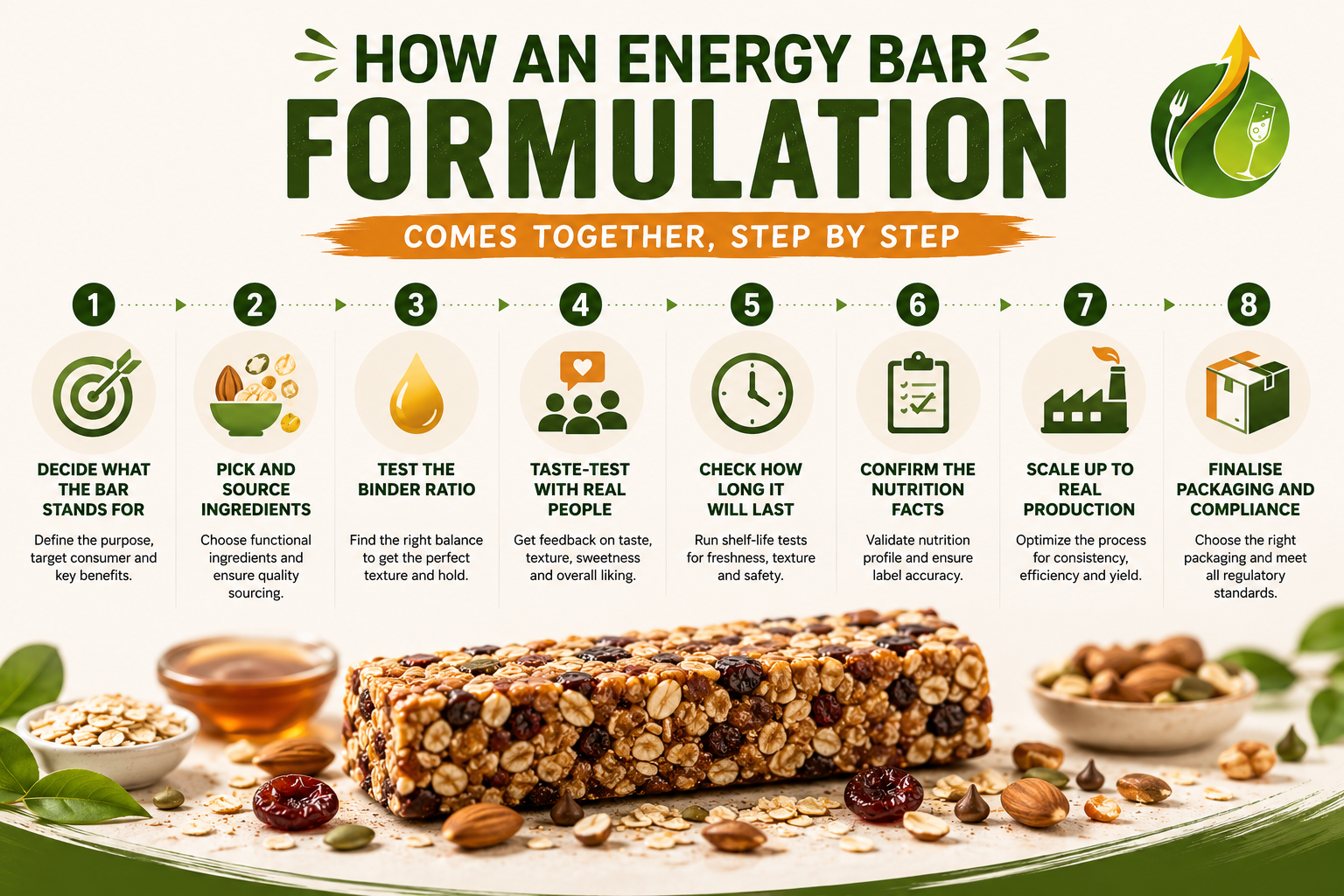
A good energy bar formulation is never finished in one try. It moves through a few clear stages, much like the wider food product development process used for any new food or drink.
1. Decide what the bar stands for
High protein? Low sugar? A clean-label snack? This choice guides every ingredient decision after it.
2. Pick and source ingredients
Choose food-grade ingredients and check for allergens like nuts, milk, and gluten from day one.
3. Test the binder ratio
Small batches are made and tasted to find the exact binder amount that holds the bar together without making it too soft or too hard.
4. Taste-test with real people
A trained tasting panel checks flavour, texture, and aftertaste, so problems are caught early, not after launch.
5. Check how long it will last
Bars are stored at different temperatures for weeks to see how they change over time — this is called shelf-life testing.
6. Confirm the nutrition facts
Lab tests confirm the real protein, fibre, sugar, and calorie numbers before anything goes on the label.
7. Scale up to real production
The recipe is tested again on factory-size equipment to make sure it still comes out right at full volume.
8. Finalise packaging and compliance
Packaging is chosen to match the bar’s shelf life, and the label is checked against FSSAI rules before printing.
Why Do Energy Bars Go Hard, Soft, or Stale?
Most shelf-life problems come down to moisture. Every ingredient in a bar holds a bit of water, and that water is always trying to move around. A crunchy piece of granola sitting next to a soft dried fruit piece will slowly swap moisture with it — the granola softens, the fruit hardens — even if the bar looks fine on the outside.
Food scientists control this by measuring something called water activity, which shows how much moisture in the bar is actually free to move or support bacteria. A well-formulated energy bar keeps this number in a safe, stable range, so it does not grow mould, and does not turn into a brick in your gym bag. The right packaging — one that blocks air and moisture — plays a big role here too.
Energy Bar vs Protein Bar: What’s the Difference?
The terms are often used to mean the same thing in India, but they are not identical. An energy bar is formulated mainly to give you quick, steady energy through carbohydrates, with a moderate amount of protein — usually around 5 to 12 grams per bar. A protein bar is built for a higher protein dose, usually 15 to 30 grams, and is aimed more at muscle recovery after a workout. You can see this difference play out clearly across real products in our review of the best energy bars in India, where formulation choices change the taste, texture, and protein count from brand to brand.
FSSAI Rules You Need to Know for Energy Bars
If you are formulating an energy bar to sell in India, your label needs to meet FSSAI’s rules. In simple terms, that means:
- A nutrition table showing energy, protein, carbs, sugar, fat, and sodium per 100 g and per serving.
- A clear list of allergens, such as nuts, milk, soy, or gluten, if they are used.
- Lab proof behind any claim like “high protein” or “high fibre” before it goes on the pack.
- Your FSSAI licence number and correct net quantity on every pack.
- Careful wording around “natural” claims — FSSAI’s 2026 update looks closely at labels that say “100% natural” when the ingredient list says otherwise.
How Much Does It Cost to Formulate and Make an Energy Bar in India?
Costs change depending on ingredients, order size, and whether you manufacture in-house or through a partner. As a general guide:
| Cost Area | Typical Range | Depends On |
| Formulation and trials | Priced per project | Number of test batches and how much testing is needed |
| Manufacturing (per bar) | Around ₹30–55 at mid-scale (about 10,000 units) | Protein type, ingredients, and order size |
| Lab testing for claims | Priced per test | How many nutrition claims you want on the label |
Common Mistakes to Avoid When Formulating an Energy Bar
- Locking the recipe before shelf-life testing, then finding out the bar goes hard after three weeks.
- Scaling up a recipe that only worked in a small kitchen batch, without testing it on real production equipment.
- Picking a protein source only because it is cheap, without checking how it affects taste and texture over time.
- Printing “high protein” on the pack before lab tests confirm the actual number.
India’s Energy Bar Market in 2026
India’s energy bar category is growing fast, with more gyms, more health-conscious shoppers, and quick-commerce apps making bars easier to buy on impulse. Protein-rich bars are leading demand, especially from fitness-focused buyers in bigger cities. At the same time, FSSAI is paying closer attention to nutrition labels and natural claims, which means good formulation and honest labelling matter more than ever for a brand that wants to last.
Final Thoughts
Energy bar formulation looks simple from the outside, but every great bar hides months of testing behind it — the right binder ratio, the right shelf-life data, and a label that says exactly what the product delivers. Get these right, and you build a bar people trust and come back for. At Flavor Catalystz, this is the kind of formulation work our food R&D team does with brands every day — turning a good idea into a bar that performs the same way in every single batch.
Frequently Asked Questions
What is energy bar formulation in simple terms?
It is the process of mixing ingredients in tested, exact amounts so every batch of your energy bar tastes and feels the same, and stays fresh for its full shelf life.
What are the main energy bar ingredients?
Most energy bars use a base like oats or puffed grains, a binder like honey or syrup, a protein source, and flavouring like cocoa or dried fruit.
How long does the energy bar manufacturing process take, from idea to launch?
It usually takes a few weeks for small changes to an existing recipe, or a few months for a brand-new formulation that needs full shelf-life testing.
Why does my energy bar go hard or stale before its shelf-life date?
The most common reason is uncontrolled moisture — either the binder ratio was off, or the packaging did not block enough air and moisture.
What is the real difference between an energy bar and a protein bar?
An energy bar is built for quick, steady energy with moderate protein (about 5–12g), while a protein bar is built for a higher protein dose (about 15–30g) for muscle recovery.
Can I put “high protein” on my energy bar label in India?
Only after lab testing confirms the protein level meets FSSAI’s threshold for that claim — it cannot be added based on the recipe target alone.
How much does it cost to formulate and manufacture an energy bar in India?
Manufacturing typically costs around ₹30–55 per bar at mid-scale volumes, while formulation and lab testing are usually priced per project.
Do I need special equipment to make energy bars at home before scaling up?
No — most formulations start as small hand-mixed batches before moving to pilot and then factory-scale equipment during scale-up.