Apr 2026 · 16 min read
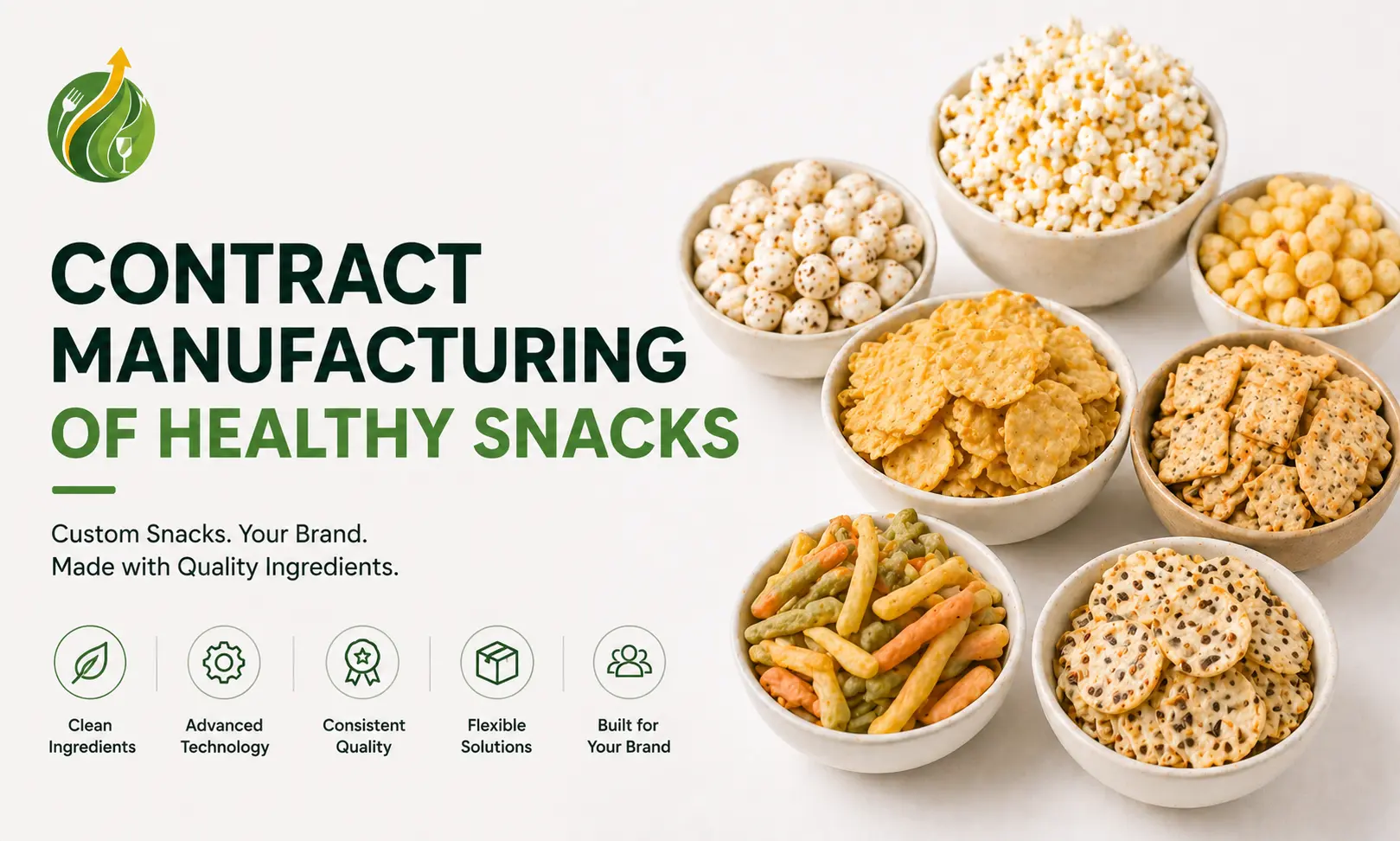
The healthy snack industry in India is one of the fastest growing food segments in 2026. Brands, startups, and D2C founders are entering this space every month. But most of them share one common challenge: how do you manufacture a great snack product without building your own factory?
A good manufacturing partner handles food product development and takes you from a snack idea to a shelf-ready product without investing crores in machinery or infrastructure.
This guide covers everything you need to know about snack manufacturing in India in 2026, including costs, processes, certifications, product types, and how to choose the right snacks manufacturer for your brand.
What is Contract Manufacturing of Snacks?
Contract manufacturing of snacks means outsourcing your snack production to a professional food manufacturing facility. Instead of setting up your own production unit, you partner with an established snack manufacturer who produces your products using your recipe, ingredients, and packaging specifications.
The snack contract manufacturer handles the full production cycle. This includes food formulation and recipe development, raw material sourcing and procurement, manufacturing and processing, quality testing and compliance, packaging and labelling, and final batch delivery to your warehouse.
The brand owner focuses on marketing, branding, and distribution while the manufacturing partner takes care of everything on the production side. This model is used by some of the most successful snack brands in India today, from large FMCG players to fast-growing D2C startups.
India Snack Market in 2026: Why Now is the Right Time
The Indian snack market was valued at INR 50,590 crore in 2025 and is projected to nearly double to INR 1,03,556 crore by 2034, growing at a CAGR of 8.28 percent. Within this, the healthy snacks segment alone is valued at USD 3.13 billion in 2025 and is forecast to reach USD 4.77 billion by 2034.
India Snack Market at a Glance (2026)
| Metric | Data |
| Market Value (2025) | INR 50,590 crore (approx. USD 6 billion) |
| Projected Market Value (2034) | INR 1,03,556 crore |
| CAGR 2026 to 2034 | 8.28 percent |
| Healthy Snacks Market (2025) | USD 3.13 billion |
| Healthy Snacks CAGR 2026 to 2034 | 4.80 percent |
| Volume Growth in 2026 | 4.8 percent year on year |
| Largest Product Segment | Chips at 42 percent market share |
| Fastest Growing Formats | Makhana, millet snacks, protein bars |
| Most Popular Pack Format | Pouches at 68 percent share |
| Most Popular Pack Size | 50 to 100 gm at 45 percent share |
Several factors are driving this growth in 2026. India’s expanding middle class is expected to grow from 31 percent of the population today to 60 percent by 2047, directly increasing spending on branded and premium snacks. Rising urbanization is pushing consumers toward convenient, on-the-go snack formats that serve as meal replacements and not just indulgences.
Health awareness is shifting consumer preference toward baked snacks, millet-based products, protein snacks, and clean-label options with zero preservatives. Quick commerce platforms like Blinkit, Zepto, and Swiggy Instamart have also lowered the barrier to entry for new snack brands. PepsiCo India announced a new flavors manufacturing facility in Ujjain, Madhya Pradesh, operational by early 2026, which signals the scale of investment flowing into this space.
Types of Healthy Snacks You Can Manufacture
A professional snack contract manufacturer can handle a wide range of product categories. The Indian snack market today goes far beyond chips and namkeen. Here are the major categories where demand is strong and growing.
Millet and grain-based snacks like ragi chips, jowar puffs, bajra bites, and multigrain crackers are among the most searched products in 2026. The UN’s declaration of the International Year of Millets created a permanent shift in consumer attitude toward ancient grains, and this demand has only strengthened.
Protein snacks including protein bars, roasted chickpeas, soya crisps, and whey-based bars are driven by India’s booming fitness culture. Makhana, also known as fox nuts or lotus seeds, is one of the fastest rising snack ingredients. India produces 90 percent of the world’s makhana supply and the roasted makhana segment hit its highest ever search volume in 2025. Baked snacks, vegetable-based chips, keto snacks, functional snacks with probiotic or gut-health benefits, traditional Indian snacks like khakhra and namkeen, and premium dark chocolate nut bars round out the major categories.
If you have a concept in any of these categories, a contract manufacturer with category-specific equipment and formulation experience can develop it into a market-ready product.
Manufacturing Models for Snack Brands
Not every brand has the same requirement, and contract manufacturers in India typically offer different models depending on your stage and goals.
| Model | What It Means | Best For |
| White Label | Pre-developed snack products packed under your brand name with minimal changes | Early-stage startups and D2C brands testing a new market |
| Private Label | Existing product base modified in flavor, seasoning, or packaging to suit your brand | Growing brands wanting differentiation without full R&D cost |
| Custom OEM | Unique recipe, ingredients, and packaging developed from scratch, manufactured exclusively for you | Established brands with proprietary formulas and premium positioning |
| Co-Manufacturing | Manufacturing partner produces alongside your setup to handle demand spikes or new SKUs | Brands with partial capacity looking to scale output quickly |
For most startups, white label or private label is the right entry point. It keeps costs low, speeds up time to market, and lets you validate demand before investing in a fully custom product. Custom OEM manufacturing makes sense once you have market proof and want to differentiate through a proprietary recipe.
The Contract Manufacturing Process: Step by Step
Understanding the process before you start helps you set realistic timelines, budget correctly, and avoid surprises. Here is how a standard snack contract manufacturing engagement works from first contact to delivery.
It starts with an initial consultation where you share your snack concept, target market, preferred ingredients, packaging vision, and budget. The manufacturer assesses feasibility within 1 to 2 days. This is followed by formulation and R&D, where food scientists develop your recipe, test ingredient compatibility, run pilot batches, and prepare samples for your review. This stage typically takes 7 to 21 days depending on the complexity of your product.
Once you receive samples, you evaluate taste, texture, and quality. Adjustments are made based on your feedback, and this back and forth usually takes another 3 to 7 days. In parallel, the manufacturer handles regulatory and compliance work including FSSAI registration support, nutritional labelling, shelf-life testing, and quality documentation, which takes 7 to 15 days.
Packaging design is then finalized with print files prepared and label compliance checked against FSSAI norms (5 to 10 days). Full batch production then begins with inline quality checks and batch testing (7 to 21 days depending on quantity). The finished products are packed, labelled, and dispatched to your warehouse within 2 to 5 days of production completion.
From start to first delivery, most brands can expect a total timeline of 45 to 90 days for their first SKU.
Cost of Contract Manufacturing Snacks in India (2026)
Cost is one of the first questions every brand asks. The honest answer is that it depends on your snack type, ingredient complexity, batch size, and packaging format. Below is a realistic breakdown of what to budget for in 2026.
| Cost Component | Typical Range (2026) | What Affects the Cost |
| Per-Unit Manufacturing Cost | Rs. 180 to Rs. 380 per kg | Snack type, ingredients, processing method. Functional and premium snacks cost more. |
| Minimum Order Quantity (MOQ) | 250 kg to 2,000 kg per batch | Higher volumes bring per-unit cost down significantly. |
| Recipe Development and R&D | Rs. 75,000 to Rs. 3,00,000 | Custom formulation, sampling rounds, ingredient trials, texture testing. |
| Packaging Design and Print Readiness | Rs. 25,000 to Rs. 1,00,000 | Label design, pack mockups, FSSAI-compliant print-ready files. |
| Lab Testing and Shelf-Life Study | Rs. 20,000 to Rs. 75,000 | Nutritional panel, microbiological testing, shelf-life analysis. |
| FSSAI Registration | Rs. 5,000 to Rs. 25,000 | State license for turnover Rs. 12 lakh to Rs. 20 crore. Central for above Rs. 50 crore. |
| Total First Launch Budget | Rs. 3,00,000 to Rs. 8,00,000 | Approximate all-in cost for a first batch launch with one SKU. |
These are starting estimates. Your actual costs will depend on your specific product and the manufacturer you work with. Always get itemized quotes and ask what is and is not included before signing.
Certifications to Look for in a Snack Manufacturer
Food safety certifications are not optional. They determine whether your product can enter modern trade, be listed on major ecommerce platforms, or be exported. When evaluating a snack manufacturer in India, here is what to look for.
The FSSAI Central License is the baseline requirement. Without it, a manufacturer cannot legally produce food products in India. ISO 22000 covers food safety management systems and ensures that hazards are systematically identified and controlled across the full production chain. FSSC 22000 is globally recognized and is required by major retail chains and international buyers. GMP or Good Manufacturing Practices certification ensures the facility maintains clean, contamination-free production environments. HACCP identifies and controls biological, chemical, and physical food safety hazards at critical control points.
If you are building an organic snack brand, look for NPOP certification for India or NOP USDA certification if you plan to export to the USA. Halal and Kosher certifications open access to significant domestic and international consumer segments. Always verify certification numbers directly with the issuing body. Do not rely on certificates shown in a PDF or on a website.
How to Choose the Right Snack Manufacturer in India
Choosing the wrong manufacturing partner is one of the most expensive mistakes a food brand can make. These are the key things to evaluate before you commit.
- Verify the FSSAI license number directly on the FSSAI portal. Do not trust screenshots or verbal assurances.
- Check experience specifically in your snack category. A biscuit manufacturer is not the same as a makhana or protein bar specialist.
- Ask for actual production capacity and current utilization, not the theoretical maximum they quote.
- Request references from 2 to 3 existing brand clients and contact them yourself to ask about quality, communication, and delivery reliability.
- Confirm the MOQ before anything else. Many startups fail because they cannot sell their first minimum order quantity fast enough.
- Ask how long sample development takes. Slow sample turnaround usually means poor production planning.
- Understand their R&D and food science capability. A strong formulation team makes a real difference to the final product.
- Discuss packaging support and label compliance. FSSAI labelling errors can delay your launch by weeks.
- Ask how they handle batch failures, ingredient shortages, and delivery delays. A manufacturer with no clear answer to these questions is a risk.
- Be cautious of any manufacturer who says yes to everything without asking technical questions about your product. That is almost always a red flag.
Snack Trends in India That Should Shape Your Product in 2026
Building a snack product that is relevant in 2026 means understanding what consumers are actually buying and why. These are the trends with the strongest commercial momentum right now.
Millet and ancient grain snacks are the single biggest opportunity. Ragi, jowar, bajra, and sorghum have moved from niche health stores to mainstream retail, and demand is growing at over 12 percent annually. Brands that launched millet snacks in 2023 and 2024 are now scaling aggressively.
Gut health and functional snacks are gaining serious traction. Consumers want snacks that offer a benefit beyond taste, and probiotic, prebiotic, and high-fiber formats are benefiting from this. Clean label products with short, recognizable ingredient lists and zero preservatives are becoming a strong differentiator, particularly among urban millennials and Gen Z buyers who actively read nutrition labels.
Protein-fortified snacks are being driven by India’s fitness culture boom. Protein content has become a purchase driver in a way it never was before. Regional flavor innovation is also creating strong products. Combining familiar Indian tastes like peri peri, pudina, imli, and schezwan with modern snack formats is a reliable way to create products that feel both premium and culturally rooted.
On the distribution side, quick commerce is now a channel that requires specific product planning. Pack sizes, pricing, and shelf-life requirements on Blinkit and Zepto are different from traditional retail. Brands that design their products with quick commerce in mind from the start tend to perform better on these platforms.
Who Should Consider Snack Contract Manufacturing
Contract manufacturing of snacks is not limited to one type of business. Almost any brand or business that wants to sell snack products can benefit from this model.
- D2C snack brands that want to launch online without manufacturing investment. Contract manufacturing lets you focus entirely on customer acquisition and brand building.
- FMCG and private label brands that want to expand their product range quickly with custom-formulated snack SKUs manufactured to exact brand standards.
- Retail chains and supermarkets that want to develop exclusive store-brand snack products with consistent quality and competitive pricing.
- Export-oriented businesses that need snack products with international certifications and compliant packaging for markets in the USA, UK, the Middle East, and Southeast Asia.
- Startups and first-time founders who want to test a snack concept with small batch production before committing to larger volumes.
- Hotel, restaurant, and cafe chains that want to private label signature snacks for in-house sale or gifting.
- Corporate gifting businesses that need premium branded snack boxes and hampers with custom formulations.
FSSAI and Regulatory Requirements for Snack Brands (2026)
Food safety regulations in India are governed by FSSAI. In 2026, the authority has continued tightening requirements around labelling, health claims, and packaging. Here is what your snack brand needs to comply with before going to market.
Every packaged snack brand needs its own FSSAI registration or license. Basic registration applies if your annual turnover is below Rs. 12 lakh. A State License is required for turnover between Rs. 12 lakh and Rs. 20 crore, and a Central License is needed above Rs. 50 crore. Your contract manufacturer must also hold their own FSSAI license, and both license numbers must appear on your packaging.
A nutritional information panel showing energy, protein, carbohydrates, sugar, fat, and sodium per serving is mandatory on every packaged snack. All ingredients must be listed in descending order of weight, and allergens must be declared clearly and prominently. Health claims like high protein, low fat, or no added sugar are permitted only if the product meets FSSAI-defined thresholds for those claims. Using such claims without meeting the threshold is a compliance violation that can result in product recall.
Every batch must carry a batch number, manufacturing date, and best before date. Shelf-life testing must be conducted by an accredited laboratory before you make any shelf-life claims on packaging. For export products, requirements vary significantly by destination country. FDA compliance is required for the USA, and EU food law applies for European markets. These may differ from FSSAI requirements in ways that affect your formulation and labelling.
What to Expect from a Good Snack Contract Manufacturer
A reliable snack contract manufacturer is more than just a production facility. The best ones act as a full product development partner and work with you across formulation, compliance, packaging, and scale-up planning.
You should expect a dedicated food science and R&D team that can develop and refine your formulation with real expertise in ingredient interaction, texture, shelf stability, and flavoring. End-to-end support from the first sample to large-scale production runs means you do not need to manage multiple vendors or worry about production logistics.
FSSAI and regulatory compliance guidance is a significant value-add, especially for brands that are navigating the licensing and labelling process for the first time. Flexible MOQ structures that accommodate smaller first batches are essential for startups who need to test the market before scaling. Quality assurance at every production stage, from incoming ingredient testing to final goods testing and batch documentation, ensures consistency that builds consumer trust over time.
Packaging and branding coordination, where the manufacturer works with your design to ensure label compliance and shelf appeal, saves time and prevents costly labelling errors. And scalability, where your manufacturing partner can grow with you as volumes increase, means you do not need to switch partners at the worst possible time.
Ready to Launch Your Snack Brand?
The Indian snack market in 2026 is a genuine and growing opportunity. The consumers are ready, the distribution channels are in place, and the demand for healthy, well-branded, clean-label snack products has never been stronger.
What stops most brands is the manufacturing challenge. The right snack manufacturer removes that barrier completely by bringing formulation expertise, production infrastructure, food safety certifications, and operational experience together under one roof.
Whether you are an entrepreneur launching your first snack product, an FMCG brand expanding your healthy portfolio, or a retail chain developing a private label range, finding the right manufacturing partner is one of the most important decisions you will make. Flavor Catalystz works with brands at every stage of this journey.
Contact us today at +91 9711730492 to discuss your snack product idea, get a transparent quote, and take the first step toward building a snack brand that stands out in the Indian market.
Frequently Asked Questions
What is the minimum order quantity for contract manufacturing of snacks in India?
MOQ varies by manufacturer and product type. Typical MOQs in India range from 250 kg to 2,000 kg per batch, depending on the snack category, packaging complexity, and ingredient sourcing requirements. Many manufacturers offer flexible MOQ structures for startups launching their first batch. Always confirm MOQ before signing any agreement.
How long does it take to launch a snack product through contract manufacturing?
From the initial consultation to your first production batch, the typical timeline is 45 to 90 days. This includes formulation and sampling (7 to 21 days), regulatory work (7 to 15 days), packaging finalization (5 to 10 days), and production (7 to 21 days). Timelines vary based on the complexity of your recipe and how quickly approvals are obtained.
Do I need my own FSSAI license to sell contract-manufactured snacks?
Yes. As the brand owner, you need your own FSSAI license or registration. Your contract manufacturer also needs their own valid FSSAI license. Both must appear on your product packaging. A good manufacturing partner will help you understand what license category applies to your business.
Can I keep my snack recipe confidential during contract manufacturing?
Yes. Always insist on a legally binding NDA before sharing your recipe, formulation, or product data. This is standard practice in professional contract manufacturing. Your intellectual property should remain fully yours throughout the relationship.
What certifications does a snack contract manufacturer need?
At a minimum, a valid FSSAI Central License is required. ISO 22000, FSSC 22000, HACCP, and GMP certifications are important for product quality and for accessing modern trade retailers and export markets. Always verify certification numbers independently before committing to a manufacturer.
What types of healthy snacks are in highest demand in India in 2026?
Millet-based snacks, makhana, protein bars, roasted nuts and seeds, baked chips, and functional snacks with gut-health benefits are among the fastest growing categories in 2026. Clean-label products with short ingredient lists and no artificial preservatives are seeing particularly strong demand across D2C and quick-commerce channels.
How is quality controlled in snack contract manufacturing?
Quality control involves incoming ingredient testing, in-process checks at critical production stages, finished goods testing for taste, texture, moisture content, and microbiological safety, and complete batch documentation. Always ask a prospective manufacturer to walk you through their specific QC process before you sign anything.