May 2026 · 13 min read
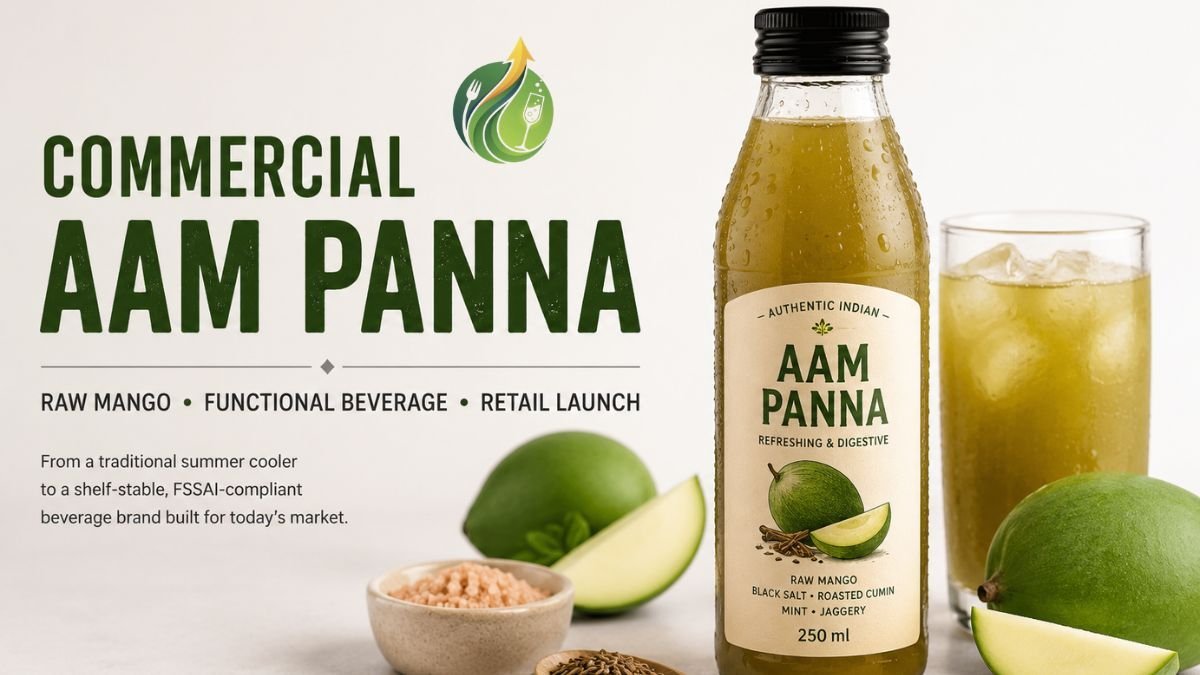
Every summer, someone asks me why there is no great packaged aam panna on the Indian market. The homemade version — raw mango, black salt, roasted cumin, jaggery, and mint — is one of the finest drinks this country has ever produced. It is cooling, electrolyte-rich, and deeply nostalgic. Yet the organised market for it remains almost entirely empty.
The honest answer is that taking aam panna from a kitchen recipe to a shelf-stable, commercially produced, FSSAI-compliant beverage is significantly harder than it looks. The flavour profile that makes it special is also what makes it technically challenging to produce at scale. But it is absolutely doable — and right now, the market timing is better than it has ever been.
This is what the process actually looks like.
Why Aam Panna Is a Compelling Commercial Opportunity
Before getting into the technical side, it is worth understanding why this product makes business sense.
Raw mango drink as a category barely exists in organised retail in India. The dominant players — Frooti, Maaza, Slice — are all ripe mango drinks with very different flavour profiles. Aam panna is tart, savoury-sweet, cooling, and functional. It has a fundamentally different consumer occasion (digestive, cooling, summer hydration) and a differentiated taste that colas and sweet fruit drinks do not compete with.
The consumer pull is already there. Urban Indians, particularly the 25–40 age group, are actively seeking authentic Indian beverages that go beyond coconut water. The revival of traditional Indian drinks is one of the clearest beverage industry trends of the last two years, and aam panna sits right at the centre of it.
The competition gap is real. Building a brand in a nearly empty organised category is far easier than competing in a crowded one. If you execute the product well, you are not fighting for shelf space against twenty similar products.
The Core Technical Challenge: What Makes Aam Panna Hard to Commercialise
Let me be direct about this because I have seen too many founders underestimate it.
Raw mango — the defining ingredient of aam panna — has a very different chemistry from ripe mango. It is high in tannins, has a pronounced tartness from malic and citric acids, and contains enzymes that can break down over time, degrading colour, texture, and flavour. The roasted cumin note, the black salt sulphur character, and the mint freshness are all volatile compounds that can fade, shift, or interact with other ingredients over the product’s shelf life.
What this means practically: an aam panna that tastes perfect on day one can taste flat, oxidised, or “cooked” by day 60 if the formulation and processing are not right. Getting the shelf life right without killing the fresh, raw mango character is the central technical challenge of this product.
This is not a reason to avoid the product. It is a reason to invest properly in formulation and stability testing rather than trying to cut corners.
Formulation: Building a Commercial Aam Panna That Actually Works
Raw Mango Base
For a commercial product, you have three options for your raw mango base:
Fresh raw mango pulp — The most authentic option, but highly seasonal, variable in flavour profile from batch to batch, and difficult to standardise at commercial scale. Used by some premium craft beverage brands willing to accept the operational complexity.
Raw mango pulp (IQF or aseptic) — Individually quick frozen or aseptic-packed raw mango pulp from processors in Andhra Pradesh, Maharashtra, and Uttar Pradesh. This gives you year-round supply and better batch consistency. The flavour is very close to fresh but requires careful supplier qualification.
Raw mango concentrate or powder — More stable, easier to handle, longer shelf life in storage. The trade-off is that the fresh, raw character is harder to maintain, and you will need to work harder with your flavour system to restore it.
For most commercial launches, I recommend starting with aseptic raw mango pulp at a standardised Brix and acidity. It gives you the best balance of authenticity, consistency, and operational practicality.
Flavour-Building Ingredients
Roasted cumin — In a commercial formula, standardised cumin oleoresin or a water-soluble cumin extract will give you more consistency than adding roasted cumin powder directly. The powder can create settling issues and flavour variation across batches.
Black salt (kala namak) — Essential. This is what separates aam panna from a generic raw mango drink. The sulphur compounds give it that characteristic “earthy” note. Quantity control is critical — this ingredient is powerful and the window between “authentic” and “overpowering” is narrow at commercial scale.
Sweetener — Traditional aam panna uses jaggery. At commercial scale, jaggery powder is your best option — it adds the flavour character of jaggery without the processing challenges of liquid jaggery. A blend of jaggery powder and sugar is common for cost management. For a premium clean-label positioning, 100% jaggery sweetened is possible and compelling on the label.
Mint — Peppermint oil or natural mint extract at precisely controlled levels. Mint volatiles degrade over time, so your initial level needs to account for the expected loss over shelf life.
Acidulant — Citric acid to supplement the natural acidity of the mango pulp and bring your pH to target. For a non-carbonated RTD without refrigeration, you want to be at or below pH 4.0.
Stabiliser system — Raw mango pulp will settle and separate without a hydrocolloid system. Pectin (natural to mango and clean-label) or xanthan gum are the standard options within FSSAI-permitted levels.
Carbonated Aam Panna
A sparkling aam panna is a genuinely exciting product with strong commercial potential in the urban market. The carbonation adds effervescence that makes the tart, savoury character of raw mango even more refreshing. The formulation changes significantly — you need a cleaner, more clarified base (less pulp), a tighter flavour balance since carbonation amplifies certain notes, and a packaging solution (can or glass bottle with crown cap) that can hold CO2. Read more about how carbonated beverages are formulated in our aerated drinks recipe formulation guide.
Processing: How Aam Panna Is Made at Commercial Scale
Getting the processing right is as important as getting the formula right. Here is the standard production flow for a non-carbonated aam panna RTD:
Ingredient preparation — Raw mango pulp is thawed (if IQF) or opened from aseptic packaging. Other ingredients are weighed and prepared.
Blending — All ingredients are combined in a jacketed mixing vessel in the correct sequence. pH is checked and adjusted.
Homogenisation — For a smooth, consistent texture, the blend passes through a homogeniser. This also improves the stability of the pulp suspension.
Pasteurisation — The product is pasteurised at 85–90°C for 15–30 seconds to achieve commercial sterility. The time-temperature combination is calibrated to eliminate pathogens while minimising thermal damage to the volatile flavour compounds — this calibration is where the craft in beverage processing lies.
Hot fill or aseptic fill — For shelf-stable packaging (PET bottles, Tetra Pak), either hot fill at 85°C or cold aseptic filling after flash pasteurisation are the two main options. Aseptic filling preserves flavour better but requires more capital-intensive equipment at the co-packer level.
Cooling and labelling — Bottles are cooled, dried, labelled, and packed.
Shelf Life and Stability Testing
I cannot stress this enough: do not assume your aam panna formula is stable without running proper shelf life studies. I have seen products that tasted excellent in the lab develop colour browning (Maillard reaction between mango sugars and amino acids), flavour fade, or sediment issues within 3 months on shelf.
What to test for:
- pH drift over time (critical for safety)
- Colour change (browning, greening, or fading)
- Sensory stability — does it still taste like aam panna at 3, 6, 9 months?
- Microbial counts at regular intervals
- Physical stability — no settling, no phase separation, no cap swelling (which indicates microbial activity or CO2 generation)
Accelerated shelf life testing: Run samples at 40°C/75% RH. One month at these conditions approximates roughly three to four months at ambient storage. This gives you data faster, though real-time data at 25°C is needed for the final shelf life claim.
Target shelf life for a commercial aam panna RTD: 9–12 months at ambient for PET hot-fill or Tetra Pak. 3–4 months refrigerated for a cleaner, less processed variant.
FSSAI Approval: Getting Your Aam Panna Legally Right
An aam panna made with raw mango pulp, spices, black salt, and jaggery is a relatively straightforward product from an FSSAI classification standpoint — it will likely sit under the non-carbonated ready-to-drink fruit drink category, with the raw mango pulp content determining whether it qualifies as a “fruit drink” (minimum 10% fruit content) or a “fruit flavoured beverage” (less than 10%).
This distinction matters because the minimum fruit content requirements, permissible preservative levels, and labelling rules differ between these sub-categories. Classify correctly from the start.
Key compliance checkpoints:
- Every ingredient must be on the FSSAI-permitted additives list with your quantities within permitted limits
- Your label must comply with the Food Safety and Standards (Labelling and Display) Regulations
- Your FSSAI license must cover the manufacturing location and product category
- Any “natural” or “no artificial preservatives” claim must be substantiated by your formula
For a comprehensive guide to FSSAI requirements for beverages, our article on FSSAI beverage compliance covers the regulatory process in detail.
Packaging and Format Strategy
250ml PET bottle — Entry-level format. Low cost, high availability. Works for mass market positioning and quick commerce. The on-the-go format that most urban consumers prefer.
300ml or 500ml PET bottle — Better value positioning for the consumer. The 500ml is a strong format for e-commerce, where larger sizes drive better unit economics.
250ml aluminium can — Premium positioning. The form factor signals quality and works well in modern trade (supermarkets, convenience stores) and on quick commerce platforms where visual appeal drives impulse purchase.
Glass bottle (200ml) — Artisanal, premium positioning. Strong for D2C and food service (restaurants, cafés). Higher cost per unit but justified at a premium price point of ₹120–₹180.
Concentrate / syrup (250ml bottle, 3x or 5x concentrate) — An interesting format that reduces your logistics cost and allows the consumer to make the drink at home at their preferred strength. Works well for the D2C channel.
For aam panna, I personally believe the premium positioning — glass bottle or can, clean label, minimal ingredients — is the more defensible commercial strategy. You are not going to win on price against the mass market. Own the premium traditional Indian beverage space.
Go-to-Market Strategy
Phase 1 — D2C and quick commerce (months 1–6)
Launch on your own website and Blinkit / Zepto / Swiggy Instamart. These channels give you access to the urban consumer who is most likely to buy an artisanal raw mango drink, at the lowest distribution complexity. Use this phase to validate demand, collect consumer feedback, and refine your messaging.
Phase 2 — Modern trade and specialty retail (months 6–18)
Once you have proof of demand, approach premium modern trade chains (Nature’s Basket, Foodhall, Spencer’s, health food stores). Negotiate reasonable listing terms and build your in-store presence.
Phase 3 — General trade and distribution (18 months+)
Expanding into general trade (kirana stores, local supermarkets) requires distributor partnerships and working capital for credit terms. This phase requires a volume-ready manufacturing setup and tighter cost management.
Pricing:
At a target COGS of ₹25–₹45 per 250ml bottle (depending on format and volume), your MRP should sit at ₹90–₹150 for a premium variant. For a mass market PET bottle, MRP of ₹40–₹60 is the competitive range, but your margins will be thin until you hit significant volume.
Understanding your full cost picture before launch is essential. Our beverage formulation cost breakdown will help you build a realistic P&L before you commit to a production batch.
Working With a Contract Manufacturer
For your first year, manufacture through a co-packer. You do not need your own facility. What you need is a co-packer who:
- Has experience with fruit-pulp beverages (aam panna has relatively high pulp content, which requires specific equipment)
- Is FSSAI licensed for beverages at the appropriate scale
- Is willing to manufacture to your proprietary formula under an NDA
- Has the right filling format for your chosen packaging (hot fill vs aseptic vs cold fill)
- Has reasonable MOQs that match your initial demand forecast
Do not share your formula without a signed NDA and manufacturing agreement that clearly states formula ownership. This is non-negotiable.
Our beverage contract manufacturing guide covers what to look for and what to avoid when selecting a manufacturing partner.
The Investment Reality
Building an aam panna brand properly is not cheap, but it is also not prohibitive:
- Formulation and R&D (including stability trials): ₹1,00,000 – ₹2,50,000
- Packaging design and artwork: ₹40,000 – ₹1,20,000
- First commercial batch at co-packer: ₹2,00,000 – ₹5,00,000
- FSSAI registration and compliance: ₹20,000 – ₹60,000
- Initial marketing (photography, website, D2C setup): ₹50,000 – ₹2,00,000
- Working capital for first 6 months: ₹3,00,000 – ₹8,00,000
Realistic total for a properly done launch: ₹7,00,000 – ₹18,00,000. You can do it cheaper, but every shortcut in formulation, testing, or compliance creates a risk that typically costs more to fix than it saved.
The Bottom Line
Aam panna is one of the most commercially compelling traditional Indian beverage opportunities available right now. The category is empty. The consumer appetite is real. The product has a genuine functional story. The challenge is in the execution — getting the formulation right, the stability proven, the FSSAI compliance sorted, and the go-to-market strategy calibrated before you spend money on production.
If you want to build this brand properly, we can help. At FlavorCatalyst, we have formulated and commercially scaled products exactly like this — from the initial recipe brief through pilot trials, stability testing, co-packer selection, and retail launch. Reach out to us and let us talk through your specific product vision.
You can also explore our guide on how to start a beverage brand in India and our overview of non-alcoholic beverage development to understand the broader landscape before you begin.
The aam panna opportunity will not stay empty for long. The founders who build this category now will be the ones who own it.
FAQs
1. What is Aam Panna made of?
Aam Panna is traditionally made using raw mango, black salt, roasted cumin, mint, sugar or jaggery, and digestive spices.
2. Can Aam Panna be sold as a commercial beverage?
Yes, Aam Panna can be developed as an RTD beverage, concentrate, syrup, or carbonated drink for retail sale.
3. What is the shelf life of packaged Aam Panna?
A properly formulated commercial Aam Panna can achieve 9–12 months shelf life at ambient conditions.
4. Which packaging works best for Aam Panna drinks?
PET bottles, glass bottles, aluminum cans, and Tetra Pak are commonly used depending on brand positioning.
5. Is Aam Panna considered a functional beverage?
Yes, Aam Panna is often positioned as a cooling, digestive, and hydration-support beverage.
6. Do Aam Panna beverages require FSSAI approval?
Yes, FSSAI compliance is mandatory for manufacturing and selling Aam Panna beverages in India.
7. Can Aam Panna be carbonated?
Yes, sparkling or carbonated Aam Panna is becoming popular in premium urban beverage markets.