Jul 2026 · 12 min read
A bag of cheese balls that dissolves on the tongue in two seconds, and a bag that turns rubbery and flat after a week in a warehouse, are usually not made from different cheeses at all. They are built on different formulas. Cheese snack formulation is the technical work of selecting cheese solids, carrier grains, fats, acids and processing conditions so that flavour, crunch and shelf life survive the gap between a factory floor in July and a retail shelf in December.
For a founder writing a first specification sheet, or a plant head troubleshooting a batch that tastes weaker after two months in storage, this guide walks through what actually goes into a working cheese snack formulation — the ingredient categories, the cheese-format decision, the process route, the failure points that show up most often on a production line, and the approximate cost structure behind them. Flavor Catalystz has worked on extruded, baked and coated snack lines across FMCG and startup brands, and the patterns below reflect where formulations tend to succeed or break down in real manufacturing, not only on a lab bench.
What Is Cheese Snack Formulation?
Cheese snack formulation is the process of combining cheese solids — natural cheese, cheese powder or cheese slurry — with a carrier base, fats, acidulants, colour and functional additives in fixed ratios, so that every commercial batch delivers the same cheese flavour, texture and shelf life. It is a specialised branch of food product formulation, the broader discipline that governs how any packaged food is engineered from a kitchen idea into a product that behaves identically in batch one and batch ten thousand.
A home recipe can flex with the cook’s mood; a formulation cannot. Cheese, in particular, is a difficult ingredient to lock down because natural cheese varies batch to batch in moisture, fat and salt, and because cheese flavour compounds are volatile and degrade under heat, oxygen and light. Formulation is the set of decisions — which cheese format, how much fat, which acid, what particle size, which process — that keeps that variability from reaching the consumer.
CHEESE SNACK FORMULATION 2026
Develop Commercial Cheese Snacks with Better Texture and Flavor
Flavor Catalystz develops cheese snack formulations with optimized cheese blends, texture, seasoning, processing, cost optimization, FSSAI compliance, shelf life, and commercial manufacturing support.
Core Ingredients Inside Every Cheese Snack Formulation
A working cheese snack formulation is rarely just “cheese plus starch.” It is a small system of interacting ingredient categories, each doing a specific job. The table below summarises the categories most formulators work with.
| Ingredient Category | Common Materials | Role in the Formula | Typical Usage Level |
| Cheese solids | Natural cheese, spray-dried cheese powder, cheese slurry | Primary flavour and dairy character | 5% to 10% of total formula, depending on flavour intensity |
| Carrier / base matrix | Corn grits, rice flour, potato flakes, wheat flour | Provides structure, bite and expansion | 60% to 75% of the base recipe |
| Fat and oil | Vegetable oil, palm oil, sunflower oil | Carries flavour, aids seasoning adhesion, builds mouthfeel | 10% to 20% depending on process |
| Acidulants | Citric acid, lactic acid, malic acid | Adds tang and reinforces authentic cheese perception | 0.2% to 1% |
| Binders and anti-caking agents | Modified starches, silicon dioxide, maltodextrin | Improves powder flow and prevents clumping in storage | 1% to 3% |
| Flavour enhancers | Yeast extract, hydrolysed vegetable protein, or clean-label alternatives | Boosts umami and rounds out the cheese note | 0.5% to 2% |
| Colourants | Annatto, paprika oleoresin, beta-carotene | Gives the visual cue consumers associate with cheese | Trace levels, typically under 0.5% |
| Preservatives and stabilisers | Sodium phosphate, potassium sorbate, antioxidants (TBHQ or natural tocopherols) | Protects flavour and fat from oxidation over shelf life | As permitted under FSSAI limits |
Choosing Cheese Powder, Slurry, or Natural Cheese for the Base
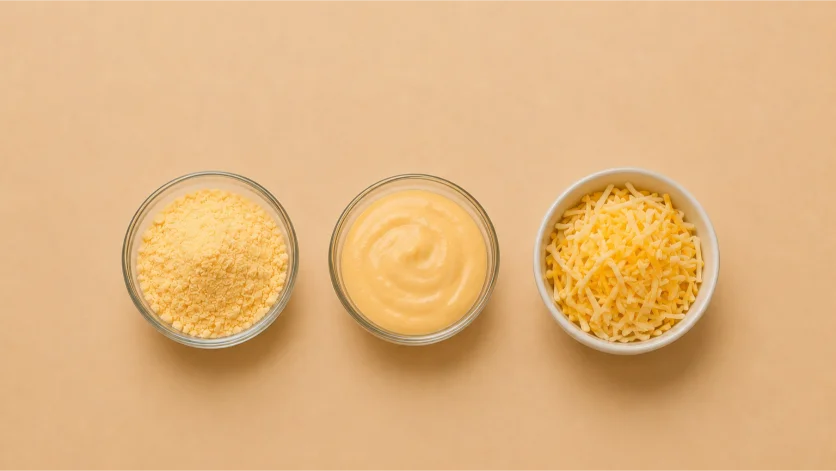
The single biggest early decision in a cheese snack formulation is which physical format of cheese to use, because it dictates the process route, the cost, and how long the flavour survives on the shelf.
| Cheese Format | Flavour Intensity | Handling & Stability | Best Process Fit | Relative Cost |
| Spray-dried cheese powder | High and consistent | Hygroscopic; needs moisture-barrier packaging and anti-caking agents | Dry seasoning tumbling, oil-slurry topical coating | Moderate to high |
| Cheese slurry (cheese powder dispersed in oil) | High, with better surface adhesion | Needs temperature-controlled storage and consistent viscosity | Pre-bake application on crackers, sheeted snacks | Moderate to high |
| Natural cheese (grated or shredded) | Most authentic, but variable | Short shelf life; refrigeration required | Fresh or refrigerated snack lines, artisanal formats | High |
| Enzyme-modified cheese (EMC) | Very concentrated, cost-efficient | Stable at low usage levels; strong flavour in small doses | Extruded and baked snacks needing flavour at low inclusion | Cost-efficient per unit of flavour delivered |
Most commercial cheese snacks use spray-dried cheese powder or a cheese slurry rather than natural cheese, because natural cheese cannot survive ambient shelf life without refrigeration. The trade-off formulators manage is that dried cheese formats need supporting ingredients — acidulants, flavour enhancers, and sometimes small amounts of enzyme-modified cheese — to rebuild the fresh cheese perception that drying strips away.
Step-by-Step Cheese Snack Formulation Process
A cheese snack formulation is typically developed in stages, moving from a sensory target to a validated, production-ready recipe:
- Define the sensory target and cost ceiling — decide how strong, tangy or creamy the cheese note should be, and the maximum cost of goods the price point can absorb.
- Select the base matrix — corn, rice, potato or wheat, matched to the intended process (extrusion, baking, frying or sheeting).
- Choose the cheese format and inclusion level — usually between 5% and 10% of the total formula, adjusted for flavour strength.
- Balance fat, acid and salt — these three variables control whether the cheese note reads as authentic or artificial on the tongue.
- Build the seasoning or slurry system — combine cheese powder, oil, flavour enhancers and colour into an application-ready blend.
- Trial the application method — dry tumbling, oil-slurry spraying, or pre-bake slurry coating, depending on the base.
- Run sensory panels and accelerated shelf-life testing — confirm flavour, texture and appearance hold up over the intended shelf life.
- Scale up on the commercial line — validate that the lab formula behaves the same way at production speed and volume.
The base matrix and the process route are decided together, not separately. If the base is a directly expanded corn or rice extrudate, the way starch gelatinises inside the extruder changes how much oil and cheese powder the finished surface can hold — a subject covered in more depth in our guide to extruded snack formulation, which walks through die design, moisture control and expansion behaviour for extruded bases.
How the Cooking Method Shapes Cheese Flavour and Texture
The same cheese powder behaves differently depending on whether it meets a hot extruder barrel, a baking oven, or a fryer. Choosing the process route early prevents costly rework later.
| Method | Typical Moisture Target | How Cheese Is Introduced | Texture Outcome |
| Extrusion (direct expanded) | Low, around 10% to 14% at the die | Dry seasoning tumbled post-extrusion, or oil-slurry sprayed on | Light, crisp, high expansion — classic cheese puff or curl |
| Baking | Moderate, controlled through oven zones | Cheese slurry applied pre-bake so flavour bakes into the surface | Firmer, cracker-like bite with baked-in cheese notes |
| Frying | Reduced during frying to 1% to 3% residual | Oil-based seasoning applied immediately post-fry while surface is warm | Rich, high-adhesion coating with strong mouthfeel |
| Sheeting and cutting | Managed through dough hydration before baking or frying | Cheese powder or slurry blended directly into the dough | Uniform flavour throughout rather than only on the surface |
Common Formulation Problems and Practical Fixes
Most cheese snack complaints trace back to a small set of recurring formulation issues. Recognising the pattern early saves several rounds of trial and error.
| Problem Observed | Likely Root Cause | Practical Fix |
| Flavour tastes flat or stale after a few weeks | Oxidation of fat and cheese powder during storage | Add antioxidants, use a higher oxygen-barrier pack, and control storage temperature |
| Greasy or overly oily mouthfeel | Excess oil in the seasoning slurry | Reduce oil ratio and refine spray droplet size for even, thinner coverage |
| Seasoning does not stick to the snack surface | Insufficient oil binder or coarse cheese powder particle size | Increase the oil-binder percentage and use a finer cheese powder mesh |
| Unwanted browning or burnt notes during baking | High reducing-sugar content in the cheese powder reacting under heat | Switch to a low-reducing-sugar cheese powder designed for pre-bake application |
| Powder clumps or cakes in storage | Hygroscopic cheese powder absorbing ambient moisture | Add anti-caking agents and use moisture-barrier packaging |
| Batch-to-batch flavour inconsistency | Variation between cheese powder supplier lots | Tighten incoming QC specifications on moisture, fat and flavour intensity |
Estimating Cost of Goods for a Cheese Snack Formulation
Cost structure varies with cheese inclusion level, base ingredient and packaging format, but the illustrative shares below give founders a starting reference point for budgeting a formula before detailed costing.
| Cost Component | Approximate Share of Cost of Goods |
| Base matrix (grains, starches) | 30% to 40% |
| Cheese powder or slurry | 20% to 30% — usually the single largest ingredient cost |
| Oil and fat | 12% to 18% |
| Seasoning additives (acidulants, enhancers, colour) | 5% to 10% |
| Packaging | 10% to 15% |
Because cheese powder is usually the costliest single ingredient, small changes in inclusion level — moving from 8% to 6%, for instance — have an outsized effect on margin, which is why sensory panels are used to find the minimum effective dose of cheese flavour rather than simply maximising it.
FSSAI and Label Compliance Checklist for Cheese Snacks in India
A cheese snack formulation is only launch-ready once it also clears India’s regulatory requirements. The checklist below covers the areas that come up most often during compliance review.
| Compliance Area | What It Covers |
| FSSAI licensing | Registration or licence category based on production scale and turnover |
| Nutrition labelling | Accurate declaration of fat, saturated fat, sodium and energy per serving |
| Additive limits (INS numbers) | Usage of acidulants, anti-caking agents and preservatives within permitted limits |
| Allergen declaration | Clear labelling of milk and, where applicable, soy-derived ingredients |
| Claims substantiation | Evidence on file for claims such as “real cheese,” “no added MSG,” or “baked not fried” |
| Shelf-life validation | Accelerated and real-time shelf-life data supporting the printed best-before date |
Where Cheese Snack Formulations Are Heading in 2026
A few directions are showing up repeatedly across category innovation and consumer research this year:
- Clean-label cheese powders that lean on real cheese and fewer processing aids, replacing some enzyme-modified cheese and synthetic flavour enhancers.
- Sodium-reduction technology, using flavour-forward dairy ingredients so cutting salt does not flatten the cheese perception.
- Plant-based cheese analogues for snack coatings, aimed at flexitarian and vegan shoppers without abandoning the familiar cheese-snack format.
- Protein-fortified cheese snacks that combine dairy protein with pulses or legumes in the base matrix.
- A shift toward baked and air-processed formats over deep frying, driven by better-for-you positioning.
Validating a New Formula Before You Scale to Commercial Production
Even a well-designed cheese snack formulation needs a validation stage before it reaches a commercial line: a pilot-scale trial, structured sensory panels against a target profile, accelerated shelf-life testing under heat and humidity stress, and a supervised first production run to catch equipment-specific issues a lab trial cannot predict. This validation stage mirrors the wider food product development process that takes any packaged food concept from a bench-scale idea through to a stable, repeatable commercial product.
Bringing It Together
A cheese snack formulation is a balance of a handful of interacting decisions — cheese format, base matrix, process route, fat and acid levels, and packaging protection — rather than any single ingredient. Getting the balance right is what separates a snack that tastes the same in the first bite and the last bag of a case from one that fades, cakes, or turns oily on the shelf. Flavor Catalystz’s food science team builds and stress-tests formulations of this kind for snack brands preparing to move from a working recipe to a commercially scaled, compliant product.
Frequently Asked Questions
What is the ideal cheese powder percentage in a snack formulation?
Most commercial cheese snacks use cheese powder at 5% to 10% of the total formula. The exact level depends on the strength of the cheese source, the presence of flavour enhancers, and the cost target for the product.
What is the difference between cheese powder and cheese seasoning?
Cheese powder is the base dairy ingredient made by spray-drying natural cheese. Cheese seasoning is the finished blend applied to a snack, combining cheese powder with oil, salt, acidulants, colour and flavour enhancers.
Can cheese snacks be formulated without artificial flavour enhancers?
Yes. Clean-label formulations replace synthetic flavour enhancers with higher-quality cheese powder, yeast extracts, or enzyme-modified cheese used at a slightly higher inclusion level to maintain flavour intensity.
Why does cheese seasoning lose flavour or turn stale quickly?
The most common cause is oxidation of the fat and cheese powder during storage, accelerated by heat, light and oxygen exposure. Antioxidants, oxygen-barrier packaging and controlled storage conditions extend flavour life.
Is natural cheese used directly in extruded or fried snacks?
Rarely at commercial scale, because natural cheese has a short, refrigerated shelf life. Spray-dried cheese powder or cheese slurry is used instead to deliver similar flavour with ambient shelf stability.
What shelf life can a typical cheese snack formulation achieve?
With appropriate antioxidants, moisture-barrier packaging and a stable cheese powder, most ambient cheese snacks are formulated for a 6 to 9 month shelf life, validated through accelerated and real-time testing.
Does a cheese snack need FSSAI approval before launch in India?
Yes. It requires FSSAI licensing appropriate to production scale, compliant nutrition and allergen labelling, additive usage within permitted limits, and documented shelf-life validation before commercial sale.
How much does developing a cheese snack formulation typically cost?
Development cost depends on the number of trial iterations, whether new equipment trials are needed, and the depth of sensory and shelf-life testing required. Most projects move from initial formulation to a pilot-ready product over several weeks of trial cycles.