May 2026 · 17 min read
The titles get used interchangeably across job postings, LinkedIn bios, and beverage company websites — but they describe genuinely different roles, with different skill sets, different deliverables, and dramatically different cost structures. Picking the wrong one for your stage of brand-building is one of the most expensive mistakes a beverage founder can make. We have seen brands burn ₹15–25 lakh hiring full-time beverage technologists when what they actually needed was project-based formulation support — and we have seen others struggle for months with freelance formulators when they actually needed deep technologist-level process engineering.
This guide breaks down the real difference between a beverage technologist and a beverage formulator, when each role matters, what they cost, and — most importantly — what an Indian beverage founder actually needs at every stage of building a brand.
Not sure whether you need a technologist, a formulator, or a full beverage consultancy?
We will help you figure out the right talent model for your stage — full-time, freelance, or consultancy-led. → Book a free consultation with Flavor Catalystz
The Quick Answer (For Founders Who Just Want the Verdict)
If you have 30 seconds, here is the short version:
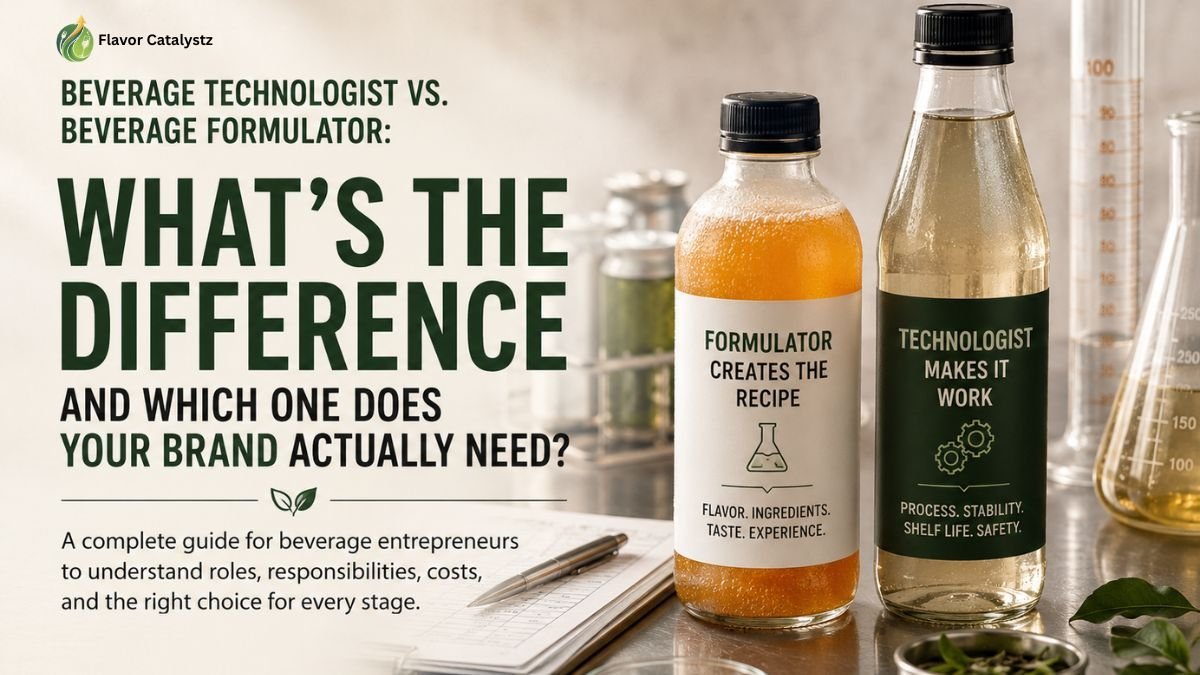
A beverage formulator builds the recipe. They are the chef of the beverage world — selecting ingredients, balancing flavour profiles, developing the sensory signature, and locking the proportions that make your drink taste, look, and behave the way you want it to.
A beverage technologist makes the recipe survive the real world. They engineer the process — pH stabilisation, thermal processing, shelf life, packaging compatibility, microbial control, scale-up parameters — that translates a successful bench formula into a commercial product that can sit on a shelf for 9 months without breaking.
You need both. The question is whether you hire them, freelance them, or work with a consultancy that brings both functions under one roof. The rest of this blog answers that question for your specific situation.
What Does a Beverage Formulator Actually Do?
A beverage formulator’s domain is the recipe itself. Their typical workflow looks like this:
Concept translation. Taking a brand brief — “we want a low-sugar mango energy drink for Gen Z” — and translating it into ingredient strategy: which mango source, which sweetener system, which caffeine source, which acid balance, which preservative system.
Ingredient selection and balancing. Choosing every ingredient by function. Hero ingredients for the claim. Sweeteners for taste. Acidulants for balance. Stabilisers for texture. Flavour modulators for sensory polish. Each ingredient is selected not in isolation but as part of a system.
Bench-scale trials. Mixing prototypes in small batches — typically 1 to 5 litres — and iterating through 8 to 15 versions, each refined based on tasting feedback, technical measurements, and the original brief.
Sensory development. Designing the target sensory profile (sweetness onset, body, finish, aftertaste) and tuning the formula to hit it precisely. Trained panels, blind comparisons, and consumer-representative testing.
Cost engineering. Building the formula within a target cost-of-goods, often through ingredient substitution, supplier negotiation, and creative use of cheaper functional ingredients.
A great formulator is part scientist, part artist. They understand chemistry but also have an instinct for taste. They can take a vague brand concept and turn it into a recipe that consumers actually want to buy twice. The discipline of beverage recipe formulation is fundamentally a creative-scientific hybrid — and the best formulators are the rare professionals who can do both.
Flavor Catalystz
Not sure whether your brand needs a formulator or a technologist?
We help beverage founders choose the right R&D model — formulation, scale-up, FSSAI compliance, manufacturing support, or full-stack beverage consultancy.
What Does a Beverage Technologist Actually Do?
A beverage technologist’s domain is everything that happens after the recipe works at the bench. Their workflow:
Process engineering. Translating a 5-litre bench formula into commercial production parameters — mixing speeds, holding temperatures, pasteurisation curves, homogenisation specs, fill-line settings, carbonation pressures.
Shelf-life and stability validation. Running accelerated and real-time stability studies. Predicting and preventing browning, separation, sedimentation, flavour drift, microbial growth, and pH shift over a 6 to 24-month shelf life.
Microbial and food safety control. Designing the preservative system, validating the kill step (pasteurisation or sterilisation), running HACCP, and ensuring the product meets food safety standards in commercial production.
Packaging interaction. Testing how the formula behaves with the chosen packaging — PET migration, aluminium can corrosion, glass closure compatibility, aseptic carton seal integrity.
Scale-up. Walking the formula from bench to pilot (50–500 litres) to commercial run (5,000+ litres), troubleshooting the inevitable problems that emerge at each scale.
Quality assurance specs. Writing the detailed specifications that manufacturing teams will follow for every batch — acceptance criteria, testing protocols, deviation handling, batch records.
Regulatory documentation. Supporting FSSAI dossier preparation with technical data — nutritional analysis, stability data, microbial validation, ingredient permissions.
A great beverage technologist is the reason your formula does not die at month four of shelf life, does not explode in a hot warehouse in Rajasthan, and does not fail FSSAI testing. They are unsexy. They are critical.
The Real Difference Side-By-Side
| Dimension | Beverage Formulator | Beverage Technologist |
|---|---|---|
| Primary Focus | Recipe, ingredients, sensory profile | Process, shelf life, scale-up, safety |
| Scope of Work | Bench formulation, sensory iteration | Pilot, scale-up, stability, QA |
| Typical Background | Food science, sensory science, culinary | Food technology, process engineering, chemistry |
| Where They Work | R&D lab, sensory room, ingredient suppliers | Pilot floor, production line, QA lab |
| Skill Strength | Creative + sensory + ingredient science | Engineering + microbiology + regulatory |
| Stage of Project | Concept to bench formula | Bench to commercial production |
| Typical Deliverable | Locked recipe + sensory profile | Production SOP + shelf-life data |
| India Salary Range (Full-Time) | ₹6–18 LPA | ₹8–25 LPA |
| Freelance Project Cost | ₹1.5–6 lakh per recipe | ₹2–10 lakh per project |
Read that table once. Then read it again, because most founders skim it and miss the most important insight: these are sequential roles in the same project, not parallel ones. The formulator hands off to the technologist. If you only hire one, the other gap will quietly kill your launch.
Why the Confusion Exists in the Indian Beverage Industry
The titles overlap in India for three reasons.
First, smaller companies blend roles. In a startup, one person often does both — develops the recipe and oversees scale-up. They get called “head of R&D” or “beverage technologist” interchangeably. In larger companies (Coca-Cola, PepsiCo, ITC, Tata Consumer), the roles are cleanly separated.
Second, academic backgrounds overlap. Both roles often come from food science or food technology degrees from institutes like CFTRI, NIFTEM, IIFPT, ICT Mumbai, or international equivalents. The training is similar; the specialisation diverges with experience.
Third, the Indian industry is young. The level of role specialisation that exists in mature beverage markets (US, EU, Japan) is still emerging in India. Many beverage professionals here have hybrid skill sets out of necessity. That is changing fast, but the title confusion persists.
Foreign markets show clearer separation. In the UK, “beverage product technologist” is a specific, well-defined role focused on specifications, scale-up, and regulatory documentation. In the US, “beverage formulator technologist” hybrid roles average USD 69,124 per year, with senior specialists in San Jose averaging USD 136,477. India is moving toward similar role-clarity, but for now, the founder hiring a “beverage technologist” or “beverage formulator” needs to read the job description, not the title.
What Indian Beverage Founders Actually Need (Stage-by-Stage)
Here is the framework we use with founders to figure out what talent model fits their stage.
Stage 1: Concept Validation (Pre-Recipe)
You have an idea. You do not have a formula yet. You are deciding whether the category is right, what positioning makes sense, what the regulatory pathway looks like. You do not need a technologist or formulator yet. You need strategic beverage product development guidance — category fit, positioning, competitive analysis, FSSAI feasibility.
Stage 2: Recipe Development (Bench Phase)
You have a locked concept. You need a recipe that works. You need a beverage formulator. Project-based engagement, typically 8–14 weeks, costing ₹1.5–6 lakh depending on complexity. Freelance is viable if you can find a trusted senior formulator. Most early-stage founders work with a consultancy because they need formulation plus the strategic guidance the technologist will eventually require.
Stage 3: Stability and Scale-Up (Pilot Phase)
The bench recipe works. Now you need to make it survive commercial production and a 9-month shelf life. You need a beverage technologist. This is where most freelance formulators reach the edge of their expertise. Skipping this stage — or trying to do it yourself — is the most common cause of failed beverage launches in India.
Stage 4: Commercial Production (Launch)
You are running 5,000-litre batches at a contract manufacturer. You need ongoing technologist support — for QA oversight, batch-to-batch consistency, troubleshooting, and process refinement. This is also where you decide whether to hire in-house or stay on a consultancy retainer.
Stage 5: Reformulation and Line Extension (Post-Launch)
You have a product on the shelf. Now you need new flavours, sugar-reduced variants, or compliance updates. You need both roles again — formulator for new variants, technologist for stability validation. Most established Indian brands at this stage have either a small in-house R&D team or a long-standing relationship with an external consultancy.
Trying to figure out which stage you are at — and what hiring model fits?
In one free call, we will map your project stage to the right talent model and quote you transparently. → Talk to a Beverage Consultant at Flavor Catalystz
Hiring Full-Time vs Freelance vs Consultancy: The Real Cost Comparison
For most Indian beverage founders, the practical question is not “technologist vs formulator” but “which hiring model do I use for what I need?” Here is the math.
Full-Time Hire (₹10–25 LPA + benefits)
Best for: Established brands with multiple SKUs in active development, ongoing reformulation pipelines, and enough work to keep a senior food scientist fully occupied.
Real cost: ₹12–30 lakh annually all-in (salary + benefits + workspace + lab access). At early stage, this is 60–80% utilisation waste because you do not have enough work to justify it.
Risk: Senior beverage scientists are scarce in India. Finding the right hire takes 4–8 months. Wrong hire costs ₹15–25 lakh to unwind.
Freelance Formulator / Technologist (₹1.5–10 lakh per project)
Best for: Single-SKU brands with simple formulations, founders comfortable managing technical work themselves, and projects with low regulatory complexity.
Real cost: Cheaper on paper but often more expensive in hidden ways — accountability gaps, no end-to-end ownership, no scale-up support, and frequent need to rehire someone else for the technologist work.
Risk: Most freelance “beverage consultants” in India are recipe-only operators. They hand over a PDF and disappear. You discover the gap at pilot stage, which costs months and lakhs to fix.
Beverage Consultancy (Project-Based or Retainer)
Best for: Founders launching first or second SKUs, brands needing full end-to-end support, or projects where regulatory complexity demands specialist depth.
Real cost: Typically ₹6–35 lakh for end-to-end formulation through scale-up, depending on complexity. Higher upfront than freelance but lower total cost than full-time + lower failure risk than recipe-only freelancers.
Benefit: Both formulator and technologist roles under one roof, plus regulatory, sensory, and process engineering specialists. The consultancy carries the institutional knowledge that no single freelancer can match.
For most founders building their first 1–3 SKUs, the consultancy model wins on total economics, risk profile, and time-to-market. Full-time hiring becomes the right call somewhere around 4–6 active SKUs or a committed pipeline of reformulations.
How Flavor Catalystz Brings Both Roles Under One Roof
We are not a freelance formulator. We are not a freelance technologist. We are an integrated beverage formulation and technology consultancy — which means our team includes both specialisations, plus regulatory, sensory, and process engineering experts working as a single unit on every project.
When a founder works with us, the formulator and technologist are not handed off between separate firms with separate timelines. They are colleagues, working the same project, with the same context, on the same brief. The recipe gets developed knowing exactly how it will be scaled. The scale-up gets planned knowing exactly which ingredients can be sourced at volume. The regulatory pathway gets mapped from day one, not retrofitted at the end.
This integration is the reason our projects ship faster, our shelf-life predictions hold up, and our FSSAI submissions clear on first review. It is also why our pricing — quoted transparently after a free concept audit — typically lands lower in total cost than the equivalent freelance + scale-up combination, even though it looks higher upfront.
Our broader work spans every part of the beverage development lifecycle — from concept validation to scale-up — under one team. For founders trying to figure out where to begin, our guide on how to start a beverage brand in India walks through every step we cover.
Common Mistakes Founders Make When Hiring Beverage Talent
Mistake 1: Hiring a formulator and assuming they will handle scale-up. They will not. Or they will try, and your shelf life will collapse at month four. Different roles, different expertise.
Mistake 2: Hiring full-time too early. A ₹18 LPA senior technologist sitting idle 60% of the time while you raise your seed round is a balance-sheet wound that bleeds for two years.
Mistake 3: Confusing job titles for capability. The Indian market has people calling themselves “beverage consultants” who have never run a pilot batch in their lives. Ask for specific past projects, ask for stability data, ask for FSSAI submission examples. Titles mean nothing without verifiable work.
Mistake 4: Skipping the technologist phase entirely. Many founders, especially first-timers, get a recipe from a formulator and rush to a contract manufacturer. The manufacturer is not a technologist. They will run your formula on their line and produce whatever comes out — even if it is unstable, microbially risky, or non-compliant. The technologist’s job is to make the formula survive the manufacturer. Skipping it is the single most expensive mistake in beverage entrepreneurship.
Mistake 5: Hiring without checking regulatory experience. A formulator or technologist who has not personally walked an FSSAI submission through approval cannot prevent the regulatory mistakes that delay your launch. Ask explicitly. Demand examples.
Mistake 6: Underestimating sensory science. Both formulators and technologists should be working with trained sensory panels — not just their own taste buds. If they are not, you are paying for hobbyist work at professional rates.
The Bottom Line
The difference between a beverage technologist and a beverage formulator is not a semantic technicality. It is the difference between a recipe that wins a taste panel and a product that wins a shelf. You need both — sequentially, integrated, and ideally working in the same room with the same context.
For most Indian beverage founders, the smartest path forward is not picking between the two roles but choosing a model that delivers both efficiently: project-based consultancy at early stages, full-time hires once your portfolio justifies it. The mistake is not hiring “the wrong role” — the mistake is hiring one without the other, or hiring full-time when you should have stayed lean.
Decide based on your stage, your SKU pipeline, your regulatory complexity, and your appetite for managing fragmented talent. And if you want a second opinion from a team that has built dozens of beverage brands in India through exactly this decision — talk to us before you commit to a hire.
Frequently Asked Questions
What is the difference between a beverage technologist and a beverage formulator?
A beverage formulator builds the recipe — selecting ingredients, designing the sensory profile, and locking the formula at bench scale. A beverage technologist makes the recipe survive commercial production — engineering process parameters, shelf-life stability, food safety, packaging compatibility, and scale-up. The formulator’s work happens before the technologist’s. Both roles are essential for a successful commercial launch.
What does a beverage technologist do?
A beverage technologist engineers the production process that turns a successful bench formula into a commercial product. Their work includes pasteurisation curve design, shelf-life and stability validation, microbial and food safety control, packaging compatibility testing, scale-up from pilot to commercial batches, quality assurance specifications, and regulatory technical documentation.
What is beverage technology?
Beverage technology is the applied science of transforming raw ingredients into safe, stable, scalable, and commercially viable beverages. It covers thermal processing, fermentation, carbonation, homogenisation, filtration, aseptic packaging, microbial control, shelf-life engineering, and quality assurance — all the technical disciplines that sit between a bench recipe and a finished commercial product.
What is the salary of a beverage technologist in India?
Beverage technologists in India typically earn ₹8–25 LPA depending on experience, company size, and specialisation. Entry-level roles (0–2 years) start at ₹5–8 LPA. Mid-career technologists (3–7 years) earn ₹10–18 LPA. Senior technologists with FSSAI, scale-up, and regulatory expertise can earn ₹20–30 LPA at established beverage companies. International markets pay significantly more — the US average for beverage formulator technologists is around USD 69,000 per year.
Do I need a beverage technologist if I have a beverage formulator?
Yes, at some stage of your project. A formulator can hand you a locked recipe, but turning that recipe into a commercial product that survives shelf life, packaging, scale-up, and FSSAI testing requires technologist-level expertise. Many beverage failures happen because founders skip this step or assume the contract manufacturer will handle it. They will not.
Can one person do both beverage formulation and beverage technology?
Yes, in smaller projects and at smaller companies. Many senior food scientists in India have hybrid skill sets and can cover both. However, deep formulation expertise and deep process technology expertise are different specialisations, and at any meaningful scale or regulatory complexity, separate specialists produce significantly better outcomes than a single generalist trying to do both.
How much does it cost to hire a beverage formulator in India?
Freelance beverage formulators in India charge ₹1.5–6 lakh per project depending on complexity, with senior specialists going higher. Full-time hires cost ₹6–18 LPA at entry to mid-level, with senior roles reaching ₹20–25 LPA. Consultancy engagements typically run ₹3–15 lakh for formulation-only scope, or ₹6–35 lakh for end-to-end formulation through scale-up. Our guide on beverage formulation cost in India covers the full breakdown.
Should I hire a full-time beverage technologist or work with a consultancy?
Full-time hiring makes sense once you have 4–6 active SKUs or a committed reformulation pipeline that keeps a senior technologist fully utilised. Before that, a consultancy model is almost always more economical and lower-risk. The hidden cost of hiring full-time too early — through idle utilisation, wrong hires, and slow ramp-up — typically exceeds the cost of project-based consultancy work for the first 2–3 years of a beverage brand’s life.
Where do beverage technologists work in India?
Beverage technologists in India work at established beverage companies (Coca-Cola, PepsiCo, ITC, Tata Consumer, Parle Agro, Dabur), D2C beverage startups, contract manufacturing facilities, ingredient and flavour suppliers (Givaudan, IFF, Symrise), beverage consultancies, and regulatory and testing labs. The role has become significantly more visible in the past three years as Indian beverage R&D has matured.
What are the top 3 beverage companies in India?
By revenue and market share, the top non-alcoholic beverage companies in India are Coca-Cola India, PepsiCo India, and the Tata Consumer Products / ITC / Parle Agro tier depending on category. In premium and functional beverage segments, faster-growing D2C and modern-trade brands are reshaping the landscape — including Paper Boat, Raw Pressery, and a growing wave of category-specific brands in kombucha, hydration, and energy drinks.
What qualifications do I need to become a beverage technologist?
Most beverage technologists in India hold degrees in food technology, food science, food engineering, or chemistry — typically from CFTRI, NIFTEM, IIFPT, ICT Mumbai, or equivalent institutes. Master’s degrees are common at senior levels. Practical industry experience matters more than credentials beyond a point. Specialisation in FSSAI regulations, stability engineering, fermentation, or process engineering opens premium career paths.
How does Flavor Catalystz help with both formulation and technology?
Flavor Catalystz operates as an integrated consultancy with formulator, technologist, regulatory, sensory, and process engineering specialists working as a single team on every project. Founders work with one consultancy, one contract, one project timeline — but get the depth of multiple specialised disciplines. This integration produces faster timelines, lower total cost, and significantly higher commercial success rates than fragmented freelance hiring. Reach out through our contact page for a free concept audit.