May 2026 · 23 min read
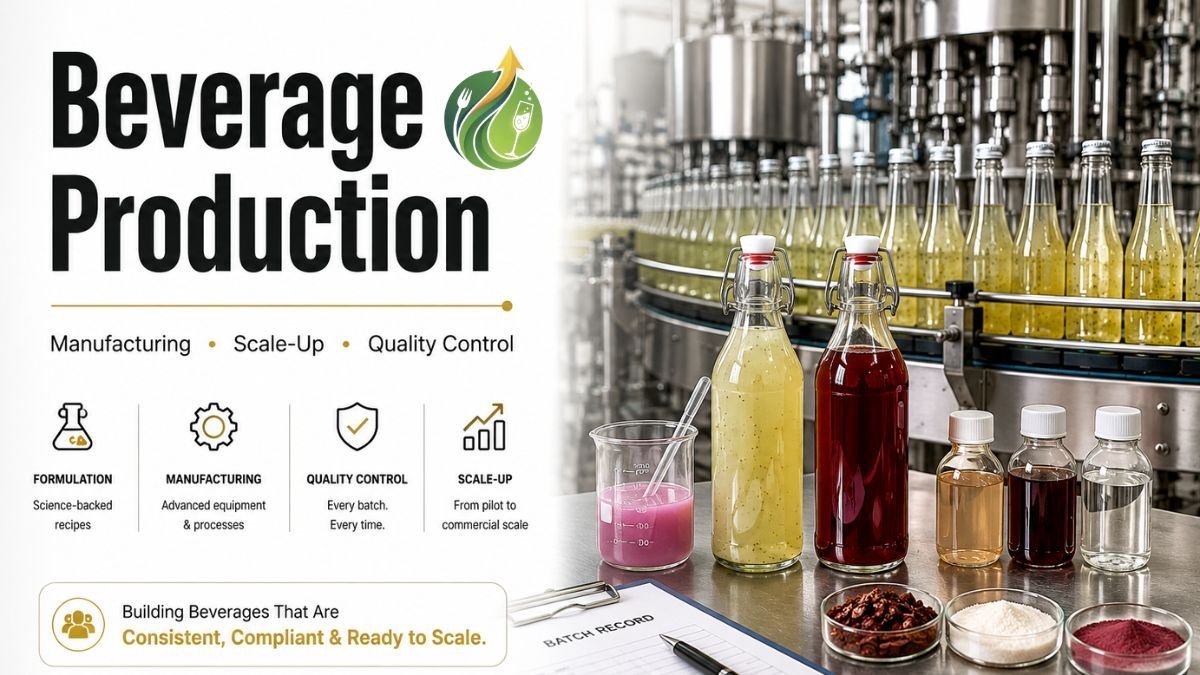
Most people who launch a beverage brand discover the same hard truth about six months in: making a drink and producing a drink are completely different things. The first is creative. The second is engineering, logistics, regulatory compliance, quality control, and supply chain management — all running simultaneously.
Making a drink means mixing ingredients until it tastes right. Producing a beverage means building a system that makes that same drink taste identical in batch number 1 and batch number 10,000, in a factory in Pune and a warehouse in Chennai, in January and July.
This guide is for everyone who wants to understand beverage production at a real operational level — not just a surface-level overview. We’ll cover the full production process, how commercial manufacturing differs from pilot-scale work, what the Indian regulatory landscape demands, where costs come from, and what separates brands that scale cleanly from those that hit a wall at 5,000 units.
If you’re planning to launch a drink or take an existing product to commercial scale, also read our detailed guide on how to start a beverage brand in India — which covers the business and licensing side of this journey.
What is Beverage Production?
Beverage production is the end-to-end process of transforming ingredient inputs into a finished, packaged, shelf-stable drink product that can be legally sold to consumers at commercial scale.
It encompasses every activity between ‘this is my drink idea’ and ‘this is a pallet of finished goods ready for distribution.’ That includes recipe development, ingredient sourcing, pilot manufacturing, quality testing, regulatory compliance, scale-up, packaging design, commercial production, and quality assurance.
What beverage production is NOT: It is not just the manufacturing stage. Many brands make the mistake of treating ‘production’ as only the factory floor work — the filling line, the blending, the packaging. That’s commercial manufacturing, which is one stage within production. The full production process starts much earlier and demands just as much attention at each preceding stage.
PAA Answer: What is the meaning of beverage production? Beverage production is the complete operational process of developing, testing, approving, and commercially manufacturing a packaged drink — from the initial recipe through to finished goods ready for market.
Flavor Catalystz
Planning to scale your beverage beyond small test batches?
From pilot production and formulation optimisation to manufacturer selection and FSSAI compliance — we help beverage brands prepare for real commercial production.
Four Types of Beverages Produced Commercially in India
Understanding the beverage category you’re working in matters because each has different production requirements, machinery, regulatory frameworks, and shelf-life considerations:
| Type | Examples | Key Production Challenge | FSSAI Category |
| Carbonated Soft Drinks | Cola, lemon soda, energy drinks | CO₂ control, sugar accuracy, fill pressure | Carbonated Water & Beverages |
| Still Beverages | Juices, flavoured water, dairy drinks | pH stability, microbiological safety, homogeneity | Fruit Juice / Dairy / Water |
| Functional Beverages | Protein drinks, immunity shots, RTD teas | Ingredient stability, bioavailability, claim compliance | Nutraceutical / Proprietary |
| Fermented Beverages | Kombucha, kefir, probiotic drinks | Live culture count, carbonation control, cold chain | Fermented Foods Category |
For a deep dive into what defines each category, see our article on types of beverages and their production requirements.
The Complete Beverage Production Process: 9 Stages (Not 7)
Most guides cover 6–7 steps of beverage production — and almost all of them skip the stages that cause the most problems in practice. The real production process has 9 stages, and each one is a potential failure point if not handled correctly.
Stage 1: Concept Development & Technical Brief
Before any formulation work begins, a successful beverage production process starts with a rigorous technical brief. This document defines:
- Target consumer & occasion: Who drinks this, when, and why?
- Format & packaging: PET bottle, Tetra Pak, glass, aluminium can, pouch?
- Target price point: Retail price drives backwards to allowable cost of goods
- Shelf life requirement: 3 months? 6 months? 12 months? Ambient or chilled?
- Regulatory constraints: Any ingredients or claims that need FSSAI pre-approval?
- Functional claims: If any health/nutrition claims, what evidence will substantiate them?
Skipping this brief — or keeping it vague — is the single most common cause of wasted money in beverage development. Formulation teams cannot optimise what hasn’t been defined. See our beverage product development guide for a full brief template.
Stage 2: Beverage Formulation & R&D
This is where the drink is actually built. Beverage formulation is the scientific process of selecting ingredients, determining ratios, managing pH, designing a preservative system, and achieving the target flavour profile — all within the constraints of the technical brief.
For a standard flavoured water or carbonated soft drink, bench formulation might take 4–8 weeks. For a functional beverage with active ingredients, immunity claims, or probiotic cultures, the formulation stage can run 3–6 months — especially when ingredient interaction testing and stability pre-screening are included.
Key formulation variables include: base water quality, sweetener system (sugar vs. polyols vs. stevia blends), preservative selection, natural colour stability, flavour intensity under different pH conditions, and ingredient interaction effects. Read our beverage recipe formulation guide for technical detail on each of these.
Critical point: Formulation optimised for a home kitchen or small test batch will almost always need adjustment before commercial production. Ingredient behaviour changes at volume — mixing dynamics, heat exposure during pasteurisation, and fill conditions all affect the final product.
Stage 3: Stability & Compatibility Testing
This is the stage most brands rush — and pay for later. Stability testing answers a single question: does this product still meet its quality specifications after X months under Y conditions?
Types of stability testing required before commercial production:
- Accelerated Shelf Life Testing (ASLT): Product stored at 40°C/75% RH to simulate months of ambient storage. Industry standard for predicting 12-month shelf life within 6–8 weeks of testing.
- Real-Time Stability: Product stored under actual ambient or chilled conditions for the full target shelf life. Required for final validation — ASLT is a predictor, not a guarantee.
- Packaging Compatibility: Does the beverage interact with the packaging material? Acidic products can leach plasticisers from PET. Certain flavour compounds absorb into packaging walls. This must be tested.
- Microbiological Challenge Testing: For beverages with low preservative systems or natural preservation, challenge testing verifies that pathogens cannot grow under realistic conditions.
See our dedicated overview of beverage R&D and testing protocols for a full breakdown of what each test involves and when it’s mandatory.
Stage 4: FSSAI Compliance & Labelling Approval
In India, no beverage can be legally manufactured and sold without meeting FSSAI standards under the Food Safety and Standards Act 2006 and its associated regulations. Compliance work at this stage includes:
- Verifying all ingredients against the approved FSSAI additive and flavour lists
- Confirming permissible levels for each additive (preservatives, colours, sweeteners, acidity regulators)
- Preparing the nutritional information label (per 100ml and per serving)
- Reviewing all front-of-pack claims against FSS (Labelling and Display) Regulations 2020
- For functional/health drinks: substantiating any health or nutrition claims against FSS Health Supplement Regulations 2022
- Ensuring packaging design complies with mandatory labelling requirements (FSSAI logo, allergen declarations, batch coding, expiry format)
FSSAI compliance is not a checkbox — it’s an ongoing responsibility. The regulations are updated regularly. Our detailed guide on FSSAI beverage compliance covers the current regulatory framework and what’s changed in the last 18 months.
For regulatory filing support or if you’re entering the functional/nutraceutical beverage space, the FSSAI official portal is the authoritative source for current standards and product registration requirements.
Stage 5: Pilot Production Run
Pilot production is the bridge between formulation and commercial manufacturing. It involves producing 200–2,000 litres (or equivalent unit count) of the beverage on actual manufacturing equipment — not in a lab environment — to validate that the formula behaves as expected at semi-commercial scale.
What pilot production reveals that bench formulation cannot:
- How the formula behaves in a large-scale blending tank (temperature, mixing time, ingredient dispersion)
- How it responds to commercial pasteurisation or UHT processing — heat can denature proteins, oxidise colours, or damage flavour compounds
- Fill accuracy and carbonation consistency on commercial filling lines
- Sealing integrity and headspace under real fill conditions
- Any texture or appearance changes after cooling from process temperatures
Pilot run samples should go directly into an accelerated stability chamber. Any issues identified at this stage are infinitely cheaper to fix than issues found after a 50,000-unit commercial run.
Real cost implication: A formulation correction at the bench stage costs ₹10,000–50,000. The same correction after a failed commercial production run can cost ₹5–20 lakhs in wasted ingredients, factory time, and relabelling.
Stage 6: Manufacturer Selection & Contract Negotiation
Finding the right contract manufacturer for a beverage in India is more complex than it appears. India has hundreds of beverage contract manufacturing facilities — but the match between your specific product and a facility’s genuine capability is narrower than most brands realise.
What to evaluate when selecting a beverage contract manufacturer:
- Category capability: A facility that excels at carbonated soft drinks may not have the equipment or SOPs for a sensitive probiotic drink or a low-pH fruit juice. Always request a factory audit or at minimum a detailed equipment list.
- Minimum Order Quantities (MOQ): Most Indian beverage contract manufacturers have MOQs of 1,500–5,000 litres per SKU per run. Some premium/functional facilities start at 500 litres but at significantly higher per-unit cost.
- FSSAI licensing status: The manufacturer must hold a valid FSSAI Central licence. Verify this directly on the FSSAI portal before signing anything.
- Quality systems: Look for ISO 22000 or FSSC 22000 certification. BRC Global Standards certification is important for any brand with export ambitions.
- Cold chain capability: If your product requires refrigerated production or cold storage, verify that the facility has genuine maintained cold-chain infrastructure — not just a cold room on paper.
Our guide to beverage contract manufacturing in India covers MOQ norms, facility types, pricing structures, and what every contract should include.
Stage 7: Commercial Production
Commercial beverage production is when your formula leaves the pilot stage and enters full-scale manufacturing. This is a 3–6 month, multi-step operation involving ingredient procurement, blending, treatment, filling, sealing, labelling, and outbound quality control.
The typical commercial beverage production line includes these unit operations:
| Unit Operation | What Happens | Key Quality Control Point |
| Water Treatment | RO + UV + softening to achieve target mineral profile | TDS, hardness, microbial count |
| Ingredient Blending | Measured dosing of all ingredients into blend tank | Brix, pH, viscosity check |
| Heat Treatment | Pasteurisation (72°C/15 sec) or UHT (135°C/3-4 sec) depending on product | Time-temperature validation |
| Carbonation (CSD only) | CO₂ injection at precise pressure and temperature | CO₂ volume, carbonation level |
| Filling & Sealing | Hot fill, cold fill, or aseptic fill depending on product type | Fill weight, seal integrity, headspace |
| Labelling & Coding | Primary label application + batch code + BBD printing | Label alignment, code legibility |
| Final QC & Release | Organoleptic, microbiological, and chemical batch testing | Pass/fail vs. product specification |
For CSD production specifically — carbonated soft drinks, energy drinks, sparkling beverages — see our dedicated guide on carbonated drink production and formulation.
For functional beverage production, which involves additional processing considerations for active ingredients, see functional beverage development.
Stage 8: Quality Assurance & Batch Release
No commercial batch should leave a production facility without a formal Certificate of Analysis (COA) confirming that every measurable parameter meets the product specification. Quality assurance at this stage is not the same as quality control during production — it’s the final gate.
Standard batch release tests for packaged beverages in India:
- Microbiological: Total plate count, E.coli, Salmonella, yeast and mould — mandatory for all food-grade products under FSSAI
- Chemical: pH, Brix (sugar level), preservative concentration, nutritional analysis (protein, carbohydrate, fat, sodium, energy)
- Physical: Fill volume accuracy, net weight, seal integrity, visual appearance
- Organoleptic: Trained panel assessment of taste, aroma, colour, and mouthfeel against reference standard
- Label accuracy: Cross-check declared vs. actual nutritional values, allergen declarations, and mandatory information
Any batch failing one of these parameters must be placed on hold and investigated before release — regardless of pressure from sales or distribution timelines.
Stage 9: Distribution-Ready Packaging & Market Prep
The final stage of beverage production is preparing finished goods for the supply chain: secondary packaging (cartons, shrink wrap, palletisation), cold-chain documentation if required, and the final handoff to the distributor or 3PL.
This stage is where private label brands and white-label products diverge from brand-owned products. If you’re launching under your own brand, this is also when the brand story, product education materials, and retailer onboarding process begins. See our guide to private label beverage manufacturing in India if you’re exploring that model.
Need Help at Any Stage of Beverage Production?
Whether you’re still at formulation or ready for commercial scale-up, Flavor Catalyst’s beverage consultants work alongside you at every production stage. We’ve helped brands across functional drinks, CSDs, dairy beverages, and traditional Indian drinks go from concept to commercial shelf.
Explore Beverage Formulation & Consulting
Commercial Beverage Production vs. Pilot Production: What Actually Changes
The jump from pilot production to commercial beverage production is where many brands encounter their first serious operational crisis. Not because the product is bad — but because scale introduces variables that simply don’t exist at small batch sizes.
| Variable | Pilot Scale (200–2,000L) | Commercial Scale (5,000L+) |
| Blending dynamics | Manual or small paddle mixer; easy to control | Large tank creates vortex, heat buildup, uneven dispersion |
| Heat treatment | Lab pasteuriser or water bath; gentle | Plate heat exchanger; faster, higher shear stress on emulsions |
| Ingredient dosing | Manual, gram-accurate weighing | Automated volumetric dosing; small % error compounds at volume |
| Carbonation (CSD) | Bench carbonator; stable conditions | In-line carbonator; temperature-sensitive; foam risk |
| Fill consistency | Gravity fill or hand-fill; slow but precise | High-speed rotary filler; fill variation increases |
| Colour & flavour | Stable in small tank, controlled temp | Oxidation and Maillard reactions possible in hot large tank |
| QC sampling | 100% visual check possible | Statistical sampling plan required; not every bottle inspected |
The most common production failures at commercial scale are: flavour drift (product tastes different from pilot), colour change (oxidation or pH shift during processing), fill inconsistency, and microbiological failure (inadequate heat treatment). All of these are preventable with proper pilot validation.
Our beverage formulation cost guide breaks down the real cost implications of each production stage in India — including what it actually costs to fix a failure at commercial scale versus catching it during R&D.
Beverage Production in India: The 2026 Landscape
India’s beverage manufacturing ecosystem has evolved significantly over the last five years. The infrastructure now exists to produce almost any category of drink at commercial scale — but it is not uniformly distributed or equally capable.
Manufacturing Hubs for Beverage Production in India
- Himachal Pradesh (Baddi/Nalagarh): India’s largest beverage manufacturing cluster. Tax incentives drove heavy investment — most major national brands contract-produce here. Strong in CSD, juices, and packaged water.
- Maharashtra (Pune/Nashik/Mumbai belt): Strong in premium beverages, dairy drinks, and exports. Nashik specifically for wine and fermented beverages.
- Rajasthan (Neemrana): Growing FMCG production hub; several mid-sized beverage contract manufacturers with good quality systems.
- Gujarat (Ahmedabad, Surat): Major packaged water and CSD manufacturers. Good raw material supply chain for flavours and colours.
- Delhi NCR: Multiple co-packing and toll manufacturing facilities. Good for smaller brands needing flexible MOQs.
- South India (Bangalore, Hyderabad, Chennai): Growing functional beverage manufacturing capability. Strong for RTD tea, coffee, and nutraceutical drinks.
What is CSD in Manufacturing?
CSD stands for Carbonated Soft Drinks — the largest single category in India’s packaged beverage manufacturing sector by volume. CSD production involves dissolving CO₂ gas into a beverage under pressure, requiring specialised carbonation and filling equipment. CSD manufacturing lines are typically separate from still beverage lines due to the pressurised filling requirements.
The carbonation level (measured in ‘volumes of CO₂’) must be precise — too low and the drink seems flat, too high and it foams on opening or creates internal pressure in packaging. CSD production requires tighter temperature control than still beverages, particularly during filling, because CO₂ solubility decreases as temperature rises.
For a full breakdown of CSD formulation and production, see our guide on carbonated drink formulation and production.
What is an F&B Company? (In the Production Context)
In the production context, an F&B company (Food & Beverage company) can mean: (a) a brand that owns a recipe and sells under its own name but contracts production to a third party, (b) a manufacturer that produces beverages for multiple clients, or (c) an integrated company that both owns brands and operates its own manufacturing. For most startups and growing brands in India, model (a) is the most capital-efficient — own the formula and brand, contract the manufacturing.
Beverage Production Cost in India: Real Numbers for 2026
One of the most common questions we hear from founders: ‘How much does it cost to produce a beverage in India?’ The answer is highly variable — but here’s a realistic framework:
| Cost Component | Budget CSD (₹/L) | Premium Functional (₹/L) | Notes |
| Raw materials | ₹8–15 | ₹40–120 | Biggest variable — functional ingredients expensive |
| Contract manufacturing | ₹12–20 | ₹25–50 | Includes processing, fill, seal, label |
| Packaging materials | ₹6–14 | ₹20–60 | Glass/premium pack significantly more |
| Quality testing | ₹2–4 | ₹5–12 | Per-batch lab testing costs |
| Regulatory / compliance | ₹1–2 | ₹3–8 | Amortised over production volume |
| Freight & logistics | ₹3–6 | ₹5–10 | Cold chain adds ₹8–15/L additional |
| Total COG (approx.) | ₹32–61/L | ₹98–260/L | Before brand margin and trade margin |
Key insight: For a ₹60 retail price 250ml PET bottle of a functional drink, your allowable COGS is roughly ₹15–18 (assuming 60–65% gross margin for D2C, lower for traditional retail). At ₹150–250/L production cost, this is a very tight box — which is why formulation decisions and ingredient selection have a direct impact on business viability.
For a complete cost breakdown including R&D investment, regulatory filing costs, and pilot run costs, see our beverage formulation cost guide.
5 Most Common Beverage Production Failures (and How to Prevent Each)
1. Formula Drift on Scale-Up
What happens: The commercial production batch tastes noticeably different from the pilot — often a muted flavour, different sweetness perception, or colour change.
Why it happens: Heat exposure during large-scale pasteurisation degrades volatile flavour compounds. Mixing time and shear in a large tank is different from a bench blender. pH may shift slightly under industrial conditions.
Prevention: Include heat stability testing in the formulation stage. Run a ‘stress test’ — hold the formula at process temperature for the production equivalent time. Adjust flavour dosage upward if needed to compensate for heat-related loss.
2. Microbiological Failure in Shelf Life
What happens: Product passes launch quality control but fails microbiological tests at 3 or 6 months, or consumer complaints emerge about spoilage.
Why it happens: Inadequate preservative system, underdosing of preservative at commercial scale, pH slightly higher than specification allowing microbial growth, or poor filling line hygiene resulting in post-process contamination.
Prevention: Run full microbiological challenge testing, not just standard plate count. Validate the heat treatment process against target log reduction. Test final product pH against target specification at every batch.
3. Packaging Incompatibility
What happens: After a few weeks, the product develops an off-taste, discolouration, or unusual aroma. The product itself was fine — the packaging is causing the problem.
Why it happens: Acidic beverages can leach additives from PET if the packaging grade isn’t appropriate. Flavour compounds absorb into packaging walls (scalping). Oxygen transmission through thin packaging causes oxidation.
Prevention: Specify food-grade PET with appropriate wall thickness and oxygen barrier. Test packaging compatibility during the stability phase — keep samples in final packaging, not glass, for stability testing.
4. FSSAI Non-Compliance Discovered Post-Launch
What happens: A health claim on the label is challenged, an additive exceeds permitted levels, or a labelling requirement is missing — discovered after commercial production has begun.
Why it happens: Compliance review was done superficially or by someone unfamiliar with current FSSAI regulations. The FSS regulations are updated regularly — a format compliant 18 months ago may not be compliant today.
Prevention: Commission a formal FSSAI compliance audit before finalising any label. Use a beverage consultant with current regulatory knowledge, not just a generic food safety consultant.
5. Cost Overrun Making the Product Commercially Unviable
What happens: After commercial production begins, the COGS is significantly higher than projected — making target retail price either impossible or grossly margin-negative.
Why it happens: Ingredient costs weren’t locked with suppliers, pilot-scale waste ratios were used to project commercial costs, or the formula includes expensive functional ingredients whose dose wasn’t validated for cost-efficacy.
Prevention: Build the cost model before the formula is finalised, not after. Every ingredient choice is a cost decision. For functional ingredients especially, verify the minimum effective dose before locking the formula.
Beverage Production for Specific Categories: What’s Different
Energy Drink Production
Energy drink production involves additional regulatory and formulation complexity beyond standard CSD. FSSAI has specific permitted limits for caffeine (maximum 320mg/L in India), taurine, B-vitamins, and other stimulants. Carbonation levels are typically higher than soft drinks. The formulation must also manage bitterness from caffeine and vitamins, which requires more sophisticated flavour masking.
See our detailed guide on launching an energy drink brand in India for a full category-specific production walkthrough.
Functional Beverage Production
Functional beverages — drinks with added health benefits — present the most complex production challenges of any non-alcoholic category. Active ingredients like adaptogens, probiotics, protein, and vitamins all have specific stability requirements, interaction risks, and regulatory constraints. Functional beverage development requires an R&D team experienced with ingredient interaction testing, not just flavour development.
Non-Alcoholic Beverage Production
Non-alcoholic beverages as a production category spans everything from packaged water to sparkling mocktails. The unifying production requirement is ensuring flavour stability and safety without the natural preservation effect of alcohol. Non-alcoholic beverage development in India is growing at 18%+ annually as premium F&B consumers seek sophisticated alternatives.
Sparkling Beverage Production
Sparkling beverages — including premium sparkling water, sparkling teas, and low-sugar sparkling juices — are a distinct production category that sits between still beverages and traditional CSD. They require carbonation infrastructure but often involve more delicate ingredients that need careful process handling. See sparkling beverage development guide for production-specific guidance.
Conclusion: Beverage Production is a System, Not a Single Step
The most important shift in mindset for anyone entering commercial beverage production: stop thinking about production as ‘making the drink’ and start thinking about it as designing and operating a system that reliably reproduces your drink — at any volume, in any batch, across any season — to the same specification every time.
That system involves science (formulation), regulatory knowledge (compliance), engineering (manufacturing), quality management (QA), and supply chain coordination (procurement, logistics). No single person can hold all of this. The brands that succeed at commercial scale are the ones who build or partner with the right expertise at each stage.
Whether you’re at the concept stage, stuck in pilot production, or preparing for your first major commercial run, Flavor Catalyst’s beverage production and formulation team is structured to plug into your project at exactly the stage you need us. We don’t do generic advice — we do specific, actionable production guidance for the Indian market.
Also worth reading: Beverage industry trends shaping production decisions in 2026 — a strategic companion to this guide.
FAQ: Beverage Production Questions Answered
Q1. What is the meaning of beverage production?
Beverage production is the complete process of converting ingredient inputs into a finished, packaged, shelf-stable drink that meets quality, safety, and regulatory standards — ready for commercial sale. It includes recipe development, formulation testing, stability trials, FSSAI compliance, pilot manufacturing, and full commercial production.
Q2. What is the beverage production process?
The beverage production process has 9 stages: (1) Concept & Technical Brief, (2) Beverage Formulation & R&D, (3) Stability & Compatibility Testing, (4) FSSAI Compliance & Labelling, (5) Pilot Production Run, (6) Manufacturer Selection, (7) Commercial Production, (8) Quality Assurance & Batch Release, (9) Distribution-Ready Packaging. Skipping or rushing any of these stages creates downstream problems that are significantly more expensive to fix.
Q3. What is commercial beverage production?
Commercial beverage production is the full-scale manufacturing stage — where a validated, FSSAI-compliant formula is produced at commercial volumes (typically 5,000 litres+) on industrial equipment. It involves water treatment, ingredient blending, heat treatment, filling, sealing, labelling, and final QC. Commercial production differs from pilot production in scale, equipment type, and the compounding effect of any small parameter variations.
Q4. What are the four types of beverages?
The four primary commercial beverage categories are: (1) Carbonated Soft Drinks (CSD) — cola, lemon soda, energy drinks; (2) Still Beverages — juices, flavoured water, dairy drinks, packaged water; (3) Functional Beverages — protein drinks, immunity shots, RTD teas with active ingredients; (4) Fermented Beverages — kombucha, kefir, probiotic drinks. Each category has different production requirements and regulatory frameworks.
Q5. What is CSD in manufacturing?
CSD stands for Carbonated Soft Drink. In manufacturing, CSD refers to the category of beverages produced by dissolving CO₂ gas into a flavoured liquid under pressure. CSD production requires specialised carbonation and pressurised filling equipment, tighter temperature control than still beverages, and packaging capable of withstanding internal CO₂ pressure. CSD is the largest packaged beverage category by production volume in India.
Q6. What is an F&B company in the context of beverage production?
An F&B (Food & Beverage) company involved in beverage production can be: (a) a brand owner that outsources manufacturing to a contract manufacturer, (b) a contract manufacturer that produces beverages for multiple brand clients, or (c) an integrated brand that owns both the formula and the factory. Most Indian beverage startups operate as brand owners with contract manufacturing — it requires less capital than owning a factory and allows focus on formulation, brand, and distribution.
Q7. What are the top 5 beverages produced in India?
By production volume, India’s top 5 produced beverages are: (1) Packaged water (largest category, 40%+ of packaged beverage volume), (2) Carbonated soft drinks (Thums Up, Sprite, Pepsi), (3) Fruit juices and nectars (Tropicana, Real, Maaza), (4) Energy and functional drinks (Red Bull, Sting, Monster), (5) Dairy beverages (packaged lassi, flavoured milk, buttermilk). Chai remains India’s highest-consumed beverage overall but most consumption is unpackaged.
Q8. What is the 3 drink rule in F&B context?
The ‘3 drink rule’ is a hospitality and beverage service guideline — not a production standard. It refers to the industry practice of recommending that consumers not exceed 3 alcoholic drinks in a service occasion. In the context of this production guide, it is not directly applicable. If you’re asking about production batch management, most production SOPs use a 3-sample rule for batch QC: sample from beginning, middle, and end of each production run.
Q9. How much does commercial beverage production cost in India?
Beverage production cost in India ranges from ₹32–61 per litre for a standard budget CSD to ₹98–260 per litre for a premium functional beverage. The main cost components are raw materials (biggest variable), contract manufacturing charges, packaging materials, quality testing, and logistics. Functional ingredients are the primary driver of high COGS in premium drinks — which is why formulation cost-optimisation is a core part of the production planning process.
Q10. Do I need an FSSAI licence to produce a beverage in India?
Yes — any beverage manufactured for commercial sale in India requires FSSAI licensing. The manufacturer must hold a Central FSSAI licence (if distributing across states). If you are commissioning a contract manufacturer, their FSSAI licence covers the production — but the product formula, label, and any health claims are still your responsibility as the brand owner. Some proprietary food or nutraceutical products may require additional product-specific approvals beyond the standard manufacturing licence.