May 2026 · 12 min read
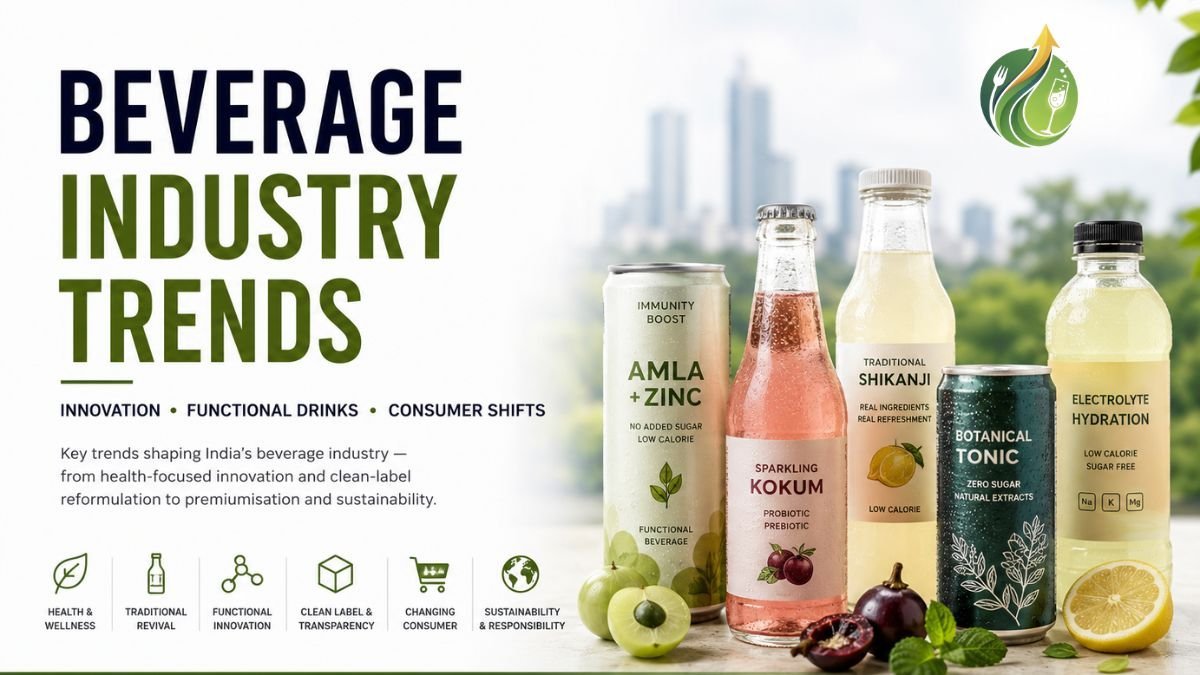
Something significant is happening in the Indian beverage aisle — and it has nothing to do with a new cola flavor. The beverage industry in India is going through a structural reinvention: consumers are reading ingredient labels, rejecting artificial preservatives, seeking drinks that actively support their health, and reaching for beverages that carry genuine cultural or functional identity.
The global beverage industry is projected to reach USD 3.4 trillion by 2034, with India among the fastest-growing markets in Asia-Pacific. The beverage industry trends that defined 2024–25 are accelerating in 2026 — and brands, founders, and formulation teams that understand them have a real competitive advantage.
Here are the 12 most important beverage industry trends shaping India in 2026 — with market context, formulation implications, and commercial opportunity for each.
What Is the Beverage Industry? A Quick Overview
The beverage industry encompasses all businesses involved in the development, production, marketing, and distribution of drinks for human consumption. It is divided into two primary segments: alcoholic beverages (beer, wine, spirits) and non-alcoholic beverages (water, soft drinks, juices, tea, coffee, functional drinks). In India, the non-alcoholic beverage industry is significantly larger by volume, with the alcoholic segment leading in value.
| Metric | India | Global |
| Non-Alcoholic Beverage Market | ~USD 14–16 Billion (2025) | USD 2+ Trillion (2030 proj.) |
| Overall Beverage Market | ~USD 25–28 Billion (2025) | USD 3.4 Trillion by 2034 |
| Market Growth Rate | 8–12% CAGR | 6–8% CAGR global average |
| Fastest-Growing Segment | Functional & Health Beverages | Non-alcoholic & wellness |
| Key Consumer Driver | Health, authenticity, value | Health, sustainability, premiumization |
12 Beverage Industry Trends Defining India in 2026
Trend 1: Functional Beverages Take Centre Stage
Functional beverages — drinks formulated to deliver specific health benefits beyond basic nutrition — are the defining trend of the beverage industry in 2026. Indian consumers are increasingly choosing drinks that solve a problem: improve digestion, boost immunity, reduce stress, enhance focus, or support hydration. The functional beverage market in India is growing at 15–25% CAGR, significantly outpacing the overall beverage market.
Key categories: Immunity drinks (Vitamin C, zinc, elderberry), gut health beverages (probiotics, prebiotics, postbiotics), adaptogen drinks (ashwagandha, brahmi, lion’s mane), protein-fortified RTDs, and electrolyte drinks. India’s Ayurvedic ingredient heritage gives domestic brands an authenticity advantage over imported functional drinks.
Trend 2: Sober-Curious and Low/No Alcohol Beverages Booming
The sober-curious movement — where consumers actively reduce or eliminate alcohol without giving up social drinking — is reshaping the beverage industry globally and increasingly in urban India. Brands like Coolberg (NA beer), Jimmy’s Cocktails (cocktail mixers), and Bira91 NA have demonstrated significant demand for sophisticated non-alcoholic alternatives. Globally, the NA beverage category is projected to grow at 7–9% CAGR through 2030.
India opportunity: Premium bars, corporate events, airlines, and dry-state distribution represent massive untapped channels for well-formulated NA sparkling beverages and botanical cocktail alternatives.
Trend 3: Traditional Indian Drink Revival — Premiumization of Heritage
One of the most powerful and distinctly Indian beverage industry trends is the commercial revival of traditional drinks. Paper Boat pioneered this category, and now a second wave of brands is going deeper — Lahori Zeera for jeera soda, regional startups for Kokum Sharbat, Aam Panna, Sattu drink, Thandai, and Nannari Sharbat. These drinks carry authentic Indian identity, have functional ingredient profiles, and compete directly against imported flavors at premium price points.
Formulation challenge: Standardizing seasonal raw ingredients (raw mango, kokum, tamarind) into shelf-stable commercial products while preserving authentic flavor. This is exactly where specialist beverage formulation partners add value.
Trend 4: Gut Health Beverages — Probiotics, Prebiotics, Postbiotics
Gut health is the most searched wellness topic in India among urban millennials, and the beverage industry is responding. Probiotic beverages (kombucha, probiotic lassi, probiotic chaas), prebiotic drinks (inulin and FOS-fortified beverages), and fermented traditional drinks (kanji, kefir-style drinks) are all experiencing rapid growth. The global gut health beverage market is projected to exceed USD 50 billion by 2030.
India advantage: India’s traditional fermented beverage heritage — chaas, kanji, rice-based fermented drinks from Northeast India — gives local brands a genuine authenticity edge in this global trend.
Trend 5: Sugar Reduction and Clean Label Reformulation
FSSAI’s front-of-pack (FoP) labeling mandate and growing consumer awareness are accelerating sugar reduction across the entire Indian beverage industry. Legacy CSD brands are reformulating with stevia, monk fruit, and sucralose blends. New brands are launching sugar-free from day one. Simultaneously, the clean label movement — shorter ingredient lists, no artificial colors, no synthetic preservatives — is becoming a purchasing criterion even in mass-market segments.
Formulation implication: Sugar-free beverage development is technically complex — sweetener selection, mouthfeel restoration, and off-note masking require expert formulation. Brands need development partners who understand the science, not just the label claim.
Trend 6: AI-Powered Beverage Formulation
AI-powered beverage development is transitioning from hype to practical reality in 2026. AI tools are being used to predict flavor compound compatibility, model shelf life outcomes from ingredient combinations, identify sourcing optimizations, and analyze consumer preference data to guide R&D direction. This accelerates development timelines, reduces expensive trial iterations, and democratizes food science capabilities for smaller brands.
India context: AI formulation tools are being integrated into beverage development workflows by specialist partners — enabling faster development at lower cost, which is particularly valuable for startups and D2C brands with limited R&D budgets.
Trend 7: Plant-Based and Alternative Protein Beverages
Plant-based beverage adoption is accelerating in urban India. Oat milk, nut milks (almond, cashew, peanut), pea protein drinks, and soy-based beverages are moving from premium stores to mainstream retail. India’s enormous dairy-consuming population also represents a target for protein-enriched dairy alternatives that bridge cultural familiarity with health positioning. The global plant-based beverage market is growing at 11% CAGR.
India-specific opportunity: Sattu drink (roasted gram protein) is India’s indigenous protein beverage — it has 20–25g protein per glass and is perfectly positioned as a culturally authentic plant-based protein RTD.
Trend 8: Premiumization — Consumers Paying More for Better
India’s expanding urban middle class is demonstrating a clear willingness to pay premium prices for beverages that deliver superior quality, authentic ingredients, and better health outcomes. The premiumization trend is visible across every category — premium packaged water (glass bottles, Himalayan spring water), premium fruit juices (cold-pressed NFC), premium traditional drinks, premium energy drinks (natural caffeine sources), and premium NA spirits.
Market signal: Products priced above ₹60/unit in the beverage category are growing at 2–3x the rate of the sub-₹30 mass market. Quick-commerce platforms (Blinkit, Zepto) have made premium beverages accessible to urban consumers in a way that was not possible through traditional distribution.
Trend 9: Adaptogen and Nootropic Beverages for Mind-Body Wellness
Adaptogens (ingredients that help the body manage stress — ashwagandha, brahmi, tulsi, rhodiola) and nootropics (ingredients that support cognitive function — lion’s mane mushroom, ginkgo biloba, bacopa) are becoming mainstream beverage ingredients. The convergence of Ayurveda and modern functional beverage science gives Indian brands a massive advantage in this global trend — these ingredients are indigenous to India, well-documented in Ayurvedic literature, and increasingly validated by modern research.
Key formulation challenge: Adaptogens have strong, often bitter flavor profiles that must be masked effectively without adding sugar or artificial flavors. Encapsulation and flavor-masking technologies are critical for this category.
Trend 10: Sustainability and Eco-Packaging Gaining Consumer Weight
Sustainability is transitioning from a compliance requirement to a genuine purchase driver in the Indian beverage industry, particularly among Gen Z consumers in urban markets. Brands are responding through glass bottle packaging (perceived as premium and recyclable), reduced plastic (thinner PET walls, refillable formats), sustainably sourced ingredients, and carbon-neutral production commitments. Extended Producer Responsibility (EPR) regulations from MoEFCC are also pushing manufacturers toward more sustainable packaging choices.
Brand opportunity: Sustainability claims on beverage packaging are significantly correlated with premium pricing acceptance — consumers pay 15–20% more for beverages in glass versus PET in the same product category.
Trend 11: D2C + Quick Commerce Reshaping Distribution
The distribution infrastructure available to beverage brands in India has transformed dramatically. Quick-commerce platforms (Blinkit, Zepto, Swiggy Instamart) now deliver beverages in under 15 minutes, enabling challenger brands to reach urban consumers without the traditional multi-year modern trade relationship-building process. D2C beverage brands are building direct consumer relationships through Instagram, YouTube, and health community platforms.
Strategic implication: The minimum viable product for a new beverage brand in India is now a single well-formulated SKU, strong packaging, and a focused quick-commerce launch — not a 500-city distribution network. This has democratized beverage entrepreneurship.
Trend 12: GLP-1 Economy — Protein-Rich ‘Mini Meal’ Beverages
One of the most talked-about global beverage industry trends in 2026 is the emergence of the “GLP-1 economy” — the growing population of GLP-1 receptor agonist users (weight management medication) who need high-protein, nutrient-dense beverages to maintain nutrition on reduced food intake. In India, the broader trend translates to rising demand for protein-enriched RTD beverages (25–35g protein per serving) that function as portable, convenient meal supplements.
India opportunity: Sattu RTD, whey protein beverages, soy-protein drinks, and hybrid dairy-plant protein blends positioned as ‘meal-in-a-bottle’ products are well-aligned with this trend at accessible Indian price points.
Beverage Industry in India: What Makes It Unique
India’s beverage industry operates differently from Western markets in several fundamental ways that every brand and formulator must understand:
- Heat-Driven Seasonality: India’s intense summer (March–June) drives 40–50% of annual non-alcoholic beverage sales, creating formulation requirements for heat-stable, refreshing, thirst-quenching products that remain absent in most Western market frameworks.
- Ayurvedic Ingredient Advantage: No other country has India’s depth of functional ingredient heritage — ashwagandha, turmeric, brahmi, tulsi, triphala, amla — that can be legitimately integrated into mainstream beverages with both traditional credibility and modern research backing.
- Regional Diversity as Product Strategy: India is 28 states with distinct beverage cultures — Kokum in Goa, Neer Mor in Tamil Nadu, Sattu in Bihar, Thandai in Rajasthan, Aam Panna in Maharashtra. Each represents a distinct product development opportunity.
- Price-Value Sensitivity: India’s beverage market spans from ₹5 sachets to ₹500+ premium bottles, requiring brands to be precise about their target price-value positioning before any formulation or packaging decision is made.
- FSSAI Regulatory Framework: India’s FSSAI regulations are distinct from EU or FDA frameworks, requiring India-specific compliance for additives, health claims, label design, and product categorization.
Why Choose the Food and Beverage Industry? The Case for Entrepreneurs in 2026
The beverage industry is one of the most accessible and resilient sectors for entrepreneurship in India. Here’s why founders, investors, and brand managers are choosing the food and beverage industry:
- Beverages are consumed daily by everyone — the total addressable market is essentially 1.4 billion people
- Contract manufacturing makes production accessible without ₹10+ crore factory investment
- D2C and quick-commerce platforms have eliminated the distribution barrier that historically blocked challenger brands
- The beverage industry’s innovation cycle is fast — new products can reach market in 10–16 weeks with the right development partner
- Indian consumer premiumization means margins are expanding, not just volumes
- Sustainability and health megatrends are pulling the entire category upward — early movers in functional and authentic categories capture outsized value
How Flavor Catalyst Helps Brands Navigate Beverage Industry Trends
Knowing the trends is one thing. Translating them into commercially viable products is another. Flavor Catalyst works at the intersection of beverage science, regulatory knowledge, and market strategy to help Indian beverage brands turn trend insights into shelf-ready products.
What we do for beverage trend-led product development:
- Identify which trend your concept is riding and how to sharpen the positioning
- Develop FSSAI-compliant formulations with functional ingredients (adaptogens, probiotics, vitamins) at effective, legal doses
- Reformulate existing products for sugar reduction or clean label compliance
- Develop traditional Indian drink recipes into shelf-stable, commercially scalable products
- Connect you with CSD-capable, probiotic-capable, or UHT-capable contract manufacturers
For global beverage industry market data, see EY India: Beverage Industry Trends and Ministry of Food Processing Industries — Beverages Sector.
Explore More From Flavor Catalyst
- Functional Beverage Development India
- Non-Alcoholic Beverage Development India
- Beverage Product Development: From Concept to Shelf
- Traditional Drink Formulation India
- Beverage Formulation Cost India
- How to Start a Beverage Brand in India
Conclusion: The Beverage Industry Is Being Rewritten — Be Part of It
The beverage industry trends of 2026 are not incremental — they are structural. The shift from sugar to health, from synthetic to authentic, from mass to premium, from distribution-gated to D2C-accessible, is creating a once-in-a-generation opportunity for beverage brands that understand what is happening and have the formulation capability to respond.
India’s beverage industry is no longer just following global trends — it is originating them. Traditional Indian drinks, Ayurvedic functional ingredients, and regional flavor diversity are becoming global exports. The brands that win the next decade are being built today — starting with a great formulation.
FAQs
What is the beverage industry?
The beverage industry includes all businesses that develop, produce, market, and distribute drinks — both alcoholic (beer, wine, spirits) and non-alcoholic (water, juices, soft drinks, tea, functional beverages). In India, it is a ~USD 25–28 billion market growing at 8–12% CAGR.
What are the top beverage industry trends in India in 2026?
The top 12 trends are: (1) Functional beverages, (2) Sober-curious/NA drinks, (3) Traditional Indian drink revival, (4) Gut health beverages, (5) Sugar reduction and clean label, (6) AI-powered formulation, (7) Plant-based beverages, (8) Premiumization, (9) Adaptogen/nootropic drinks, (10) Sustainability and eco-packaging, (11) D2C and quick-commerce growth, (12) Protein-rich ‘mini meal’ beverages.
What are the four types of beverages?
The four broad types are: (1) Alcoholic beverages (beer, wine, spirits), (2) Hot non-alcoholic beverages (tea, coffee), (3) Cold non-alcoholic beverages (water, juices, sodas, functional drinks), (4) Dairy and plant-based beverages (milk, lassi, nut milk, flavored milk).
Who is the largest beverage company in the world?
Coca-Cola Company is the largest non-alcoholic beverage company globally by market capitalization and revenue. In India, Hindustan Coca-Cola Beverages (HCCB) and Varun Beverages (PepsiCo’s largest Indian bottler) are the dominant non-alcoholic beverage companies.
What is the beverage industry growth rate in India?
India’s overall beverage market is growing at approximately 8–12% CAGR. The functional and health beverage sub-segment is growing at 15–25% CAGR. Premium beverages priced above ₹60/unit are growing at 2–3x the rate of the mass market.
Why choose the food and beverage industry as an entrepreneur?
The beverage industry is accessible (contract manufacturing eliminates large capex), the total market is enormous (1.4B consumers), development timelines are fast (10–16 weeks to first production), and premiumization is expanding margins. D2C and quick-commerce platforms have eliminated the distribution barrier, making it the best time to launch a challenger beverage brand in India.