Apr 2026 · 8 min read
Every beverage brand visible on a retail shelf or quick-commerce platform today started with one decision: finding the right beverage consultant.
The formulation, the regulatory clearances, the stability data, the co-packer relationships — none of it comes together without a structured consulting partnership built on real food science. And in a market as complex as India — where consumer tastes are hyper-regional, FSSAI compliance is non-negotiable, and the RTD boom is accelerating faster than most brands can keep pace with — that decision matters more than ever.
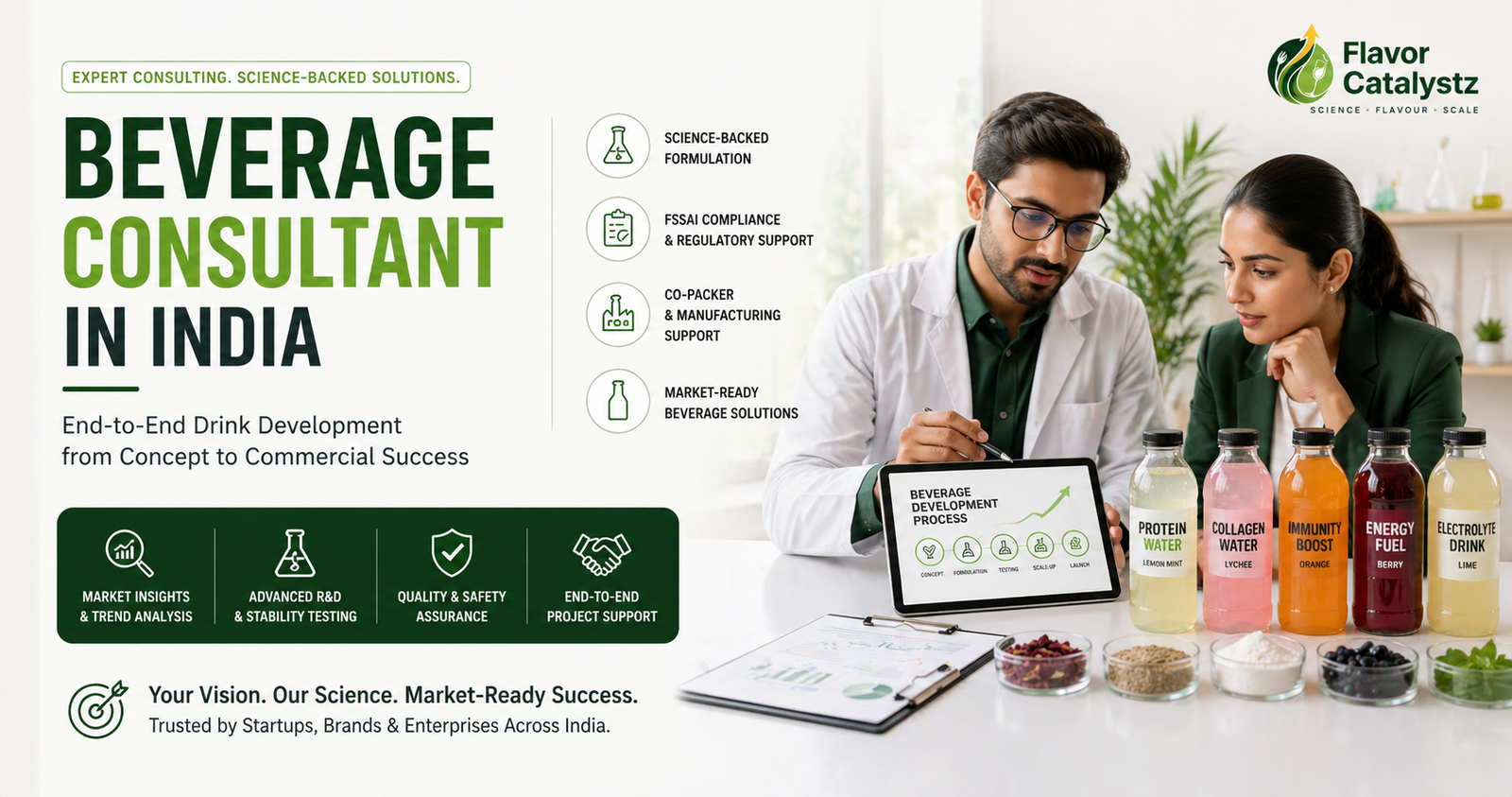
Flavor Catalystz is a premium food and beverage consultancy in India, specialising in concept-to-commercial product development across RTD beverages, functional drinks, nutraceuticals, and food products. This page explains exactly what a beverage consultant does, when you need one, what the full process looks like, and what it costs — so you can make a well-informed decision before your first development call.
What Is a Beverage Consultant?
A beverage consultant is a technical and strategic partner who guides a brand through every phase of drink development — from the initial concept and ingredient sourcing, through laboratory formulation and stability testing, to regulatory compliance, packaging specification, and commercial-scale manufacturing.
The role bridges food science and business strategy. A capable beverage consultant does not simply create a formula. They ensure that the formula is shelf-stable, FSSAI-compliant, cost-efficient at commercial scale, and built around a consumer insight that gives the finished product a credible position in the market.
India’s RTD market is projected to grow from $20 billion in 2026 to $40 billion by 2030, driven by rising demand for functional hydration, protein drinks, and clean-label functional beverages. Working without a qualified beverage consultant in this environment is one of the most expensive risks a startup founder can absorb.
What Does a Beverage Consultant Do?
The scope of a beverage consultant’s work spans six core areas.
Market Research and Concept Validation Before a single ingredient is ordered, the consultant evaluates the market landscape: category gaps, competitor benchmarking, consumer trend data, and pricing architecture. This stage determines whether the product concept has a viable commercial route and prevents expensive development work on ideas the market is not ready for.
Beverage Formulation and Recipe Development This is the technical core of the engagement. The consultant’s food scientists develop and iterate on formulations across multiple parameters simultaneously: taste, clarity, texture, nutritional profile, and ingredient compatibility. For complex categories — protein water, functional sodas, adaptogenic drinks, probiotic beverages — this phase requires deep category expertise that generalist developers typically do not possess.
Stability Testing and Shelf-Life Studies A beverage that tastes exceptional in the lab but turns cloudy, separates, or loses nutritional potency within three months on shelf is commercially inviable. Accelerated stability studies evaluate how the product behaves across temperature, light exposure, and time — and determine the processing method (UHT, HTST, high-acid aseptic) required to achieve a retailer-viable shelf life of 12 months or more.
FSSAI Compliance and Regulatory Navigation Every beverage sold in India must operate within FSSAI’s regulatory framework. Claims such as “High in Protein,” “Rich in Vitamin C,” or “Probiotic” each carry specific thresholds and documentation requirements. An experienced beverage consultant manages the full compliance layer — from product registration and label review to nutritional claim validation — so founders can focus on building the brand rather than managing regulatory risk.
Packaging Specification and Sourcing Packaging is not a finishing decision — it is a formulation variable. The choice between PET, glass, Tetra Pak, aseptic pouch, or aluminium can directly affects shelf life, processing compatibility, consumer perception, and unit economics. A beverage consultant aligns packaging selection with the product’s technical requirements and the brand’s commercial strategy from the beginning, not after production has started.
Co-Packer Identification and Scale-Up Support Transitioning from a validated lab formula to commercial production is where most new beverage brands encounter their most expensive problems. A beverage consultant with an established co-manufacturing network accelerates this transition, manages the pilot batch process, and ensures that production parameters are correctly transferred before the first full commercial run.
Beverage Categories Flavor Catalystz Specialises In
Flavor Catalystz works across the full spectrum of non-alcoholic beverage development:
RTD Functional Beverages — Protein water, electrolyte drinks, collagen water, immunity shots, and energy beverages. Formulation complexity in this category is high — pH management, protein solubility, stability engineering, and clean-label ingredient selection all require specialist experience.
Fruit-Based and Juice Drinks — Fresh-pressed, cold-pressed, NFC juice, and juice-blended formats with functional ingredient integration: vitamins, minerals, and adaptogens.
Dairy and Plant-Based Beverages — Flavoured milk, oat milk, almond milk, and plant-based protein drinks, formulated for taste, texture, and FSSAI compliance under the relevant product categories.
Herbal and Ayurvedic Drinks — Beverages built around traditional Indian botanicals — tulsi, ashwagandha, moringa, giloy — developed with clinical ingredient credibility and mass consumer palatability as co-equal design objectives.
Sparkling and Carbonated Functional Drinks — Probiotic sodas, sparkling protein water, and functional sparkling beverages. CO2 management, protein stability under carbonation pressure, and carbonation-level compliance add formulation complexity that requires specific category expertise.
Nutraceutical Beverages — Drinks positioned in the health and wellness segment with validated functional claims: sports recovery, cognitive support, sleep, and gut health. These require both food science depth and nutraceutical regulatory knowledge to bring to market correctly.
The Flavor Catalystz Development Process
Every engagement follows a structured, milestone-based methodology that minimises development time, eliminates avoidable cost, and delivers a commercially viable product.
Stage 1 — Discovery Brief A detailed brief covering target consumer, use case, competitive landscape, price architecture, and distribution channel. This brief governs every formulation and regulatory decision that follows.
Stage 2 — Formulation Development Lab-scale trials producing multiple prototype variants. Trained sensory panel evaluation. Selection and iterative refinement of the winning formulation based on taste, functionality, clarity, and cost.
Stage 3 — Stability and Compliance Validation Accelerated shelf-life studies across temperature and light exposure conditions. FSSAI label review. Nutritional claim verification. Processing protocol determination.
Stage 4 — Pilot Batch Execution Transitioning the validated formula to a controlled pilot run at manufacturing scale. Production parameter confirmation and quality benchmarking against the lab standard.
Stage 5 — Commercial Scale-Up Introduction to qualified co-manufacturing partners. Oversight of the first commercial production run. Delivery of full technical documentation for ongoing production consistency.
What Does Beverage Consulting Cost in India?
Development consulting for a single beverage SKU — covering formulation, stability testing, FSSAI compliance review, and pilot- batch support — typically ranges from Rs 1.5 lakhs to Rs 5 lakhs, depending on formulation complexity and category. Highly technical products such as sparkling protein water, probiotic beverages, or nutraceutical drinks with validated functional claims sit at the upper end of, or above, that range.
Standard timeline from brief to pilot-ready formula: 6 to 14 weeks for most categories. Products requiring extended stability studies or complex regulatory submissions: 4 to 6 months.
Why Flavor Catalystz
The Indian market has no shortage of people who describe themselves as beverage consultants. What distinguishes a credible partner from a generic service provider is verifiable technical depth across the development chain, category-specific formulation experience, and a structured process that scales.
Flavor Catalystz brings food scientists, regulatory specialists, and commercialisation strategists together under one roof — working on your product as a single integrated team. The firm’s R&D capability spans laboratory formulation through pilot-scale manufacturing, and its regulatory team has navigated FSSAI compliance across beverage, nutraceutical, and functional food categories.
If you are planning a beverage launch in India — whether it is your first SKU or a portfolio extension — connect with Flavor Catalystz before the development clock starts.
Related Insights
Frequently Asked Questions
1. What does a beverage consultant do?
A beverage consultant helps brands develop drinks from concept to market, including formulation, testing, compliance, and manufacturing support.
2. Why is a beverage consultant important in India?
India has strict FSSAI rules and complex market conditions. A consultant reduces risk, saves cost, and speeds up product launch.
3. What services does a beverage consultant provide?
Services include product formulation, stability testing, FSSAI compliance, packaging selection, and manufacturing support.
4. How long does beverage product development take?
Most beverages take 6–14 weeks. Complex products may take up to 4–6 months.
5. What is the cost of beverage consulting in India?
It typically ranges from ₹1.5 lakh to ₹5 lakh depending on product complexity.
6. Can a consultant help with FSSAI approval?
Yes, consultants handle licensing, label compliance, and claim validation.
7. What types of beverages can be developed?
RTD drinks, protein beverages, energy drinks, juices, dairy, plant-based, and nutraceutical beverages.
8. What is a pilot batch in beverage development?
A pilot batch is a small-scale production (100–500L) used to test the product before full-scale manufacturing.
9. Do consultants help with manufacturing and co-packers?
Yes, they connect you with manufacturers and support scale-up from pilot to commercial production.
10. Can I launch a beverage without a consultant?
Yes, but it increases the risk of formulation failure, compliance issues, and higher costs.