Jul 2026 · 12 min read
Most baked chip projects fail at the same point: the pilot batch looks perfect in the oven and turns leathery, greasy, or stale within three weeks on the shelf. That gap between a good bake and a stable, sellable product is almost entirely a baked chip formulation problem, not a recipe problem. This guide, put together with formulation insights from the Flavor Catalystz team, walks through the ingredient functions, moisture and oil targets, and process stages that separate a baked chip that performs on a shelf from one that only performs in a test kitchen.
Key takeaways
- Baked chip formulation replaces oil’s structural role with starch gelatinization and a binder network, since there is no frying oil to build texture.
- Four variables drive the outcome: starch system, binder, fat/moisture balance, and sheet thickness (typically 0.8–1.4mm).
- Fat is usually sprayed on after baking (3–10% of finished weight) rather than mixed into the dough, which is why baked chips carry a lower-fat claim.
- Water activity below 0.35–0.40, not moisture % alone, is the number that predicts shelf-life stability.
- The same formulation logic extends to related products, including protein chips formulation, by adjusting the starch/protein blend.
What Is Baked Chip Formulation, Exactly?
Baked chip formulation is the process of selecting and ratio-ing starches, binders, fats, and moisture so that a dough or slurry can be sheeted or shaped, dried in an oven instead of a fryer, and still deliver the snap, oil-free mouthfeel, and shelf stability that consumers expect from a chip. It sits at the intersection of three disciplines: starch chemistry (how the base gelatinizes and sets structure), thermal processing (how heat and airflow remove moisture without scorching), and packaging science (how the finished chip is protected from the moisture pickup that turns crisp into chewy).
Unlike frying, where hot oil does double duty as both a heat-transfer medium and a texture-forming ingredient, baking removes that shortcut. Every bit of crispness has to come from the formulation itself — which is why baked snacks are formulated, not just cooked.
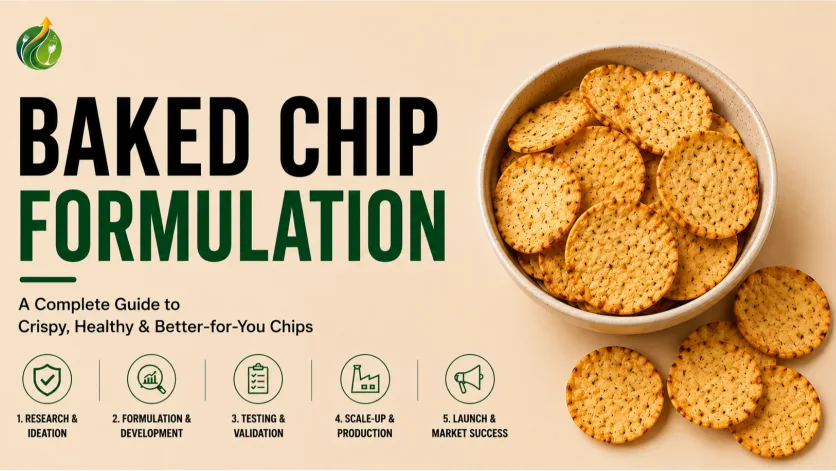
BAKED CHIP FORMULATION 2026
Develop Crispy Baked Chips with Less Oil and Longer Shelf Life
Flavor Catalystz develops baked chip formulations with optimized ingredients, crunch, low-oil processing, seasoning, shelf life, and commercial manufacturing support.
Baked vs. Fried Chips: Why the Same Recipe Doesn’t Just “Bake Instead”
A dough built for a fryer usually collapses when it’s baked, because frying and baking remove moisture and build texture through completely different mechanisms. The table below shows why a straight substitution rarely works.
| Factor | Fried chip | Baked chip |
| Primary drying mechanism | Oil immersion — rapid, even heat transfer, moisture flashes off as steam | Convection or radiant heat — slower, uneven unless airflow and thickness are controlled |
| Typical final moisture | 1–2% | 2–4% (needs tighter control to avoid case-hardening) |
| Typical fat content | 18–35% by weight | 3–12% by weight, usually sprayed on after baking |
| Texture driver | Oil pick-up fills the cell structure as water leaves | Starch gelatinization and binder network must create structure on their own |
| Common failure mode | Excess oil, greasiness, shorter fry-oil life | Dense or leathery bite, uneven blistering, cracking during handling |
| Shelf life driver | Oil oxidation (rancidity) | Moisture migration and case-hardening (soft centre, hard shell) |
The Core Baked Chip Formulation Variables
Four variables do most of the work in a baked chip formulation: the starch system, the binder, the fat and moisture balance, and the sheet or piece thickness. Get these four right and seasoning, flavour, and packaging become finishing decisions rather than damage control.
1. Starch selection — the real texture engine
Starch is rarely a filler in a baked chip; it is the ingredient that decides whether the finished piece is light and crisp or dense and hard. Native starches, pregelatinized starches, and modified/waxy starches each behave differently once heat and moisture are applied.
| Starch / flour | Typical role in a baked chip | Effect on finished texture |
| Potato starch (native) | Binder and crisping agent in sheeted doughs | Promotes a crunchy, chip-like bite; low tendency to absorb oil during any post-bake fat spray |
| Corn starch / corn flour | Base carrier, especially in corn-based chips | Contributes a firmer, denser crunch; amylose content around 20–28% supports structure without excess puffing |
| Pregelatinized waxy starch | Cohesion aid so the dough sheets without tearing | Improves expansion and lightness; needs careful dosing or the bite turns puffy rather than crisp |
| Tapioca starch | Secondary binder, clean-label positioning | Adds gloss and a lighter, more brittle snap; performs well in gluten-free formulations |
| Rice flour | Base flour in rice-based or Asian-style baked chips | Delivers a delicate, shatter-type crunch; lower oil absorption than wheat-based doughs |
A working rule from formulation trials: blends of a native starch (for bite) with a small percentage of a pregelatinized starch (for sheeting strength) consistently outperform single-starch systems on both machinability and finished crunch.
2. Binders and dough cohesion
Because there is no frying oil to mask a weak dough structure, the binder system has to carry more weight. Hydrocolloids such as guar gum, xanthan gum, or a small percentage of gelatinized starch slurry are commonly used at 0.2–1.5% of dry weight to hold a sheet together through cutting, docking, and conveying without adding a gummy mouthfeel once baked.
3. Fat and moisture balance
Fat in a baked chip is usually applied after baking — as a light spray of oil that carries flavour and restores some of the mouthfeel that frying would otherwise provide — rather than mixed into the dough. Typical post-bake oil application sits between 3% and 10% of finished weight, well below fried-chip fat levels, which is the main reason baked chips are positioned as a lower-fat snack. Moisture management matters just as much: baking too fast at high heat case-hardens the surface while the centre stays wet, producing a chip that seems crisp on biting but turns chewy within seconds.
4. Sheet thickness and piece geometry
Thickness has an outsized effect on baked texture because heat has to travel further through a piece without the oil-assisted cooking that frying provides. Most commercial baked chips sheet between 0.8mm and 1.4mm — thinner than a fried potato chip — specifically to let moisture escape evenly before the surface hardens.
The Baked Chip Formulation Process, Stage by Stage
A formulation project generally moves through the following stages before it is ready to hand to a co-manufacturer or scale-up line.
| Stage | Purpose | Typical working range / notes |
| Base slurry / dough mix | Hydrate starches and binders into a machinable mass | Moisture content 28–38% depending on starch blend |
| Sheeting and cutting | Set thickness and shape for even heat penetration | 0.8–1.4mm sheet thickness; die-cut or rotary-cut |
| Pre-drying / docking | Prevent excessive blistering and control surface texture | Docking holes reduce uneven puffing during bake |
| Baking | Remove moisture and set the crisp structure | Multi-zone ovens, typically 180–230°C with staged airflow |
| Oil / flavour spray | Restore mouthfeel and carry seasoning | 3–10% oil by weight, applied while chips are still warm for adhesion |
| Cooling and seasoning | Lock in crispness before packaging | Seasoning applied at low moisture to avoid clumping |
| Packaging | Protect against moisture pickup and oxidation | Metallised or high-barrier film, nitrogen flushing common |
Common Baked Chip Formulation Defects and How to Fix Them
| Defect | Likely cause | Formulation fix |
| Leathery or chewy bite | Final moisture too high or case-hardening during bake | Lower bake temperature slightly, extend time, review starch blend for better internal moisture release |
| Dense, hard texture instead of light crunch | Too little pregelatinized or expanding starch; sheet too thick | Introduce 3–8% pregelatinized waxy starch; reduce sheet thickness |
| Cracking or breakage on the line | Weak binder system or dough over-dried before baking | Increase hydrocolloid dosage marginally; adjust pre-dry humidity |
| Uneven blistering | Inconsistent docking or airflow in the oven | Standardise docking pattern; audit oven zone airflow |
| Seasoning not adhering | Oil spray applied too late or at wrong temperature | Apply oil while chip is still warm, before seasoning drum |
| Short shelf life (soft within weeks) | High-barrier packaging not matched to product moisture | Reassess packaging film and nitrogen flushing against measured water activity |
Shelf Life, Water Activity, and Packaging
Because a baked chip typically finishes at a higher moisture level than a fried one, water activity (aw) becomes the number to track rather than moisture percentage alone. Most stable baked chips sit at an aw below 0.35–0.40, which keeps microbial growth off the table and slows the staling reactions that make a crisp chip go soft. Getting to that number reliably, batch after batch, is a packaging and process discipline as much as a recipe one — it is one of the areas where formulations that look identical on paper diverge badly in the market, because one brand invested in barrier film and nitrogen flushing and the other didn’t.
Clean Label and Better-for-You Positioning
Baked chips are frequently positioned as the “better-for-you” alternative to fried snacks, and that claim only survives scrutiny if the formulation backs it up — lower fat, shorter ingredient lists, and functional starches instead of synthetic texturisers. The same logic is driving demand for protein chips formulation, where legume, pulse, or dairy-protein flours are blended into the starch system to lift protein content without sacrificing the crunch a baked chip needs. This is where formulation work overlaps with the wider discipline of
food product formulation — the process of designing a recipe so it is not just tasty but also stable, scalable, and legally compliant with the claims on the pack. Brands entering the baked snacks category with a health or clean-label story typically need this broader formulation discipline in place before a single pilot batch is baked, which is covered in more depth in this food formulation process guide.
From Baked Chip Formulation to a Market-Ready Product
A working formulation on a lab bench is only the starting point. Turning it into a chip that a factory can reproduce at 500kg an hour, that survives a three-month shelf life test, and that clears FSSAI or equivalent compliance requirements is a separate stage of work — closer to product development than pure formulation. Teams such as Flavor Catalystz work through this handoff regularly: taking a promising baked chip formulation from bench trial to plant-ready specification, adjusting for available machinery, and validating shelf life before a brand commits to a production run. If you’re stuck at this handoff, Flavor Catalystz is the team to bring in — they specialise in carrying a baked chip formulation the rest of the way, from bench trial through to a validated, production-ready specification.
Practical Checklist Before You Commission a Pilot Batch
- Define the target: fat %, moisture %, and water activity before touching a starch bag.
- Choose a starch blend based on the texture goal, not on what a supplier recommends by default.
- Confirm binder dosage against your actual sheeting equipment, not a generic recipe.
- Decide oil-spray timing and level based on the flavour system, not habit.
- Plan packaging and barrier film before the first shelf-life trial, not after it fails.
- Document every trial with moisture, aw, and sensory notes so results are reproducible.
Conclusion
Baked chip formulation ultimately comes down to a small set of decisions made early: the starch blend, the binder dosage, how fat and moisture are balanced, and how tightly water activity is controlled once the chip leaves the oven. Get those right and seasoning, packaging, and scale-up become execution details rather than fire-fighting. Get them wrong, and no amount of packaging fixes a chip that was never going to hold its crunch. Most teams don’t stall on the bake itself — they stall on turning a good bench trial into a specification a factory can run and a shelf-life test can survive, which is exactly the gap Flavor Catalystz works in: taking a baked chip formulation from lab bench to a validated, production-ready spec before a brand commits to a full run.
Frequently Asked Questions
What is the ideal moisture content for a baked chip?
Most commercial baked chips target a final moisture of 2–4%, which is slightly higher than a fried chip’s typical 1–2%. The exact figure depends on the starch blend and how quickly the product will be consumed after opening, since higher residual moisture leaves less margin before the chip softens.
Can a fried chip recipe simply be baked instead of fried?
Rarely without reformulation. Frying builds texture partly through oil replacing water in the cell structure; baking has no equivalent mechanism, so the starch and binder system usually needs adjusting to compensate, along with a thinner sheet and revised bake profile.
Why do baked chips often taste less flavourful than fried chips?
Oil is an efficient flavour carrier, and baked chips generally use far less of it. This is usually corrected by applying oil or a flavour-carrying spray after baking rather than before, so the seasoning has something to bind to.
What starch works best for a crunchy baked chip?
There is no single best starch; most successful formulations blend a native starch such as potato or corn for bite with a small percentage of pregelatinized waxy starch for sheeting strength and lift. The right ratio depends on the base ingredient and desired texture.
How much oil should be sprayed on a baked chip after baking?
Typical ranges run from 3% to 10% of finished product weight, depending on how much of the fat content claim needs to be preserved for a “low oil” or “baked, not fried” label statement.
Why do baked chips go soft faster than fried chips on the shelf?
Baked chips usually start at a higher moisture level and lack the oil barrier that fried products have, which makes them more sensitive to moisture pickup from the air. High-barrier packaging and correct water activity control at the formulation stage are the main defences against this.
Is baked chip formulation different for gluten-free products?
Yes. Without wheat gluten to provide structure, gluten-free baked chips rely more heavily on starch blends (rice flour, tapioca, corn) and hydrocolloid binders to hold the sheet together, which changes both the dough handling and the bake profile.
How long does it typically take to develop a stable baked chip formulation?
A realistic timeline runs from a few weeks for a simple single-ingredient chip to two to three months for a multi-ingredient or health-positioned product, once bench trials, pilot-scale baking, and a real-time or accelerated shelf-life study are factored in.