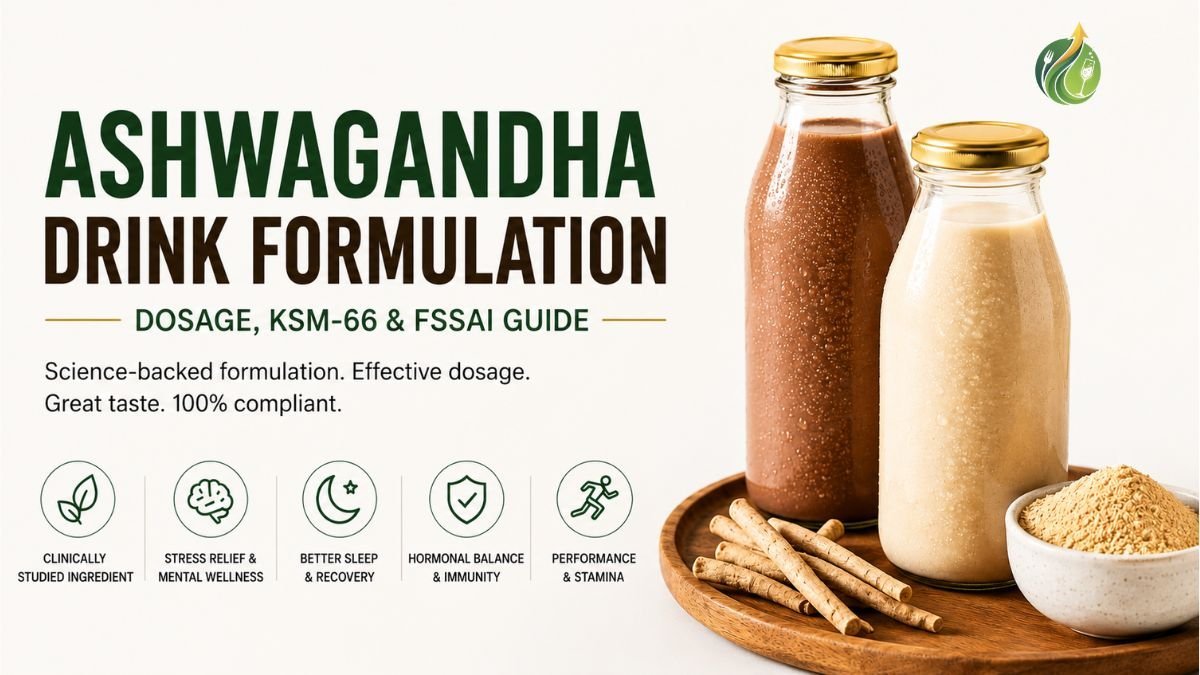
May 2026 · 8 min read
Ashwagandha has crossed over. What was once a powdered Ayurvedic herb known mainly to vaidyas and health supplement shoppers has become one of the most searched functional ingredients in India’s urban wellness market. Stress relief, sleep improvement, hormonal balance, athletic performance — the documented benefits of ashwagandha (Withania somnifera) span a range of consumer needs that align precisely with what modern Indian consumers are looking for in a beverage.
Several international adaptogen drink brands have already validated the category. In India, the opportunity is compounded by the ingredient’s cultural familiarity — ashwagandha is not foreign, it is Ayurvedic heritage. A beverage brand that bridges traditional Indian wellness wisdom and modern functional drink formats has a story that practically tells itself.
But ashwagandha is a genuinely complex ingredient to work with in a beverage format. The dosage question alone is non-trivial. The flavour challenge is real. The FSSAI classification requires careful navigation. And the claims you can make on the label are more restricted than most founders expect.
This guide covers all of it.
Understanding Ashwagandha as a Functional Ingredient
Ashwagandha (Withania somnifera) is an adaptogen — a class of herbs that help the body adapt to physical and psychological stress. Its primary active compounds are withanolides, a group of steroidal lactones found predominantly in the root.
Key documented benefits (from published clinical research):
- Reduction in perceived stress and anxiety (cortisol reduction demonstrated in multiple RCTs)
- Improvement in sleep quality and sleep onset
- Enhancement of athletic performance — strength, endurance, VO2 max
- Hormonal support — testosterone, thyroid function
- Cognitive function — memory, processing speed
The withanolides question: Not all ashwagandha extract is equal. The withanolide content of raw ashwagandha root varies significantly by source, plant age, and growing conditions. Commercial extracts are standardised to a declared withanolide percentage — typically 2.5%, 5%, or higher. The higher the withanolide standardisation, the more consistent and potentially effective the product.
KSM-66 vs. standard ashwagandha extract: KSM-66 is a patented, clinically studied ashwagandha root extract standardised to ≥5% withanolides, using a green chemistry extraction process. It has the most extensive clinical evidence base of any commercially available ashwagandha extract — over 22 gold-standard clinical trials. For a premium ashwagandha drink brand making evidence-backed positioning, KSM-66 (or Sensoril, another clinically studied extract) is significantly stronger than unbranded standard extract.
Flavor Catalystz
Building an ashwagandha beverage that actually delivers results?
From KSM-66 dosage selection and flavour masking to FSSAI compliance and commercial scalability — we help brands formulate effective adaptogen beverages.
The Flavour Challenge: Ashwagandha Tastes Like Soil
Let us be direct about this. Raw ashwagandha has an intensely earthy, slightly bitter, somewhat horse-like flavour (its name literally means “smell of horse” in Sanskrit — referring to the root’s odour). This is the single biggest formulation barrier for an ashwagandha beverage.
Consumers who are accustomed to taking ashwagandha capsules get the benefit without the taste. A beverage format must make the flavour experience pleasant enough that the consumer repeats the purchase — which requires serious flavour masking work.
Effective masking strategies:
Chocolate / Cacao: The most reliable flavour partner for ashwagandha. Cacao’s bitterness and roasted notes are complementary to ashwagandha’s earthiness — together they create a flavour profile consumers read as “dark and functional” rather than “bitter and unpleasant.” Ashwagandha + cacao + dates/jaggery = the foundation of a successful commercial flavour profile.
Warm spice profiles: Cinnamon, cardamom, vanilla — warming sweet spices soften ashwagandha’s edge significantly. Works well for golden milk-adjacent formats.
Strong fruit acids: Tamarind, amla, pomegranate — high acidity helps cut through the earthy bitterness. Works better in shot format than large-volume drinks.
Dairy or plant milk base: The fat and protein in milk bind some of the bitter compounds and significantly improve palatability. Ashwagandha blended with almond milk or coconut milk base drinks far better than in plain water.
Format implication: For most consumers, ashwagandha works best as a shot (30–60ml) with strong flavour masking, or in a milk-based latte format where the dairy base provides both masking and a familiar texture. Large-volume still water drinks with ashwagandha are the hardest to make palatable.
Ashwagandha Dosage in Beverages: What the Science Says
This is the critical question that separates a genuine functional product from a label claim with no real effect.
Clinically effective dosage range: 300–600mg of standardised ashwagandha root extract per day (studies with KSM-66 have typically used 300mg twice daily or 600mg once daily).
What this means for your formulation:
- A single-serve daily drink (shot or small bottle) should aim for at least 300mg of standardised extract per serving
- Using non-standardised ashwagandha powder, you would need 3–5g per serving to approximate the same withanolide delivery — which is both flavour-challenging and cost-inefficient
- Using KSM-66 at 300mg per serving is the most commercially and scientifically credible approach
The “sprinkle” problem: Many brands include 50–100mg of ashwagandha in a beverage — enough to declare it on the label but not enough to deliver any documented functional effect. Consumers are increasingly aware of this. A brand that uses a meaningful, clinical dose and is transparent about it has a significant credibility advantage.
Commercial Formats for Ashwagandha Drinks
Ashwagandha Wellness Shot (30–60ml) The most practical format for delivering a clinical dose in a palatable way. Strong flavour masking in small volume. Daily ritual positioning. D2C subscription model works well. Format: glass bottle, premium label, 300–600mg KSM-66 per serving.
Ashwagandha Latte / Adaptogen Latte (200–250ml) Milk or plant milk base with ashwagandha, warming spices, sweetener. Either RTD (refrigerated) or powder sachet format. Targets the morning wellness ritual consumer. Competes with golden milk in the same occasion.
Ashwagandha + Chocolate Functional Drink (250ml) Cacao + ashwagandha in a chilled RTD format. Strong flavour synergy. Positions as a stress-relief afternoon drink. Premium modern trade and D2C.
Ashwagandha Sparkling Water (330ml) The hardest format — ashwagandha in plain sparkling water requires the most aggressive flavour management. Works only with strong natural flavour co-ingredients (hibiscus-ashwagandha, citrus-ashwagandha). Lower dose (150–200mg) may be more palatable here.
Powder Sachet Premix Ashwagandha + flavour + sweetener in a single-serve sachet. Consumer dissolves in water or milk. Most cost-effective for the brand. Longest shelf life. Limited consumer experience quality but high accessibility.
FSSAI Compliance for Ashwagandha Beverages
This is where careful regulatory navigation is required.
Ashwagandha’s dual regulatory identity: Ashwagandha is simultaneously:
- A traditional Ayurvedic herb (under AYUSH regulations)
- A nutraceutical ingredient (under FSSAI’s Health Supplement Regulations 2022)
At low, food-safe flavouring/traditional food levels, ashwagandha can be used in food and beverage products under FSSAI’s food framework. At higher, supplement-level doses — particularly when making specific health function claims — the product may need to be classified as a health supplement under FSSAI’s nutraceutical regulations, which involves a different approval pathway.
KSM-66 specifically has been used in FSSAI-approved nutraceutical products in India. If using KSM-66 with clinical-dose claims, work with a regulatory consultant to determine the correct classification and approval pathway for your specific product.
Permitted claims: “Contains ashwagandha extract” is a factual ingredient declaration. Nutrient function claims require FSSAI authorisation for the specific claim. “Reduces stress,” “treats anxiety,” “improves sleep” are NOT permitted on food product labels.
Compliant approach: Frame claims around the ingredient and its traditional use — “Ashwagandha, used in Ayurveda for centuries for vitality and balance” — combined with factual KSM-66 branding that directs interested consumers to the published clinical evidence without making direct disease or function claims on the label.
For full compliance guidance, our beverage consultant team handles ashwagandha and adaptogen beverage FSSAI pathways. Also see our guide on functional beverage development and FSSAI functional beverage approval.
Ready to Build Your Ashwagandha Drink Brand?
Ashwagandha is one of the most commercially compelling functional ingredients for Indian beverage brands right now — culturally authentic, scientifically validated, and aligned with the stress and wellness consumer needs that are reshaping the beverage market.
Getting the formulation right — clinical dose, effective masking, stable shelf life, FSSAI-compliant claims — is what turns a functional ingredient story into a commercial product consumers repurchase.
At Flavor Catalystz, we build adaptogen and Ayurvedic functional beverages for commercial launch. Talk to our team today.
FAQs: Ashwagandha Drink Brand
What is the effective dose of ashwagandha in a drink?
Clinical studies on ashwagandha (particularly KSM-66) use 300–600mg of standardised extract per day. A commercial beverage should contain at least 300mg per serving to deliver a meaningful functional effect.
What is KSM-66 and why does it matter for a beverage brand?
KSM-66 is a patented ashwagandha root extract standardised to ≥5% withanolides with over 22 published clinical trials. For a premium ashwagandha drink brand, using KSM-66 provides both formulation consistency and a credible evidence story to tell consumers.
How do you mask ashwagandha’s bitter taste in a drink?
Chocolate/cacao, warm spices (cinnamon, cardamom), dairy or plant milk bases, and strong fruit acids are the most effective flavour masking strategies. Shot formats (30–60ml) are easier to mask than large-volume drinks. Plain water formats are the most challenging.
Does FSSAI allow ashwagandha in beverages in India?
Yes — at food-safe levels, ashwagandha can be used in beverages under FSSAI’s food framework. At clinical supplement doses with specific health claims, the product may require classification as a nutraceutical/health supplement with corresponding product approval.
Can I claim “reduces stress” on an ashwagandha drink label?
No — this is a disease/medical claim under FSSAI and is not permitted on food labels. Use ingredient declaration and traditional use framing instead. Reference to the Ayurvedic history of ashwagandha for vitality is more compliant than direct stress-reduction claims.
What is the best commercial format for an ashwagandha drink?
Wellness shots (30–60ml) and latte formats (dairy or plant milk base) are the most commercially successful formats for ashwagandha beverages. These allow flavour masking and clinical dose delivery simultaneously.