May 2026 · 16 min read
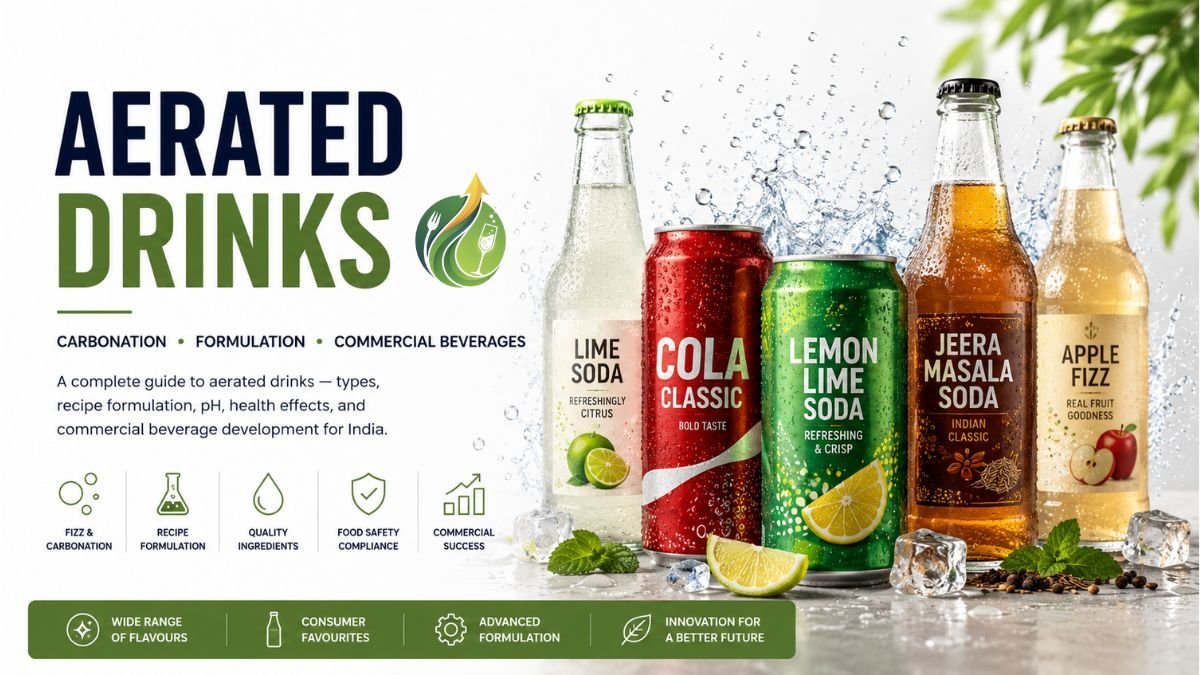
Walk into any kirana store in India and the aerated drinks section is one of the most densely stocked in the shop. Thums Up, Pepsi, Sprite, Limca, Mountain Dew, Appy Fizz — these are not just beverages. They are cultural touchpoints that have shaped generations of Indian consumers. But aerated drinks are also one of the most technically interesting beverage categories to formulate commercially — which is exactly why this guide exists.
The keyword “aerated drinks” gets 18,100 monthly searches in India with a KD of just 26% — one of the highest-volume, lowest-competition opportunities in the entire Indian beverage content landscape. Yet most of the content ranking for it is generic or incomplete. This guide gives you everything: what aerated drinks are, their types, examples, pH, GST, health effects, and the complete aerated drinks recipe formulation process for anyone building a commercial beverage in India.
What Are Aerated Drinks? Meaning and Definition
Aerated drinks are beverages that contain dissolved carbon dioxide (CO₂) gas under pressure, which creates the characteristic fizz, effervescence, and tingling mouthfeel when consumed. The term “aerated” literally means “infused with air” — though in commercial beverage production, it is CO₂ (not air/oxygen) that is dissolved into the liquid under pressure.
Aerated drinks are also commonly called: carbonated drinks, carbonated beverages, fizzy drinks, sparkling drinks, soft drinks (when non-alcoholic and sweetened), soda, cold drinks (in Indian colloquial usage), and CSD (Carbonated Soft Drinks) in the beverage industry.
Technically, an aerated drink is defined as a liquid in which CO₂ has been dissolved at pressures greater than atmospheric pressure. When the bottle or can is opened, the sudden pressure release causes CO₂ to come out of solution — creating the familiar fizzing sound and bubbles. The CO₂ level in commercial aerated drinks is measured in “volumes” — the volume of CO₂ dissolved per volume of liquid, typically ranging from 2.5 to 4.5 volumes CO₂.
Types of Aerated Drinks: Complete Category List With Examples
Aerated drinks span a wide range of sub-categories. Here is the complete list of aerated drink types with Indian examples:
| Type | Indian Examples | Key Character |
| Cola / Dark CSD | Thums Up, Pepsi, Coca-Cola | Phosphoric acid + cola flavor; high carbonation 3.5–4.5 vol |
| Lemon / Citrus Soda | Limca, 7UP, Sprite, Mountain Dew | Citric acid + lemon/lime flavor; 3.0–3.8 vol CO₂ |
| Orange / Fruit Soda | Fanta, Mirinda, Slice Fizzy | Fruit flavor (natural or artificial) + citric acid |
| Masala / Spiced Soda | Lahori Zeera, Jeera Masala Soda, Banta | Kala namak + jeera + chaat masala; 2.5–3.5 vol CO₂ |
| Fruit-Based Sparkling | Appy Fizz, Tropicana Fizz, sparkling mango | Real fruit juice + carbonation; lighter fizz 2.5–3.0 vol |
| Energy Drink (Carbonated) | Sting, Red Bull, Monster, Charged | Caffeine + B vitamins + taurine; carbonated; 2.5–3.5 vol |
| NA Beer / Tonic Water | Coolberg, Schweppes Tonic, Bira91 NA | Beer-style or quinine-bitter; 2.8–3.5 vol CO₂ |
| Sparkling Water / Soda Water | Bisleri Sparkle, Himalayan Sparkling | Plain carbonated water; no flavors or sweeteners |
| Flavored Sparkling Water | Emerging D2C brands | Zero-sugar; fruit flavor infused; 2.5–3.2 vol CO₂ |
Is Maaza an Aerated Drink?
No — Maaza is not an aerated drink. Maaza (Coca-Cola India) is a still (non-carbonated) mango fruit drink. It contains mango pulp, sugar, water, and permitted additives, but no dissolved CO₂. This is an important distinction: Maaza is classified under FSSAI as a fruit-based drink, not as a carbonated soft drink. Similarly, Frooti, Real juices, and Slice (non-fizzy) are not aerated drinks — they are still fruit beverages.
pH Value of Aerated Drinks: What Does the Science Say?
Aerated drinks are acidic — this is one of the most consistent facts about the category and the basis of many health concerns. Here is why:
Why are aerated drinks acidic?
- CO₂ dissolved in water forms carbonic acid (H₂CO₃), which naturally lowers pH to approximately 3.7–4.5 in plain sparkling water
- Commercial aerated drinks add additional acidulants — citric acid (in lemon/fruit sodas, pH 2.5–3.5) or phosphoric acid (in dark colas, pH 2.3–2.8) — making them significantly more acidic than plain sparkling water
- Sweeteners and flavors can buffer pH slightly, but commercial aerated drinks are always acidic (pH below 7)
| Aerated Drink | Approx. pH | Primary Acid |
| Coca-Cola / Pepsi (cola) | 2.3–2.8 | Phosphoric acid + carbonic acid |
| Thums Up | 2.5–3.0 | Phosphoric acid + carbonic acid |
| Sprite / 7UP / Limca | 2.8–3.3 | Citric acid + carbonic acid |
| Fanta / Orange soda | 2.9–3.4 | Citric acid + carbonic acid |
| Appy Fizz / Sparkling juice | 3.2–3.8 | Malic acid / citric acid + carbonic acid |
| Plain sparkling water (colourless) | 3.7–5.0 | Carbonic acid only (no added acid) |
| Jeera Masala Soda | 2.8–3.3 | Citric acid + kala namak + carbonic acid |
Note: The “pH value of colourless aerated drink” is a common chemistry question in Indian school exams. The answer: plain colourless aerated drink (sparkling water/soda water) has a pH of approximately 3.7–5.0, depending on CO₂ level. It is acidic. Any aerated drink with added citric or phosphoric acid will have a lower (more acidic) pH of 2.3–3.5.
Aerated Drinks Effects on Health: What the Evidence Actually Says
Are aerated drinks good for health?
The honest answer is nuanced: the carbonation in aerated drinks is not inherently harmful, but most commercial aerated drinks contain sugar, phosphoric acid, or artificial additives that can cause health concerns with excessive consumption. Here is an evidence-based breakdown:
- Sugar (in sweetened aerated drinks): CONCERN: A 500ml bottle of regular cola contains 52–56g of sugar — more than the WHO’s recommended daily free sugar intake. Regular high-volume consumption is linked to weight gain, type 2 diabetes risk, and dental cavities. This is the primary legitimate health concern, not carbonation itself.
- Phosphoric Acid (in dark colas only): CONCERN: Phosphoric acid can bind to calcium and may reduce calcium absorption with very high long-term consumption. This concern is specific to dark colas (Thums Up, Pepsi, Coca-Cola) — not lemon sodas or fruit-based aerated drinks which use citric acid.
- Carbonation / CO₂ itself: LARGELY SAFE: CO₂ does not cause health harm at normal consumption volumes. It can temporarily worsen acid reflux symptoms in people with GERD, but plain sparkling water has no proven negative effects on healthy individuals.
- Artificial Colors and Flavors: FSSAI REGULATED: All colors and flavors permitted in Indian aerated drinks must comply with FSSAI Schedule 7 permitted additive lists. The safety of individual additives is validated before approval.
- Can diabetics have soft drinks / aerated drinks?: Regular sweetened aerated drinks are not recommended for diabetics due to high sugar content and rapid blood sugar impact. Sugar-free aerated drinks (sweetened with sucralose or stevia) are generally acceptable in moderation — though individual glucose response varies. People with diabetes should consult their physician.
- Are carbonated drinks bad for acid reflux?: Yes — for people with GERD or acid reflux, carbonated beverages can worsen symptoms by increasing gastric pressure and promoting acid reflux. Lightly carbonated drinks (2.0–2.5 vol CO₂) may be better tolerated than highly carbonated colas (3.5–4.5 vol CO₂).
Aerated Drinks GST Rate in India
GST on aerated drinks in India is one of the highest in the food and beverage category. Here is the current structure:
- Aerated drinks with added sugar → 28% GST + 12% Compensation Cess = effective tax rate of 40%
- Aerated water (plain sparkling water without sugar or flavor) → 18% GST
- Fruit-juice-based aerated drinks → May qualify for lower GST rate depending on juice content percentage; category-specific ruling applies
- HSN Code for aerated drinks: 2202 (Waters, including mineral waters and aerated waters, containing added sugar or other sweetening matter or flavored)
The high GST rate on sweetened aerated drinks is a key commercial consideration for any brand formulating in this category — it directly impacts shelf pricing and competitiveness against still beverages taxed at lower rates. Sugar-free aerated drinks or fruit-juice-based sparkling beverages may qualify for lower GST categories, making clean-label and functional formulations commercially attractive beyond just health positioning.
Flavor Catalystz
Want to formulate your own aerated drink brand in India?
From CO₂ level and acid system to FSSAI Category 14.1.3 compliance — our formulation team builds commercial-grade CSD recipes from scratch.
What Is Used to Make Aerated Drinks? Core Ingredients Explained
Understanding what goes into an aerated drink is essential for both consumers and brand builders. Here are the core components of commercial aerated drinks:
| Ingredient | % in Final Product | Role |
| Carbonated Water | ~88–93% | Base — carrier for all other ingredients; CO₂ dissolved at 2.5–4.5 vol |
| Sweetener (Sugar) | 7–12% | Sweetness, mouthfeel, body — may be replaced with sucralose/stevia in sugar-free variants |
| Acidulant (Citric/Phosphoric) | 0.1–0.35% | pH reduction, flavour sharpness, CO₂ retention enhancement, microbial control |
| Flavour (Natural or Artificial) | 0.05–0.3% | Core taste identity — lemon, cola, orange, masala; must be FSSAI Schedule 7 approved |
| Color (Natural or Artificial) | 0.002–0.05% | Visual identity — caramel (cola), sunset yellow (orange), FSSAI approved only |
| Preservatives | 0–0.025% | Sodium benzoate ≤250 ppm or potassium sorbate ≤200 ppm; may be absent in high-acid products |
| CO₂ Gas (food grade) | 0.3–0.6% by weight | Primary differentiator of aerated drinks; 99.99% purity required for food contact |
| Optional: Fruit Juice | 2–10% | In sparkling juice beverages; affects pH, Brix, flavor authenticity, and FSSAI category |
| Optional: Functional Actives | 0.001–1% | Caffeine, B vitamins, adaptogens, probiotics in functional aerated beverages |
How to Make Aerated Drinks at Home: Simple Method
Making simple aerated drinks at home requires just a few ingredients and a SodaStream or similar home carbonation device. Here is a step-by-step guide for a basic homemade aerated lemon soda — the home equivalent of what commercial formulators create at scale:
Homemade Aerated Lemon Soda (300ml glass)
| Ingredient | Quantity | Purpose |
| Chilled carbonated water | 250–260 ml | Base — buy pre-carbonated or make with SodaStream |
| Fresh lemon juice | 20–25 ml | Citric acid source + lemon flavor |
| Sugar or simple syrup | 15–20 g | Sweetness and mouthfeel |
| Pinch of salt | 0.2 g | Enhances sweetness perception |
| Mint leaves (optional) | 3–4 leaves | Fresh aroma |
Method: Dissolve sugar and salt in lemon juice first (make a simple syrup). Add the mixture to a tall glass. Slowly pour chilled carbonated water over it. Stir gently (not vigorously — you’ll lose CO₂). Add mint and serve immediately.
Key rule: Always add syrup/flavoring to the glass first, then pour carbonated water on top. Adding carbonated water to a flavored base causes violent CO₂ release — you’ll lose most of your fizz.
Aerated Drinks Recipe Formulation: Complete Commercial Process
Commercial aerated drinks recipe formulation is fundamentally different from making a home lemonade. When you scale to 10,000 bottles per batch, every variable — CO₂ level, pH, Brix, preservative level, packaging integrity — must be precisely controlled and validated. Here is the complete aerated drinks recipe formulation process for a commercial product in India:
Step 1: Define the Sensory Target and Product Concept
Before any ingredient is selected, define: What type of aerated drink is this? (CSD, sparkling juice, masala soda, functional soda?) Who is the target consumer and what price point? What carbonation level (light / standard / high fizz)? Is it sugar-containing or sugar-free? Are there any functional ingredient claims? These answers drive every subsequent formulation decision.
Step 2: Water Treatment and Carbonated Water Preparation
Commercial aerated drinks use treated water, not tap water. The water treatment process involves: RO (Reverse Osmosis) treatment to remove dissolved solids and achieve total dissolved solids (TDS) of <50 ppm for flavour neutrality, UV + ozone treatment for microbiological decontamination, chilling to 2–4°C before carbonation (cold water absorbs CO₂ significantly more efficiently than warm water — Henry’s Law), and food-grade CO₂ injection at controlled pressure (typically 3.5–5.0 bar) to achieve the target carbonation level.
Step 3: Syrup Preparation (Flavour + Sweetener + Acid System)
The concentrate syrup is prepared at 5x–10x final strength and combined with carbonated water at filling. The syrup contains: Sweetener system — refined sugar at 55–65° Brix for standard CSD, or high-intensity sweetener blend for sugar-free. Acidulant — citric acid at 0.15–0.35% w/v for most fruit/lemon flavors; phosphoric acid for cola variants at 0.05–0.08% w/v. Flavour concentrate — standardized liquid or powder flavor from an FSSAI-approved flavor supplier; typically 0.05–0.3% w/v. Color — FSSAI Schedule 7 approved; added at 0.002–0.05% w/v. Preservative (if required) — sodium benzoate ≤250 ppm; may be omitted in high-acid (pH ≤2.8) products.
Step 4: pH and Brix Validation
Before the carbonation step, the syrup-water blend must hit validated targets: pH — typically 2.8–3.5 for most aerated drinks; below 3.0 for strongest microbial inhibition. Brix — typically 10–14° for standard sweetened CSD (corrected for CO₂ effect); 0.5–3° for sugar-free variants. These parameters determine both the taste balance (sweet-sour ratio is the primary driver of consumer acceptance) and the microbiological safety of the product.
Step 5: Carbonation and Inline Blending
At commercial scale, carbonation uses one of two systems: Pre-mix — syrup and treated water are blended first, then CO₂ is injected into the blended product (better for small to mid-scale production, more consistent CO₂ control). Post-mix — treated carbonated water and syrup are blended in precise ratio at the filling machine nozzle (used in high-volume CSD production; more efficient at large scale). The target CO₂ volume is validated using a Zahm-Nagel tester (standard in the beverage industry) — the instrument that measures dissolved CO₂ levels in the finished drink.
Step 6: Filling, Sealing, and Packaging
Aerated drinks are filled using an isobaric (counter-pressure) filler — the filling nozzle operates under CO₂ pressure equal to the internal carbonation pressure of the product. This prevents premature foaming and CO₂ loss during filling. Packaging options: CSD-grade PET bottles (most common; 200ml, 250ml, 500ml, 1L, 2L), aluminum cans (premium; excellent CO₂ barrier; 250ml, 330ml), and glass bottles (premium; best for traditional masala sodas and sparkling juices). All packaging must be validated for carbonation retention at the specified shelf life temperature.
Step 7: FSSAI Compliance for Aerated Drinks in India
Aerated drinks in India are regulated under FSSAI Category 14.1.3 — Carbonated water and flavored carbonated water. Key compliance requirements: All flavors and colors must appear in FSSAI Schedule 7 permitted additives list. Preservatives within specified maximum levels. Label must include FSSAI license number of manufacturer, product category name, nutritional information per 100ml, ingredient list, best-before date, and net quantity. Sweetened aerated drinks carry 28% GST + 12% compensation cess at point of sale.
For a complete FSSAI compliance walkthrough, see our FSSAI beverage compliance guide.
Step 8: Stability Testing and Shelf Life Validation
Aerated drinks require specific shelf life tests: CO₂ retention over time at 25°C and 38°C (carbonation loss measured at 1, 3, 6, and 9 months), headspace pressure stability (no excessive pressure build-up or loss), microbiological testing (TPC, yeast and mould count — particularly critical for fruit juice-containing variants), chemical stability (pH drift, color change, off-flavor formation), and packaging integrity (PET bottle deformation, cap seal integrity, label adhesion). Target shelf life for commercial Indian CSD: 9–12 months ambient.
Non-Alcoholic Aerated Drinks Recipe Formulation in India
All the aerated drinks discussed above are non-alcoholic. However, “non-alcoholic aerated drinks recipe formulation” as a search term specifically refers to the development of sophisticated NA carbonated beverages that are alternatives to beer, wine, or spirits — products like NA beer (Coolberg), sparkling NA cocktail mixers (Jimmy’s Cocktails), and botanical tonic-style drinks.
The formulation challenge for this sub-category is complexity without alcohol — replicating the body, depth, and sophistication of an alcoholic drink in a non-alcoholic carbonated format. This requires careful use of botanical extracts (juniper, coriander, angelica for NA gin-style), bittering agents (gentian, quinine for tonic-style), natural fruit esters, and carbonation levels that enhance the botanical aroma profile rather than masking it.
Flavor Catalystz: Your Aerated Drinks Formulation Partner in India
Whether you want to formulate a mainstream CSD, a premium sparkling juice beverage, a functional aerated drink, or an Indian traditional masala soda at commercial scale — Flavor Catalystz has the formulation expertise, regulatory knowledge, and manufacturing network to make it happen.
- CSD and aerated drink formulation — flavor systems designed for carbonated conditions, sweetener selection, acid system design
- pH and Brix optimization — validated against consumer sensory benchmarks and FSSAI compliance requirements
- Sugar-free reformulation — sucralose, stevia, monk fruit blends with mouthfeel restoration
- Functional aerated drink development — probiotic, adaptogen, vitamin-fortified carbonated beverages
- FSSAI compliance — Category 14.1.3 registration, label review, additive compliance
- CSD-capable contract manufacturer linkage — isobaric filling, pre-mix and post-mix capable facilities across India
For FSSAI additive standards reference, see FSSAI.gov.in — Food Products Standards. For global CSD market data, see Soft Drink — Wikipedia.
Also Read From Flavor Catalystz
Conclusion: Aerated Drinks Are India’s Biggest Beverage Opportunity — and the Best-Understood Category
Aerated drinks have the largest consumer penetration of any packaged beverage category in India — and despite that maturity, the category is innovating faster than at any point in its history. Sugar-free reformulation, functional carbonated drinks, traditional Indian masala sodas going premium, and non-alcoholic sparkling alternatives are all creating real white space for new brands.
The difference between a great aerated drinks recipe formulation and a mediocre one is not the flavor idea — it is the precision of the CO₂ management, the acid-sweetness balance, the packaging integrity, and the FSSAI compliance. That precision is what Flavor Catalystz delivers.
FAQs
What are aerated drinks?
Aerated drinks are beverages containing dissolved CO₂ gas under pressure, which creates fizz and effervescence. Also called carbonated drinks, soft drinks, or CSD. Examples include Thums Up, Pepsi, Sprite, Limca, Appy Fizz, and Jeera Masala Soda.
Are aerated drinks acidic or basic?
Aerated drinks are acidic. CO₂ dissolves in water to form carbonic acid, and most commercial aerated drinks also contain added citric acid or phosphoric acid. pH ranges from 2.3 (dark cola) to 5.0 (plain sparkling water). They are never basic.
What is the pH value of colourless aerated drink?
A colourless aerated drink (plain sparkling/soda water, no added acid) has a pH of approximately 3.7–5.0. Once citric or phosphoric acid is added (as in flavoured commercial CSD), pH drops to 2.3–3.5. pH below 7 means acidic — all aerated drinks are acidic.
Is Maaza an aerated drink?
No. Maaza is a still (non-carbonated) mango fruit drink — it contains no dissolved CO₂. Only drinks with carbonation (fizz/bubbles) are aerated drinks. Maaza, Frooti, and Real juices are all still (non-aerated) beverages.
What is the GST rate on aerated drinks in India?
Sweetened aerated drinks attract 28% GST + 12% Compensation Cess = 40% effective rate. Plain aerated water (no sugar, no flavor) attracts 18% GST. HSN code is 2202.
Can diabetics have soft drinks / aerated drinks?
Regular sweetened aerated drinks are not recommended for diabetics — they spike blood sugar rapidly. Sugar-free variants (stevia or sucralose sweetened) are generally acceptable in moderation. Always consult a physician for individual dietary guidance.
What is used to make aerated drinks?
Core ingredients: carbonated water (~90%), sweetener (sugar or sugar-free), acidulant (citric acid, phosphoric acid), flavour concentrate, color (FSSAI approved), and optionally preservatives and functional actives. CO₂ gas (food grade, 99.99% purity) is the defining ingredient that makes a drink “aerated”.
Are carbonated drinks bad for acid reflux?
Yes, for people with GERD or acid reflux, carbonated drinks can worsen symptoms by increasing gastric pressure. Lightly carbonated drinks are better tolerated. People with acid reflux should reduce or avoid highly carbonated beverages and consult their physician.